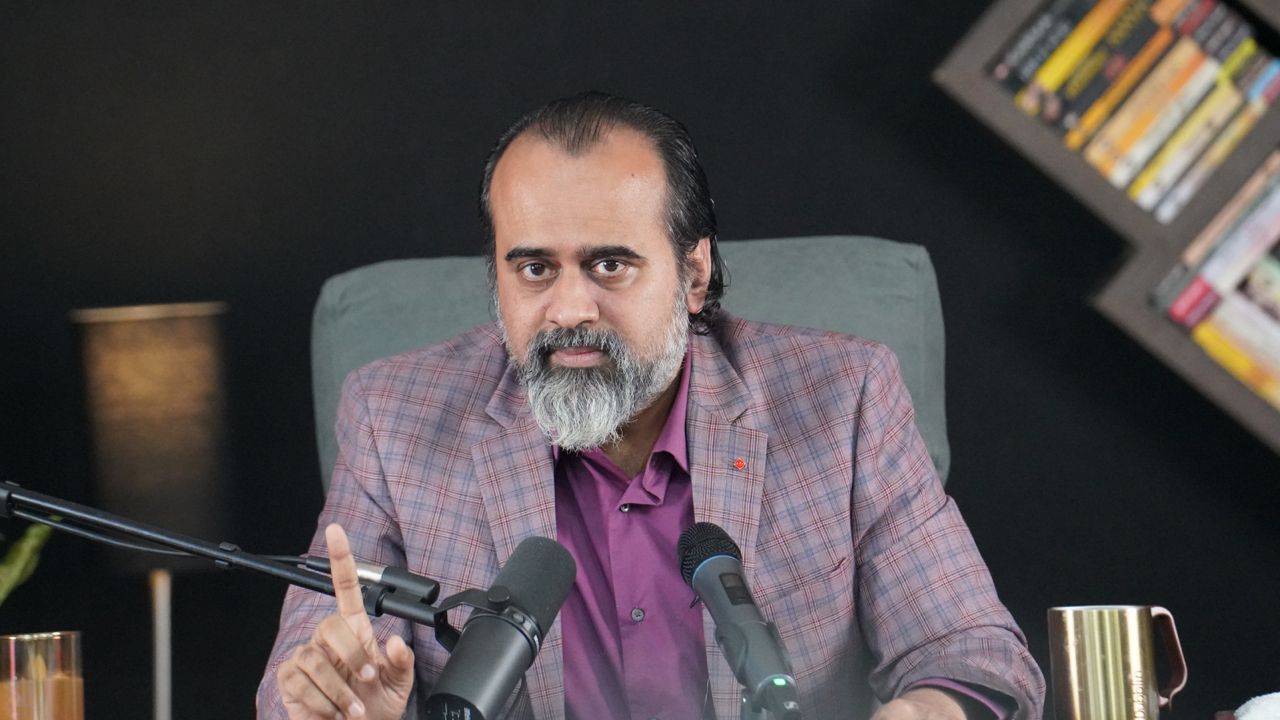
Yoga is action without attachment. Yoga is to refuse everything that keeps you little and limited. To live without a reason, to love without a cause, to act without greed and desire, that is Yoga. Total purposelessness is Yoga. Yoga is freedom from all whys.
This summary is AI-generated. Please read the full article for complete understanding.
Overview
Yoga is action without attachment. Yoga is to refuse everything that keeps you little and limited. To live without a reason, to love without a cause, to act without greed and desire, that is Yoga. Total purposelessness is Yoga. Yoga is freedom from all whys.
Yoga is freedom from thoughts and feelings. Yoga is to not place any demand on any kind of thought or feeling. When you do something needlessly, reasonlessly, there is a particular beauty about it. That beauty is Yoga.
Perform your actions, O Dhananjaya (Arjuna) being established in or integrated with Yoga, abandoning attachment and remaining even minded both in success and failure. This evenness of mind is called Yoga.
Acharya Prashant (AP): The science of uniting the individual consciousness with the ultimate consciousness, this equanimity, is known as Yoga. Which equanimity is he talking of? Becoming equipoised in success and failure. Could you get a more concise and direct definition of Yoga? Perform your activities giving up attachment, and become equipoised in success and failure. This is Yoga. What does it mean to remain equipoised in success and failure?
Yoga is about the actor, not action
Q: To not become a football of situations and circumstances?
AP: It means that even when you enter an action, you enter it as somebody to whom the action does not matter too much. It is then not about the action but the actor. You enter as an already fulfilled actor: I am acting, but the actor is not acting for the sake of rewards; the actor is already fulfilled. When the actor is already fulfilled, then the action does not matter too much; then one can have a little playfulness about the action. ‘It does not matter which way the thing goes because whatever I wanted to have has been achieved even before the action; the action cannot really bring anything new to me. I am all right as I am. I am not acting in order to become all right.’ This is Yoga. Too simple? (Smiles) Unbelievable?
This is the science of decision-making and acting. ‘I am all right as I am. I am not acting to become all right, yet I am acting. Why am I acting? Just like that! I may as well not act and that would make no difference to my health. I may as well doubly act, with triple the intensity and energy, and that, too, would not really make a difference.’ This is Yoga.
Yoga is being equipoised in success-failure
Now success and failure cannot really matter because they can neither inflate nor diminish you. Why won’t they inflate you? ‘Because I am already all right. What can the fruit of my action give me? I require no fruit.’ Ah, wonderful word: I require no fruit. ‘That doesn’t mean that there would be no fruit; there would be fruit, of course. Each cause bears an effect; the tree would bear the fruit. But I require no fruit. If I get a fruit, wonderful. Nice fruit, nice taste! Ah, a little bitter? It is okay. I require no fruit. I am already all right.’ This is Yoga.
Yoga is freedom from feelings
Yoga is not usual feelings
To not have the thought that you are diseased is health, and that is Yoga. Yoga is not about feeling special. Yoga is not about being in a great state of consciousness. Yoga is about not having a lot of things that we usually have. Now, what do we usually have? We usually have inferiority; we usually have lack of fulfillment; we usually have a lot of search and seeking; we usually have a lot of questions. Yoga is about not having these.
Yoga is not special and divine feelings
‘I am already all right. What would I do with achievement? I am already all right. What would I do with medicines and methods? I am already all right. What would I do with questions and their answers?’ That is Yoga.Yoga is not a special feeling, mind you. Yoga is the absence of that which we usually keep feeling.
Look at the common man on the road, look at the streets of Rishikesh. Do you see people with no feeling? No. People are walking, and they are walking with a lot of feeling. The feeling might be divine—so-called divine; it might be heavenly; it might be different from the feeling that one usually has in a metro city, in a corporate city. It is a holy city, so you have different feelings.
Yoga is freedom from feelings
Yoga is to be free of all feelings. Yoga is to not place any demand on any kind of thought or feeling. Every thought, every feeling arises as a promise, as a solution. It says, ‘There is something missing in your life, I will provide that to you.’ To be situated in Yoga is to not need any promises. ‘I do not require your promise because whatever you would promise, I already have that. What can you promise to me when I have the Highest?’
Yoga is freedom from thoughts
Hence, Yoga is to be free of a lot of things. That does not mean that in Yoga you do not have those things; that does not mean that the yogi kills those things.
But thoughts are still there!
Thoughts are still there, feelings are still there, yet there is freedom from thought and feeling. We said cause would bear effect. We said action would bear fruit, so the fruit is still there. Prakriti operates, so the body is there. Prakriti operates, so thoughts are also there, but one does not place a lot of demands on thought; one does not want to think his way to wellness.
Don’t we use thought as a means to our welfare? When we are not well, what do we do? We think how to be well. Whenever we are faced with a problem, what do we do? We think how to get a solution. In Yoga, you do not place the onus of your welfare upon anything or anybody simply because you are already well. In Yoga, you do not follow any path or any role. Why? Because you are already home.
Yoga is not about following methods
Hence, Yoga is not at all about following this method or that method. Yoga is about realizing that all methods are futile. ‘I am already there! I do not need any of these tactics.’ If tactics are there, then one would want success from those tactics, and Krishna is saying, ‘You have to be equanimous towards success and failure.’ Hence, success is not something that you can take seriously.
Yoga is action without attachment
Action without attachment is Yoga, and action without attachment is possible only when the actor is a very, very innocent and healthy actor; then he acts just for fun, just for no reason. Such acting has a beautiful quality about it because then it is not the action of a beggar.
Are you attached to results?
When you are desirous of a result, you go about like a beggar who acts in order to get a result. Why does a beggar approach you? Does he approach you in love? He approaches you because he wants something from you. He wants a result. That is how the lot of mankind goes through life doing whatever it does for the sake of getting something. That is viyoga (disunion, separation).
Krishna is saying, ‘No! Do not act to get. Realize that you already have it, and then act.’ He is inverting the way we act. We act so that we may get. Krishna is saying, ‘Get, and then act.’
Beauty of Yoga lies in non-attachment
And that is a little incomprehensible to our purpose-driven mind because we ask, ‘If we have already got it, then why would we act at all?’ You would know that when you are free of the thought that you do not have it. Then you will see what joy lies in acting even though you do not need the action. We do not know the charm of needlessness. When you do something needlessly, reasonlessly, there is a particular beauty about it. That beauty is Yoga.
Yoga is to love without cause
To live without a reason, to love without a cause, to act without greed and desire, that is Yoga. Total purposelessness is Yoga. Yoga is freedom from all whys. Yoga is freedom from all questions. Yoga is freedom from all concepts and theories and sutras.
Yoga is simply the statement: ‘I am all right.’ You need not say you are Brahman; you need not say you are God or the son of God or the daughter of God; you need not say you are
the Ātmān; you need not say that you are the holy Truth.
All you need to say is, ‘I am not unwell.’ I am not even saying that you need to say that you are all right because then even that would become a concept. We are buffeted by the thoughts of not being well.
Yoga is freedom from sickness
In fact, every single thought that we have is a thought about our sickness. When everything is all right, do you think about it? When do you think about your thumb? When do you think about your tooth?
Q: When it hurts.
AP: When it hurts! Thought itself arises when there is a perception of something being problematic, of something being not all right. So, Yoga is simply freedom from thoughts
of disease.
That does not mean that thoughts are not there, I am repeating this. Thoughts will be there, yet you will be free of them, you are not laying importance upon them. Thoughts are doing what they must, and you are where you must be. You are following your own nature, thoughts are following their own patterns, and you are not obliged to interfere in the patterns of thought or body. They are taking their own due course; you are letting them do what they want to do. This is Yoga.
Yoga offers freedom from attachment
Yoga means that you would not be unsettled by the fierce currents of body, mind, Prakriti, even as they flow all around you.
Yoga is detachment from Prakriti
One of the most beautiful images of Yoga is the statue of Shiva in the middle of the Ganges. Have you seen that statue at Haridwar? The Ganges is flowing all around Shiva, and Shiva is still. That is Yoga.
The streams of Prakriti are flowing all around you, even over you, and yet they are not carrying you away. That is Yoga. To be seated unflinchingly like Shiva is Yoga, which means that life goes on and does what it does, and you keep relaxing; you keep relaxing even as your body-mind apparatus keeps responding to life.
Yoga offers capability for right action
That does not mean that you have become lazy or incapable of right action. In fact, you are now capable of right and vigorous action, and yet you are relaxing. With the Ganges all around you, you are relaxing like Shiva. That is Yoga. And in your relaxation lies the potency for vigorous action, right action. That is Yoga.
Yoga removes inferiority
Yoga is giving up of all that which proves to you that you are little, inferior, handicapped, or small. To be in Yoga is to be with Krishna. To be with Krishna is to be only with Krishna and not with that which is sick, ugly, limited, and an agent of grief.
Yoga offers freedom from littleness
To be in Yoga is to not touch anything, anybody, any situation that causes a sense of littleness in you. Even if that littleness is induced in you in a holy pretext, even if it is induced in you as an ostensible means of welfare, you refuse to admit it in.
Somebody may come and say, ‘You need protection!’ You quickly see through what he is saying: you realize he is saying that you are weak. ‘If I am not weak, why would I need protection?’ You refuse to entertain the advice. You refuse to take that person seriously. This is Yoga.
Yoga offers freedom from ignorance
Somebody comes and tells you, ‘You need God and God is all that you need.’ You refuse to entertain this person because if he is saying that you need God, then surely he means that you do not have God; he is proving that you are Godless. You refuse that person.
Somebody comes and says, ‘You need a lot of self- enquiry.’ You immediately refuse this person because if you need to look, see, and discover, then surely, first of all, you must believe that you do not know because you are ignorant, which you are not.
Yoga is refusal of littleness
To be in Yoga is to refuse everything that keeps you little and limited.
Littleness would not come to you as littleness. It would come to you as friendly advice, as brotherly concern, as the sermons of a teacher, as a promise of security.
Had littleness been honest enough to admit its real name, you could’ve easily refused it. But littleness rarely admits its real name. Littleness comes wearing the mask of things that appear nice and sweet and promising.
Beauty of Yoga lies in the charm of needlessness
Be very cautious of all this stuff that is always ready to enter your mind. Anything that promises to make you better is an allegation upon you. Why is it an allegation? It is an allegation that you are currently not all right.
Anybody who offers to improve your life or help you realize that which you do not know, is actually proving to you that ignorance is what you are. The advertiser who is telling you that the next home or the next position or the next car will add something to your life is actually causing viyoga in you because he is proving to you that unless you have that house or that car, there is something missing in life. And you buy into that. Why? Arjuna, too, must have bought into a lot of those things!
We do not know the charm of needlessness. When you do something needlessly, reasonlessly, there is a particular beauty about it. That beauty is Yoga.
आप बहुत गलत तरीके से जी रहे थे, अब आपको बता रही जिंदगी
ज़िंदगी की छोटी-से-छोटी स्थिति भी आपके सामने आती है तो अगर आपकी सुधरने की, सीखने की नीयत है तो उस स्थिति के बाद आप वैसे ही नहीं रह जाएंगे जैसे कि आप उस स्थिति के पहले थे. यह मैंने बात करी जीवन की किसी भी साधारण स्थिति की. अभी जो वैश्विक आपदा हमारे सामने है, वह तो निश्चित ही असाधारण है.
A Lesser Known Incident From Mahatma Gandhi’s Life
Mahatma Gandhi had been in South Africa at the center of a civil movement for more than two decades but he kept coming to India to attend Congress sessions. There was not much depth in those visits.
क्या हम यज्ञ जानते हैं? हम न ध्यान जानते, न यज्ञ जानते, न पूजा जानते, न पाठ जानते, न भजन जानते, न कीर्तन जानते। न हम ये जानते कि वो क्या हैं, न हम ये मानते कि हमारी समस्या क्या है, तो तुम्हारे काम क्या आएगा?
The planet is irreversibly tipping. Who is pushing it?
We have begun to speak of the future climate as though we could settle the bill later. We shall keep emitting greenhouse gases, warm the planet beyond the limit we have agreed upon and, when technology has improved, bring the temperature down again.
Especially in the modern world, unfortunately, a degree of constant anxiety has become an almost normalized state for us. A large portion of our mental health problems as a collective is very much about anxiety and fear. Burn-outs, career pressures, problems with self-esteem, fear of others, stress about studies etc.
Independence Day: अपने मन के भीतर की इन गुलामी से मुक्ति पा लेना ही वास्तविक स्वतंत्रता है
जीवन को चुनौती दिए बिना जब स्वयं को स्वतंत्र मान लिया जाता है तो वह स्वतंत्रता नहीं, पलायन होता है। आप कितने स्वतंत्र हो, यह पता तब चलता है जब आप अपनी बेड़ियों और बंधनों को चुनौती देते हैं।
इतना तो हम सभी जानते हैं कि राम के स्पर्श ने रामबोला को तुलसीराम और तुलसीराम को तुलसीदास बना दिया। लेकिन याद रखना होगा कि जैसा भक्त होता है, वैसा ही उसका भगवान भी होता है। भगवान तो भक्त को रचता ही है, भक्त के हाथों भी भगवान की रचना निरंतर होती रहती है।
The Mirage of Revolutions: Why Uprisings Fail Without Inner Freedom
When we think of revolutions, it is often the sound that comes back first: the roar of voices in the streets, slogans ringing through capitals, crowds that feel unstoppable, and rulers suddenly brought down. For a fleeting moment, it feels as if a new dawn has arrived. Yet when the dust clears, the old shadows return.
Complex challenges necessitate consciousness and policy shift
India faces multitudes of challenges arising from different quarters. But essentially all problems have their roots in the mind of the human being and arise from a lack of adequate understanding of the self. The solutions therefore have to be both in the external and the internal domain.
अध्यात्म आने का नाम नहीं है; अध्यात्म एक अंतिम विदाई का नाम है। अध्यात्म बिलकुल अलग आयाम की बात करता है। वो कहता है ये आने-जाने का कार्यक्रम तो तुम्हारा बहुत चलता रहा, तुम्हारा आना भी झूठा, तुम्हारा जाना भी झूठा।
कुछ भी करने में एक डर क्यों बना रहता है कि कोई और मेरे विषय में क्या सोचेगा? ये डर सिर्फ कुछ स्थितियों में नहीं होता हमारे जीवन में। सच तो ये है कि हमारा जीवन ही डर बनकर रह गया है।
Children’s Day: What Are We Really Giving Our Children?
Children’s Day is celebrated on 14 November every year. We try to provide the best schools, facilities, and plans for our children’s future and celebrate their achievements with pride.
Decision-making, for most of us, becomes heavier than it needs to be. The moment a choice appears, the mind begins its familiar dance. Thoughts circle around the options, trying to predict outcomes, trying to secure certainty, and the whole thing turns strangely tiring.
Sanatan Dharma is the way if the world is to be saved, rest is just cult
When it comes to philosophy and spirituality, the discourse often becomes dense. But in our endeavour to understand Sanatan Dharma, we will proceed with simple definitions and queries.
तो आप जो भी कुछ करते हो, पूजा-पाठ, तप, यज्ञ इत्यादि, आप पूछ लीजिए इससे आपकी परेशानी कैसे मिट रही है। आप ये सवाल इसलिए नहीं पूछ पाते क्योंकि आपने कभी खुद से ही स्वीकार नहीं किया कि आपकी असली समस्या क्या है।
Dr. Ambedkar is an enduring symbol of struggle, dignity, and the relentless pursuit of justice. His life was not merely a series of events that were linked with politics or social reform. It was an intellectual, social, and spiritual odyssey. Dr.
दीपावली पर घर साफ होते हैं, पुरानी वस्तुएं हटती हैं, कोने चमकते हैं। उधर बाजार कपड़ों, आभूषणों और उपहारों से भर जाते हैं। एक ओर घर से अनावश्यक सामान निकालते हैं, दूसरी ओर नई वस्तुओं से उसे फिर भरते हैं। लेकिन जिस गंभीरता से घर साफ करते हैं, क्या उसी गंभीरता से अपने जीवन की भी जांच करते हैं? दीपावली प्रकाश का पर्व है।
यह प्रश्न केवल ईश्वर के बारे में नहीं है। इससे कहीं ज़्यादा यह हमारे बारे में है। हम किसे राम कहते हैं, इससे पता चलता है कि हम स्वयं को क्या समझते हैं, किसमें सुरक्षा खोजते हैं और किसके लिए अपना जीवन लगा रहे हैं।
A true victory is not over an external opponent, But over one’s own limitations: personal, cultural, historical. When women play freely, the nation breathes freely. When women claim their place, the planet finds its peace.
अहंकार के लिए समझना बहुत ज़रूरी है कि उसकी वास्तविक स्थिति क्या है। अपने बारे में कल्पना में रहना कोई अच्छी बात नहीं। हमारी तो चेतना भी हमारे शरीर से उठी है। तुम प्रकृति से मुक्त कैसे हो जाओगे ?
Nobody wants to admit to jealousy, not even to themselves. It is easier to look away from than to examine. But it is worth looking at, because jealousy tells you where your sense of worth is kept.
You have ample gurus who come over and say, “You know, you do this and then you can do whatever you want to do.” Now the moment you hear this kind of philosophy that Yoga will help you do better whatever you want to do, I suppose one must run away. Because that’s exactly antithetical to Yoga. Yoga is not about doing whatever you want to do; it’s the ego that says that, not the dedicated, devoted, wise mind. That does not come from there.
If the word ‘Yog’ comes to be synonymous with physical exercise, then it’s a joke. When you look at the mass of people, what is it that you find more unhealthy — the body or the mind? It is the mind that is extremely unhealthy. And all of that is because the mind is in ‘Viyog’ — the mind is separated from something that it desperately wants. So, Yog has to be an inquiry into who we are, and what it is that we really want.
Acharya Prashant:
You will see that I'm repeatedly stressing on Shri Krishna as the demolisher, on Shri Krishna as someone who not only does not accept our prevalent definitions of right-wrong, true and false, humility, authority, right action, non-violence but, in fact, unabashedly and actively demolishes them. It is one