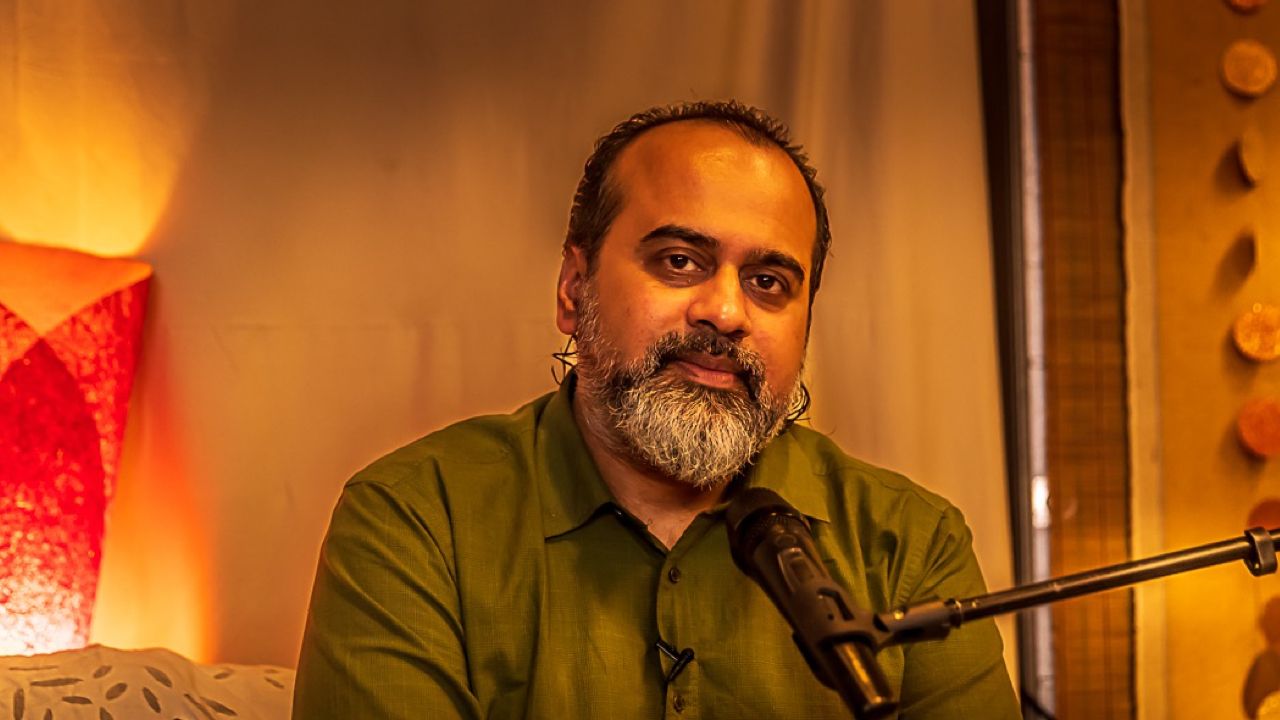
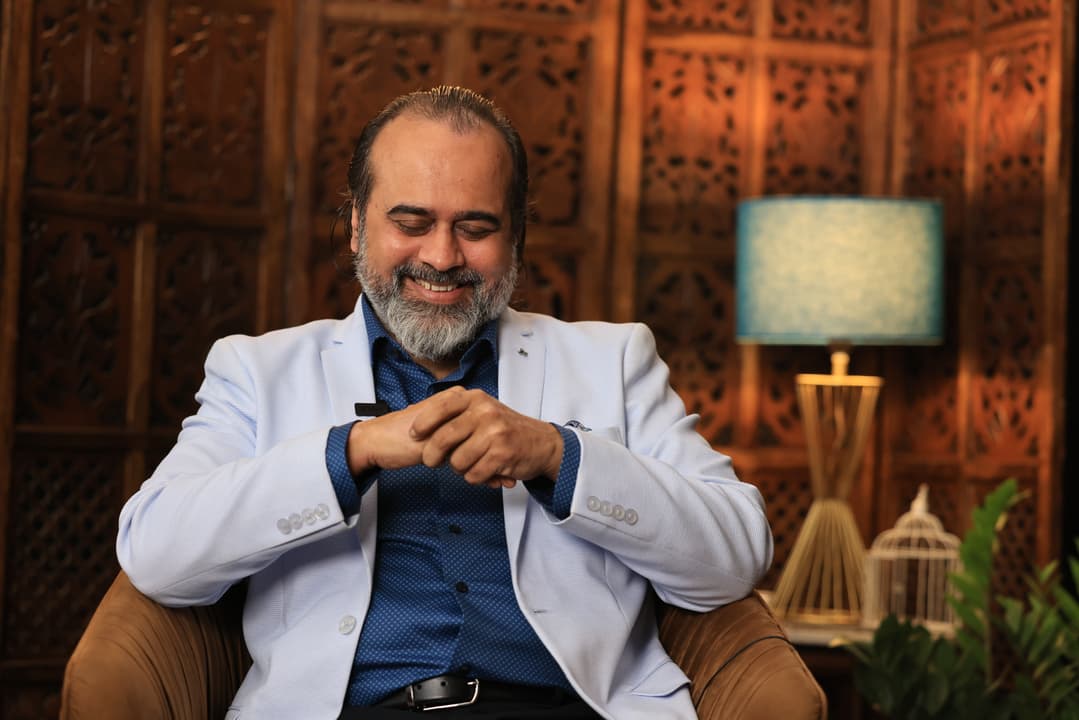
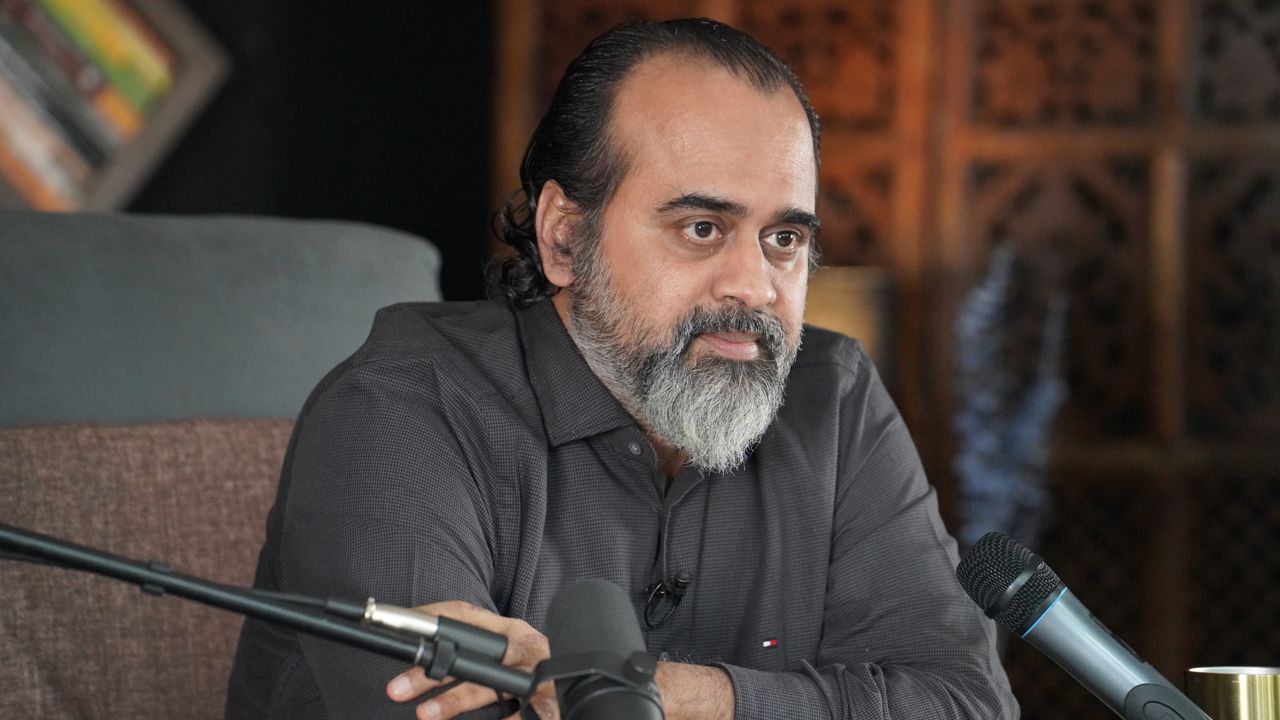
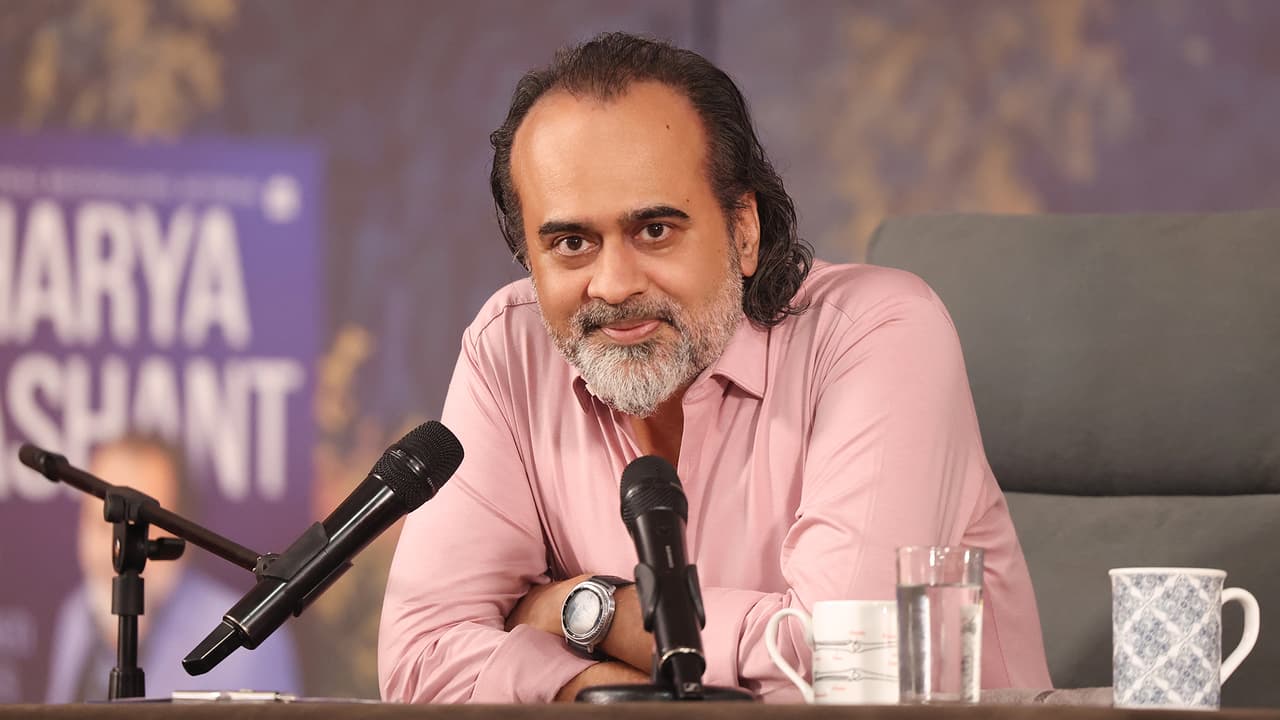
Acharya Prashant at Oxford University || Ishavasya Upanishad (2026)

Acharya Prashant

36 min
99 reads
Acharya Prashant at Oxford University || Ishavasya Upanishad (2026)
Science can examine material claims, but Advaita Vedanta deals with the subjective self, ego, suffering, bondage, and liberation—areas outside science’s objective framework. Vedanta need not be accepted because of one’s religion or tradition; its value lies in whether its insights can be personally verified and help free one from suffering. The ultimate responsibility is not toward any philosophy, but toward oneself: to live a truly free life. This summary is AI-generated. Please read the full article for complete understanding.

Acharya Prashant: This is the place where the Upanishads first came to the English-speaking world, and it was from the Oxford University Press that the Upanishads were published for the first time in English. So it's a wonderful coincidence that we are taking up the Ishavasya this evening. Right?

Verse two:

कुर्वन्नेवेह कर्माणि जिजीविषेच्छतं समाः। एवं त्वयि नान्यथेतोऽस्ति न कर्म लिप्यते नरे॥

~ ईशावास्य उपनिषद्

Kurvanneveha karmāṇi jijīviṣecchataṁ samāḥ. Evaṁ tvayi nānyatheto'sti na karma lipyate nare.
~ Ishavasya Upanishad

“One should wish to live for a hundred years only while performing actions. For you, there is no other way besides this. In this way, actions do not bind a human being.”

One should wish to live: jijiviset, that's the word, the desire to live. One should wish to live a hundred years with the condition, with the caveat, only while performing actions. For you, there is no other way except this. And in this way, actions do not bind a human being.

Now replace "bind" with "smear," because the word here actually is "lipyate." So "bind" is some kind of a flattening, a smoothening. The right translation is "smearing." Smear. And that word "smear" has a special significance.

The actor has to be looked into. The verse is talking of actions. Actions, right? It talks of action at two places. One: live for a hundred years only while performing actions, and then again, in this way, actions won't smear you. So when actions are being referred to, it becomes very important to go into the actor. Who is the actor? Whose action are we referring to?

The one who acts is at the center of all Upanishadic inquiry. Why? Why must such an inquiry be made? For intellect's sake? Because of general curiosity? Just the kind of curiosity that we have towards things and objects in the universe, the kind of curiosity that every kid has towards whatever she can look at, touch, hold, feel? No, not the same. Existential curiosity is the reason.

The actor is the ego. And the ego is the lifelong sufferer of its own existence. The ego is what experiences itself as restlessness, as loneliness, as anxiety, as hollowness, as a void. And that remains throughout life in every single person. There is no moment when we are not insecure or doubtful or fearful. It's just that the intensity of these experiences varies, and because we are a species of intellect, so we have invented colorful and diverse names for what is essentially a singular experience: the experience of incomplete being.

I am, but I feel hollow. I am, but there is a lingering experience that something is missing. Something is missing irrespective of the time of the day, the place where I stand, my age, my economic status, my scholarliness, my nationality, my race, my gender. Irrespective of any of these conditions, there remains that unpleasant sensation within. That unpleasant sensation accompanies "I-amness" always.

So the seers said, if these two things necessarily go together, then they ought to be one, and they are one because the experiencer of restlessness is the same as the object that is being experienced. These two are never, never separate.

You can keep changing the objects that you are looking at, yet the condition of the subject has been empirically observed to remain the same. So we claim that the ego is its own suffering, that the ego's status does not really depend on the objects it is viewing, holding, or experiencing.

When the objects change, the ego finds newer ways to continue its old condition. Right? And that's the reason why we must inquire into the actor behind the actions, because the actor is the ego. Ego is the thinker, the doer, the actor, the experiencer, the seer, the holder, the gatherer, also the renouncer.

The ego is the doer of all deeds, and the ego is perpetually suffering. Therefore, the actor is the sufferer. Therefore, we must go into the actor.

Now, this actor, ego, has two instincts: one, self-preservation; and second, self-dissolution.

We have to get into this step by step. If you miss any link of this chain of logic, you'll find that you have to step into believing, and believing is not what the Upanishads are for. Vedanta is not a belief system. We are not discussing faith here in the ordinary sense of the word. This is rigorous philosophy, and this is philosophy of life.

Therefore, we are not here just to hear and accumulate a story. We are not here to participate in a narrative. We are here to examine our life as a proof of what the Upanishad is revealing, step by step. Whatsoever is being said here has to be taken as a claim, and the claim can be verified only in light of our own life, because this is not about some metaphysical entity. This is about the living being, the suffering being. This is about us. This is about you and me.

This is not about a special object that only the seers have esoteric knowledge of. This is about the entity that is as common, as usual, as the human being. They are not revealing mystical secrets here. They are holding up a mirror here, a mirror in which each one of us must examine ourself. Right?

So please participate inwardly. Though I'll be doing the bulk of the speaking, inner participation has to be intense and equal. Are we game? Yes. Right? Because if you miss parts of it, then you'll be left with no option but to just believe. Believe or reject, maybe. Such belief would be hollow, and such rejection, too, would be baseless. Right?

And what else can one do when one does not understand? If one does not understand, one is left with very few options: believe, reject, or maybe ignore. So, exercising the third option, probably you will find yourself sitting here and just letting everything pass through you. Right? So, please.

So, the ego is the doer. Are we together till this? Do we see this? I am the actor. Whatever is done is done by me, for my sake, for my purposes. And who am I? My inner experience, which is the shared experience of all mankind, not particular to me, not a secret, is that I do not feel well about myself. I may claim to, but when I examine the claim honestly, it turns out to be hollow.

A random phone call can unsettle me. There are dreams that I do not understand. There are things that I live by, swear by, and yet don't understand. I have taken decisions just so that I keep belonging to the crowd. Right? I profess commitment to values that I never examined. I don't even know how I came to hold those values. Equally, I profess commitment to religious identities I never chose. I live by them. That's how the ego is.

And when you live by something you have never deliberately examined, let alone chosen, obviously there will be fear. You are bound to be doubtful, and you are now being doubtful not of a thing but of yourself, because that thing has been turned into an identity. What does identity mean? That thing is no more a thing. That thing is who I am. Identity is more than equality. Identity is more than unity. Identity is sameness. Sameness. If I'm identified with this (pointing towards the cup of tea), then this is not this; this is me. And the ego lives in all kinds of identifications, and that will lead to doubt, insecurity, and fears.

If we are asked, why did you take the kind of education you did, we would not have a solid answer. If one is asked, why did you step into such and such institution, be it a formal institution of learning, right, of education, of livelihood, or of relationship like marriage, we would hardly have a satisfactory answer. Obviously, to save face, we'll come up with some replies, some arguments. But we would know inwardly it doesn't suffice. There's not much in it. That's the ego.

And because the ego feels incomplete at all times, therefore it acts with purpose to seek completion. But completion is sought with an eye on self-preservation. I am incomplete, but still I am something. I am followed by a long blank. Fine, the blank is empty, but that doesn't mean everything is empty. I exist, not that I am nothing. I am something, just that I'm incompletely something.

So now you have two conflicting priorities. On one hand, that which you are has to be preserved. On the other hand, something has to be added to it in order to remove suffering. That which you are has to be protected. We are discussing the egoic condition here. We are not trying to solve it. We are just describing it.

On the one hand, that which you are has to be preserved. On the other hand, you are not happy with what you have. So you want to get rid of suffering. So, you want to preserve what you are, and you want to dissolve your suffering.

Now, what if suffering is what you are? What if suffering is what you are? And that's what we started with this evening. The ego is not just the sufferer but suffering itself. The sufferer is the suffering. So the ego is at once both self-preservatory and also self-dissolutory. It wants self-dissolution. It also wants self-preservation. And these are two conflicting priorities.

One says, "I need security." The other screams, "I need love." And these two don't go together. Love is self-dissolution. Security is self-preservation, and action can come from either of the priorities. When the ego acts, action can come from either of the priorities. Action in itself is quite neutral. You cannot judge action. The same action could come from either of the two centers.

So you cannot say the action is right or wrong, good or bad, or all the other labels. No. The center of action, the situation of the actor, is what matters. What are you working for? Self-preservation or self-dissolution?

If you preserve yourself, you have preserved your suffering because you are the suffering. But the ego is insecure, and when you are insecure, you cling. Ego says, "I want to reduce my suffering, not myself. The suffering should reduce. I should not reduce. The unease should disappear. I should remain." This is an impossible demand. But the ego keeps making it.

The verse at hand today is a beautiful attempt to reconcile the two. Beautiful attempt, because the ego is self-preservatory. Please see what that entails. The ego is an error that arises with the body. The ego is the feeling of "I-amness" that comes into play with the birth of the body itself. In fact, even before birth, in the womb too, the being has a sense of self, which is the ego. Right?

The being in the womb responds to the various stimuli. So the sense of self is already developing even when it is a fetus, and when it is born, it feels, “I am.” It does not have language, but it still has instincts. It knows that this body is who I am. You slap at the wall, the infant won't necessarily react. But you pat the body, and the infant is quite likely to respond in some way or the other. So there is already the concept that that is not me and this is me. Had that two been me, the infant would have responded equally in both cases. Touch the table, the infant responds. And touch the cheek, the infant responds. But we don't observe that. Do we observe that? No. So even as an infant, there is the concept, even as a newborn, there is the concept that this is me and what's beyond is not me. Now this concept is purely physical. It is born with the body. Are we getting this?

So for self-preservation, for self-preservation, the first thing the ego needs is continuation of the body because the body is the ego's natural host. The ego takes birth along with the body. Who is afraid of death? Who always keeps shivering? What if I die? Not the body. Your nose is not afraid of dying. Your hair is not afraid of dying. The arm is not afraid of dying. Somebody sitting within is afraid of dying. Who is that? The ego.

But the ego remains only in a particular physical configuration of the body. When that configuration changes, the ego is gone. A drastic change of that configuration is called death.

But death does not come to the body. Death comes only to the ego. The body has only changed configuration. The body will remain in the universe. The changed configuration has not put the body to extinction. The body is still here, right? The body is still here with an altered configuration. Maybe with a smashed skull. The configuration has changed. The heart is not beating anymore. The configuration has changed. But the body is still here.

You weigh the body. It's the same weight, right? Or you incinerate the body, as happens in Hindus, and you collect all the residue. It's possible. And you wait, and the weight is exactly the same. The body is still here. Then who has died? If death means extinction, who has gone extinct? The one who used to say I. That is no more. This body will now no more say I.

So the ego is the one that meets death. The body does not die. But the ego survives only in a particular configuration of the body. Therefore, the ego is very scared with respect to the body. Please, please retain your configuration, otherwise I'll go.

And now you see why the ego is so terribly body identified. Because if the body changes itself in a big way, the ego will have to go. And now you also see why the ego does not like aging and such things. The entire cosmetics market. The ego will have to go if aging happens beyond a point because aging is a change of configuration, right? And that configuration can render the ego extinct. Do we get this?

So if we say that self-preservation is one of the important instincts of the ego out of the two instincts it has, then for self-preservation it needs the body. It says, “Please make me live long.” The seers are addressing that here in this verse, Ishavasya Upanishad. They are saying, “Fine, you live a hundred years. Happy. Self-preservatory instinct. Pleased.” But with an important caveat, with a qualifying condition. What is that condition? You will have to act in a way that does not smear you.

How does action smear the actor? Through the fruit of action. Action is right now. Action is happening. But ego does not act for the sake of the action. Ego acts for the sake of the fruit of action. And what does the ego want from action? Something that will fulfill me.

We do not take one step without motive. The hungry man cannot take one step purposelessly. The hungry man will be taking each and every step, every single action, with the purpose of somehow getting something to eat. You get this? Please quench my thirst. Please feed my hunger. We do not know motiveless action. It is impossible. Motiveless action is impossible for the ego.

If the ego acts, there is motive, and there is a singular motive. What's that? I'm incomplete. Can this action give me a result that completes me? Will you wed me, please? You complete me. And that's taken as romantic. You complete me. No, that's terrible because the ego is looking at someone to fill in the blank because the ego is now looking at an additional host. The first host is the body itself. Now the ego is looking at another body. Can I consume that one as well? Maybe that would satisfy my hunger.

Unfortunately, nothing is going to satisfy the ego's hunger. No action succeeds in providing a result that can satisfy the ego. Please tell me why? Because this (pointing towards the glass of water) can be filled. This can be filled. (taking a sip from glass) It can still be filled. The biggest container, the biggest empty container in the world can be filled. Now fill a container that doesn't exist. That cannot be done.

How can you satisfy someone whose very claim at being is false? If I were really hungry, you could feed me. What if both the hunger and the hungry one are non-existent? How will you satisfy hunger? Only hunger exists, and hunger is an apparition. Hunger is an error rather than an entity. This has to be understood. The body is a fact. The ego is an error. Why is the ego an error? Because it is making a claim that cannot hold on being examined.

What is the claim that the ego makes? I am the operator, the owner of the body. I am the thinker. But dear ego, thought proceeds very smoothly, very nicely even without you. Which means you are not the thinker. You are just a claim, and you are a false one at that.

Who am I? I am the doer of the deed. But dear ego, I have observed that I can do a lot of good things even without you. Which means you are not the doer of the deed. You are just the distorter of the deed. You are just the distorter of the deed. You don't do anything creative or constructive. You just arrive to stamp your name at the result. When the thing happens, you arrive and say, “I did it.” And because I did it, I'll now consume the fruit. Since I'm the actor of the action, I'll be a consumer of the fruit.

The ego is an error because it says the body belongs to me. This is my body. Don't we all say that? Please tell me where is the one who says, “This is my body.” Who is the one? Please tell me the location of the one who says, “This is my body.” And we all keep uttering that all our life. Please tell me whose body. It's the ego making this claim. And it's an erroneous claim. The ego is an error.

Whose body is this? It is the body's body. It is nobody else's body. But the ego says, “No, I am separate. I'm not the body. I'm other than the body. The body is mine. I'm the owner of the body.”

The ego is simply an exploiter. It is a claimant with malicious intent. No, this is not an allegation. You didn't create the ego. As the body is born, the ego is born with it. So, we are not blaming the body for that. Do you get this?

Scrutinize every single claim the ego makes, and you will find it false. In fact, the best deeds happen in absence of the ego, don't they? You are at your best when you are not. Have you seen that? Have you seen how something is most pleasant when in its presence or in its company you find yourself dissolved or gone? Have you seen that?

A great movie, and you find that your sense of self has dissolved for a while, a great discussion, a genuinely warm hug, and for those 10 seconds you are not. And that's why those 10 seconds are so valuable. Immersion even in basic physical activity like sexual orgasm. Why is there so much importance? Because those are the moments when the ego is somehow gone or reduced. When I say gone, that is an overclaim. The ego never goes away. But at least it gets minimalized. Are we getting this?

But the ego will say, “I am the one who will save you.” The ego doesn't save the body. It rather destroys it. In the West especially, the most malicious ailments are mostly lifestyle ones, and the body will never choose an adverse lifestyle. It is the ego that chooses a bad lifestyle for the body.

The lungs don't say, “Please give me cigarette smoke,” do they? But the ego, the ego pushes the lungs to absorb something they never want to absorb. The ego compels the liver to metabolize ethanol. Has the liver asked for alcohol? The liver doesn't ask for alcohol.

The ego is not even the body's friend. How does one get overweight? For example, well, the intestines and the stomach, they are not asking for more food. But the ego will look at food as a means towards psychological completion. The ego says, “If I eat more, I'll feel psychologically completed,” even if physically bloated.

Now, physical bloating is admissible as long as there is the promise of psychological fulfillment. That promise is never kept. That's another matter. But the ego will overeat. And the ego kills the body for its own purposes. The ego is not good to anybody. And the claim that the ego is a well-wisher of the body is false. Every single claim that the ego makes is false.

Are we saying only the claims of the ego are false? No. We are saying its very existence is false. Why? Because the ego says, “I am,” and says, “I am. I am.” But this is my shoulder, and this is my chest. Where is the ego? You're not there.

So your fundamental claim itself is false. When you say, “I am,” the fact is you are not. Where are you? When you say, “I am.” I mean, fine, intestines, liver, lung, kidneys, heart. But where are you? Where is the claimant? The one making the claim is nowhere to be found.

The ego, therefore, is a false claim. And the ego is self-referential. What does it mean? Ego will say, “Because I say I am, therefore I am. Because I say I am, therefore I am.” But that's not the way of genuine scientific inquiry. Just because you assert something, it cannot be the Truth. It cannot be taken on face value. Right?

Do you ever feel like inquiring into your own existence? No. Because the ego is self-referential. You will inquire into everything else. Is this right? Is this full? Is this half full? Does this even exist? But does the ego ever feel like inquiring into itself? No, it does not.

And that's why the Upanishads are valuable because they are asking you to do what does not come naturally to the ego. The ego is ever so keen to inquire into the universe. Tell me about the atoms. Tell me about the cosmos. Tell me of the galaxies. Tell me about stuff that is light years away. Or let me get into the body and inquire into the organs and tissues and get into something new. Can I map the DNA? Can I come up with newer kinds of genetic medicines? Can I do this? Can I do that? But the ego will not want to inquire into the I-sense which is itself. That's why the Upanishads are valuable. We get this now.

Now, keeping in mind the demand of the ego for self-preservation, the seers concede. They say, “Fine, you live for a hundred years,” which is anyway the natural biological span of the body. Fine. So they have not really conceded anything material. They are saying you can do that provided you do not remain, and they don't say that in so many words. They are not saying ego should disappear and the body should live on. Though that's all that the verse is saying.

Let the body live on, but not the ego. That's the central message of the verse. Let the body live on for a hundred years. But it is not necessary that the ego lives on along with the body.

And there's a beautiful distinction here. Please see. The body can live, and the body is entitled to live. But that does not mean that the ego too has to live along. So the ego doesn't have to accompany the body.

How is that being asserted? By saying, by saying that you act in a way that does not smear you. You see, to smear something, you require first of all a surface that would receive the smear, a surface to which the smear can attach itself. Right? You cannot smear a table with water, can you? You cannot do that because there is no attachment. But you can smear this surface, for example, the table in front of me, with paint, with ink. Why? Because the surface here is just so keen to attach itself with the ink, with the paint, or whatever pigment.

The ego is the one that is so keen to attach itself with anything in the blind hope that attachment would result in fulfillment. Now attachment will never give fulfillment, but the ego does that. It is what we call as attachment that the seers are referring to as a smear. liptyata, lipyate, that's the word being used. Lep. Do you understand, Lep? To put something on top of something. Like a scar exists on the body. And there is a wonderful aside to this.

Actually, the chances of the body living for a hundred years meaningfully increase when the body is spared of the ego because it is the ego that is the most common killer of the body. Though the ego will say, "I save the body. I come up with medicines and all that." But the thing is that creatures in the jungle and the trees, they hardly receive medical attention. But they live their entire lifespan, don't they? I mean, keeping aside events such as the deer being hunted down by the tiger or lightning striking a healthy green tree, you keep such events aside. The body is anyway a machine meant to last long.

The question is not how to make it live up to hundred. The question is what is it that prevents it from completing its natural span? What is it?

We are dying of cardiac illness. We are suffering from mental illness. Has the heart decided to go sick? Where does the sickness of the heart come from? The ego does that, both through tension, right? You're living a life because of your ambitions, because of your attachments, because of your hollow goals, desires, because of the unnecessary load of memories you are carrying from the past, that the heart is troubled, and on top of that, you are eating garbage, packaged garbage. And who decides to eat that? The heart? Does the heart decide that way? It is the ego decides that.

"Ah, fancy packaging, nice advertising, big brand. I want that. I want that."

If you want that, you should have eaten it. Why did you feed it to the heart? Why should the heart suffer for the chips or the burgers that the ego chose? Who should suffer? The ego. So the ego is also deeply irresponsible. It does things that it does not have to pay for. Somebody else is paying for the misdeeds of the ego. Do you see this? Can you count the number of ways in which we destroy our body? Otherwise, the body will live happily. Maybe not a hundred years, X years, whatever some natural period. Are we getting this?

So yes, live on. Please live on. But you will be truly alive only when the ego is gone. Otherwise, these are not the hundred years that the body lives. These are the hundred years that the ego keeps the body alive to feast on it. We are surviving as colonies, and ego is the colonizer, and the colonizer does not want to totally kill the colony, would he? No.

When a host pathogen is just so fatal, the mortality rate is so high that you are infected and you die in one day or two days, then the disease doesn't spread because the virus too dies along with the body. For the virus to survive, it is important that the body must be kept alive. That's the reason the ego wants to keep the body alive. Not because the ego loves the body, but because the colony has to be kept alive so that the colonizer can exploit it.

What the seers are offering here is best from both sides.

Yes, live long, and yes, live freely. Live long and have inner freedom as you live, because life without inner freedom is just servitude.

If you are told today conclusively, conclusively, that you would be put in jail, right? And every action that you do there will be in service of something else, somebody else. You would be put in jail with zero hope of ever, ever emerging free from the jail. Would you really want to live on if you were told that even the single breath would be in service of some master external to you? Would you even want to live? So a long life spent unexamined is simply a long term in jail.

**Living long is wonderful only when the length is secondary to freedom. Yes, length of life is good. But freedom is better. And if freedom can be ascertained, then I do want to live a hundred years. Having said that, I will always remember which of these two is primary. Freedom is primary. And what freedom are we talking of? Freedom for the ego, freedom from the ego?

What we have, the concept of freedom or liberty that we have the world over, is mostly freedom for the ego. "I'll do as I please. This is what I want. This is my choice, I want to go there." Without having ever examined who is the one making the choice.

Without self-awareness, that kind of freedom is, I repeat, just slavery of an unknown self. And who is the slave? The self itself. The ego is the master. And this ego has everybody as a slave.

The body, yes, the body is a slave. The entire universe is a slave. If the ego could exploit everything and everybody, it would. And that's what it tries through technologies of all kinds. Can I exploit everything? Every nook and corner of the world. Every atom has to be at my service. But the ego exploits itself as well. Had the ego been its own well-wisher, it would have chosen dissolution. And that brings us to love. Remember that I would say that brings us back to love because we talked of self-dissolution as love. Ego that loves itself chooses to reduce. Ego that does not love itself chooses to expand, fatten, reinforce.

I'll go through the verse again. I'll read it out for you. “One should wish to live for a hundred years only while performing actions.” What kind of actions? Actions that do not smear. And then they categorically deny an escape. They say , “For you there is no other way besides this.” Kindly don't take this as an option. This is the only way.

Why does that have to be said?

Because the ego will say, "Okay, okay, yes, yes. I want happiness. I want peace. I want prosperity. But can that be done in some other way, through great technologies, through green technologies, through EVs, for example, or through enlightened policy measures? Can that be done?"

So the seers are categorically, unequivocally closing that escape door for the ego. They are saying, "No, no, no, no other way is possible." If even a slight opportunity is presented, the ego will grab it. The ego will say, "Okay, self-dissolution is not needed. I can use some other way." Some other way, something can be done. And if nothing can be done, let's leave the earth and fly away to Mars. That option is there, right? Do you get this?

So it is important to close that door on your own face. It is important to tell yourself, no. Egoic measures won't succeed because success itself is defined by the dissolution of ego, and egoic measures by definition sustain the ego. So egoic measures obviously cannot succeed. Are we getting this? Are we together?

Action. Beautiful action that arises in the moment and completes itself. Action without any residue for the future. Action without any expectation of egoic continuation. Action spontaneous and unmotivated. That's the action being referred to. Action that does not smear. Great continuity, but not of the actor. Continuity of what then? Continuity of existence. Continuity of totality that continues. The actor is not allowed to continue.

I was interested this afternoon in visiting Christ Church here at Oxford because John Locke… I uttered continuity, so I was reminded of that. John Locke, here, the English philosopher, he talked of personal identity as continuity of memory and consciousness. That's his concept. Where does the self come from? Where does the ego come from, he said? It is a continuity of memory and the stream of consciousness. He said that's where we gain personal identity from. Now that's exactly the self that we do not need. We do not want that actor to persist.

Where will action come from if there will be no actor? Where will action come from? Ah, who is asking that question? The one who wants to occupy and keep occupying the seat of the actor. Anyway, anyway, we have located you. We know who you are. But we'll still answer your question. We'll still answer your question. The question is, if I am not there, who will act? Because all throughout life, I have been the actor. If the ego is not there, who will make decisions? If the ego is not there, who will make relationships?

First thing, I see you. I know who you are. Second thing, the answer. How does the wind blow and how does the grass grow? Who is the actor there?

Listener: No one.

Acharya Prashant: No one. So the actor is not needed. Action will happen. And the most beautiful and the greatest action happens when the actor is not there. So please don't threaten me with the gloomy prospect of your absence. No, it's not gloomy. It's a most welcome thing. Please disappear. "What if I go? You'll fall flat." No, I'll rise for the first time.

So can this ego thing disappear totally? Because we are talking of dissolution. We are saying go. We said it comes with the body. So as long as the body remains, the ground for ego will remain. Which means it will keep returning. It will keep returning. But the more you identify it, the more you are able to see through it, the more self-observant you are, the more its tendency to return reduces. It will return, but with lesser intensity. All your life it will keep returning. And your job, therefore, is to be self-observant always and not engage in 20-minute practices. Self-observant always, not in those special 20 minutes of meditative or religious practices.

Power yoga, “5 minutes a day, and you're home.” No. Super sauna, that's happening, actually, not dreaming it up. They've also come up with mystical diets these days, mystical drinks. Drinks, they always had. Rings also, mystical rings. Wear them and you're home. Cheap. Cheap in intent, not in price. In price they are very expensive. Do you get this?

It's just happening. I won't even say it's happening through me. Because if I say it's happening through me, I have still managed some kind of a separation from totality. Just as everything is moving in the universe, I too am moving. I too am moving without an agency. The agency won't love hearing this. I can see that on some of the faces. But that's not your face. That's your face hijacked by the agency. What problem can your face have with the minimization of the ego? No problems.

But you see how the face? What am I doing to your cheek? Nothing. Why? Why is the facial expression then getting distorted? Because this (pointing towards the cheeks), this has been colonized by the ego. So now, if the colonial master faces a war, the colony too is dragged into it. This is the colony. Are you getting this now?

Please avoid the lok-dharmic interpretations that go with this verse. You know, you know what the usual interpretation is, and you'll find that everywhere in the libraries and on Google. “Keep performing your karma and aim to live a hundred years.” No, no, that's not what the sages are saying. They are not saying that. Are you getting this?

First of all, what is meant? The key word here is lipyate, and that does not meet with due justice. That's the pivot. And the ego plays on it, distorts its meaning, and that renders the entire verse a little impotent.

Not the ordinary kind of action is being referred to here. Egoless action is being referred to, just as in the first verse. What was said? “Tena tyaktena bhunjīthā.” Same thing. There they said, yes, consume. Here they are saying, yes, live on. But there they attached a condition. What was the condition? Consume with illumination. Consume with renunciation. Renunciation of what? The ego itself. So that was the condition there.

In the same vein, here they are saying, yes, you can live long, but without the overriding ego. The spirit is the same, right? And the usual interpretations distort both verse, verse one and two. So be careful.

This article has been created by volunteers of the PrashantAdvait Foundation from transcriptions of sessions by Acharya Prashant
Comments
LIVE Sessions
Experience Transformation Everyday from the Convenience of your Home
Live Bhagavad Gita Sessions with Acharya Prashant
Categories