If you are religious, then shouldn’t you be truly religious? Religion is about a total commitment to the Truth. You’ll have to recognize that the objective of religion is not to attain heaven, not to please a holy figure, but to come to your own inner Truth. All good books exist to awaken your consciousness. When it comes to you and the Truth, do you want somebody in between? And wherever you spot fakeness, falseness, hollowness or ignorance, drop it.
This summary is AI-generated. Please read the full article for complete understanding.
Questioner: Namaste Acharya Ji, and I am a first-year student of PG at IIT Kanpur. So my inclusion is that when I see religious practices, particularly in my household, I see some practices that are going without some rationale, like our forefathers did it so we are doing it. But I want to introduce that rationale to my family, to my elders like my father, my other sister, and my grandfather. So for that, how should I approach them, or how should I discuss it with them, so that it does not affect their faith and it does not offend them?
Acharya Prashant: You’ll have to tell them that the objective of religion is not to attain heaven, not to please a holy figure, but to come to your own inner Truth. And that is sacred. You’ll have to tell them.
Questioner: I’m a Muslim.
Acharya Prashant: You are a Muslim. Be it a Hindu, a Muslim, a Christian, anybody, the highest objective of religion is Truth. Your family would understand the word haq.
Questioner: Yes.
Acharya Prashant: That is the highest. And if the Truth is the highest, then shouldn’t you begin by dropping falseness wherever you see them? Is that not a good way to begin?
Questioner: Yeah, that’s a very good way to begin. But the thing is, the rationality you have, I have. But how should I convince them to do it?
Acharya Prashant: No, don’t convince them. Just ask them what it is that they want and show them. Request them and show them that which they really want, which is the objective and the pinnacle of all religion, is not going to be attained through blind ritualism.
Questioner: Yes, of course.
Acharya Prashant: If they are religious, then shouldn’t they be truly religious? If I say I’m religious and you tell me, “No, no, religion is nothing, waste,” then obviously I’ll be offended. I won’t listen to you. So even practically, this kind of approach won’t work. A far better approach, which is not just a good policy but actually a very honest thing to do, is to ask: “If you are religious, sir, don’t you want to be truly and purely religious?” And religion is about a total commitment to the Truth, is it not?
Questioner: Yes.
Acharya Prashant: And if I am to be committed to the Truth, shouldn’t the first thing be to examine my life as I’m living it? And wherever I spot fakeness, falseness, hollowness, ignorance, drop it.
If I’m doing something as a mere ritual without knowing what it means, am I being truthful?
Questioner: No.
Acharya Prashant: So that’s the question to ask. It’s a very simple question. In the holy books, it is often said, you must never live in falseness, in darkness, in hollow dreams. Do not go down the wrong lane. They declare that way, don’t they? What do those words, those lines, what do they really mean? See things as they are, that’s what they mean. Do not be captivated by mere appearances. Do not live on hearsay, and tradition is not necessarily Truth. Just because people have been doing something for years or centuries, that does not become the Truth.
So can we look at our religions, our traditions, our rituals, our beliefs, and say, “We are committed to purity?” Don’t we want to refine our thoughts, our traditions? Don’t we want to come to the sacred with a certain honesty? Isn’t there pretense in a lot of things that we do in the name of religion? And that’s a question you should not answer, that’s a question they should answer.
Because, you see, it’s a very personal thing, right? It’s about reaching your own inner Truth. You cannot bulldoze somebody. You cannot force yourself on somebody. You cannot drag somebody to liberation.
Questioner: That’s often what I find, whenever I try to tell them something or explain something, I get stuck at some point. They say the pain comes above. That is the thing where I get stuck, and I cannot go ahead without offending them or offending their religion.
Acharya Prashant: No, I have learned it the hard way, and you must benefit from my experience that offense is not necessarily the best way. Don’t do that. Don’t try that. That should be your last resort. Not that you are totally discounted, but that should be used only when nothing else works.
You see, I am a religious person, right? In my own mind, in my own belief, I’m doing the right thing. I think I’m pleasing my Lord, right? If I do these things, then the Lord will be happy. That is how most religious persons would describe their actions, right? If I do all these things, then the Master, the Lord, He’ll be happy.
Your question must be: have you actually understood what the Truth is? If you want to be religious, are you sure the path you are walking is truly religious?
Yes, you want to be a good person. That’s what we often say. Religious people are good people, right? At least the religious ones like to say that.
Questioner: They consider.
Acharya Prashant: They consider themselves that way, but can we be sure that the path you are walking in the name of religion is actually of goodness? And even if you are walking down the right path, can we somehow increase the pace? Maybe you’re going in the right direction. Yes, the direction is almost right. But can we choose the smarter lane instead of being approximately religious? Can we be exactly religious?
You can’t tell them that what you’re doing in the name of religion is actually the opposite of religion, which often is the Truth, by the way. But if you put it that way, their listening would simply stop at that point. Don’t do that.
A religious person, there are some things that you ought to respect about them. They do make sacrifices in the name of religion, right? Sometimes they would limit their consumption. Sometimes they won’t even eat. Sometimes they’ll want to modify their behavior. So there are a lot of adjustments that they make, a lot of prices that they pay to be called religious. And let’s respect their sentiment.
In their own mind, they are trying to do the right thing. Just that they do not really know that what they are doing in the name of rightness or righteousness is not really the right thing. So don’t tell them, “I have come to break you.” Tell them, “I have come to improve you.” And that’s also true. That’s also the honest thing to tell them. You don’t want to break them, right? You want to help them improve.
Often, going closer to the scripture also helps because a lot of religious people, in fact, not a lot, an overwhelming majority of religious people, have never by themselves studied the scripture.
Questioner: Yeah, that’s one thing I often find that they just follow someone, like some guy who knows the scriptures. They follow them. They don’t actually try to understand what is written in it.
A single sentence can have different meanings in the scripture. To understand it, I have to do it myself. I cannot just follow someone else’s work or someone else’s what they have understood. So he said, “No, I believe in them. They have more knowledge than me. They have more experience than me. So I follow them. I can follow them.” So how should I convince them that you yourself should do it? It will benefit you more, or is he right and I am wrong?
Acharya Prashant: See, all good books exist to awaken your consciousness, to make you brighter, sharper, clearer, right? And if you are to constantly stay someone who needs some kind of a middleman to approach the scripture, then it doesn’t behold the very purpose of the scripture.
In the beginning, yes, for a few years maybe you can have someone who interprets it for you. But if that person I referred to as a middleman, you can call that person a teacher, a guru, somebody, a maulvi, If that person is actually doing his task properly, then after a point you should be able to relate to the scripture on your own. Otherwise, the entire process has failed, has it not?
Questioner: Yes. Yes.
Acharya Prashant: Because the whole purpose of scripture is to help you stand on your own and live life independently, and to have a very, very personal and intimate relationship with the Truth. When it comes to you and the Truth, do you want somebody in between?
Questioner: No.
Acharya Prashant: No. Right? So yes, initially you can depend on an interpretation or someone who is doing the teaching thing for you, maybe, yes. But you must also keep asking yourself: am I growing within or not? Am I developing a personal relationship with the book or not? Can I see the words in a clearer light by myself or not? Also, have I become sharp enough to see a meaning beyond the traditional one? If not at all places, then at least at a few places. If that is happening, then it’s a healthy relationship between the individual and the scripture.
Whereas if the person is just depending on belief, this is the common interpretation doing the rounds, so I too have bought it, if that is your position then there is a great problem.
Because, the Truth is a very, very intimate thing, is it not?
Questioner: Yeah. I also think it’s very personal for me. These kinds of things are quite personal to me. I also think the same.
Acharya Prashant: And when you are speaking to people in matters of religion, be a little discreet. On one hand, you are responsible and you are loving, so you want to bring the right thing to a lot of people. That is understandable and appreciable. But also you must understand not everybody is ready. So no point trying to push your way through.
Questioner: Yes sir. I have a follow-up, like charity begins at home. I want to improve myself first, then god.
Acharya Prashant: Yes. Yes. Wonderful.
Human beings are born into uncertainty, surrounded by beliefs, identities, and social conditioning that offer ready-made answers to fundamental questions. Real spirituality begins not with accepting collective or personal beliefs, but with honestly examining one’s own suffering, fears, and false identities. The journey is not toward comforting ideas, but toward self-inquiry, where truth is discovered through questioning, observation, and the gradual rejection of illusion.
The one who is religion-less. A real Hindu does not have any religion. To go beyond all religions is to be a Hindu. There are religions that are on one plane, and then there is Sanatan Dharma, which is another dimension — the eternal religiousness. Liberation from religion is religiousness. Sanatan Dharma is awakened intelligence.
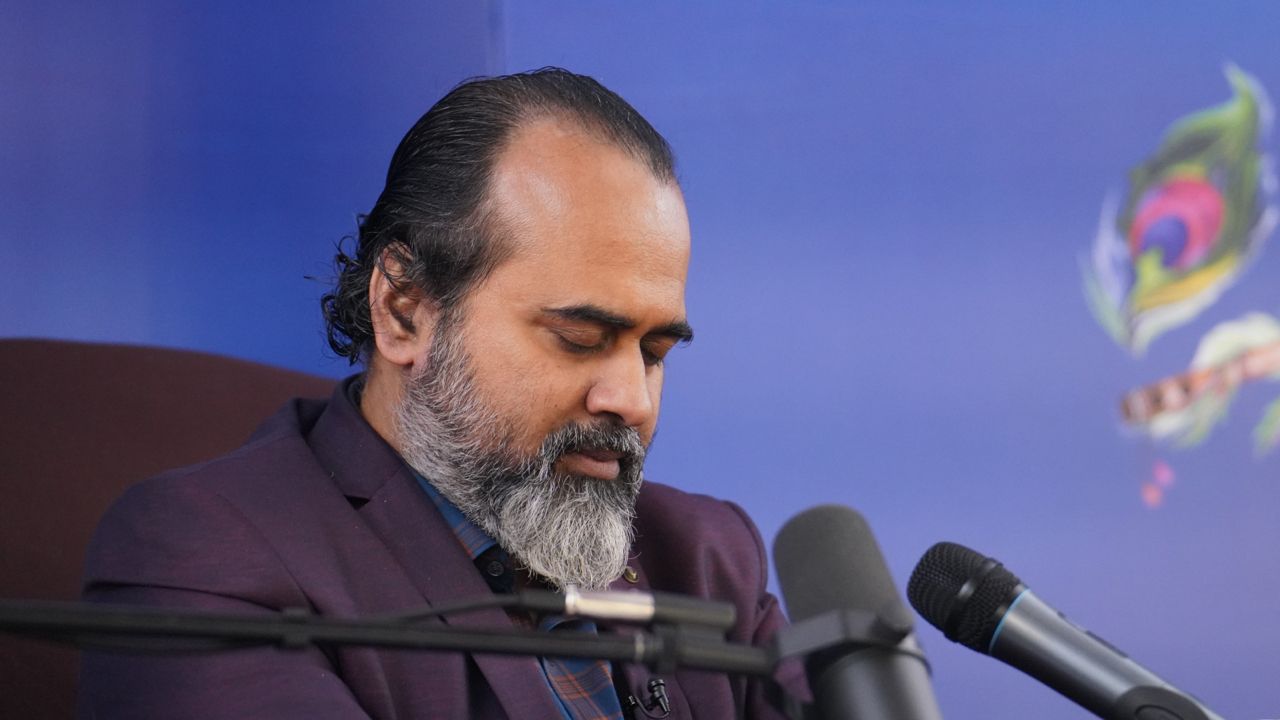
Listener: (Reading a quote of Acharya Prashant from a quote-calendar)
What lies beyond mind?More mind.What is more mind?What and lies and mind.Questions, perceptions on the concept of the mind.
Acharya Prashant: Any question about beyondness would be a useless question because the question itself is coming…