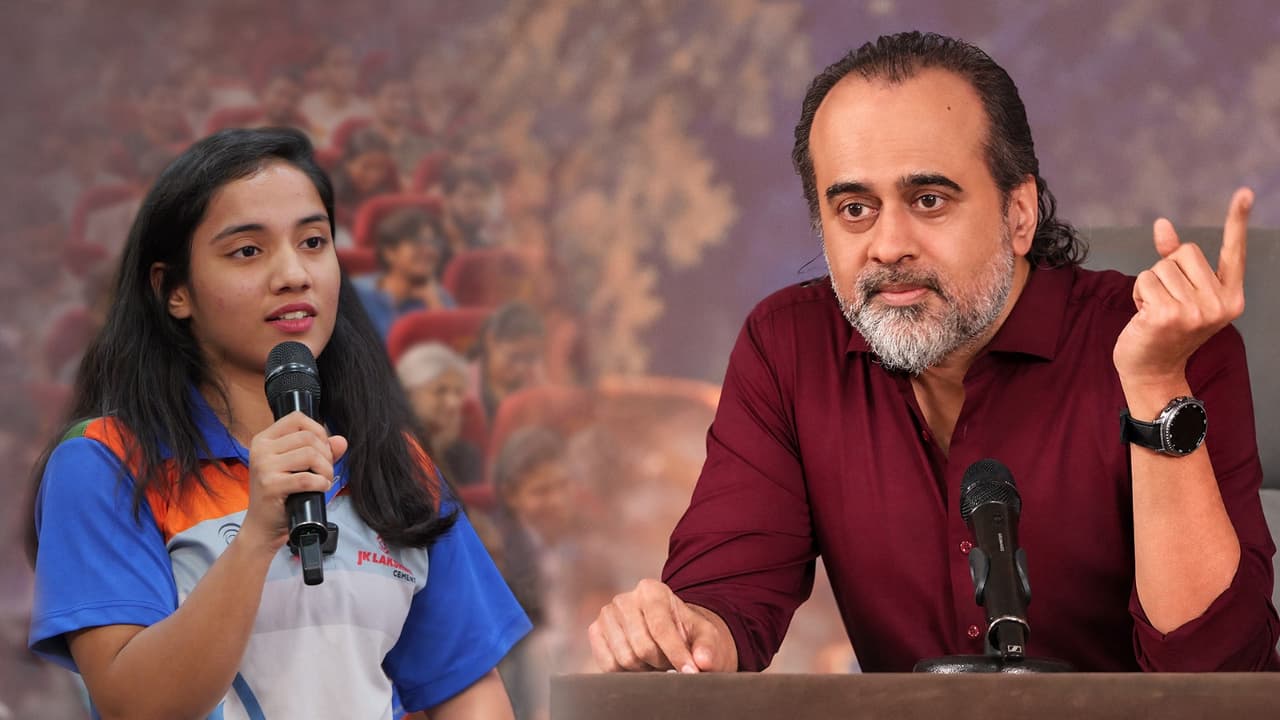
Questioner: Hello sir, I am Pratik. I am a master’s student in quantum technology over here. So, from childhood I have seen science as a very great subject for me. The meaning of moving in life for me was science. Because of that I also took admission in ISC. I have also been part of the Gita community with you for around 3 years.
So I have one question over here. I found that in physics we have inertia. Ego also is very similar. It does not want to change. But if it has to change, it takes the easiest path. The corresponding analogy I can see is the law of least action over there.
In maths also we see that ego has an illusion of choices. It really does not have a choice but it thinks it has some choices. And in maths we try to remove all the paradoxes which we find. In paradox also I see some illusion of choices. In paradox it feels like I can go either this way or this way and I do not know, so I can take any choice as I am standing over here. Because of this subjectivity, I think maths removes all the paradoxes. Science does not talk about ego or something, but still I have a question. Why do we have these two different kinds of curiosities? Why are science and philosophy different?
Acharya Prashant: Because, the inertia that you are talking of are fundamentally different. You tried to set up an analogy and to some extent that is all right. But there is a great difference between the inertial nature of matter and the inertial nature of ego.
When you talk of the inertial nature of matter, what you want to say is that it wants to continue in its state until and unless an external force is applied on it. Resting, it wants to stay in rest. Moving, it wants to stay in continuous uniform motion. That is what material inertia is about, the continuation of one’s state. Whereas egoic inertia is not about continuation of one’s state. Egoic inertia is ontological. It is about the continuation of one’s existence. And for continuation of existence, the ego is always so eager to change states.
Now material does not want to change states. You put this (pointing towards the cup) here and it will stay here unless there is an earthquake or something or somebody picks it up and does something with it, right? It stays here for a long time. That is material inertia.
The ego is always ready to change costumes. Sitting one moment, running the other moment. What happened to material inertia? Nothing. Aren’t you moving the entire day? You change your velocity, your momentum, your shape, your size. People even change their gender. That is egoic inertia.
Everything is negotiable except my existence. Material wants to preserve its state. The ego wants to preserve its being. There is a great difference. So your analogy will not go too far.
Questioner: Sir, then why do we say, in what sense do we say that jad is chetan and that ego and material are the same?
Acharya Prashant: In the sense that the ego thinks of itself as something separate from material, but the ego is nothing but another form of material. The ego is nothing but a property of material. The ego is nothing but an output of a particular configuration of material.
In that sense it is said that that which you call as chetan, which is conscious, is not really different from jad. In that sense it is said by philosophers. That does not mean that the ego itself is material. What you are doing is you are postulating the ego as some kind of material particle, right? And you are superimposing inertial properties on it, which is fine, but not so fine.
Questioner: Sir, actually I was trying to see that ego has some tendencies. So I was just trying to see how the axioms of physics or science which we have are.
Acharya Prashant: The fundamental tendency is existence itself. The fundamental tendency is “Ahamvriti”, which simply says, “I am.” It does not say, “I am stable” or “I am moving” or “the vector points that way.” It simply says, “I am.” And after “I am” it very happily, very deliberately leaves a blank. What is the blank for? The blank is for the sake of existential flexibility. So, to exist, if I need to be silent, I will simply say, “I am.” Now this silence is negotiable. The ego is very flexible with every object, every predicate it has.
“I am X.” Now this X is very variable. The X is deliberately kept variable so that the “I am” can survive. For the “I am” to remain inviable, indestructible, and hopefully eternal, the X is kept as a blank so that according to the need of random situations, the ego can opportunistically fill up the blank.
So, in front of your PhD guide, you are?
Listener: Student.
Acharya Prashant: A student, sometimes a submissive and obedient student. That is fine. X has been decently filled up. In front of your girlfriend, you are?
Listener: Boyfriend.
Acharya Prashant: In front of your mother or your father you are, in front of your friends, in front of a temple, in front of a mosque, in front of your lab equipment; the X is kept variable so that “I am” does not need to vary. So the ego does not try to preserve its state. It tries to preserve its being, existence. So that is why even though it is so intimately linked to material, yet it successfully manages to convince itself that it is the owner of the material and not the material itself.
You never say, “I am the universe.” You say, “I am the observer of the universe.” You never say, “I am this body.” You say, “I have this body.” In both the cases what you imply is that I am separate from the material universe or the material body. The ego is very adept at this sly game.
Questioner: Sir, can this ego be part of our survival instinct?
Acharya Prashant: What do you mean by our survival instinct? Who has to survive?
Questioner: Human beings.
Acharya Prashant: What do you mean by human? What the human being. Is your finger too eager to survive?
Questioner: For example, you gave one example of a rabbit which is curious. So does that curiosity lead him to avoid danger? So it is better for him to stay curious.
Acharya Prashant: What do you mean by danger? Please understand what do you mean by danger? See, the wolf comes and divides the body of the rabbit. Material has been cut into material, and that material body has been absorbed by another material body and has gone in and become protein and calories and other things.
What was the danger in this? Please tell me who has been harmed. Have the molecules disappeared? There were protein molecules or fat molecules in the rabbit's body. Have they disappeared? No. They have simply been reabsorbed by the wolf's body. So, who has been endangered?
The ego. It is only the ego that feels threatened. Nothing happens to the body. The universe has mass – energy permanence. What can happen to the body? Where can mass disappear? But because the ego is linked to a particular configuration of the body, therefore the ego feels threatened. Otherwise nothing can happen to you.
In some sense, the body is immortal. What can happen to the molecules? Nothing.
Questioner: So, it is the very sense of “I”, the ego?
Acharya Prashant; Yes, yes. And let us say the wolf is standing at the rabbit's head and the rabbit is still asleep. Is there danger? You require somebody to perceive that danger. Who is that somebody?
If the body were to perceive danger, then the rabbit would have perceived it when the wolf's body was standing close to the rabbit's body. But no. A particular state of ego has to be the perceiver of the danger. So there is nothing called danger objectively.
Objectively there is just the material changing configuration. All danger is subjective. There has to be somebody to feel the threat, and that somebody who feels the threat is nobody but this ego sense, the self.
Questioner: Sir, like we said that ego is the fundamental tendency. It says “I am” and it wants some X. We also know that ego and prakriti cannot exist separately. They both exist together. And when we are saying that “I am” is the most fundamental tendency, are we not saying that then prakriti would be a subproduct of this fundamental tendency?
Acharya Prashant: A product of… In what way?
Questioner: Sir, like in some of the sessions you have said that “Aham hi prakriti ko janm deta hai.” Material is the essence of…
Acharya Prashant: No, no.
Questioner: Actually, the more I go deeper into myself, I have held this question very closely in my mind or heart, and I am not able to leave this question. You are giving me some…
Acharya Prashant: Existence. What you call existence is always subjective. There has to be somebody to say that the suns and the moons and the stars exist. So yes, ego is needed to experience all this. But that does not mean that the ego is the originator of all this. Please go back to the laws of duality. The two ends of duality are not originators of each other. What do we call it? Sam-utpād. What does sam-utpād mean? Questioner: Exist together.
Acharya Prashant: Coexistence. And not just coexistence. Dependent co-origination, pratītya-samutpād. Dependent co-origination. So you cannot say ego is the mother of prakriti. No, they co-originate, and therefore both are false. Both are false because that one cannot exist without this (pointing towards oneself) one, and this one cannot exist without that one. And this feeling that both are real, “I am real and this universe is real,” “I am real and the creator of this universe is real,” this feeling is all human suffering.
Questioner: Yes sir. So like the suffering we talked about. I have kind of held this question very close to me and it has kind of, like we were talking, that we have to release our burden. We have to become light. I thought, okay, this is my meaning. Now with this question I will get more understanding. And now I see that I have made this question a burden on myself. And because of that I could have many more things to do.
Acharya Prashant: No need to drop questions. Please. That is not implied at all. Beliefs you anyway carry, and a question is your attempt to shed light on the belief. Drop your question only when you have dropped the belief as well. You cannot say, “I am carrying belief but want to drop the question.”
The questions actually should have no permanence, right? And questions do feel like a burden, right? But please do carry that burden because you are already carrying a belief. Questions should disappear only when beliefs do. As long as beliefs are there, please do not drop the questions saying that they feel heavy.
Questioner: Sir, but it is very difficult to find the belief. The things I told you, the questions I asked, I am not able to find.
Acharya Prashant: Then gain more exposure. Go to places where people follow different beliefs, or meet people like me who are always ready to wrestle with beliefs, right? Or read. There is the entire wisdom literature of the world available, and they will challenge your belief.
See, belief is like a wound. Often it will not make itself felt unless it is touched or pressed. So if you say you cannot detect your belief, then the way is to roll on the ground, or jump into a pool, or wrestle with someone. When you wrestle with someone, your sore spots start showing up and crying, don’t they? Right?
So beliefs you are carrying, but because you have become accustomed to them, hence their existence is not experienced. Otherwise, what we call the self is nothing but an organized mass of belief. That is all. It cannot feel itself because we feel only suffering. And when will belief suffer? When it meets the opposite belief.
That does not mean the opposite belief is true, but at least there would be some suffering. So you believe, for example, your God is green. Go and meet people who believe their God is blue. Now you will know you are carrying beliefs, because as long as you are with people who all feel that God is green, your beliefs will not pain, because everybody believes God is green. So you must travel. So you must read. So you must talk, especially with those who do not carry the same cultural baggage. And then they will insist with equal force that God is blue, and then your beliefs will hurt. And then you will know, yes, I am carrying belief.
Questioner: Myself, Somendra, and currently I am a second-year student. Sir, I have this question regarding superstitions. Before the question, I am assuming that a superstitious person who is involved with science in any way is better than a person who is in general superstitious.
Acharya Prashant: Superstitious and also unscientific.
Questioner: Yes, it can be said. So now the question is, if me being a student of science, if I am involved in superstition and that superstition is giving me a sense of belief, and that belief is helping me in pushing harder and harder to do good and well in life in the way which you say, or Vedant say, whatever the norms are, not as per society but as per the thing that we actually do; then what is the problem with superstition?
Acharya Prashant: This is the superstition, that arising from a point of ignorance or belief, still helps you do something good in life. And this is the most commonly forwarded argument, that by being superstitious we are actually able to do some good things in life.
We are able to have courage. We are able to have faith. We are able to stand through tough times. That is what people usually say. But that is flawed, very flawed.
Questioner: Sir, like an example. When I go to the lab, I do my research and all things. After that, one of the panelists also mentioned this. Then when I come out from the lab and go and play sports or do music or whatever I do, then in those things, if there are some aspects where I do something like before playing I chant for five minutes so that I can gather my mind in this game and do well, that actually helps me. So if I am doing that, then what is the problem with this?
Acharya Prashant: The problem with this is that if at all it helps you, let us say it does. Because the mind, being a machine, there can be efficiency improvement measures. For the time I am accepting that chanting does help you become more efficient and focused at what you are doing. The problem with that is that you will become more efficient and focused at whatever you are doing.
Questioner: Yeah. Whatever might not be possible.
Acharya Prashant: And whatever you are doing is very dangerous. There are people who have used these kinds of practices, neuro-linguistic methods, tricks and techniques for all kinds of obnoxious purposes. In fact, let me say all these things, the entire range starting from self-help, self-improvement, to programming the mind, to doing this, including chanting also, all these things are used mostly in the service of the ego.
I want to be a better negotiator, so I will enter the negotiation hall after five minutes of meditation. And what is the negotiation about? Furthering my greed. Furthering my greed.
Even in war zones, where outright butchery is happening, soldiers are often given not just these mental methods. Even physical methods exist. There are pills that are given. There is the name of the pill that was given to the German soldiers. The name starts with M.
Listener: Methamphetamine.
Acharya Prashant: It helped them stay concentrated, feel blissful, stay awake for long periods, and also go without food. Now this sounds almost yogic, does it not? But what was all that for? Go and butcher the Jews.
Questioner: But that is not superstition. That is logical. That is biological.
Acharya Prashant: No, no. That is superstition because whatever comes to the service of the ego is superstition. Mind you, ego is the fundamental superstition, and anything that assists the ego is superstitious.
You are saying “good things”. Now that goodness itself is being defined by the ego. You are saying, “I use this so-called spiritual practice and that enables me to do better in whatever I am doing.” Right? Whatever you are doing is being decided by the ego. So basically your spiritual practice is in service of the?
Questioner: Ego.
Acharya Prashant: Ego. That is the problem.
Questioner: Yes. Thank you, sir.
Acharya Prashant: Be very cautious when it is said that by using this spiritual method you will become good at whatever you do. Because whatever you do, that “whateverness” is your hell. The question is why you do whatever you do. That is exactly the problem. We do all kinds of nonsense. And then that Baba comes and says, “I will make you better at whatever you do,” and we like that. “Okay, okay, fine.” Gita for corporate productivity. This is evil.
Questioner: And sir, its not some beacuse of baba, i myself…
Acharya Prashant: We do not know where it comes from. Maybe you did not directly hear it from some Baba. See, that is the power of cultural conditioning. You need not hear it from a particular mouth. You need not read it from a particular book.
The lady, what she is saying is coming straight away from some of the **Smriti books. Have you ever read them? She has not read them, but she is verbatim reiterating those things. She has never read them. That is the power of cultural conditioning. The whole thing then penetrates the air even without your knowledge. The influence penetrates you. So you may say, “No, no, I have not heard it from somebody.” De facto you have.
Questioner: Yes, maybe indirectly.
Acharya Prashant: Indirectly, yes.
Questioner: Thank you, sir.