True God is the Truth right now in your heart. That is true godliness, true bhagavatta. The problem is that people want to avoid the real living Truth in their heart. Therefore, they come up with stories that place an imaginary God somewhere up in the skies. God is wonderful, but the stories and the imaginations about God are all very disrespectful towards God. When there is love for God, God is held very close to the chest, and that God is called Truth. That God is the very purpose of philosophy and the very origin.

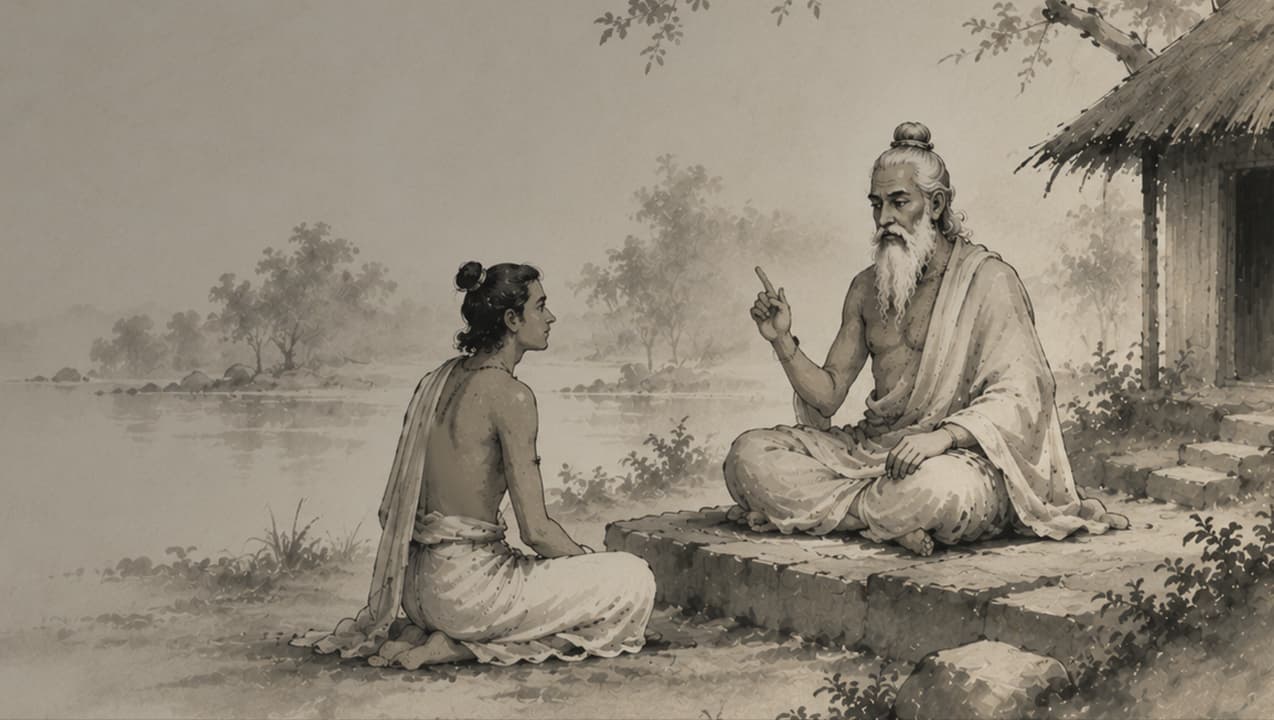
Science can examine material claims, but Advaita Vedanta deals with the subjective self, ego, suffering, bondage, and liberation—areas outside science’s objective framework. Vedanta need not be accepted because of one’s religion or tradition; its value lies in whether its insights can be personally verified and help free one from suffering. The ultimate responsibility is not toward any philosophy, but toward oneself: to live a truly free life.

Superhero films appeal to our desire to escape inner inadequacy through external power. The fantasy of an ordinary, fearful person becoming extraordinary reinforces the ego’s belief that more strength, money, possessions, or status will bring happiness. Consumerism follows the same pattern, endlessly adding objects to fill an inner void. Real freedom does not come from becoming more powerful or acquiring more, but from honestly seeing and understanding the ego that feels incomplete.

Questioning pseudo-science and superstition is the first step toward genuine freedom. Beliefs such as *Vastu, Kundli,* and *Muhurat* should not be accepted merely because they have been followed traditionally. Fear and attachment to privileges often prevent people from questioning authority. A truth-seeker must be willing to challenge age, status, and authority. Human progress has come through curiosity, inquiry, experimentation, and reason—not through blind obedience.

Desires and beliefs may keep changing, but the deeper tendency to believe, think, choose, and seek fulfilment often remains unchanged. Real transformation begins by examining this constant inner pattern rather than changing superficial preferences. Instead of seeking conclusions about greed or desire, honestly observe recurring behavior and support the truth you already recognize. Expressing that truth can dissolve false identities, relationships, and habits, creating space for genuine change.
Climate change is more than an environmental crisis—it is a crisis of human choices. Our patterns of consumption, consumerism and endless pursuit of more are putting increasing pressure on the planet. But meaningful change does not necessarily begin with new technology or stricter policies. It begins with a deeper question: what are we willing to change within ourselves?

Modern life is increasingly driven by materialism, social validation, and the desire to impress, leaving authenticity behind. When image becomes more important than substance, relationships, education, and success turn into performances rather than expressions of truth. Real transformation begins with inward honesty—the courage to stop seeking approval, confront inner emptiness, and choose authenticity over appearances, imitation, and external validation.

What is the relationship between quantum physics, consciousness, and the ego? This dialogue explores where scientific inquiry ends and self-enquiry begins. Through Vedanta, Acharya Prashant explains why the ego clings to its own existence, how beliefs and superstition shape our lives, and why lasting freedom lies beyond conditioned thinking.

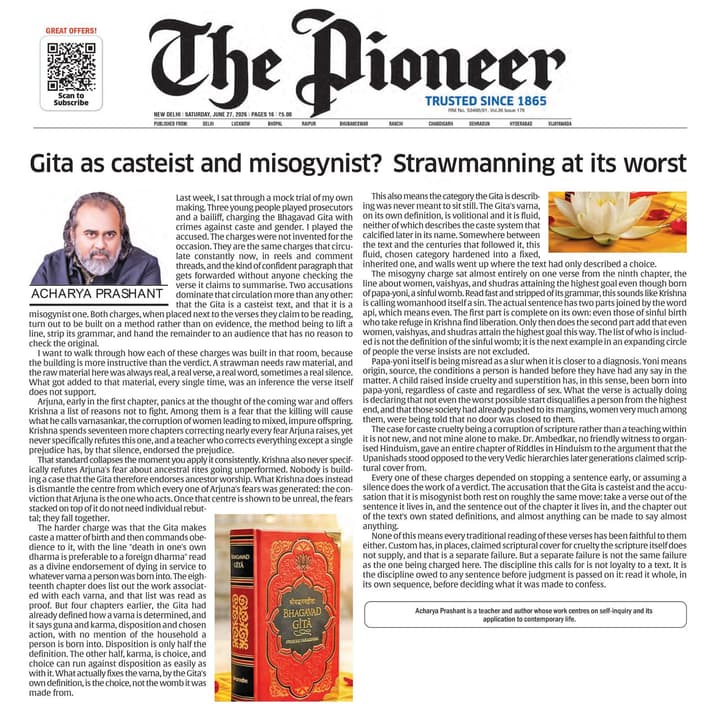
The Bhagavad Gita is often accused of supporting caste and misogyny through selective quotations that ignore context, grammar, and the text's central teachings. A closer reading shows that its emphasis is on inner qualities, conscious action, and spiritual equality rather than birth-based hierarchy or gender discrimination. Misinterpretations arise when isolated verses are detached from their broader meaning, while the Gita consistently points toward self-knowledge, freedom from ego, and the universal possibility of liberation for every human being.

Science and philosophy arise from different kinds of inquiry. Matter seeks continuity of state, while the ego seeks continuity of existence and constantly changes identities to preserve itself. Fear, danger, and suffering are rooted in the ego’s sense of “I,” not in material reality itself. Questions are valuable because they expose hidden beliefs, and genuine learning requires challenging assumptions through inquiry, dialogue, and self-examination.

The climate crisis is not merely an external environmental problem but a reflection of inner human greed, desire, and psychological disorder. Drawing from the Gita’s idea of yagya as desireless action, it says real ecological healing requires inner transformation. Outer pollution, exploitation, and destruction mirror the ego’s inner confusion, making personal consciousness and planetary health deeply inseparable.

Many so-called spiritual practices falsely promote intoxication as a path to higher consciousness. In reality, this only deepens confusion. True spirituality is about clarity and self-understanding, not external experiences or blind belief. Neither gurus nor media can offer truth. It must be discovered within by honestly observing and rejecting inner falseness, with awareness and sincerity.

Global conflicts stem not from geopolitical interests but from the ego's fundamental incompleteness. Nations are merely expressions of collective egoic consciousness. Leaders represent humanity's worst tendencies, not its average. The ego requires duality and boundaries to survive. True disarmament means detoxifying the ego itself. External wars reflect internal disturbance. No diplomatic solution addresses the root cause, only wisdom and self-knowledge can dissolve the ego's need for conflict and separation.
Question: A gentleman was saying that a person, who is drinking or is drunk, he still has got some kind of stability on mind, and he too, can judge. That is what I felt to be perhaps wrong. A person who is drunk probably loses his judgement and whatever we…

Mojud – The man with the inexplicable life
There was once a man named Mojud. He lived in a town where he had obtained a post as a small official, and it seemed likely that he would end his days as inspector of weights and measures.
One day when he…

The only principle that truly runs this world, created by all of us, is the principle of greed and power. What do you think that fellow has earned his billions for? He didn't become a politician to be noble. The only thing that separates us from animals is the intellect, not the center the intellect is operated from. Don't locate the problem and the responsibility somewhere out there. We change ourselves; the world changes.

The world is a crooked place. You will have to be zig-zag, tangential; that is the nature of the world. Realization of crookedness is the only straight thing possible. If you want to become straight, let yourself be crooked. Once you know that the straight One, the innocent One, is sitting in your heart, then you no more feel the need to display a fake straightness. Now you can get rid of all morality. Whatever you are doing is coming out of your love and compassion or just enjoyment.

Superficiality offers pleasures. Superficiality offers cheap salvation. Therefore, it is easy to be attracted to superficiality. On the other hand, true spirituality challenges you to pay a heavy price. So, you see, all this knowledge has existed since antiquity. Yet there are people who do not want to read the Gita.

Questioner: All the forms of multimedia, the film industry and advertisements, have presented images of both sexes that are very often unrealistic and debatable. The very quality of femininity has been portrayed in the film industry, ironically, as victimizing them, merely pretty faces, and sidekicks. Why do you think women…

Ignorance is not about not having some particular knowledge. Ignorance is not an absence; ignorance is having knowledge. That which your mind is full of is ignorance. Ignorance is your basic sustenance. In such a situation, this utterance, “In reality, you are the One,” I repeat, must not be taken as the Truth in the sense of an affirmation. It is a method to help you drop that which fills you up. All it is telling you is this: “You are an entire universe sitting in your mind; you are not that.”

The universe does not care for any human being. The universe is a very, very neutral place and a very random place. We are all products of randomness. Do you get this? The universe is not going to have any specific intention towards a specific individual. All that we are experiencing is episodes and events of random distribution. That’s all. Please understand the philosophy.

There is no revolution possible without the Gita. That’s the reason why even those who are not remembered particularly for their spiritual inclination, people like Subhash Chandra Bose, even they founded their core on Gita. What kind of revolution can you do if it’s the body that’s always at the top of your mind? You require a Gita to tell you that this body is perishable and would anyway go. Gita only teaches you, "Endure and fight."

There can be no self-respect without self-knowledge. And we have been repeatedly saying that the ego survives only in lack of self-knowledge. The less you know yourself, the denser and more crystallized your ego is. Self-respect is nothing but self-awareness. The more you know yourself, the more you realize who you are not, and that brings you to who you are. That is real self-respect, knowing oneself.

Shri Krishna is saying: the mind is conditioned to move towards objects and perceive only their surface, periphery, or form. Develop the practice of penetrating further. Let Truth be your practice. The moment you would look at something, and you are in no position not to look at things being embodied, you would look at things. Nobody said that you have to practice lust. Lust just comes. You might be a total fool, an utter retard, and still you will find yourself getting sexually excited once you reach a particular age. Did you need some practice? No, you didn’t. It just happened. But if you are to understand lust, if you are to cross over, if you are to be a master of your body, then it will require a lot of practice, and that will necessarily and obviously tell you about your predicament.

Beliefs can’t talk to each other. You will say, ‘The world was created on a Sunday.’ He’ll say, ‘No, on a Monday.’ He’ll say, ‘Tuesday.’ He’ll say, ‘Wednesday.’ Now talk, how will you reconcile this? You can only fight. Why do you need to believe? You look at the question, "What should I believe in?” Well, nothing.

Every living being, from humans to the smallest species, is trying to change the world to suit its own needs. But this is not intended to do any good to the world, it is just coming from the little ego. And the ego will not say, “I'm not all right;” it will try to change the world. So, if your idea of ‘good’ is only relative to your personal self, is it right to impose it on others? You must be clear about why you aspire to change the world, and whether you have brought about any change in yourself first.

If you are in charge of a kid, then you have to be very sensitive, very careful, and loving. Just being with the kid in a loving way, not even having planned what to teach him, is sufficient. Instead of teaching kids, I have been learning from them, and they have given my ego great lessons by exposing me. No kid needs any training; we need de-training.

Drop the center of confusion, come to the center of clarity. Drop what the masses practice, come to the direct route of self-realization. That’s what it means.

Spirituality is not belief. Please, please. In fact, spirituality is constantly sniffing for belief. And if I smell belief there, I’ll come hunting. Spirituality is the unrelenting enquiry into all beliefs in life. “Why am I living on imaginations? I want to question.” Enquiry does yield results, but it requires honesty. If you honestly look at yourself, you’ll discover there is a reason why you are irritated. In the absence of honesty, belief is the crutch.

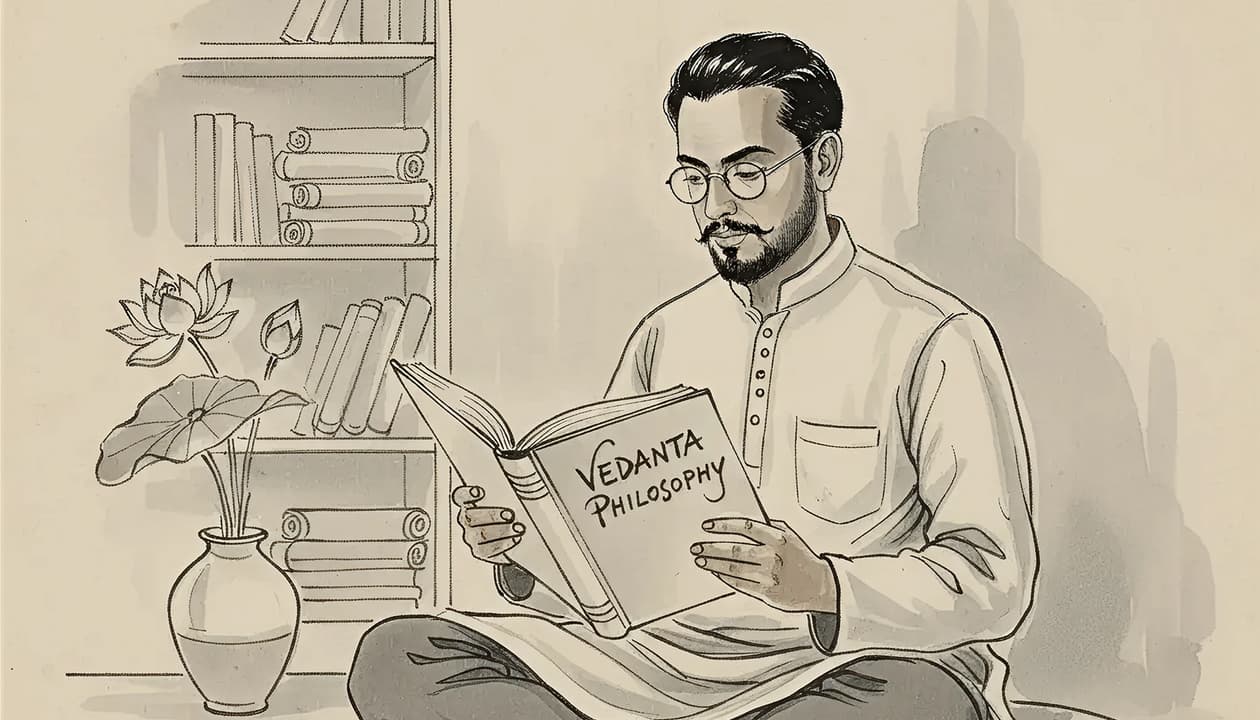
Joy is not a problem. Suffering is a problem. I am the sufferer. And if this ‘I’ is the problem, the sufferer, then firstly the ‘I’ itself has to be approached. And when I find that my efforts are getting saturated, I will have to go to a book that talks exclusively of the ‘I.’ The Upanishads are such books, because their subject matter is nothing but the ‘I.’ So, if you come across something that is dealing in stories, beliefs, and deviating from the self, you must know that it is not Vedanta at all.

The theoretical reply would be that if condemnation hurts you, then somewhere you are looking for praise. Even if it’s implicit praise or subtle praise, there is some hunger for praise. Or the inner condition that the ego has set is, don’t give me praise, but don’t condemn me either. So there is some condition that the ego is setting on the world. The fact is, the world has a movement, a flow of its own. You cannot set any condition on it. If you are getting hurt, it means there is an expectation, a condition.

Prasad is what you get by being in contact with a luminous source. You are close to the Bhagavad Gita, there are insights, you start living those insights, others look at you and see something special, something luminous, and feel inspired — that is prasad. There is a certain realization, and you want to share it with everybody — that is prasad. Your own inner illumination is prasad.

At the level of the body, this world will have an influence on you, and there is no need to even contest that. Let it happen, because it is going to happen anyway. But inwardly, let there be a place so sacred that nobody is allowed to enter — not even you. And when that is there, you can freely participate in the world because you'll no longer be afraid. You'll say, “Come what may, I'm secure within.” Then you will live in deep security, and we all know how pleasing security is.

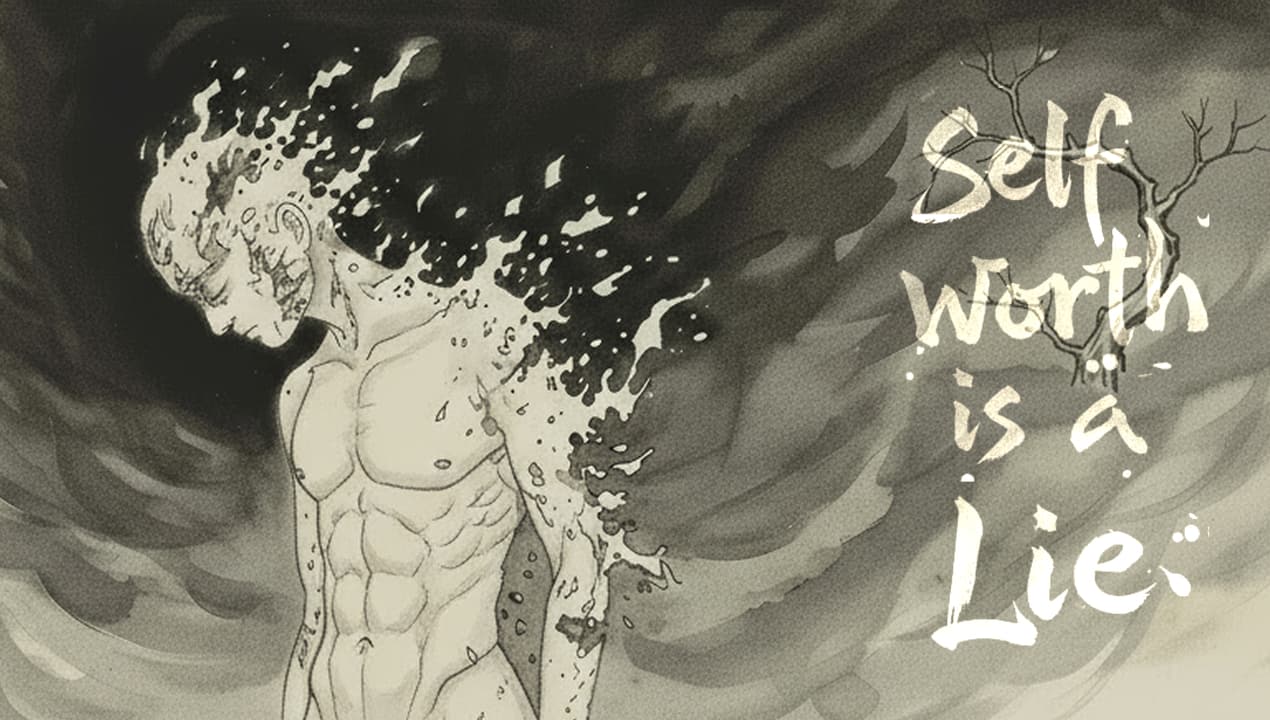
The self is a hollow, incomplete thing by its own admission. It has no free existence of its own; it is nothing but associations with the objects around it, absorbing its worth from the environment. To hide this absence of self-worth, you keep running after all kinds of things, yet the promise of fulfillment is never kept, and you are deceived. Therefore, to have any self-worth, you must have clarity about the self. All wisdom literature is about clearing away your false notions of the self.

When it comes to social media, hardly anybody is in charge. Now the mischief maker is faceless, anonymous, because there are just so many of them that you cannot call out or point out one single face. You cannot regulate so many people, and you cannot have laws that punish people for their intentions. The only solution then is individual responsibility. Vedanta has to become a part of mainstream education. There is nothing more important today than awakening the individual.

Question: If love is death of ego, then how will we live? Man is made of only these things. So, the only thing left will be ‘soul’. So we can say that we have moksha (liberation).
Speaker: The question is: If love is death of ego, then a loving man…

Questioner: If love is death of ego, then loving man will be just soul. So, is love Moksha (Salvation)?
Acharya Prashant: Everything that you just said, is a concept in your mind. Ego lives on concepts; ego lives on thoughts—concepts are thoughts.
What is the definition of a concept? Where…

The worldly philosophy says, “Even if you lead a corrupt life, at the last moment you utter ‘Ram, Ram’, and you are redeemed.” I say just the opposite. Even if you have lived a life of wisdom, you can still lose it in your last breath. Even your wisdom requires a supporting and nourishing ecosystem. You can never afford to be complacent.

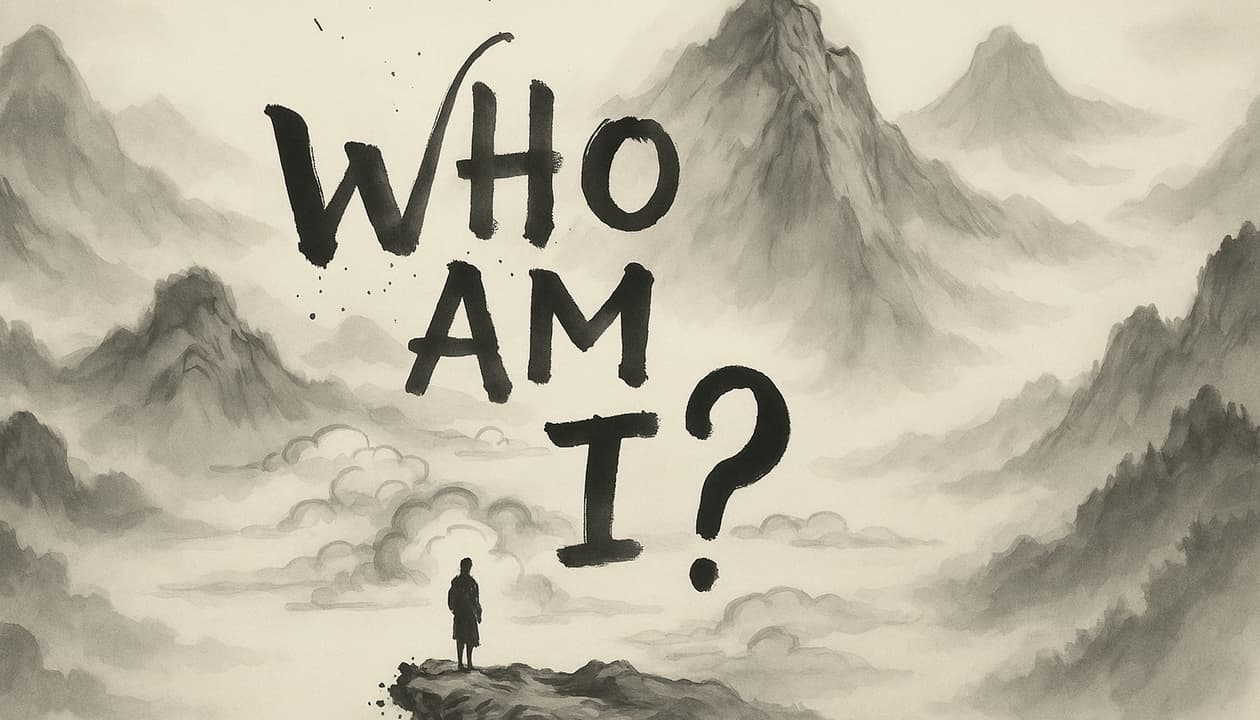
You are the quality of your present action. You are, right now, attention itself, if you are indeed listening to me. Unfortunately, this identity won't last. Soon you will be distracted. You'll become somebody else. The discipline lies in holding on to the highest identity possible, that which you know to be the highest, given your limited capacity. That's who you should be. That's the answer to — ‘Who am I?’

Real spirituality is actually a shameless path — not something that sounds elevated or admirable. In contrast, conventional spirituality or ‘Lokdharm’ feels poetic and enchanting — romantic mysticism. The most common statements are often the ones that deserve your scrutiny. Whenever you're bombarded with high-sounding fluff, ask: “What exactly do you mean by that?” Expect answers rooted in bare facts, not in abstractions, idioms, or euphemisms.

Do the right thing before you can be a non-doer. You are anyway used to doing, and you have been doing all the wrong things. Now that you have been doing the wrong things, wake up to your power to choose, your right to choose, and do a few things right. And then you will slowly discover that you don’t even need to do. That is called ‘non-doership.’ For choicelessness to descend upon you, at least first make good choices.

The wish remains unfulfilled because that which we want by extending our dead life cannot be had through extension. It can be had only through termination of the dead life. So our ways are stupid. That which must be terminated is rather extended by us. We need to give death to death. This dead life needs to be brought to death, and then you will give death to a dead life, death to death, which is good. Instead we keep trying to prolong the dead life. And if you are prolonging a dead life, you are only prolonging the death that you are living.

As young people, we mistakenly take tradition to be the Truth. Tradition tells you in advance, "This is important," and you believe it. This has to stop. You must question, inquire, and experiment. Because if you have readymade definitions of what is important, then you will never come to what is truly important. And when you independently inquire, a lot of unimportant nonsense disappears from life, and fresh space is revealed. Now, through your own discretion and wisdom, if you decide that these things are indeed important, then so be it.

In the universe, there is no good, no evil. Ask instead, ‘To whom is good, and to whom is evil?’ The self, the ‘I,’ the ‘me,’ the one who wants to define good, the one who wants to define evil — he is evil, because he does not exist. Spirituality is giving the evil something right to do. If you do not give the evil the right thing to do, it will pick something else, making itself feel relevant, whereas the fact is that it has zero relevance. Work to remove yourself. That's your task.

Realization is your essential nature, and that nature means nothing. That nature is neither solid nor liquid. That nature is not hot nor cold. That nature is not beautiful, not ugly. That nature is not expansive, not limited.

You are promoting belief, and religion's mandate is to demolish belief. Religion's mandate is to promote inquiry. But as your example suggests, that has never really been the case. First of all, religion gets into all kinds of worldly things. Who made the rivers? Which tree is sacred and which tree is not? What to wear? Where to sleep? Whom to marry? What to eat? Religion gets into all these things which are none of religion's business. True religion is just an inquiry into the ego, the self. "Who am I?" That's religion.

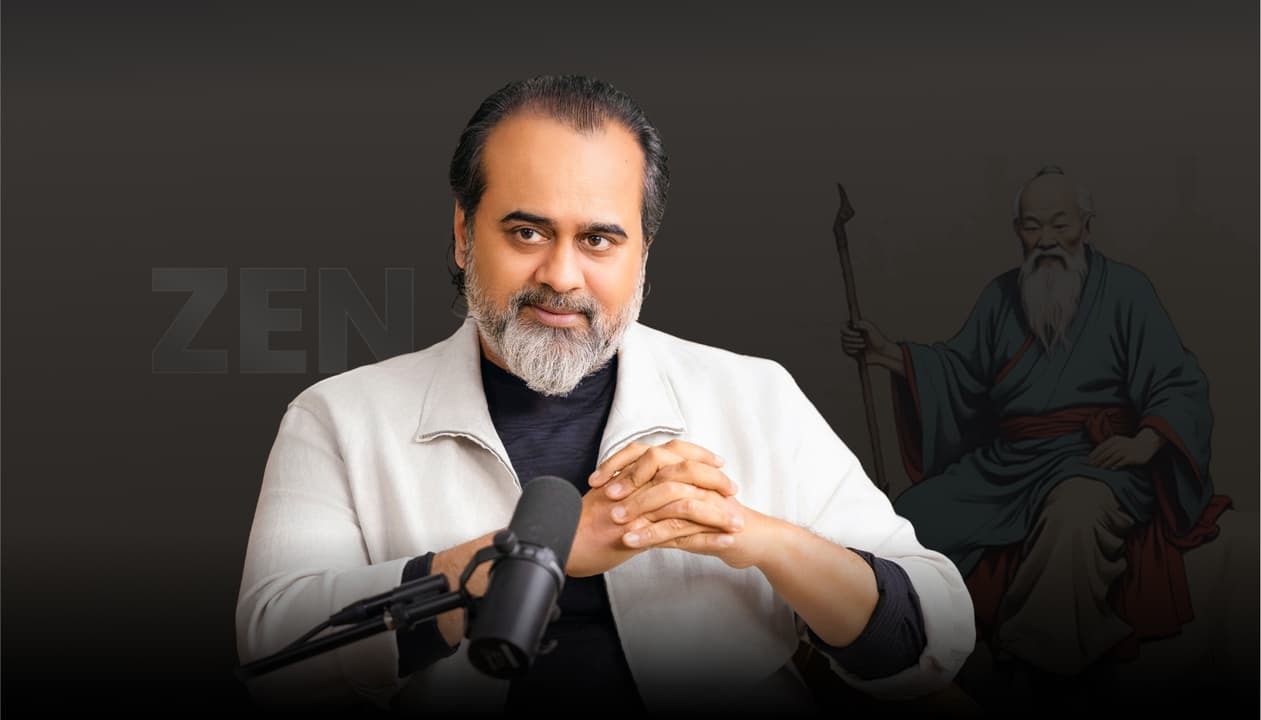
In Zen, the student asks a question to the master, and the reply brings sudden enlightenment. It means something had long cluttered the mind, and in one deft stroke, like a genius, the master cuts the relationship between the ego and its belief. What Vedanta does through persuasive argument, the koan does through an abrupt shock.

A dirty plate is a dirty mind. It is carrying traces. It is carrying stuff from somewhere else. Go clean the plate. If your plate is clean, if your mind is clean, what is left to be done? But cleaning the mind, making it lighter, comes like a threat. “Oh! Something in me is getting reduced. I am under attack. My notions are getting shaken up.” That’s what Zen is all about, a total shake-up! Such a shake-up that clears away all the rubbish.

So many books and gurus have created a very wonderful image of the enlightened one, and it is a totally unrealistic image. There is no scripture worth the name which gives any image of enlightenment. The realised one lives a very ordinary life, simply in the ‘facts.’ There is no spiritual or religious duty as such to become enlightened. No, not at all. You can be shamelessly unenlightened, and that is enlightenment.

Overview
Fighting Duryodhana is Dharma. Fight Duryodhana in the way you can, that is swadharma. Dharma is the same for everybody, but swadharma varies according to your physical, social, temporal conditions.
But remember that swadharma can never be in contradiction of Dharma; swadharma will always be something…