Acharya Prashant: We are starting this new series, “Wisdom from the World,” which will allow us to look at wisdom literature from all parts of the world and all times, irrespective of their place of origin, culture, history or identity. So we'll be able to take up Zen Koans. We'll be able to take up Sufi mysticism, Christian mysticism and, closer to our times, existential stories. These plays will help us widen our perspective.
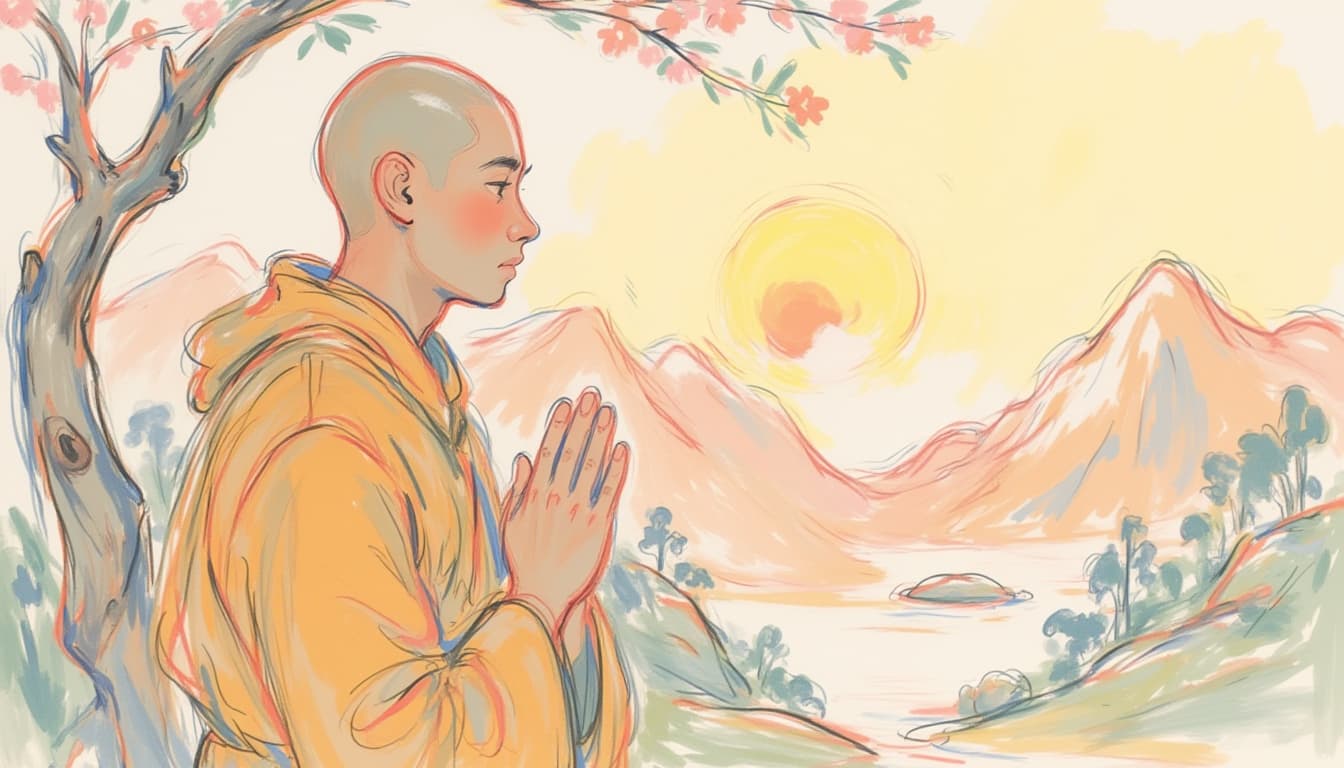
So we'll start with koans today. Koans originate in China. Buddhism reaches China from India and emphasizes direct meditative observation. And that dhyāna becomes chán in Chinese. That was also after its interaction with the revealing tradition of Daoism there. From China, this chán travels to Japan and becomes Zen.
So, there is Buddhism in India. Buddhism travels to China, becomes chán, and then travels to Japan and becomes Zen. In Zen, there is a particular Rinzai school, named after the teacher Rinzai. This Rinzai was a very peculiar teacher actually, and Koans are attributed to him. The beginning of the Koan stream. Though, in time many big names got associated with it.
So, Rinzai was known for shocking his students out of their egoistic slumber, and Koans are a form of spiritual innovation. So, what Rinzai innovated was a method of shock. His method of shock would go to the extent of shouting at his disciples or even beating them up. So Koans are the verbal counterpart of the shock methods of Rinzai. They shock the mind into getting out of its usual patterns. The mind is a flow. Koans are meant to challenge the very fundamentals. The very fundamentals, right?
So, for example, you will say, "This is my face. That is your hand. Stay away. This is my face. That is your hand. The two of us are different.” And this looks entirely sound logic: My face, your hand. A koan would very innocently ask, "What was your face before you were born?" So that which looks unchallengeable is challenged by the koan, and that too with a lot of insouciance, a lot of childlike innocence. "What was your face before you were born? Please tell me." And then the koan would proceed to say, "What was your parents' face before you were born?"
And here you feel like rushing to say, "Well, my parents had a particular face, and I have seen that face in pics, and that existed even before I was born." The koan would want you to think about it. Getting it? So, that to which Vedanta comes in a philosophical and analytical way — Koans come in a poetic and abrupt way. After a long line of refined logic, very refined logic.
For example, the Upanishads will say, ekam eva advitīyam. The second really does not exist. And the koan would simply ask, "What is the sound of one hand clapping?" Yatra yatra mano yāti, tatra tatra samādhayaḥ. That is the highest thing. That wherever you are, that's where the Truth is.
And how would the koan put it?
The disciple asked the master, "What is the Buddha?" And the master said, "The ground under your feet." A very famous koan is, "Does a dog have Buddha nature?" And the answer to that is silence. But the master does not remain silent. He says, "Mu, mu."
And what does “mu” imply?
That the depth of the answer is far beyond the scope of your little question. Your question cannot accommodate the answer. And that is “mu.” There is no way an answer can be given within the narrow paradigm you are asking the question. That is “mu.”
So “mu” is a “sound for silence.”
The Upanishads — the Kena Upanishad puts it more philosophically. They would say, when the teacher is asked, "What is the Truth? How to reach it?" This is the most beautiful part of Kena Upanishad. The teacher says, na tatra cakṣur gacchati, na vāg gacchati, no manaḥ "The eyes do not go there. The ears don't, nor does the mind." So there is no way that can be reached or touched or described. That implies the Truth.
In Zen, in Koans, the answer is a very brief “mu". And because it is very brief, it stuns, it shocks. It leaves you speechless. So repeatedly you find the mention that the student asked such a question to the master, and the master replies. And that reply is a Koan. And the reply resulted in sudden enlightenment for the disciple. Sudden enlightenment.
What does sudden enlightenment mean?
That there was something that was clouding, cluttering the mind for a long time, and the disciple was unable to get rid of it. And in one deft stroke, like a genius, the master was able to cut the clutter, cut the cord of illusion, cut the relationship between the ego and its object, the ego and its belief. That's the Koan.
What Vedanta does through a lot of persuasive argument, the koan does through an abrupt shock. It shocks you out of your illusion. It leaves you suffocated. You are left crying, craving for an answer to a question that defies logic. In the process, you see that what you call as obvious facts, and then proceed to live on them, are just mere beliefs. And that is the very problematic limit of logic.
All logic is based on propositions, and propositions are often just assumptions. Often just assumptions.
Let's look at a few koans. I asked ten or more interesting ones to be compiled, and here is this list. Which one do we begin with?
So let's begin in the typical Rinzai way.
The fifth one: The elder Ting asked Lin-chi, "Master, what is the great meaning of Buddha's teachings?"
Ting here is the disciple, and he is asking Lin-chi. And it is a perfectly legitimate question, a very sincere question, politely asked, "Master, what is the great meaning of Buddha's teachings?" We would expect any teacher to appreciate such a question.
But what do we get here?
Lin-chi came down from his seat, slapped Ting and pushed him away. And what has Ting done? Just asked, "What is the great meaning of Buddha's teachings?" and he has been slapped and pushed away. Ting was stunned and stood motionless.
This moment of receiving an electric shock is very central to the koan method. Ting was stunned and stood motionless. A monk nearby said, "Ting, why do you not bow?"
This is usual practice, politeness, decorum, mannerism to bow to the master. When you receive an answer, you ask a question, and if the master answers you, you're supposed to bow. But Ting has been so badly stunned that he has forgotten the protocol. And at that moment Ting attained great enlightenment. This is the koan.
And with the usual conditioned mind, you'll not be able to make much sense of it. What is happening?
Here you are Ting, thinking of yourself as a student. You think you are a student. But had you really been a student, then all that you act like being a student would have been very central to your being. If I am a student right from my core, then all my actions that I display as being those of a student should be spontaneous. Should be very spontaneous. Right? Never optional.
But here, see, one push, one slap, and you forgot all decency, all politeness. You just stood shocked.
What does that mean?
That being a student is not your primary identity. Being a student, or even being Ting, is just something that you are wearing over yourself. And that which you are wearing over yourself is exactly what has been slapped and pushed aside by the teacher.
Please understand.
So Ting is asking, "What is the core of Buddha's teaching?" And the master says, "This is the core of Buddha's teaching — that all that which is false must be slapped and pushed away." And whatever Ting has become, whatever he thinks of himself, whatever his personality is, whatever his identity is, all that is just false. And that is exactly what the Buddha has taught.
Whatever you think of yourself deserves to be slapped and pushed away. And that's exactly what I did. And when I did that, I was proven right. Because when the student was slapped and pushed away, the student ceased to be a student. The proof is that he did not bow.
Had the student been really inexorably a student, irreversibly a student, choicelessly a student, he would have remained a student even in his death. Even in the moment of his death, he would have still not forgotten that he is a student and would have continued to show the usual cultural obedience and reverence to the teacher.
But you see, whatever you think of yourself is just like the courtesy of bending and bowing to the teacher. It is a thing of the mind. It is a thing of memory. It is a thing of convenience. It is a thing of conditioning. And that is what needs to be slapped and pushed away. And that's the Buddha's teaching.
So koans, in that sense, become more experiential than just analytical. Analysts require time. Koans do not give you time to analyze. They are like a bolt from the blue. You are hit, shattered, before your defenses can get activated, before your logic can become a shield, an armor, and protect you. The master just suddenly sends something your way and you are unprepared. And he says, "Watch.” Getting it?
The same thing Vedanta does in a more elaborate way. The teacher will go a long distance, very laboriously teaching you that your personality is false, that the ego is the false center, that your thoughts, beliefs, opinions, emotions are just objects of conditioning. And the student would be sitting, and the teacher would be taking a lot of pains delivering these things to him.
In the koan method, these things are delivered experientially and instantaneously. But the limitation of the koan method is that these things can work only on someone who is very very prepared, very very ripe already. If you are not ripe enough, when the teacher slaps you, you will just feel offended. Worse still, you may slap the teacher back.
What the koan does not say is that Ting was already a very mature student. And when you are just there, right at the edge of the cliff but unable to take the final step into the abyss, the depths of the unknown, that's when koans come handy.
Koans are not for someone who is just beginning his journey or is at some point in the middle of it. Koans are for those who are like ripe mangoes hanging from the branches, already very ripe, but for some reason unable to leave the attachment to the branch. And in that process, now they run the danger of getting decayed or being spoiled by birds or something. Right?
If a ripe fruit stays for too long on the tree, then that's not good. It must leave the branch. Otherwise, both the seed and the pulp stand threatened.
But it often does happen that a mango or some fruit might be quite ripe, but still not falling. Koans are like the shock. You go and just shake the trunk up or the branch. You shake it up and the ripe ones fall.
Vedanta takes you from your very ordinary state to a state of ripeness. And that's why you will find that most of the Koans are presented as discussions between the disciple and the master. So it is already a disciple, an advanced disciple, who is asking a question. And the master replies, and then often the Koan ends with, "And the disciple was immediately enlightened."
So, it is already an advanced disciple who gets immediately enlightened.
Pick up the simpler ones first and then proceed to the more high voltage ones.
Eighth one: So, this is about Chao-chou.
One day Chao-chou fell down in the snow and called out, “Help me up, help me up.” So there is this Chao-chou, most probably himself a monk. So, Chao-chou has fallen in the snow and he's calling, "Help me, help me." So a monk came and lay down beside him. So he finds someone coming to him, must be expecting that this fellow will now lend a hand and pull him up. But instead of pulling him up, what does this monk do? Came and lay down beside him. Now Chao-chou got up and went away.
This Chao-chou was shouting, "Come, help me, help me, I have fallen into the snow, can't get up, somebody lend a hand." Now instead of extending help, this monk comes and lies down beside him. Chao-chou sees this, gets a jolt, simply gets up and walks away.
What has this other monk in a second experientially taught Chao-chou?
Bondage is a choice. You're not helpless, you're pretending to be. Just as you chose to fall into the snow, you can equally choose to get up and walk away. It is within your power. But you are pretending to be helpless. And that is a very old way of the ego. Pretend to be helpless when you are actually not. Getting it?
Now obviously, this cannot work with someone who is in no position to receive the instruction or who has actually fallen so deep into the snow that he can't get out on his own. In the zone of facts and physicality, that is possible. You could be a very weak person physically, right? Or you could have slipped deep into the snow. That too is possible. And it is not always possible that you get up and walk away on your own.
So here it is seen that probably the disciple Chao-chou is young and strong. He does have the capacity to get up and walk away, but is still acting feeble and helpless. So a fellow monk or a teacher, a master, saw this as an opportune time to deliver an instruction, a message, and said, "Let me use this situation to drive home a very important point."
And how was that done?
A monk, a friend, walked up to Chao-chou and just lay down beside him. And Chao-chou got the message, simply got up and walked away. Walked away and what's left unsaid here is, in the typical Koan style, “Walked away, Enlightened.”
Now another shocker.
Ninth one: “If you meet the Buddha, kill the Buddha.”
Now that shocks us so much, and these are all followers of the Buddha. These are all Zen Buddhists. And they are saying, "If you meet the Buddha, kill the Buddha."
Why are they saying that?
Because you cannot meet someone you do not already know of. You just don't know Dímelo. Can you meet Dímelo? Even if Dímelo crosses your path, would you say, "I met Dímelo?"
So meeting the Buddha would imply that you already know the Buddha.
You already know Sharma Ji. So suddenly when you happen to see him on the road, you say, "Sharma Ji, I met Sharma Ji." But if you do not know Dímelo, Dímelo can coolly walk past you and you will not be able to claim that you have met or seen or encountered Dímelo. Right?
How can you meet the Buddha? If you say you have met the Buddha, that means that you already have an image of Buddha just as you have an image of Sharma Ji. Right? You already know Sharma Ji. But how do you already know the Buddha? By having a cultivated image of your own. And in that image lie all your conveniences, all your mischief, and all your bondage. Right? So first of all, you build up an image of the Buddha. And then, if you find someone corresponding to that image, you declare that person to be Buddha.
The funny thing is, often the other person also knows what particular image you have maintained of the Buddha in your mind. He already knows that in your mind, the Buddha is like this, this, and this (gesturing toward various mental notions). So that makes it very easy for the other person to look, act, behave like the Buddha. And when you encounter that person, you will immediately say, "Today I met the Buddha."
The Zen masters could have put it in a simpler way, less shocking way, in a more sober way, but they want to shake your mind, your consciousness up. They are saying, "The real one can never be known." In other words, Truth is unknowable. Truth is unknowable.
The Upanishads continue to repeat that your descriptions, your images will never be able to capture the Truth. And if something that can be described is being touted as the Truth, just run away. Anything with attributes, anything with properties, anything that can be registered in the memory just cannot correspond to the Truth. Wherever you find such a thing happening, just smile and know that it's Maya.
"If you meet the Buddha, kill the Buddha." Which Buddha? The one that you have met on the road or the one that exists in your mind as an image. If there is an image of greatness that you have in mind, kill that image. The more you carry that image, the more greatness will remain elusive. Getting it?
Questioner: Namaste Acharya Ji. In most koans, I can see that there is an element of small physical pain. As you said, koans are about giving shock. So does bodily pain have a role in the disillusionment of a student or is it just a matter of illustration?
Acharya Prashant: You see, the ego is related to physical comfort, no? So if you want to unsettle the ego, it is sometimes helpful to unsettle the body.
We talked about Rinzai today. I think it was Rinzai himself who delivered the utmost shock to the body. So there was this student he had. And whenever Rinzai would ask a deep, important question that he wanted the students to reflect over, now instead of giving the question sufficient time and respect and reflection, this one student would just raise his finger as if he already knows the answer in a very impudent kind of way.
So the teacher would ask the question, and this fellow would not take time to absorb the question, understand it, but would behave as if he already knows. And probably this student was not really an idiot, was a sharp one, because he belonged to the master's group of disciples. Had he really been a duffer, he wouldn't have been found in front of the master.
Probably a sharp student, and probably there was some merit in his assertion that he already knew the answer. But he obviously didn't quite fully know it — yet he was insisting, 'I am the know-all one.’ So the master seeing this happen repeatedly goes to this disciple and simply cuts off his finger. And the Koan says that it was at this moment that the disciple got immediately enlightened. Do you understand this?
Maybe the finger was not totally cut off. Maybe he just took the finger and bent it backwards a little painfully or delivered a little cut to it, something. But the master did do something painful to the finger because the fundamental association of the ego is with the body, right? I am the body. So you shake up the body, the ego shakes up.
That does not really support or validate physical mistreatment. But what that tells is that in the rarest of cases, it is possible for a wise and skillful master to deliver a subtle message through physical pain also. But those are rare conditions and they require a very willing and ripe disciple and a skillful teacher. In today's context, if you go and if you chop off a kid's finger, you would be in jail. Right?
So it is in very unique, very rare, very distinct environments and in very deep student-teacher relationships that it is possible for the teacher to inflict physical pain on the student and help the student through that pain. It is possible, but in very rare circumstances.
Questioner: I wanted to ask about what you exactly mean when you say the ripe ones, that the Zen koans work only on the ripe ones. Only a few instructions are used. So it is said that it works only on the ripe. And you describe ripe as a fruit that is weakly hung to a tree and can fall at any moment but it is still attached to the tree. What is the difference between this — a person who is attached in this way, and a person who is not ripe?
Acharya Prashant: Falling is an event. It is a particular moment when the fruit falls. The ripening is a process. Falling is an event. The koans refer to that event like a sudden shattering of glass. It's an event. It's a loud event, right? It's a conspicuous event. It catches your attention. It's an event.
But the ripening of the fruit is a silent, unattractive process. It takes effort. It requires being in the process, staying on the path. That's what results in ripening.
So is enlightenment a process? Not exactly. Is it an event? Not exactly. It's neither a process nor an event. Is it a combination of both? Even that cannot really be said.
But what is definite is that you cannot escape the process. For example, you cannot escape writing reflections or writing exams or attending sessions or engaging with the kind of stuff I send your way. You cannot escape all that and still hope to be ripe. All that is a process. You engage with that over a period of time and then slowly you find that you're ripening, that the sour, tangy fruit is turning sweet.
Questioner: What role does the choice play here, personal choice?
Acharya Prashant: All the role and all the credit are due to choice because you cannot stay in that process absurdly. Prakriti is absurd. Prakriti is random. You probably can come to me due to a random happening. It is possible. But you cannot stay here randomly. It will require a lot of conscious choice. You will have to choose every time, every day, every session, every exam. You'll have to choose.
Prakriti does not require any choices. Liberation from Prakriti requires choices. You can continue to be in the prakritik flow without applying choice of any kind. Right?
Questioner: Thank you.
Acharya Prashant: Prakriti has to be seen for what it is and left at its place. The universe is absurd and I don't want to find meaning in that absurdity. This is called detachment. This is also liberation. All liberation in some sense is liberation from the attempt to project meaning on absurdity. Liberation is to refrain from projecting doership on randomness. That is liberation.
Are you getting it?
Vedanta proceeds through explanation and brings you to a point where Koan delivers it through experience. From explanation to experience.