Question All Traditions

Acharya Prashant

25 min
622 reads
Question All Traditions
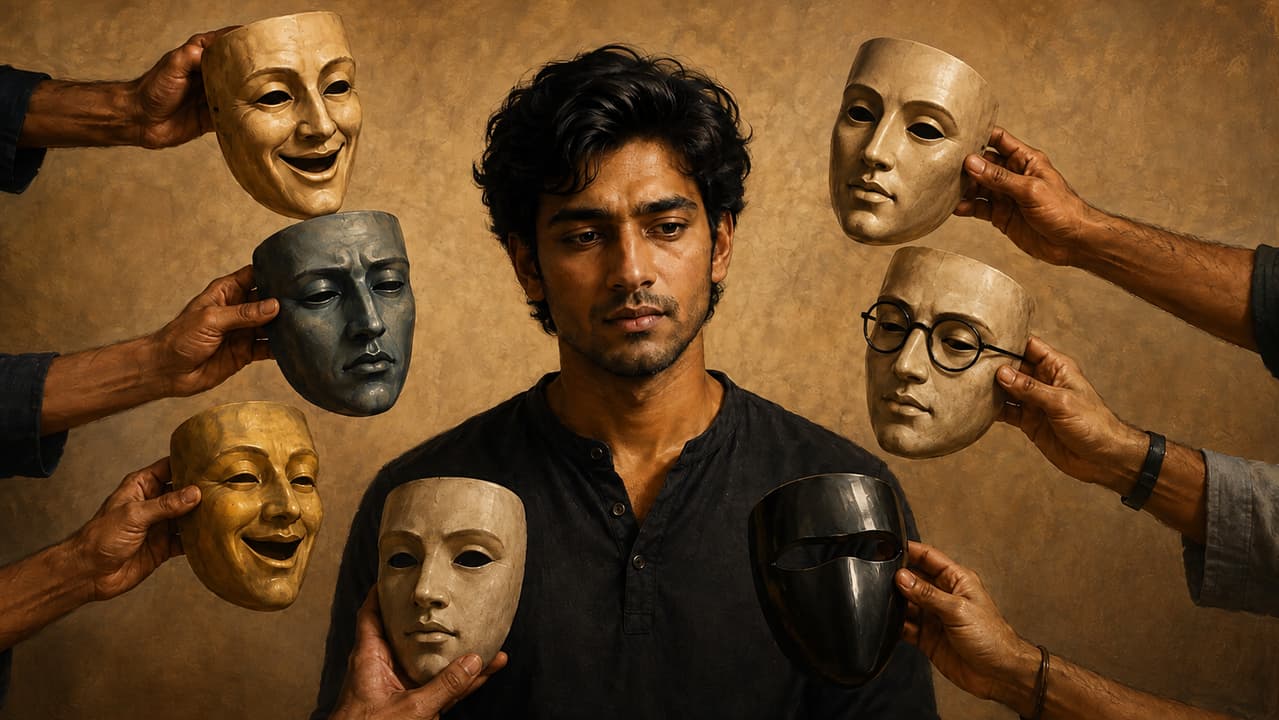
As young people, we mistakenly take tradition to be the Truth. Tradition tells you in advance, "This is important," and you believe it. This has to stop. You must question, inquire, and experiment. Because if you have readymade definitions of what is important, then you will never come to what is truly important. And when you independently inquire, a lot of unimportant nonsense disappears from life, and fresh space is revealed. Now, through your own discretion and wisdom, if you decide that these things are indeed important, then so be it. This summary is AI-generated. Please read the full article for complete understanding.

Questioner: Good afternoon, sir. I am Siddhi Deshwal. I am in 11th grade right now. And first of all, your words, they truly inspired me. My mother is a big follower of yours, so she's told me a lot about you. One thing which I really wanted to know is that we're all 11th and 12th graders, and we all have to deal with failures, setbacks, we have to deal with external responsibilities, distractions, and whatnot. So, the Gita, it's not just a religious book, it's also a life coach. Are there any verses in it or any advice from it which you would like to explain to us, which helps us deal with that specifically?

Acharya Prashant: Ignore the random noises. Choose the right war and then give yourself fully to it.

There would be random provocations, insinuations, stimulations. Something pricks from here, somebody pokes from there. All those petty things are to be ignored. And then you'll be in a position to pick only the right war for yourself, the right war. That's all. You cannot have a war on a thousand fronts. That's not possible. You have to ignore the 999 trivial fronts.

Choose the one thing that's worth doing in life and then allow yourself to be fully immersed in it, totally immersed in it.

That's what Shri Krishna is telling Arjun. Now fight. You have lived all your life only to come to this point. Now you can't run away. Fight. This is the right battle, and this is not something you can abscond from.

And please remember, Arjun fought so many wars in his life. The Gita was not delivered. The Gita came to Arjun only when it was the moment of the highest battle. You'll have to choose the highest battle for yourself, and then you'll have Shri Krishna and the Gita for yourself.

If you are involved in all kinds of trivial engagements, locking horns with this one, brushing shoulders against that one, getting irritated by that one, “Oh! That one rubbed me the wrong way.” The Gita is not for these things. You need to have a battle worthy enough and then you'll have a life great enough.

Questioner: Thank you so much.

Questioner: Good afternoon sir. I'm Divyanshi. I wanted to know, how can an individual live a life without seeking validation or recognition from an authoritative figure, especially when it has been withheld in the past?

Acharya Prashant: Authority is needed. Yes. Let me reframe the question and then tell me whether I have rightly done so. What you do not want is an external authority. It's not that you do not want authority at all. What is problematic is an external authority. Let your best discretion be the authority. How about that?

Because internally we are not one being, right? Have you seen one part of you that wants to play mischief? One part of you wants to say no. 'What's the point in completing the assignment? Let me copy it from somewhere. What's the point in waking up and setting up the alarm and preparing for the exam? Let me just sleep through it. It's fine.' You know, that's one part. And then the other part says no, no. There is a higher self within, and there is a lower self within.

The lower self says, 'Keep sleeping, even through the moments that beckon you, that call you to accept the challenge.' That's the lower self. The higher self says, 'Don't worry about the damage you will suffer. If the challenge is worth it, accept it.' That's the higher self. Let the higher self be the authority. And when you have the right authority within yourself, then you do not require somebody outside of yourself to be authority.

An external authority or an external discipline is needed only because we lack internal authority and internal discipline.

Then the external authority comes and says, 'You be disciplined. You move this way. You follow this schedule. You stick to this deadline.' That's what the external authority does, right? Sets, do's and don'ts, operation manuals, codes of conduct. That's what the external authority does and says, 'You'll have to take validation from me. I'll authorize, I'll approve, I'll permit.' All these things can be done by the internal authority also.

The punishment for not having an internal authority is that you'll have to tolerate an external authority. Do you want to tolerate that? Then be your own strictest authority.

You see, there are two kinds of people. One, those who are not doing what they should and when the external authority chastises them, reminds them, or occasionally rebukes them, then they feel angry at the external authority. Now, you were not doing what you should anyway be doing, and somebody comes and tells you, 'This is what you must be doing. This is in your own interest. If you do this, you'll be a better person.' And who do you get angry at? The external one. This is one kind.

The other kind is, 'I'm not doing what I should. And the external one comes and reminds me or admonishes me. I get angry at myself and I feel gratitude for him.' The situation is reversed now. 'I get angry at myself. Why did I have to bring it to a point where somebody else had to get in and remind me? This is something that I should be doing on my own. Why do I need an external authority? And if the external authority had to step in, that's not the fault of that authority. That's my fault because I should have been doing it without needing any reminders, without needing any stimulation, without needing any encouragement to do what I must.'

But most of us lack this mustness in life. All we have is petty desires or flow of the past, flow of habits. 'I've not been doing this for two years, so I won't do this today either.' That doesn't even sound good. How can it feel good while doing it?

So when you find yourself being disciplined by an external authority, ask yourself, 'What did I do to deserve this?' Don't get angry at that one. In fact, thank that one, because that source, that authority, deserves to be thanked. That one has come to tell you what you must do. So thank that one.

But internally make a promise to yourself, 'Next time I should not need this person. This time he had to step in, and I duly thanked him or her, whatever.' Right? ‘This time this fellow had to intervene, and I thank him for that. But I commit to myself that next time I will not need this person. If it's my life, then it's my responsibility. If it's my life, then I have to be the authority. I'll be the king and the queen of my life because it's my life. Why should I need somebody to discipline me?’ Right.

Questioner: Greetings Sir. I'm Navami. I'm a student of class 12, and I would feel that, you know, this age that we're in, all of us students here, we're quoted as teenagers. My question would be that, as teenagers, it is really difficult for us sometimes to comprehend and navigate through our emotions, especially as a lot of these emotions that we feel are really unfamiliar and new to us, and we end up thinking, 'Oh, my problems are much bigger than what they actually are.' So, what advice would you give to all of us here?’

Acharya Prashant: Thank you, very pertinent question. See, until you have seen the Himalayas, even the little hillock in your backyard appears like Mount Everest. Do you get this?

The mistake that we make as young people is that we take our surroundings as the universe and we take tradition as the Truth. We feel that if something is not visible in our surroundings, it probably does not exist at all. And the way the human species is, it is very, very probable, almost 100% certain, that what any of us will have in our surroundings, in our vicinity, will be dwarfs. And that's not an insult to the society that we have around us. That's the fundamental human condition.

We are all born probably to be mediocre. Greatness is a rare thing.

Greatness has to be earned, and very few people display the commitment to rise to greatness.

Consequently, what you will usually find yourself amidst is a large number of very small people. What you'll usually find all around you is a large number of small people. And the mistake that you make is that you start thinking that what's near you is universal.

So, you have somebody around you, and this fellow is a senior. You are 15, 17, or 18, a teenager, and this fellow could be 40 or 60. He appears experienced, respectable, and you're seeing that even for this fellow, some petty matter becomes huge, and he is totally engaged with it, totally consumed by it. So what do you start thinking? You start thinking that this petty thing is indeed something so significant, something so colossal that it deserves this kind of consideration and attention, because that's what you find people doing all around you. Are you getting it?

We said greatness is rare. So go to the rare ones, and those rare ones, by definition, will be rarely found around you. You will have to make special efforts to go to them. It is an extremely rare thing to find the rare one right next to you. And that rare event should actually not happen, because when the rare one is right next to you, then for you, he ceases to be rare, and then you turn kind of indifferent or even contemptuous. You say, 'He's right here. How can he be the rare one?' So it's best then to go to the rare ones through their works, specifically books.

Books are where you will find those who could just ignore the petty and little things of life. And you look at them and you see what all they stood through, what all they took in their stride. You look at the challenges that they happily endorsed, and then you look at your own troubles.

And what do you find?

You find your troubles are tiny, puny, and then you say, 'I don't need to give too much attention to my troubles. Look at this one. This one in the book.' And I'm not talking of fictitious figures here. We are talking of real people who have lived, breathed, and died on this planet. Look at them. But they won't be found in the neighborhood. It's going to be very difficult if you look for these figures in the neighborhood, Khanna Ji aur Tau Ji. Difficult, maybe impossible, but the probability is like one upon Avogadro's number. Are you getting it?

If you do not come in touch with, as they talk of in Hindi, the 'Koop Manduk,' the frog in the well, what does he know of the ocean? If you have not known the ocean, at least know those who have known the ocean. At least you'll have some idea of the ocean, and that will maybe encourage you to leave your own little well one day and move towards the ocean.

Otherwise, the petty affairs of the little well will consume you totally, and that's a grave danger. All these little petty things of daily life. Getting it? ‘I have to buy a new shirt. The vehicle is to be serviced.’ I'm not saying these things must not be done. These things must be done. But it must also be remembered that these are very trivial things. ‘The vehicle needs to be serviced. Somebody uttered a bad word to me. Any wedding is approaching, so I must get new clothes for myself. I didn't get enough likes on my last Insta post.’ Nothing is enough.

But when you are with the greats through their work, through documentaries made on them, through their biographies, through their autobiographies, then you realize what life really is about. Then you feel like standing in front of the real Mount Everest and saying, 'Here is where the earth meets the sky.'

Without reading, you will be consumed. The world is such that it will suck you in and destroy you.

Questioner: Good afternoon, Prashant Sir. My name is Anugrah. My question for you is that today's generation, while being exposed to the internet, is making certain choices that will affect them in the future — for example, their lifestyle, how they want to flaunt it, as you have said earlier in your speech. So how does one navigate through this without getting affected by their surroundings, by what others are doing?

Acharya Prashant: You can get affected by what others are doing, but those others have to be worthy others. Worthy others. You don't need to be influenced by every Tom, Dick, and Harry. But fortunately for you, we are a species that keeps records, details, accounts of history. And since we are in the 21st century post-Christ, we have more than 3,000 years of history of the great available to us. Allow them to have an impact on you.

Why not go to the great scientists, or athletes, or artists, or even warriors, philosophers? Why not go to them? Why not sit in their company? Why is it a compulsion on you that you must be only around your Insta community? I'm asking you, even that is virtual, right? Will you ever physically see all the people who have liked your posts? No. Even though they are virtual, right? And if you have to deal with virtual people, why not deal with the greats of the past?

They didn't do it necessarily for themselves, whatever they did. So many of them wanted nothing really from the world because they were already all right. They were already fulfilled and joyful doing what they did and living how they lived. But they still left very detailed accounts for you because they loved you, because they knew that it would not be easy for you to find something comparable to what they had found. So they left behind their accounts, their stories.

It's like inheritance, real inheritance, not the kind of material inheritance that we get from parents and grandparents, not that. Something much beyond that. They left it in their love for your sake. Allow them to leave an imprint on you. Great books. That's what you need. Allow yourself to be inspired. Do not bear the tyranny of the immediate.

Because these are my classmates, so I have to be with them? Not necessary. You know, these are the kind of people in my society. What do I do? Jeena to inhi ke saath hai. Not necessarily. For some practical reasons, yes, we have to be with the people around us because we are social people, obviously. But then internally, you can choose to be in your own elevated world. Getting it? Externally, maybe you'll be sitting with your immediate surroundings. Sometimes that is unavoidable. But internally, you can be in a very noble, very august company. Let that happen. I use the word tyranny.

Why should the external be compulsorily allowed to become internal? Why should the external be allowed to dictate the environment within, outside of me? There might be all noisy people, all petty people, all selfish people. But why should I allow them to penetrate my heart and occupy a very central position here?

Yes, you can keep sitting outside. I'm just a student. Class 11th, class 12th. I don't have much resistance to offer when it comes to the external situation. But my internal situation will be my own decision. This internal province, I will be the king, and I choose to raise this internal thing to a high point. Even if all around me is chaos and noise and littleness and meanness, yet see who I am really with. I'm really with someone.

That's probably one of the only ways possible, because getting great company of living people may take time. It's not impossible, but it's not always easy. It may take time. You don't need to wait till then.

Give yourself the right books.

Questioner: Good afternoon, sir. I'm Gurnur Kaur, class 11th. First of all, your words have provided enlightenment about success and a lot more things, I feel, not only to me but to each one of us sitting over here. As you mentioned earlier, there are a lot of distractions, particularly at this age, like social media nowadays, and constant comparison, also the temptations to opt for shortcuts. So precisely, my question to you is: how should we train our mind to focus on what truly matters?

Acharya Prashant: By knowing what truly matters. See, the thing with that, the thing with what truly matters, is that once you know it, you cannot ignore it. So just knowing it is sufficient. Once you know what is really, really important, you will be helpless. You will be choiceless. You will no longer have the option to see it and yet unsee it, to come to its greatness and then turn your back to it. That will become impossible. So seeing is sufficient.

But how do you see? How do you know what is truly important?

By not being in a hurry to accept the definitions of importance handed over to you by tradition. See, tradition does not want you to independently figure out what is important in life. Tradition tells you in advance, 'This is important.' You didn't decide it for yourself. You were told such things are important, and you just bought them. You didn't even buy them; you believed in them. Now that has to stop.

You're grown-ups. You must question. You must ask. You must inquire. You must experiment. Because if you have readymade definitions of what is important, then you will never come to what is truly important. You must reject all the definitions that tradition has handed over to you.

You must pick such and such subjects in class 11th and 12th. That kind of college is wonderful. That stream offers great opportunities. Now, whatever 'opportunities' mean, ‘Oh, there is great scope in that field,’ and what the word 'scope' means always remains fuzzy. But these are buzzwords. Scope. Now, what does scope mean? What do you mean by scope? We don't know. Potential for what? We don't know. What kind of success?

Oh, now you have reached this age. Now you must start thinking of getting married. And once you are married, you must start thinking of having kids, and then one kid does not suffice. You must have another one. All these things are very important. Oh, you are now 35, and you still don't have a house of your own. Where is the house loan? Where are the EMIs? Why is your car so small? It's important to have a big one. How do you know all these things are important? I'm not saying they're not important. I'm saying the definitions must be your own. And then, if on your own, independently, at your own discretion, in your own wisdom, you decide that these things are indeed important, then so be it. Then it's fine.

But don't take these things on a platter, on face value, just because somebody says it is important to be like that or do that. No, I'm not rejecting you. I'm asking you to explain. I'm just saying this is something so intimate, so intimate, that I must be allowed to independently come to it. These are not things that one person can decide for another. There are some things that a young man, young woman should do very, very individually, without interference, without fear, and without the burden of tradition. In many ways, we can accept rules made by others.

For example, on the road, traffic rules—you don't need to be a rebel there. You don't need to say, 'I’ll drive on the wrong side because that's my individuality,' or 'I'll drive only in reverse gear because who are you to tell me the rules? My life, my rules, and I drive in reverse.' That's stupid. When it comes to small things, external things, then we can accept rules made by others. That's fine. That's fine. I didn't decide the dimensions of this stage, and I'm okay with it. Fine. And there have been smaller stages, and there have been stages that are five times this width. That's fine. These are small things; I don't need to worry about these things.

But I'll be very, very particular that the content is very individual, that what I'm saying to you, our relationship here is very intimate. Nobody can decide what I'm going to tell you or say to you, because this is not something somebody should interfere in. Yes, you can dictate all other things. Fine. Are you getting it?

And when you are able to independently inquire into what's really important, the first thing that happens is a lot of unimportant things disappear from life. A fresh space gets revealed because the nonsense is now out. This nonsense was never being revealed as nonsense. This nonsense was being touted as some of the most important things in life. 'Oh, you must look pretty as a girl. That's very important. Why don't you look pretty or dainty or attractive?' Are you getting it?

You must ask, 'Why must I? No, I'm not rejecting. I'm inquiring. Why must I? Who am I? What is meant by attraction? What is meant by attractiveness?' When these kinds of things are out of the window, then there is space for the truly important to reveal itself. As long as, please note this, your mind is cluttered with trivia, the really important thing will remain buried beneath the trivia.

So you don't really need to discover what is important. It will show up. But it can show up only when you have first cleared away and decluttered the nonsense. Rejection is important, very important. And if at your age you cannot inquire, question, reject, then what's the point? We said tradition is not Truth, mind you.

Questioner: Everything that you've said today has truly changed my way of thinking in some way. My follow-up question would be: we just talked about tradition not being the Truth, and all the buzzwords that are thrown at us. In today's world, there are a lot of students, a lot of brilliant young minds who try to rise above it, but somewhere or another there is this notion that the one who goes against tradition, the one who tries to defy it, is somehow the one in the wrong. So how does one truly rise above this tradition?

Acharya Prashant: No, let that notion be there on the outside. There are other people who carry that notion. Why must you carry that notion? You, or somebody here, or many people here may carry the notion that somebody wearing a yellow blazer is stupid. That's fine. That is your notion, not mine. Are you getting it?

People are free to carry whatever notions they can. People carry all kinds of weird notions. Let them carry their notions. As long as it exists outside of you, you are all right. It's like a virus. The coronavirus. Let it be there.

Everything has a place under the sun. All these pathogens have been existing in jungles and their own native places since the beginning of time. Let them exist there. If a virus exists in the jungle, in the bat, how does it trouble you? The problem is when you allow it to enter your interiors. Don't give it access. This has to be your sacred spot.

Your mind has to be your temple. Not all thoughts, no random ideas can be given access to this place. This is what sacredness is.

Questioner: As you mentioned, it's not always the case that we should agree to the age-old tradition, the age-old principle that has been laid out over the ages. But on the other hand, we see that we can rely on thinkers, on people from historical instances who have done something great in their time. We see that every era, every situation has different circumstances, and it's not like we can always rely on the principles that were laid out at that time.

So I just want to know, how can we tune in to their message, their principles, the ideals that they lived up to?

Acharya Prashant: They never give you do's and don'ts. Typically, a great one will not give you principles. The great one is great because he inspires you with his struggles. He does not impose his principles on you. What you will find in his or her life is a lot of relentless inquiry and living up to challenges. It is not the job or characteristic of the great one to impose his thoughts or ideas on somebody else, especially the coming generations. That's not what the great one is ever going to do.

For example, the Gita. Somebody talked of the Gita. The Gita is not an idea. The Gita does not consist of a set of principles. There is ruthless, raw questioning involved there. And the Gita exhorts you to ask questions, similar questions. Are you getting it?

Your question is, 'Why must I accept the answers that are coming from another century?' What I'm saying is, if those things are coming from the great, they will not be in the shape of answers. Rather, they'll be in the shape of questions. They'll tell you not to accept easy answers. That's what the great tell you.

Questioner: Thanks a lot, sir.

This article has been created by volunteers of the PrashantAdvait Foundation from transcriptions of sessions by Acharya Prashant
Comments
LIVE Sessions
Experience Transformation Everyday from the Convenience of your Home
Live Bhagavad Gita Sessions with Acharya Prashant
Categories