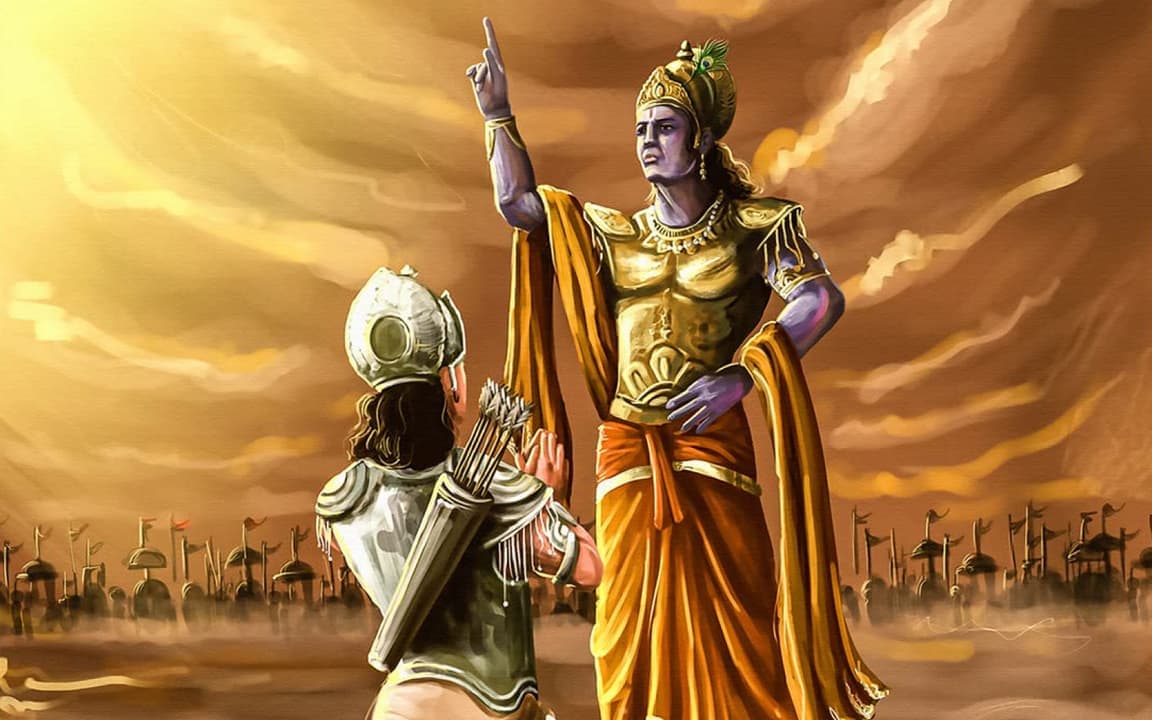
The Bhagavad Gita is often accused of supporting caste and misogyny through selective quotations that ignore context, grammar, and the text's central teachings. A closer reading shows that its emphasis is on inner qualities, conscious action, and spiritual equality rather than birth-based hierarchy or gender discrimination. Misinterpretations arise when isolated verses are detached from their broader meaning, while the Gita consistently points toward self-knowledge, freedom from ego, and the universal possibility of liberation for every human being.
It is said that when you are in the waking state (jāgrat), you are identified with the world; in the dream state (svapna), you are identified with the dream; and in deep sleep (suṣupti) you are still identified with some kind of primitive darkness. But, it is not as if that you have gone beyond identification. Turīya is the state that is present behind the drama of waking, sleeping and dreaming. Turīya, the witness state, is not ‘yours;’ it witnesses you, it is outside of you. So, your birth and death do not touch it.
No wise man will ever take your problem seriously, believe me. For the wise one, all your problems are bad jokes—not even worthy of a sound laughter. But then he says, "You know, I can see through. You cannot. So, I'll give up my right to laugh at you. I'll instead pretend to be serious." "Yes, yes, yes, of course! We have a problem!" He says, "You know, there was a time I was so much like you. These same things were big issues even to me. But I know they can be outgrown.
Acharya Prashant (AP): That which you call “Vipassana” today, is a very recent phenomenon. They claim that it comes from the Buddha, actually, it is not. The stream flowing from Buddha got extinct around the 8th or 10th century AD. This modern Vipassana came up in Burma, just around a…
Shiv isn’t a person who existed at some point in time. Shiv isn’t confined to a specific place. Stories are sometimes useful pointers to the truth, but in our ignorance, we take the pointers themselves as history, facts or Truth. Shiv is the joy of pure consciousness. When false identifications and attachments are dropped in the light of self-knowledge, what remains is called the untainted essence of Shiv.
The world is a crooked place. You will have to be zig-zag, tangential; that is the nature of the world. Realization of crookedness is the only straight thing possible. If you want to become straight, let yourself be crooked. Once you know that the straight One, the innocent One, is sitting in your heart, then you no more feel the need to display a fake straightness. Now you can get rid of all morality. Whatever you are doing is coming out of your love and compassion or just enjoyment.
5
Shri Krishna is saying: the mind is conditioned to move towards objects and perceive only their surface, periphery, or form. Develop the practice of penetrating further. Let Truth be your practice. The moment you would look at something, and you are in no position not to look at things being embodied, you would look at things. Nobody said that you have to practice lust. Lust just comes. You might be a total fool, an utter retard, and still you will find yourself getting sexually excited once you reach a particular age. Did you need some practice? No, you didn’t. It just happened. But if you are to understand lust, if you are to cross over, if you are to be a master of your body, then it will require a lot of practice, and that will necessarily and obviously tell you about your predicament.
Excerpts from Articles
Climate Change: The Solution Is a Choice
Climate change is more than an environmental crisis—it is a crisis of human choices. Our patterns of consumption, consumerism and endless pursuit of more are putting increasing pressure on the planet. But meaningful change does not necessarily begin with new technology or stricter policies. It begins with a deeper question: what are we willing to change within ourselves?
कई तरह के डर—अकेले पड़ने, छवि खोने या छोटा समझे जाने—की जड़ अक्सर अतीत में बनी पहचान और कहानियों में होती है। शरीर की हाइट जैसी चीज़ों को समस्या मानकर उनसे जूझने के बजाय उनकी अप्रासंगिकता को समझकर आगे बढ़ना चाहिए। अतीत को दबाने से मुक्ति नहीं मिलती; उसके करीब जाकर अपनी स्मृतियों, धारणाओं और पुराने पैटर्न को निष्पक्षता से देखना ज़रूरी है।
ज्योतिष कितना सच है? कुंडली, ग्रह-नक्षत्र: इनका क्या अर्थ है?
वेदांत को केवल इसलिए सही या श्रेष्ठ नहीं माना जा सकता कि वह किसी विशेष परंपरा से आता है। विज्ञान जहाँ भौतिक जगत की वस्तुनिष्ठ जाँच करता है, वहीं अद्वैत वेदांत सीधे मनुष्य के ‘मैं’, उसके दुख, बंधन और मुक्ति की पड़ताल करता है। इसकी कसौटी वैज्ञानिक प्रमाण नहीं, बल्कि अपने जीवन में इसकी सच्चाई को देख पाना है। किसी दर्शन को मान लेना नहीं, बल्कि उससे स्वयं को मुक्त करना ही उसका वास्तविक उद्देश्य है।
Struggling to choose between a secure job and the path you actually feel drawn to? This isn't really a question about careers. It's about why other people's opinions have so much power over you in the first place. Real clarity doesn't come from finding the 'right' choice. It comes from honestly looking at your own fear, again and again, until it stops running the decision for you.
Justice Without Boundaries: Why Compassion Cannot Stop at Species
Oppression should not see caste, gender, creed or colour, and it should not see species either. The moral threshold is sentience, not intelligence. An animal feels pain as fully as a human does, whether or not it can explain its suffering.
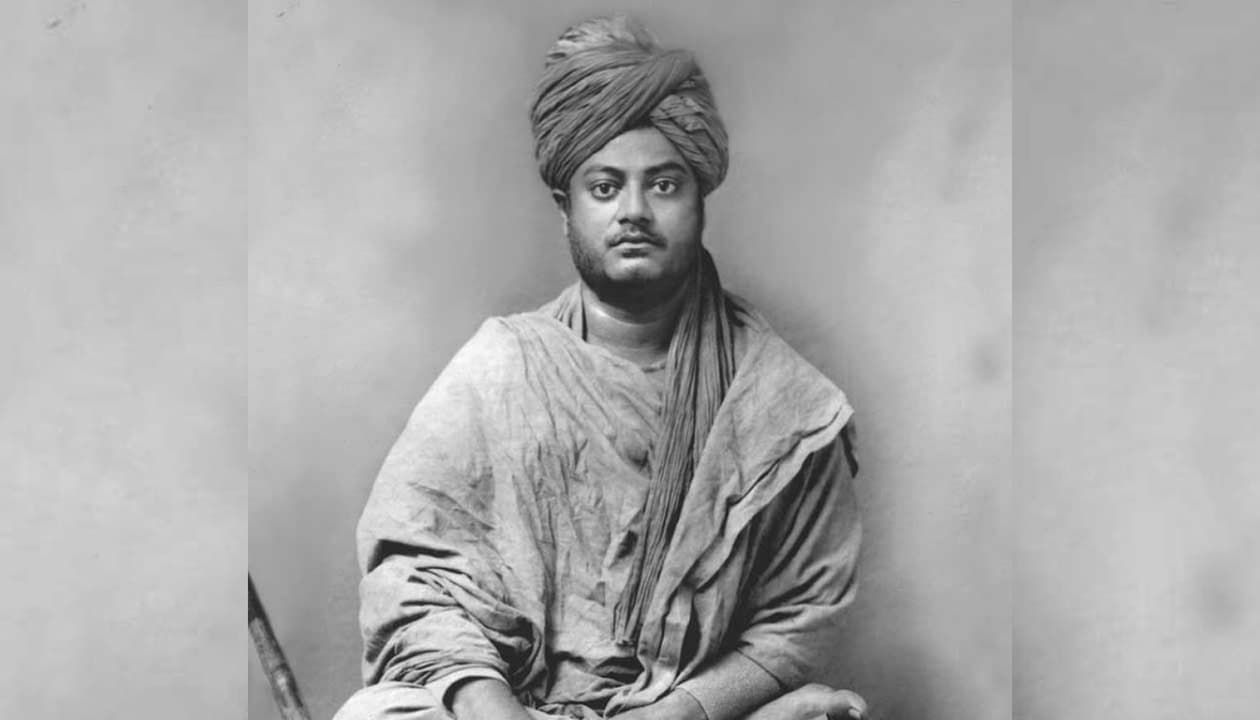
We love to talk of Swami Vivekananda as a youth icon. And I am asserting that were he to be here today, it is the youth that would resist him the most. When he returned from the United States, a huge procession greeted him, right at the port. But when he asked for just a hundred people who could be his soldiers, he was denied. Nobody wants to accept a Swami Vivekananda. He was resisted then, he would be resisted even today.
Ramana Maharshi says, “Silence of the mind is higher than the silence of the eye and the ear,” because even if the eye and the ear are not compulsive about sucking in sensual inputs, still something will reach the mind. A silent mind is the one that is not under any internal pressure, any internal compulsion to react to what comes to it. Stuff has come; the mind says, “Alright, you have come. I am inert towards you. I am non-reactive!” “Real silence is silence of the mind.”
7
Adam and Eve are people with a body and choice. ‘Garden of Eden’ is the state of bliss that one enjoys as long as one keeps making the right choice. ‘Tree of Knowledge’ is the intellect that has an ego as its root. ‘Bitten Fruit’ is taking sustenance from intellect rather than God. Jesus is that man who is not quite a man because he is left with no choices, he is the highest potentiality of Adam and Eve.
6
Drop the center of confusion, come to the center of clarity. Drop what the masses practice, come to the direct route of self-realization. That’s what it means.
Just see what their presence does to you. Are they really able to remove fear from your mind, or are they putting you in greater fear? Do not know them by their forms, medallions, or all the respect that society gives them. Know them by one criterion only — "Have they liberated you, or have they put you in greater bondage?"
To say, “I am such a devotee that I will reach freedom through my efforts. And I will not stop till I am liberated,” might sound like a statement of commitment, devotion, and deep mystical thirst — but it is actually just arrogance. Rumi has done the fullest that the human mind can do, and has left no stone unturned. And after doing what he could do, he simply raised his hands and surrendered. This is the utmost that this mortal form can do.
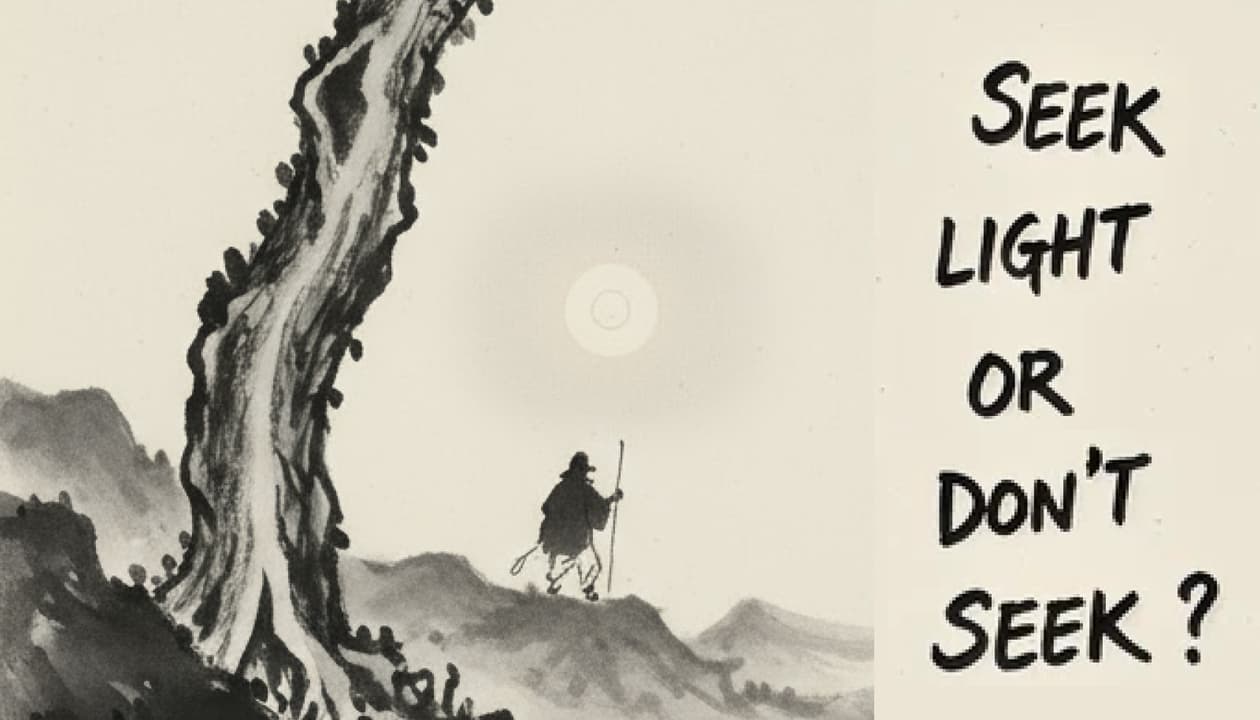
On one hand, there is a great danger that if you seek Light, you will seek the wrong kind of light; you will just seek darkness disguised as light. On the other hand, there is the equally dark option of not seeking at all. Between these two possibilities, I prefer the possibility of seeking Light, with all its associated dangers — that is still better than not seeking at all. Isn’t it better to die fighting in the battle than not fight at all?
2
The worldly philosophy says, “Even if you lead a corrupt life, at the last moment you utter ‘Ram, Ram’, and you are redeemed.” I say just the opposite. Even if you have lived a life of wisdom, you can still lose it in your last breath. Even your wisdom requires a supporting and nourishing ecosystem. You can never afford to be complacent.
The object of love is so big, so total, so filling, so occupying that it leaves no space for the subject to hide and survive. The task is so damn big that it can’t be done if you protect yourself. If you protect yourself, it won’t happen. Love involves a lot of bloodshed and demolition. And there are fireworks. Great structures collapse. Formidable enemies have to be defeated. All that is love.
5
The real problem is that you don’t ‘know’ the problem. Had you really known the problem, the problem would have very quickly faded away. Whenever you come across a problem, do not begin by saying that this is the problem and now I am going to solve it. First of all, drop all your pretensions about your understanding. You do not know anything, so you have to start from an absolute zero. You observe.
13
It is not really happiness that is to be found through self-knowledge. In fact, self-knowledge often is a danger to happiness. Self-knowledge dissolves both happiness and sadness, and you are left with nothing but a naked and silent joy. If you can see yourself clearly, without motivation, then the seeing itself is great fun.
8
The Gita can come only from someone who understands the world. And if you understand the world, you cannot keep failing in the world. Shri Krishna was the one who brought victory when defeat looked so probable. The Ātman, the Self, within you is the climax of perfection. The man of God is a winner in the world as well. That is full embrace.
The words of a wise man must be read with wisdom, with empathy. When J. Krishnamurti says, “Become deeply aware,” read it as ‘Unbecoming Unaware.’ There is nothing called becoming aware. ‘Awareness Is.’ Over the innate awareness, there is a cloud of assumed unawareness. You just have to see that there is no fact in your assertion that there exists unawareness. So, you unbecome unaware. You cannot become aware. Awareness is not something that you can achieve or become or reach. It is.
13
For you to benefit from the darshan of Shri Krishna's statue, you should already have a relationship with Shri Krishna and the Gita. If you have had no prior connection with the Gita, then darshan makes no sense. Darshan is a great way to immediately bring back all that has been hidden under the dust of time. You could either re-read the entire Gita or simply look at Shri Krishna’s statue. It’s a fantastic method — but only for Gita lovers.
Overview
Fighting Duryodhana is Dharma. Fight Duryodhana in the way you can, that is swadharma. Dharma is the same for everybody, but swadharma varies according to your physical, social, temporal conditions.
But remember that swadharma can never be in contradiction of Dharma; swadharma will always be something…
11
Adi Shankaracharya goes to his teacher and is asked to introduce himself, and he says, “Cidānandarūpaḥ Śivoham Śivoham — I am pure blissful consciousness; I am Shiv, I am Shiv." My real identity is not at all related to the body. The great teacher is very clearly telling us that Shiv is the one who has nothing bodily about himself. But because we are bodily, our ego does not allow us to admit that there can be anything beyond who we are. And that’s also the cause of all human suffering.
1
Explore Books on Lord Shiv by Acharya Prashant, revealing deep Vedantic insights into Shiv’s true essence, symbols, and spiritual wisdom beyond misconceptions.
8
Shakti represents everything in motion, everything that can be experienced, everything in space-time. We move in search of a final destination. That point is symbolically represented by Shiva. Those who are inclined towards having the right kind of movement worship Shakti. Those who have fallen in love with the destination itself, worship Shiva. The fact is that the two are inseparable.
Love, for the one who is at a low level of consciousness, is to aspire for a higher level. And love, for one sitting on the Himalayan peaks of consciousness, is to be compassionate towards those at lower levels — and, for their sake, if needed, lay down your life.
18
There is no particular glory or joy in defeat. Victory is likable because man associates joy with victory and the loss of joy with defeat. Your victories will not bring you joy. If your victories are bringing you joy, then it is a very shallow joy. And when joy there is, joy remains equally in victory and in defeat. Victory appeared favorable, defeat appeared unfavorable, the poet is celebrating the fact that that which appeared unfavorable is no more unfavorable.
The Truth cannot be objectified as a thing, place, person, or book. So, don't be too quick to accept your own assessments, judgments, likes, dislikes, and experiences. Whatever you're seeing is seen by "you" — the Ego — and you are no absolute. Everything must be available to enquiry, investigation, and questioning — and questioning cannot happen if you declare that you’ve already come to the Truth. Never believe that the journey has ended or that the ego itself is the Truth.
Don’t think of heaven and hell as the afterlife; both are here, right now. As the Niralamba Upanishad says: Right company is heaven; wrong company is hell. If you are someone who loves to be with people who will take you towards truth, joy, and simplicity, you are already in heaven. And if you surround yourself with people who pull down your consciousness, then verily, you are—right now—in hell.
Acharya Prashant: You will see that I'm repeatedly stressing on Shri Krishna as the demolisher, on Shri Krishna as someone who not only does not accept our prevalent definitions of right-wrong, true and false, humility, authority, right action, non-violence but, in fact, unabashedly and actively demolishes them. It is one…
Now comes the deeper symbolism of Shivlinga. It says—look, if you have taken birth, then you are there in the body. But even while living in the body, you have to live as if you are without a body. So, the shape of the Yoni that you see in the Shivalinga is actually the world or the body, and this Lingam that you see in the middle of it is the Consciousness—the Consciousness which is located in the body.
1
You look at a Swami Vivekanand and then you want the others to be like that. But a Swami Vivekanand is not normal. He's an aberration. He's a great exception. Just by looking at him, if you start assuming that all young human beings by default should be like him, then you are missing the fact of what it means to be a human being.
Buddha had some core traits which remain the same today. A sharp mind and a certain curiosity in knowing the depths of life, not feeling that ‘I already know.’ Deep compassion, detachment, and an unending desire to reach the ultimate knowledge, not lazily concluding at one point. He shared his knowledge with the world. A practical man — raised an organization that became the dominant religion of the land. Today, in an age where religion has distorted, we need hundreds of Buddhas.
Only the man who believes in the world that he sees with his eyes would want the proof of Godliness admissible through the eyes. Such doubting Thomases do not see that what the eyes see is not really true. Only a Christ can tell you what is True and what is false. And if you are suspecting Christ himself, there is nobody who can now tell you the difference.
8
Jesus is not a hater of persons. He is saying hate the way you have become. The Bible is not a document of hate, the central message is of Love. But when we love, we chain each other. When God loves us, He sets us free. So Jesus is saying to hate the way we relate to each other — because our love is not Godly. Love each other just as God the Father has loved you.
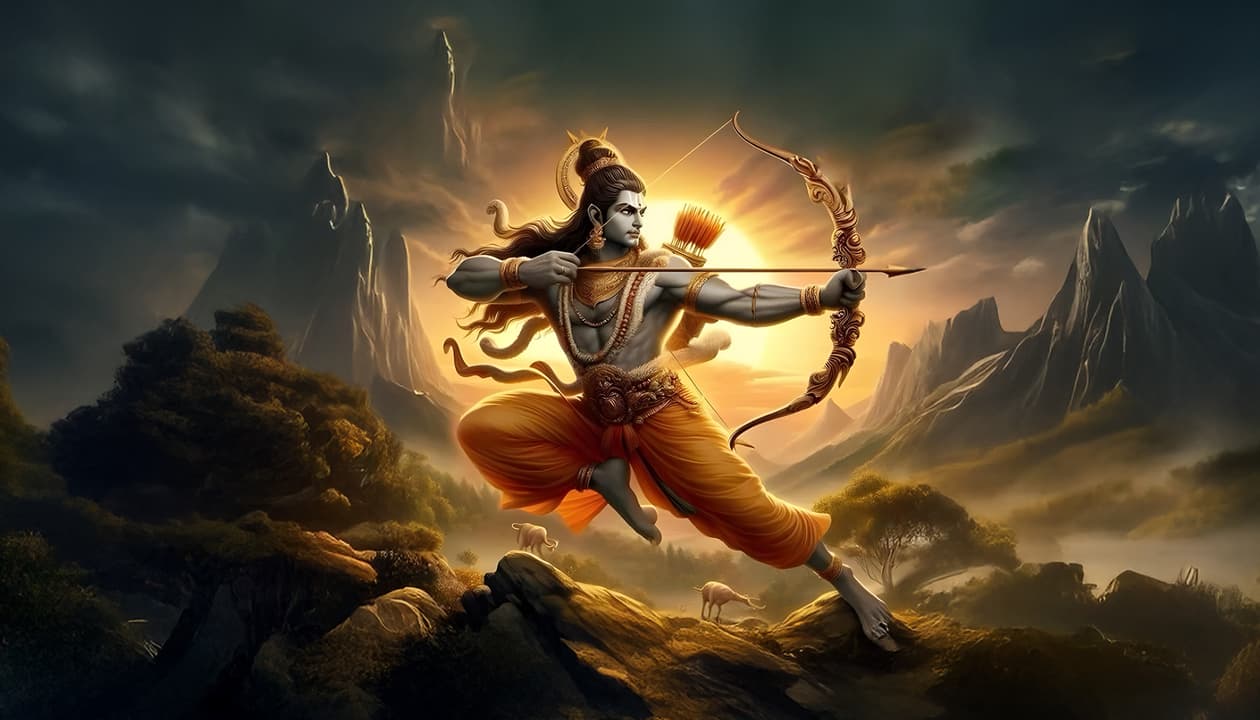
Shri Ram is the source of all excellence—Kabir Sahab’s excellence, the excellence of an astronaut, the excellence of a deep-sea diver, the excellence of a professional, etc. If you don’t have excellence in what you do, it is because you have been disloyal to Ram. Without Ram, you can’t do anything nicely.
2
Obsession with the future is a compulsion with the ego. The only way to be free of the future is to be free of yourself. Be free of yourself and flow like the wind. But will the right things happen to me then? Can you assure me? Is there a guarantee? So desireless, motiveless action and faith, they always go together. Somebody who's asking for guarantees, somebody who is craving for assurances, he is unfit to even touch the Bhagavad Gita. This is only for the courageous ones.
Rishikesh is the city of Shiva; it is the city of ending. While many cities mark beginnings, Rishikesh is where you come to stop. Haven’t we already had enough beginnings? Things must end somewhere. Having passed through Brahma and Vishnu, it is now time to meet Shiva. Shiva is annihilation—a full stop.
Shiv is unthinkable—beyond words, thought, and representation. He cannot be captured in pictures or idols. Yet, for most people, imagining truth without form feels impossible. This is where Shankar arrives. Shankar is the highest point a man’s imagination can reach. The maximum flight of the mind is Shankar, and Shiv is the disappearance of the mind into the sky.
1
The question should be which one is relevant to you? What will you do by enquiring about Shri Krishna’s grace? That’s Shri Krishna’s prerogative, right? Shri Krishna will take care of his grace if he has to offer grace. Whatever he has to do, we do not know what grace is. We do not know who Shri Krishna is. How does it concern us to go into matters of his grace? What is it that’s in your control? Your own preparation, your own willingness. So, you take care of that.
2
So 'know', don’t try to know about Shiva. Shiva is not furniture. Shiva is not a tree. Shiva is not a cloud, not even the sky. How will you know Shiva? Do you know of anything that has no shape, no form, and is eternal? How will you know Shiva? But know, do know. What can you know? This world and yourself. Know that. That knowing is Shiva-ness. Shivatva.
The Gita is useful because its setting is extremely relatable. Just like us, Arjuna does not know himself—he's a victim of multiple identities and all kinds of conditioning. Therefore, the Gita is about letting Arjuna know who he is, and this illumination enables him to do what he must. So, first of all, see that you are Arjuna. Then, step by step, verse by verse, there will be some resolution.
6
देवान्भावयतानेन ते देवा भावयन्तु वः।
परस्परं भावयन्तः श्रेयः परमवाप्स्यथ।।
~ श्रीमद्भगवद्गीता, अध्याय 3, श्लोक 11
अर्थ:
यज्ञ से देवताओं को आगे बढ़ाओ, तो वो दैवत्य तुम्हारी उन्नति करेंगे। इस तरह परस्पर (आपस में) उन्नति करते हुए तुम परम श्रेय प्राप्त करते हो।
काव्यात्मक अर्थ:
*यज्ञ से देवत्व बढ़े
देवत्व से…
2
No, no, you don't have to be empty of anything. You just have to be empty of the choice to use anything in your defense. You are born with ammunition; you don't have to keep the ammunition aside. Let the gun be there with you—just don't fire at the teacher. That's all that Shri Krishna is saying. You don't have to empty the gun. Keep it loaded; it's all right.
5
Who are the people who never understand Shri Krishna? The ones whose minds are full of Karmakand. If your mind is full of Karmakand, Shri Krishna himself has very clearly said, you will never understand the Gita because Karma Kand deals with desire, because whatever you do, you do for the sake of desire.
2
If all that the Ego wants is liberation from itself, which means coming to see its own non-existence, then the only way to see its non-existence is by paying attention to itself. The more the Ego pays attention to itself, it sees that it does not exist. The more the Ego remains attached to this and that, all the sensory inputs, the Ego feels that is real and this is real.
6
The center of the Gita is 'Nishkamta'—desireless action stemming from self-knowledge. Whereas popular religion is all about the fulfillment of desire. We go to a supernatural power and beg him to grant our desires. That is popular religion. You can either have the Gita or the entirety of religion as practiced in common culture. They are totally incompatible.
3
The word for a Guru does not really exist in the English language. So, they have borrowed Guru itself, Guru. But they have borrowed the word Guru and rather misunderstood it and misapplied it. So, anybody who seems to be an expert at anything, can be justifiably called a Guru in the English language. Now that's not the proper usage in spirituality or in Sanskrit.
In modern times, reading and respecting the Shastras is often seen in a derogatory light. An Asura disregards the scriptures, saying, “What I know is right. My own experience determines the Truth,” rejecting them because they will not allow him to do what he wants. We have come to a point where we are not merely ignoring but actually insulting the scriptures. If you're sincere about knowing life, why avoid a document with deep insights into it?
7
'The observer is the observed; an honest observation dissolves them both.' Or, 'The observer is the observed, and both are false.' We lay a lot of emphasis on the world, assuming it to be the Truth. If the world is an entity independent of everything, then it has to be the Truth, right? Truth is that which is independent of everything.