The center of the Gita is 'Nishkamta'—desireless action stemming from self-knowledge. Whereas popular religion is all about the fulfillment of desire. We go to a supernatural power and beg him to grant our desires. That is popular religion. You can either have the Gita or the entirety of religion as practiced in common culture. They are totally incompatible.
This summary is AI-generated. Please read the full article for complete understanding.
Acharya Prashant: We will be going into the relationship between the ego and knowledge. This will cover aspects of action, worship, imagination, prayer and much more. Verses 45 and 46 of Chapter 2 of Bhagavad Gita are revolutionary, unpalatable, unacceptable, indigestible to those who do not understand what spirituality or wisdom are all about. Whenever one talks of the Gita, rarely does it happen that one brings up these two verses.
In fact, It is quite a miracle that these two verses and a few more, we'll come to them later, have survived the tyranny and deceit of time. Otherwise what usually happens is that the part of a spiritual text that doesn't agree with or support the popular perceptions about religion, that part is somehow silently and deceitfully cut off, deleted, truncated from the scripture itself.
So, given how polemical these two verses are, I find it, indeed, a matter of fortune rather grace that these two verses have survived because these strike at the core of what I refer to as ’Lok Dharm.’ You can either have the Gita as represented by 2.45 and 2.46 or you can have the entirety of religion as it is practised by the common man in the common culture. These cannot go together.
You cannot have Gita specifically—the Gita that shows up in these two verses and the version of religion that you have been seeing today and over the centuries in India and all over the world. Totally incompatible, they are.
Verse 45 says, 'The Karmakand part of the Vedas, which is 99% of the Vedic corpus, stems simply from the desire of the ego to consume Prakriti and therefore, you need to forget that portion of religion.' Shri Krishna is not being equivocal here. He's not mincing words. He's leaving nothing to doubt or chance. He's making things clear as daylight.
त्रैगुण्यविषया वेदा निस्त्रैगुण्यो भवार्जुन। निर्द्वन्द्वो नित्यसत्त्वस्थो निर्योगक्षेम आत्मवान् ।। २.४५ ।।
trai-guṇya-viṣhayā vedā nistrai-guṇyo bhavārjuna nirdvandvo nitya-satt-avastho niryoga-kṣhema ātmavān।। 2.45 ।।
Meaning:
Hey Arjun! Vedas are of these three qualities – Sattva, Raja and Tama, that is, they are desire-oriented. You should become free from these three qualities, that is, you should become free. Be free from conflicts of happiness and sorrow, always self-oriented i.e. patient and effort-free in attaining and protecting the necessary things, healthy i.e. dependent on God.
~ Chapter 2, Verse 45
➖➖➖
Acharya Prashant: As if the first line here is to discard the very foundation on which the whole structure of popular culture is built. What is religion, if not a morally sanctioned way to fulfill your desires? It has been so boldly put by Shri Krishna here. That the Vedas, and when he's saying Veda, he's referring not to Vedanta but to the Karmakand part. And I have often asked you to read a lot. It would be obviously the right thing if each of us has a copy of the Vedas with us, that will help you better understand what Shri Krishna is saying.
So the first line if you see is about rejecting Karmakand.
त्रैगुण्यविषया वेदा निस्त्रैगुण्यो भवार्जुन।
trai-guṇya-viṣhayā vedā nistrai-guṇyo bhavārjuna
The Vedas deal just with your desire towards Trigunatmak Prakriti — ‘trai-guṇya-viṣhayā vedā' (त्रैगुण्यविषया वेदा)
The Vedas at their center have Prakriti. That is desire for Prakriti. At their center, vishaya is not the desire for liberation. Their Vishaya is not Mukti. Therefore, Arjuna you need to be Nishtraigunya. What does 'Nishtraigunya’ mean?
Free of the three 'Gunas’ which means be free of 'Prakriti,’ whereas Vedas are dealing only with Prakriti. Vedas are dealing only with Prakriti. And what is Prakriti? The ego itself is Prakriti. The ego and its observed objects are all Prakriti and that's what the subject matter of the Vedas is.
You keep all that aside Arjuna if you are to fight the right war. You cannot be one of those who go to their favorite deities to ask for their favorite objects. Is that not what most religions are about? You choose your favorite deity, your favorite method of worship, your favorite prayer and your favorite place. It could be whatever — temple, mosque, church or a place of pilgrimage. It could be a hill or a river.
And then, you go to it and ask for your favorite thing. Can I have a new car? My favorite girl or boy, a son, whatever, more money. Can I have all that? There is somebody in the family sick and diseased. Can you please be cured? Sir, reject all that. All that is for those who just want to be at the gate of religion or maximum at the porch. Not being allowed entry into the center.
Those who are serious about life, those who love themselves, those who want to make the best of the limited opportunity available, all those things are not for them.
Oh Lord, 'We worship Thee.' Kindly grant us our desire. What kind of religion is this? And if you are still in doubt, whether Shri Krishna really means what I am presenting to you, comes the next verse and it says that you know if the entire surface of the earth were to have just water, then tell me Arjuna, what kind of desire or relationship would a wise man have for a limited body of water?
If the entire earth were to be a giant sea, then how much value would you have left for a small pond? Please tell me, Arjuna. Only that value, only that much value does a wise man accord to the Vedas. And what does he mean by the Vedas here?
Obviously, not the Upanishads but the ritualistic part. The ritualistic part. The part full of desire. See at the center of the Gita is — Nishkamna, desireless action. Desireless action stemming from self-knowledge. That's what the message of Gita is. Full stop. Self-knowledge leading to desireless action, also leading to freedom from useless relationships and affiliations.
Atmagyan leading to Karm Yoga and also Karmasannyasa.
That's what the Gita is, whereas popular religion is all about Kaamna and Gita is about Nishkamna. How can these two go together? So Gita is dynamite. The entire structure of popular religion is blown up, that's what Shri Krishna is doing and that's why Shri Krishna can be accepted very smoothly as a cow herd but the Shri Krishna of Gita is very difficult to accept and that's why most religious people avoid the Shri Krishna of Gita. They would rather have Shri Krishna of Mathura and Vrindavan. But they avoid, like death, Shri Krishna of Kurukshetra.
I often wonder why all these babas and saints sit only at Mathura and Vrindavan. Why not at Kurukshetra? But that's the real place, that's where the Gita came from. You should have a lot of ashrams there but they will never go to Kurukshetra because Kurukshetra is about Nishkamna, whereas popular religion is all about fulfilling your desires. Are you getting it? Popular religion is just about consuming Prakriti. Prakriti appearing in its three gunas- ‘Trai-Guṇya-Viṣhayā Vedā' and therefore you drop the Vedas.
By dropping the Vedas, Shri Krishna is talking about dropping the rituals. These rituals are of no use at all. These rituals are of no use at all. Drop them. How much value should you give to the rituals? As much value as you give to the pond when the ocean is available to you, which means practically zero value. How much value is to be given to all kinds of rituals? And mind you, every single ritual is associated with fulfillment of desire. Is it not?
If you have some ritual and ask for the reason or if you can call that as logic, it's an abuse of the word logic. But whatever. If you ask, what does this ritual stand for, they will say if you do this, then 'something' and that 'something' pertains to desire, right?
And 'that' and the Gita cannot go together. Gita is about seeing and letting action happen from the seeing. Desire is about not seeing at all, remaining blind and therefore, following desire. Gita's action stems from seeing. The action in popular religion stems from wanting. Popular religion is, ‘I want therefore, I act and that act is somehow called praying or worship or whatever adulation.’
Gita is: ‘I see, therefore I act.’ Popular religion is ‘I desire, therefore, I act.’ Gita and popular religion just cannot go together. I said, ‘Gita is a dynamite.’ A dynamite that, first of all, blasts away the religious ones. So if you call yourself religious and want to sustain your version of religion then you should not come to Gita. If you come to Gita then whatever religion you subscribe to, you will have to fall off.
You cannot continue to be the old religious self and yet know the Gita. For the Gita, there is only one religion. Know who you are and then simply let things happen. That's all. Full stop.
That itself has been elaborated over the 700 verses and the entire corpus of Vedantic literature knows, 'Who you are,' and from that realization, 'Let things happen, let things happen.'
Don't make things happen, you don't have to make things happen. Things will happen, just don't obstruct. Just don't obstruct, your job is to see, your job is not to act. Action will happen. In matters of action, your job is at most to not obstruct, that's all. You don't have to be effortful, therefore mind you, desireless action is also effortless action, action will happen effortlessly.
Nishkamna is also Nishprayaas. To make it sound better, I'll say, 'Nishprayojan is also Nishprayaas.' Nishprayojan and Nishkam are the same thing. If you are desireless, you'll also be effortless. Which means there can be nothing called tiredness, inward tiredness. Obviously, the instrument can get heated up, but you will not get heated up.
The car, which is the body, can start showing signs of fatigue. The tank can start running out of fuel, but you will never be tired because you have not been making any effort in the first place. It's all happening on its own very smoothly. There is no question of tiredness. It's like a driverless car. The car obviously can run out of fuel, but can the driver get tired? Why didn't the driver get tired? That's a Zen Koan. Why didn't the driver get tired even when the car ran out of fuel?
Because there was no driver at all. The Gita is about being a driverless car. So if you look at Verse 45, the way it's crafted, it's quite interesting and revealing. The first line is an exercise in negation— trai-guṇya-viṣhayā vedā and then the second line is Vedanta itself.
The first line says, ‘All right, enough of the ritualistic and desireful religion. I'm done with that.’ And then you come to the real religion as if you have moved beyond the Karmakand part and entered Gyan kaand.
Look at what the second line says.
nirdvandvo nitya-sat-avastho niryoga-kṣhema ātmavān
Nirdvandvo, so now that is religion. Being free of the strife that arises between two ends of duality necessarily. Dwand, — where there is Dvait there is Dwand because now there are two and these two are never in harmony with each other. One is the consumer, the other is the consumed. They will always fight. There will always be strife. And that strife itself is the suffering of humankind.
Then, Nitya Sat Avastho, — timeless, true. The ego abiding in timelessness and truth.
The first line, what does it do? It negates the foolish kind of religion. The religion in which your purpose is just to somehow get your desires sanctioned by a deity that you think of as higher than yourself. The same foolishness that gives rise to desires, the same foolishness also gives rise to the imagination that there is a higher power somewhere who can grant you your desires.
These two stupidities go together. Obviously, do you see that there is somebody very stupid sitting within who first of all raises desires and then says, "Oh, you know, there must be somebody out there or up there who can fulfill these desires." So, what do I do? I carry my basket of desires and I go to that supernatural power and I beg him to please grant my desires. That's what popular religion is.
You have great diversities. If you go to Africa or you go to Europe, you go to America, you go to China, or you come to India, the kind of religion that you find will be studied with diversities. You'll say no this is different than this. Such diversity in the field of religion. Behind the apparent diversities, there is a very basic, very primitive, very shameful commonality desire. In all its diverse forms and appearances and differences, religion always and everywhere has been about self appeasement.
How can I appease myself? How can I gratify myself? Can you give me one more cow, please, my favorite god? Or if I do not please my favorite god, then something bad will happen. Something bad will happen. And what defines bad? That which goes contrary to my desires is called bad. That itself is the definition of bad. Nothing else is bad. Goes per my desires. Good. Goes against my desire, it's bad.
I was just coming to Bodh Sthal and all over the place, some really religious person rather an entire community of persons have placed these diyas in the middle of the road. The PSO is off today. He's a very religious man. So I was driving. I had good fun like a little kid crushing all the diyas. (Everybody laughs.)
Apparently, that's supposed to bring very, very bad luck to you. I love to invite that. I want to see what can be worse than the situation I am in. But that's what religion is. You see they say this is tantra and this ritual at some places is called Daliddar Fenkna. ’Daliddar Fenkna.’
So all the suffering and misery of your house, you know, you somehow put in that diya and you keep it in the middle of the road and if somebody touches it, then all that suffering goes to that person. So I crushed no less than a dozen of them today. I said what difference can twelve more make? I have already taken over the sufferings of at least… the community knows the number. Plus twelve means nothing.
That's religion. That's religion. Do you look at the violence implicit in that? First of all, the foolishness, all the suffering can be put in the diya and then you put the diya in the middle of the road and then it goes to somebody else's house. You look at the ignorance and the violence both. Do you see that? That's religion.
Isn't it just befitting that Shri Krishna is totally discarding that religion? Totally discarding with no care, regards, concern not even the appearance of respect. He's disdainful. He's saying, ‘Two hoots, Two hoots to the religion that the masses practise.’ That's Gita. Two hoots to the religion that the masses practise. Look at this.
निर्योगक्षेम आत्मवान् ~ 'Niryoga-kṣhema ātmavān'
This is the teaching in affirmative. This is what you must learn. First of all, he told you what you should reject. What should you reject? All the rituals and nonsensical practices that have desire at their center. If you do this, this is what you'll get. If you do this, this is what you'll get. There is no ritual, I challenge you, that does not have desire at its center. And what is the desire about? Consumption. Know the desire.
Had the desire been one of liberation, we could have understood that. The desire is always of consumption. Always. How do I consume more? The Vedas are imploring Indra. How can you make our cows more fertile? No, this is obviously not a religion that Shri Krishna is going to teach. How do you make our cows yield more milk? Now, this is not the religion that Shri Krishna is going to teach.
So, Shri Krishna is telling Arjuna, you keep all that aside. Even if all that is there in the Vedas, you keep all that aside. The Vedas that are to be known by Upanishads. The immortal part of Vedas is Vedanta.
The other part is just historical or literary. You can read that as ancient literature. You can go into that if you want to know how historically a religious scripture evolves. That's the utility of the Karmakand part, just historical or scholarly. Academic utility— that is there. That will always be there. Academically, you study museums. Why don't you...? Do all those things.
There is archaeology. You want to go into old things. You get something, you get a twig, you get a bone and then you say fine, let's do some radiocarbon dating and figure out what's going on. That's the maximum use that is there. You get a historical perspective. So the bulk of the Vedic corpus has only historical utility. Historical in the sense of academic but the part of Vedas that is timeless and would always be useful in a contemporary sense is 'Vedanta Upanishads.'
So, Vedas are to be remembered as Vedanta and that's what Shri Krishna is saying. Don't abuse me for that. I don't care anyway. You may but the credit goes to Shri Krishna. So kindly direct whatever you have towards him. Are you getting it?
Next time somebody says, "Why are you not following religion?" Just quote 2.45 and 2.46. I'm not following your religion because I am following Shri Krishna's religion. I am following real religion. Therefore, I don't follow your religion.
Now, the question is upon you. Why are you not following Shri Krishna's religion? Why are you following fake religion and not real religion? Why are you following the religion that Shri Krishna himself has very directly and loudly asked you to discard? When Shri Krishna himself has said that you discard all these desire-based rituals, why are you still following them? Why are you so contemptuous towards Shri Krishna?
That's the question you should ask. Instead of being on the defensive, you should be the one asking questions. You should be the one probing all these people following Lok Dharma. On one hand, you say you worship Shri Krishna. On the other hand, you are doing things that Shri Krishna has prescribed. Shri Krishna is categorically saying do not get into desire based rituals. Just discard them.
Can you be clearer than this? Can you be clearer than this? There is no ambiguity left. But you must go and ask. You must be on the front foot. You must be, if I could say, aggressive. But you never are. You're always found somehow shielding yourself, shrinking to a corner very defensively, very apologetically, and saying, "No, you know that bum, that brat called 'Acharya', he has been feeding us all kinds of rebellious nonsense. So that's why I got carried away. But I'm so apologetic.
Now, I'll come after you and follow rituals as you order me. That is mostly your response. You are defensive. You are kind of ashamed. What are you ashamed of? Following Shri Krishna? Huh? Understanding the Gita? Is that something you ought to hang your head in shame about? But that's what is practically happening.
All the stupid ones are so loud, so vocal and so dominant. And I find my people just shriveling, shrinking, apologizing; it's tremendous disrespect. If you stand for somebody great and yet behave like a loser, that's tremendous disrespect to the great one.
You're not blowing your own trumpet. You are carrying the flag of greatness. It's not your self-respect at stake. You stand for something much bigger than you, much bigger than anybody. And if you can't be proud of it, then it's not the other who is disrespecting Shri Krishna or Gita. The first disrespect is coming from you.
It would have happened today. Many of you would have received calls from your friends, relatives and you would have stammered telling them the facts. Has that not happened? This is the moment you should be out in the open doing crackers and stuff. Instead of that you are assembled here reading the Gita on Diwali night. Unpardonable, is it not?
And at this moment if you are called up by your closed ones, by your well-wishers, I know how you will stutter and stammer. No, no, no. I was on not attending any session. No, no, no fuljhari, fuljhari jala raha tha. (Burning the crackers.)
(Everybody laughs.)
The attendance tonight online, would be one of the lowest, we have had across the whole year. Not that our dear participants would have forgotten that we have a session tonight. It's just that it is beyond their courage to attend. It is unthinkable for them to switch on the screen and log in and connect on the night of a religious festival. After all, religiosity is about fuljhari, not about the Gita.
What does 'Niryoga Kshema’ mean? ‘Yog’ is to attain. Yog is to go and become one. And ‘Kshema’ is to remain in that state. Because just attaining is not sufficient. Even after attaining something remains within that does not like the attainment. So, Yog is great but you talk of ‘Yog Kshema’, that's more complete. Shri Krishna says, 'Get rid of the one that does not allow you to remain in yog even after attaining yog, so you become Niryoga Kshema.' Wow.
In Krishna's presence, for example, Arjuna does attain to yog. Obviously, in Shri Krishna's field. When he is in the physical presence of Shri Krishna, Arjuna's internal turmoil at some point, at many points comes to a knot. He becomes restful, empty, silent but still he retains the seed of turbulence of separation. That seed is the ego.
Just as you say that when the session is on then you feel that you have understood everything but when you write the exam then your old self comes back to life and you mess up. And when the results are declared, then you wonder how you could choose such an obviously stupid option. That's because it is not necessary that yog will be followed by kshema.
It is very much possible that in the powerful field of a Guru or a Granth, the ego just recedes into dormancy, into hibernation because that's what is best for it. It pretends to be dead. In the presence of the Guru or Granth, the ego pretends to be dead. So that it has not been beaten up anymore. So that you take some pity and leave it to its own fate. You know, it's gone. It's dead. But the moment the field is withdrawn or the moment you skip out of the field, the ego jumps back to life.
Kabir Sahab has put it very beautifully. He says, I'm not sure if I'll be able to recall his exact words, but what he intends is that even if you find Maya as dead, do not believe it. Even in a dead body, it still carries life. Maya is an expert at faking death. So in front of the Gita, Maya, your internal maya which is ego will pretend to be dead so that you gain confidence and you say, you know, I have learned everything now Shri Krishna has taught me.
Desireless-ness and I see that I'm totally desireless. Shri Krishna has taught me fearlessness and I see, I have no fear. And then the session gets over and you move out and some half dead dog chases you and you are sweating and yelling, "Save me. Save me."
Bachao and you were absolutely fearless inside. The ego was dead. That's what Shri Krishna is saying, ‘Come to a real closure.’ When you come to a real closure, then the problem of retaining what the Guru or the Granth gives you no longer exists because the problem is solved. There is no need for retention anymore. The yog kshema is wonderful but niryoga-kṣhema is even more praiseworthy. And niryoga-kṣhema goes well with Nishkam, Nish Prayojana ātmavān.
First line we said was about what is to be discarded. The second line is about what is to be accepted. What is to be lived. This is what you must come to. What does ātmavān mean? Simply that the ego has to be seen for what it is. An emptiness, a vacuum, a void. Atman is not the attainment of something wonderful. It is the disappearance of rubbish.
Atman is not about coming to a beautiful place. Atman is about waking up from a nightmare. Do you understand this? At the bottom most level, even yog is impossible. So first thing if you have said, you know, you'll be brought to yog that itself is a wow, then after that comes yog-kṣhema, your Prakritic state is of viyoga. What? Viyoga.
You are separated from the truth: ‘Viyoga then yog.’ Then yog-kṣhema and then the highest is of niryoga-kṣhema.
बूंद समानी समुद्र में, सो कत हेरी जाई
Boond Samaani Samudra Mei, So kat heri Jaai
~Kabir Sahab
Separation is now not possible at all. So there is no need to guard the union anymore. Our union is a very fragile one. Even if we get united, there is always a sword hanging over the head, always a lingering possibility of separation. So it's a very tenuous milan or yog or union. Tenuous and tentative Niryoga-kṣhema means now the possibility of separation itself is finished. Higher than even yogkshem.
Niryoga-kṣhema higher than that. So niryoga-kṣhema, getting it?
But this comes later. What comes before this?
त्रैगुण्यविषया वेदा निस्त्रैगुण्यो भवार्जुन
trai-guṇya-viṣhayā vedā nistrai-guṇyo bhavārjuna
That comes first. You cannot come to any of this if you continue to retain your old ways. You continue to be full of desires, then your religion will just be a way to fulfill your desires. And mind you, for all the respect that you grant to religion, religion is nothing more than that.
A place of worship and a shopping mall, essentially they are the same centers where you can get what pleases you, right? A place of worship and a shopping mall. And you can add to that list. You can add to that list in a very grotesque way, in a very blunt, very challenging and very offensive way. You know of places that please you, right?
So just as you can equate a place of worship to a shopping mall, you can also equate a place of worship to all those obnoxious places people go to for pleasing themselves. There is no fundamental difference. You have gone to the place of worship to please yourself. You have also gone to that forbidden place, just to please yourself. So what is the difference?
Just desire, rooted in ignorance, is making you talk, making you walk. When you go to a place where you pay the price to appease yourself, at least the transaction is honest. At least, things are factual. I'm offering you some money, you are delivering some goods in return.
The fundamental is crooked obviously because you are buying that thing in the hope that the thing will ingratiate you, will fulfill you. It will not be so. To that extent, the transaction is meaningless but at least there is some honesty. If you are paying money, you are at least getting something but when you go to a place of worship even that kind of skeletal honesty is not there.
You pay money and what you get is some sounds, some vague assurances, some ideas, some beliefs. Look at the profit margin. Cost of operations is zero. The cost of goods sold (COGS) is zero. And that's why religion has been one of the most profitable businesses ever. COGS is zero because you are not selling a good, you are selling hope, you're selling beliefs, selling goods is expensive. There is some cost associated with that. Selling beliefs, selling dreams, selling ideas, selling stories, no cost at all.
Why don't you say, you know, just as you are offering me subtle assurances, similarly I will offer subtle money to the place of worship? Why do you offer hard cash? Why don't you offer something as subtle as the belief system that you are supposed to espouse just as you enter that place of worship, any place of worship, I'm saying.
Not just Hindus, not just Muslims, not only in India everywhere. Just as you enter the place of worship, you're supposed to, you know, feel the vibrations, similarly, when you are asked to pay up, ‘Why don't you say, ‘No, I have paid you. Feel the money.’ Why does the money have to be hard cash? Why can't it be a feeling? Because the entire field of religion is just about feeling. So the money should also be about the feeling. Feel it. Yes. 100. 400. Feel it.
And the priest would say, "Yeah, yeah, man. I feel you, man. I feel you, man." Yeah, man. Such deceit. Trading words. Words that will never translate into anything earthly. Words that will never have any uplifting effect on the life that you lead. You'll remain the same man full of desire, full of ignorance. You will repeat all the great mantras that have been handed over to you.
You will go to the same shop, carry out the same transactions, being the same self, sell the same goods, loot your customer in the same way and return home with the same kind of surplus. What has changed? You are ignorant in the morning. You are ignorant in the night. Before you became religious, you were just ignorant. Now you are religiously ignorant. But ignorance has remained. On top of ignorance, you have dawned religiosity like our great ass. I mean that Gadhawa friend. No pun intended.
People anyway take me as some vulgar fellow and then, you talk of ass in a spiritual session. You you take that gadhawa and you put religious clothing on it. That's what the common religious man is like. The clothing is wonderfully religious. White, saffron, green, red, the entire rainbow. But you remove the clothing and what you see is ‘the Ass’, the same old ass.
And because it is now all the time covered, so it stinks, becomes badass. That's what the religious man is like. Many of you are hesitating even to laugh. That's what religiosity is about. You're so afraid. Common religion is just about fear, instilling fear into your mind. And that's why it was so necessary to drive my vehicle over those diyas. You understand?
Religion is not just a part of your life. Since common religion lok dharm stems from ignorance and that ignorance is the very center of our life. Therefore, what you call as common religion, that is your entire life. Unless you take care of that, your life itself will not change. Everything about us in some sense is deterred by religion. Even those who claim to be atheists, they too are driven by religion.
We all know 90% of our mind is unconscious or subconscious and fake religion sits there in the form of suppressed desires. Therefore, even if you claim to have nothing to do with religion, religion is still your master. Fake religion, false religion. Lok dharm is still your master. It dictates your day-to-day activities. It informs your life decisions big and small. Man is condemned to be a religious animal.
Therefore, the only option is to have the right kind of religion because religious, you would be anyway and always be. Even if you claim to be irreligious, you would still be religious.
So not being concerned with religion is not an option at all. If religion is indispensable then the only option is to have the right religion. Are you getting it?
Why do you have wars all over the world? Now you are saying, today for example, first of all, it was Hamas from Palestine that attacked Israel the same month last year. So it was between Israel and Hamas. Then Lebanon got in through the Hezbollah and you very well know who pulls the strings there. So when the leaders of these organizations were killed by Israel, then Iran got into the mix and they fired some hundred or thousand missiles at Israel and then Israel has recently bombed Iran.
What is going on? What's going, what's happening is religion lok dharm. The wider Muslim world does not want to accept Iran because the Iranians are mostly Shia. This is one of the ways Iran wants to buy acceptability and leadership in the Muslim world because they are, otherwise, not accepting Iran as one of them.
And if an all-out Israel-Iran conflict breaks out, then the axis of Russia, China and North Korea that too will be set in motion. Now why can't the Sunnis accept Shia? Because we don't know what real religion is about. Such a small thing.
You think, you are discriminating against your neighbor. No, you are a Sunni. The neighbor is a Shia and you are saying, you know, you are not a proper Muslim. I'm a proper Muslim. You are some kind of second grade Muslim. You think it is between you and your neighbor. No, it is the same thing that becomes World War II. It is not just between you and your neighbor. Religion is everything.
You think your relationship with your wife is between a free man and a free woman? No, not at all. It's a relationship dictated by religion. Even in your bedroom, it is religion in action. The way a Sunni couple behaves in the bedroom versus the way a Vaishnav couple behaves in the bedroom versus the way a Catholic couple behaves in the bedroom is going to be greatly different even if they belong to the same place, same culture. Religion is everything.
If religion is everything, why have religion that is nothing but dogma and desire and rituals? Why not have the right religion? Entire India rushes to Goa. Is it just because of the beaches? Similar beaches are available at many other points in the Konkan coast. The western ghats too are not limited to Goa. But there is something very specific about Goa — Religion and that's why, the whole country flocks to Goa. Are you getting it?
We talk of India and China. Till the mid 80s, India's per capita income was much the same as that of China, in fact higher than that of China and then China just sped ahead, zoomed past us. How did that happen? One of the reasons is that the foolish kind of religion is totally prohibited in China. It's an official thing.
You cannot ask for a week's off to go to your place and say, you know, I have come to my place to celebrate my favorite festival. They said, ‘No, that will not change your life.’ There is no God up there to change your life. Your life is in your own hands. You think hard, you work hard, you party hard. No god, no religion. That's not going to help you.
Today, China's per capita income stands at five or six times that of India. And that has happened in a matter of just three or four decades. Religion is everything. If today we are in a miserable state, a lot of that has to do with the miserable state of our religion.
And we very well know that even in India the most religious states are the most miserable in terms of income, in terms of education, in terms of equity, in terms of gender specific indices, in terms of child mortality, in terms of sex ratio, in terms of — I mean everything that constitutes human development.
Had the Chinese been as religious as Indians are, China's growth and development would have been impossible because common religion is centrally about having a wish fulfilling supernatural power up in the skies, right? Some supernatural power is up in the skies and he controls my destiny. He plays me like the puppeteer plays the puppet.
The CCP said, ‘Nothing doing.’ Their nation's growth is going to be about human volition, human decision, human discretion and human effort. It's not going to be about some god's divine grace. We are there and this earth is there and we have intelligence and discretion and we will figure out what to do with it. My destiny, my decision. No supernatural being is needed.
And today, even when you have parlays and negotiations over the boundary dispute, the fact is that you have to negotiate from a position of weakness. The fact is that the Chinese always have an upper hand because religion is everything. If you are stuck with the wrong kind of religion, you would always find yourself in a compromised position and if you find yourself in a compromised position, look within, look hard and look honestly.
Surely somewhere you are a follower of the wrong kind of religion. Throw out the wrong kind of religion. Make space for Shri Krishna. That's a clarion call. You are being invited to war. Tear away all nonsense and throw it out. And then you will rise in life.
You cannot have the stupid kind of religion and the religion of Gita. These two cannot coexist. You remember and pray, they cannot coexist. You cannot say I will continue to partake in all the stupid rituals and all the nonsense and I will also be a student of the Gita. These two can't go together. Pick one. Are you getting it?
The mistake that many of us are making is we want the goodies that the second line here offers without paying the price that the first line here demands. You want the offering without fulfilling the demand.
The first line says, 'First stop your nonsense. First put paid to your old self. First of all throw out your beliefs and superstitions and then you will gain the worth, the credentials to avail what the second line offers.' Pay the price. You can't just pick up something and start using it.
What do you do first? You go to the showroom and drive the car home? First of all, you pay the price. 'Pay the price —that's the first line.' 'Enjoy the ride — that's the second line.' And if you want to enjoy the ride without paying the price, look at the rear view mirror. Do you hear the silent siren? As they say, things in the rear view mirror are closer than they appear. Do you see somebody chasing you on a buffalo?
And we have many stalwarts here who complain, you know, we are so dedicated but the Gita is not really benefiting us. Here is the bill sir, pay the price first. Not paid the price and yet want to enjoy the ride? That's not happening. No.
Anybody that's a talisman for you. Anybody who comes to you and says, ‘I'm not benefiting from the Gita, just know immediately the fellow is a thief.’ Without paying the price, you can hang about in the showroom even for a decade and you will not be entitled to touch the car. You can be in the company of the guru for an entire decade or five years or eight years and you may say, you know, I've been there for so long and I'm not benefiting.
The reason is you are just squatting in the showroom. You're not paying the price, sir! Just squatting here will not....Will that help you? When you visit a showroom, they have places where you can sit. They can also feed you. There are nice gentle pools sometimes. Does that entitle you to the car so you can be here?
For eight years, six years, five years. You are just out on a stroll. You'll not benefit.
We often feel that the Mahabharata war was about avenging the atrocities that Duryodhana had been committing. But in fact, the war was to stop Duryodhana from wreaking havoc on the entire country in the future. If the state policies themselves promote Adharma, then the effect on the population would certainly be derogatory. Therefore, despite the likely great loss of lives, it was still important to fight the war.
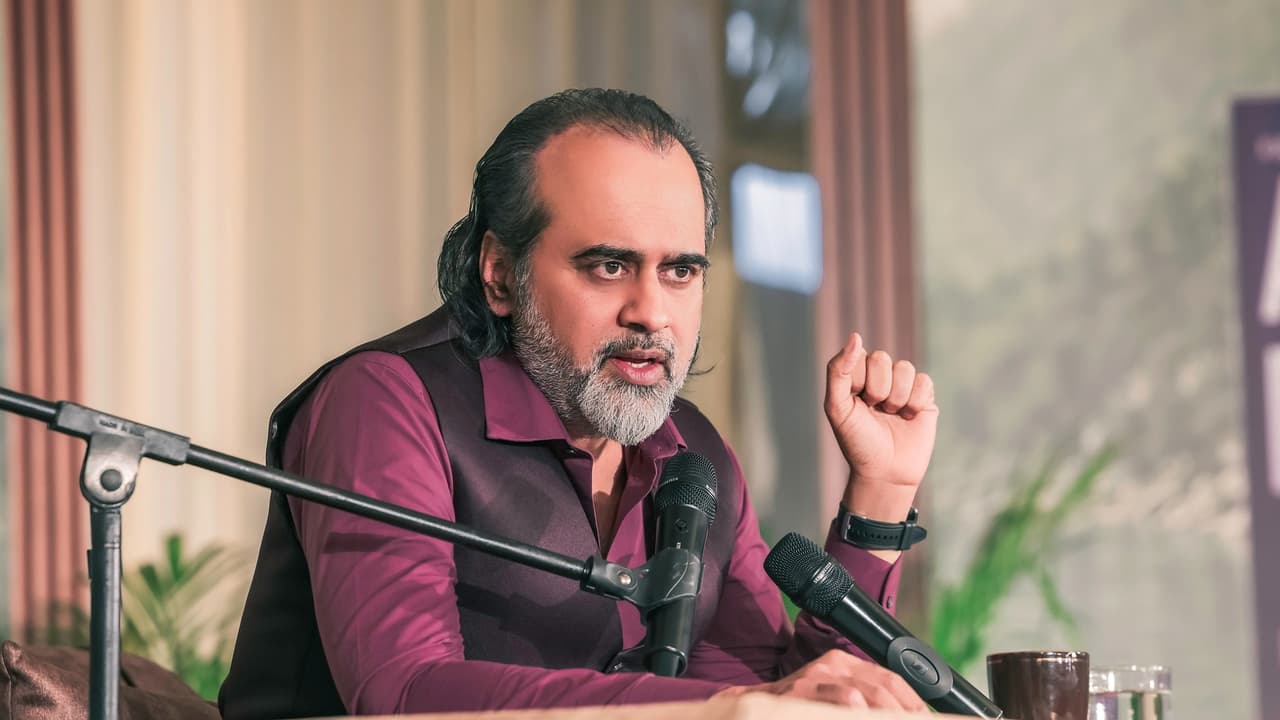
Overview
Fighting Duryodhana is Dharma. Fight Duryodhana in the way you can, that is swadharma. Dharma is the same for everybody, but swadharma varies according to your physical, social, temporal conditions.
But remember that swadharma can never be in contradiction of Dharma; swadharma will always be something…
We gladly worship Krishna the cowherd of Mathura and Vrindavan, yet the Krishna of Kurukshetra, who speaks the Gita, is rarely welcome. Much of what we call religion is a request: we pick a favourite deity, place and ritual, then ask for a car, money or a cure. The Gita values rituals done for desire as little as a pond beside the ocean. Popular religion says, "I want, therefore I act." The Gita says, "Know who you are and then simply let things happen." Which of the two do our prayers come from?
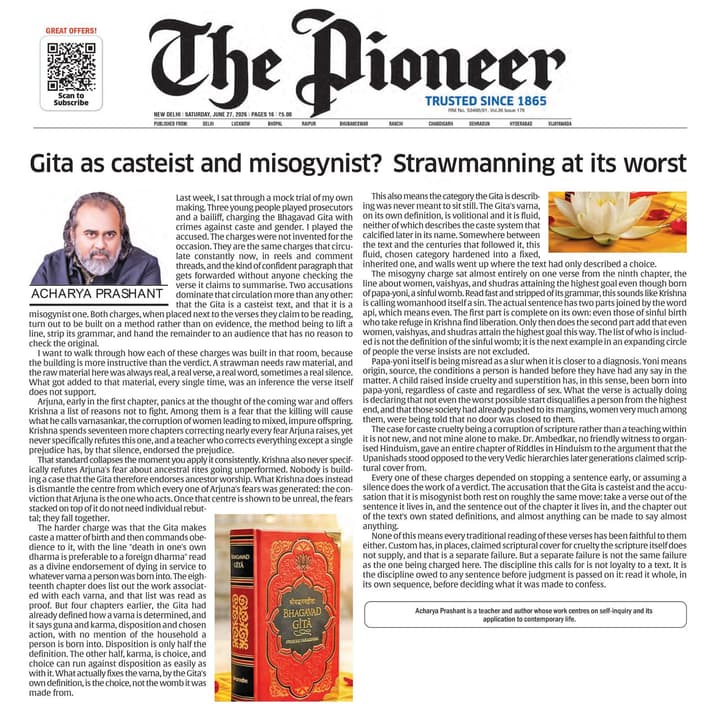
The Bhagavad Gita is often accused of supporting caste and misogyny through selective quotations that ignore context, grammar, and the text's central teachings. A closer reading shows that its emphasis is on inner qualities, conscious action, and spiritual equality rather than birth-based hierarchy or gender discrimination. Misinterpretations arise when isolated verses are detached from their broader meaning, while the Gita consistently points toward self-knowledge, freedom from ego, and the universal possibility of liberation for every human being.
Ghosts and gods and goddesses and all the stories we have read about this and that, obviously, they come from our own minds. Spirituality isn't about God; spirituality isn't about believing in anything. Neither ghosts nor gods. Not only does it say, ‘Do not believe in ghosts, do not believe in God,’ but it’s also so brutally honest that it says, ‘Do not believe even in yourself.’

Questioning pseudo-science and superstition is the first step toward genuine freedom. Beliefs such as *Vastu, Kundli,* and *Muhurat* should not be accepted merely because they have been followed traditionally. Fear and attachment to privileges often prevent people from questioning authority. A truth-seeker must be willing to challenge age, status, and authority. Human progress has come through curiosity, inquiry, experimentation, and reason—not through blind obedience.
Shri Krishna is saying: the mind is conditioned to move towards objects and perceive only their surface, periphery, or form. Develop the practice of penetrating further. Let Truth be your practice. The moment you would look at something, and you are in no position not to look at things being embodied, you would look at things. Nobody said that you have to practice lust. Lust just comes. You might be a total fool, an utter retard, and still you will find yourself getting sexually excited once you reach a particular age. Did you need some practice? No, you didn’t. It just happened. But if you are to understand lust, if you are to cross over, if you are to be a master of your body, then it will require a lot of practice, and that will necessarily and obviously tell you about your predicament.
Drop the center of confusion, come to the center of clarity. Drop what the masses practice, come to the direct route of self-realization. That’s what it means.
True God is the Truth right now in your heart. That is true godliness, true bhagavatta. The problem is that people want to avoid the real living Truth in their heart. Therefore, they come up with stories that place an imaginary God somewhere up in the skies. God is wonderful, but the stories and the imaginations about God are all very disrespectful towards God. When there is love for God, God is held very close to the chest, and that God is called Truth. That God is the very purpose of philosophy and the very origin.