You have to know what you are doing. Once you know what you are doing, then the knowledge itself is the motivator. Whereas, if things are happening in a very unconscious way, you will not know why you should exert yourself at all. If you are somebody who frequently needs to be motivated by an external source, then you should ask yourself, “Do I really know what I am doing?”
Acharya Prashant: Those of you who have tried to chase success in this world know very well that all that you have received is fear. Kindly do not punish your children now. Kindly do not push them to make the same foolish mistakes that you kept making all your life.
Questioner: My name is Rohit. My question is related to failures. At certain moments of life we feel that we have had enough of failures and we are tired of it. Similar goes with me, like I have been trying my best in my life to do everything that I
Acharya Prashant (AP): Are we able to actually put in efforts into anything? Is there really that we have ever given our heart and soul to something? We are talking as if we let effort freely flow through us and what I’m saying would block that flow. Your question assumes…
There is no success in chasing a stupid goal and managing to attain it. If the goal in the first place is unworthy, what glory is there in attaining it more speedily than others?
So do not ask, “How do I get success in whatever I do?” You are trivializing…
We do not do what we can. We do not challenge ourselves enough. We do not make the best, utter and desperate use of our own personal limited resources, but we want some kind of a helping hand to descend from the heavens. It won’t.
A temple must really be a university in the purest sense of the word. When people go to a temple, they must return enriched. You are able to listen to a profound lecture, or to an animated debate. You come to know of things that you otherwise do not know.
Questioner (Q): Sir, many times in life we go through such periods where we lose our hope, and there's absolutely no motivation and we feel very down. And no matter how much harder we try, nothing works out. So sir, how do you push yourself through these worst phases of
Questioner (Q): Sir, I wanted to know how do you find direction in your life? How do you find the mission that you want to pursue and how do you find excellence in every second? That's my question.
Acharya Prashant: The question is that it is alright to motivate somebody but for a real, permanent effect to take place, and for that the motivation should turn into a habit. What should be done to bring this into effect?
Questioner (Q): So, we often have many tasks to do in our day-to-day life and we make a to-do list, but we fail to complete it and the loop goes on every time. So, what can be the other ways to overcome this?
A world champion asks why she cannot sleep when a teammate outperforms her, and why even big wins leave her restless. The restlessness is not a problem but unspent energy, a sign that we have more to give. When every bit of our time and attention goes to what we have chosen, there is no surplus left to worry with. The right fight is never only against an opponent; it is against the ego within. What would it mean to fight so fully that nothing is left to celebrate or mourn?
We often defend a bad choice by pointing to a worse one: stay dishonest or starve, keep the wrong grip or stop playing. But the real trouble is not the option we picked. It is the option we never let ourselves see. Action does not need greed or attachment to find its energy. The third way begins by rejecting both false choices, without knowing what comes next. Which of our everyday choices are really false dilemmas?
Many of us look for role models of our own gender and hope to succeed as a man or as a woman, yet no one great was ever great as a gender. The moment we tie our aims to being a woman or a man, we tie them to the body, and much of our attention goes into how we look and how we are seen. So much around us keeps reminding a woman of her body, from songs to the fear of a street at night. But the body has never achieved anything by itself. What might we attempt if gender stopped mattering?
Sisyphus pushes a rock up a hill forever, knowing it will always roll back down. A regular workman does the same thing inside a job: he keeps pushing too, except he hopes it will eventually pay off, a promotion, a house, a better life. This hope is often just a comfortable lie. Sisyphus, who expects nothing and still keeps going, is actually more honest than we are. The real question is not whether the effort is worth it, but whether we can stop lying to ourselves about it.
Detachment and ambition are not opposites. Both arise from clear insight into what is truly valuable. Detachment means naturally dropping what is seen as false, futile, or harmful, while ambition means pursuing the highest and most meaningful truth with complete intensity. Spiritual surrender is continuous: as understanding deepens, false attachments are repeatedly abandoned, until renunciation becomes natural and almost choiceless.
Success and failure matter less when your work is driven by love rather than outcomes. Setbacks are opportunities to reflect, not reasons to quit, and true failure comes only when you stop trying. Regret and guilt become meaningful only if they transform you into a different person instead of becoming excuses for self-pity. Real growth begins by questioning your assumptions, facing reality honestly, and living with awareness rather than mechanical habit.
Social media has not destroyed attention spans; it has exposed our dissatisfaction with what we consume. The real problem is repeatedly returning to content we already know is empty instead of respecting our own intelligence. Books are only one medium for knowledge, not knowledge itself. What truly matters is reclaiming attention from distractions, demolishing the borrowed mental structures imposed by society, and creating an inner space where meaningful learning, reflection, and self-knowledge can flourish.
All motivation and ambition are rooted in a sense of unworthiness, inferiority, and incompleteness. Motivation is external, meaning an outside force is acting upon you, making you react. If motivation can come from outside, it can also disappear when the outside factor disappears. That’s no way of living a conscious life. However, when you start from a point of completeness, you perform all your actions out of love and joy, and the result becomes irrelevant.
Questioner:* I am Darshan, and my question is very simple yet complicated. So why do we not work? So even after knowing that if we work, we will get something that we are looking for. So, to take an example, I had the opportunity to interact with a lot…
Be compassionate towards yourself, and have faith that freedom is possible and that life can be enjoyed really. Life need not be a melancholy song; it can be a symphony of ecstasy. That faith has to be there.
Do not surrender so easily to the forces of littleness. They will…
Acharya Prashant: Our story is that somebody says, ‘Hey! looking gorgeous today’. And we work up such a nice mood. And somebody says, ‘Hey! Where did you get this haircut from? Take two rupees from me, get a better haircut’. And we feel as if we have been put in…
Excerpts from Articles
ज्योतिष कितना सच है? कुंडली, ग्रह-नक्षत्र: इनका क्या अर्थ है?
वेदांत को केवल इसलिए सही या श्रेष्ठ नहीं माना जा सकता कि वह किसी विशेष परंपरा से आता है। विज्ञान जहाँ भौतिक जगत की वस्तुनिष्ठ जाँच करता है, वहीं अद्वैत वेदांत सीधे मनुष्य के ‘मैं’, उसके दुख, बंधन और मुक्ति की पड़ताल करता है। इसकी कसौटी वैज्ञानिक प्रमाण नहीं, बल्कि अपने जीवन में इसकी सच्चाई को देख पाना है। किसी दर्शन को मान लेना नहीं, बल्कि उससे स्वयं को मुक्त करना ही उसका वास्तविक उद्देश्य है।
Animal cruelty: Who deserves mercy, and who doesn’t?
Violence begins long before the knife or the slaughterhouse—it begins with the ego, the one that draws boundaries, seeks justification, and decides who deserves compassion. Laws and reforms may reduce suffering, but they cannot end violence while the ego remains intact. When the ego dissolves, exploitation ends naturally, and compassion no longer depends on regulation or moral boundaries.
You Don't Understand the Bhagvad Gita, But You Still Claim That You Love Krishna?
The Bhagavad Gita deserves reverence not because of inherited beliefs about its author, but because of its power to dissolve falsehood and reveal Truth. Real devotion is not ritual or blind faith—it is understanding, inquiry, and living the wisdom of the Gita. Through sincere study, one discovers the true meaning of Krishna, making the Gita the most authentic path to knowing and worshipping Him.
कई तरह के डर—अकेले पड़ने, छवि खोने या छोटा समझे जाने—की जड़ अक्सर अतीत में बनी पहचान और कहानियों में होती है। शरीर की हाइट जैसी चीज़ों को समस्या मानकर उनसे जूझने के बजाय उनकी अप्रासंगिकता को समझकर आगे बढ़ना चाहिए। अतीत को दबाने से मुक्ति नहीं मिलती; उसके करीब जाकर अपनी स्मृतियों, धारणाओं और पुराने पैटर्न को निष्पक्षता से देखना ज़रूरी है।
Justice Without Boundaries: Why Compassion Cannot Stop at Species
Oppression should not see caste, gender, creed or colour, and it should not see species either. The moral threshold is sentience, not intelligence. An animal feels pain as fully as a human does, whether or not it can explain its suffering.
Climate change is more than an environmental crisis—it is a crisis of human choices. Our patterns of consumption, consumerism and endless pursuit of more are putting increasing pressure on the planet. But meaningful change does not necessarily begin with new technology or stricter policies. It begins with a deeper question: what are we willing to change within ourselves?
Struggling to choose between a secure job and the path you actually feel drawn to? This isn't really a question about careers. It's about why other people's opinions have so much power over you in the first place. Real clarity doesn't come from finding the 'right' choice. It comes from honestly looking at your own fear, again and again, until it stops running the decision for you.
'Laziness' is an unnecessary pejorative. You’re imposing morality on Prakriti (physical nature) and calling it laziness. There’s nothing called laziness. In nature, there’s a tendency towards work minimization, which is logical—get maximum output with minimum effort. You view it through a moral lens and call it laziness. If something gives more output with less work, you’ll choose it. You call it laziness, but it’s simply efficiency. You calculate the pleasure-to-effort ratio, and if lying in bed offers more pleasure than working out, you’ll naturally choose the bed.
…
…
To go as far as possible for a human being. Do you know how far a human being can go? Do you know what heights can be scaled? That’s what I call real ambition. We live lukewarm lives. Two kids’, two BHK flat, two cars, two air conditioners, two husbands that’s all. Is there anything more that you want? Anything more? Two jobs from the campus that will fill up your heart; two wives, maybe a mistress or a concubine, it’s alright. Anything more that you want? Two bank accounts, one for white money, one for black money; two flats, one for living, one as an asset.
1
Questioner: I worked as a software developer for three and a half years, but then I moved to soft-skills training due to job dissatisfaction. Then I left that as well, and worked in sales for three to four years. I was always interested in the field I was changing my…
Share
1
Questioner (Q): I'm not feeling completely good with myself. So, I'm trying to search for that missing part in others. Every single time I see someone, and I think, “Oh maybe I can be complete with this guy or with that guy”, and it comes irrationally, and I get sick…
Questioner:
How to get success in whatever I do?
Acharya Prashant: Success does not lie in doing any random thing. That is the first, the most important, and probably the last thing. The game is not at all about picking up some arbitrary thing to do and then investing yourself…
Share
1
Real courage is needed only when you fight the real battle, and the real battle is against yourself.
Not all problems are worth facing. Most problems you must totally avoid, even if that means that you will be called a coward by others.
Not all battles are worth fighting. In…
And this is good news,…
…
…
So, when you say, for example, that you are afraid of something, you will have to ask, “What am I really afraid of?” Penetrate it.
Fear tells you, “Something wrong…
Acharya Prashant (AP): You have to know what you are doing. You…
1
Questioner (Q): Sir, how to stay motivated and ambitious even after repeated failures in life?
Acharya Prashant (AP): Our friend is asking that how to stay motivated and ambitious even after repeated failures.
Do you understand what is ambition? Do you understand what is motivation? Do you understand what is…
Firstly, why must you believe that the HIDP is about…
Who is the teacher? The teacher is the most obedient and voluntary of all students. The teacher is not a non-student; the teacher is the first student, the best student, the most voluntary student.
…
Fight a high battle. Be your own hero. Heroes don’t have to cry in loneliness on their pillows, right?
That’s one…
Acharya Prashant (AP): Right the right things…
1
Questioner (Q): How can we remain constantly motivated throughout the academic year and throughout our life also? There are a lot of motivational videos out there, but their effect is short-lived; we remain motivated for a while and then go back to feeling demotivated. But we want to remain constantly…
5
Struggling to choose between a secure job and the path you actually feel drawn to? This isn't really a question about careers. It's about why other people's opinions have so much power over you in the first place. Real clarity doesn't come from finding the 'right' choice. It comes from honestly looking at your own fear, again and again, until it stops running the decision for you.
2
Wrong career choices, unhealthy relationships, and endless entertainment are often symptoms of escaping oneself rather than seeking happiness. Self-deception, ego, and inner dissatisfaction drive people toward temporary relief through social media, gaming, movies, and distractions. Real transformation begins with self-inquiry, honest awareness, and the courage to face reality instead of running from it, leading to clarity, freedom, and meaningful living.
1
Success achieved under pressure or conditioning is not true success because the goal was never truly one's own. Before chasing any achievement, one must ask whether the desire is authentic or borrowed from society. Real change comes not from becoming stronger but from gaining clarity and honesty about oneself. Young people are already capable; what keeps them trapped is the comfort of obeying external expectations. Life is too short to spend serving invisible masters instead of pursuing what one genuinely loves and understands.
2
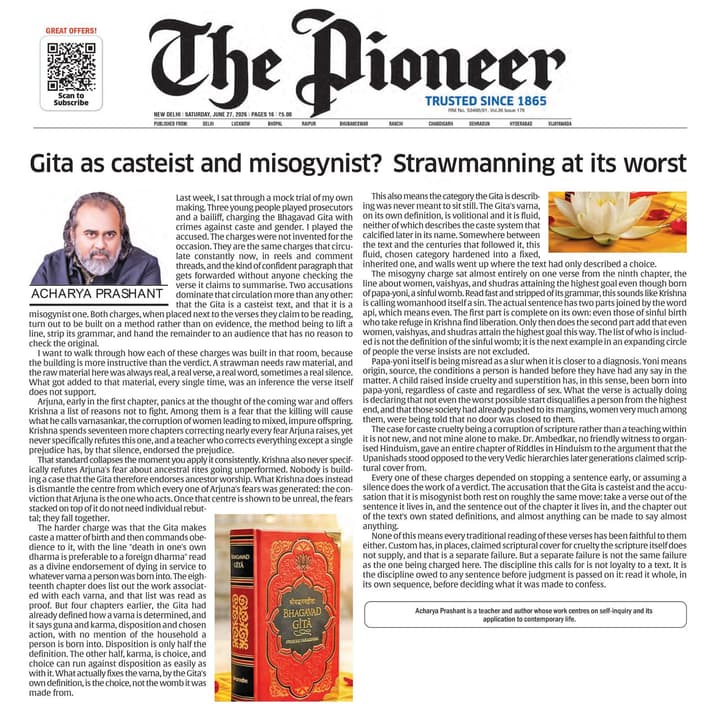
The Bhagavad Gita is often accused of supporting caste and misogyny through selective quotations that ignore context, grammar, and the text's central teachings. A closer reading shows that its emphasis is on inner qualities, conscious action, and spiritual equality rather than birth-based hierarchy or gender discrimination. Misinterpretations arise when isolated verses are detached from their broader meaning, while the Gita consistently points toward self-knowledge, freedom from ego, and the universal possibility of liberation for every human being.
True dedication does not feel like painful sacrifice. When a goal becomes love, unnecessary distractions quietly lose importance instead of being forcefully abandoned. Personal growth and contribution to society are not separate; meaningful work naturally benefits both oneself and others. Real freedom is not outward performance but inner clarity. Life should be measured by inner elevation, not by comparison with others’ achievements.
The climate crisis is not merely an external environmental problem but a reflection of inner human greed, desire, and psychological disorder. Drawing from the Gita’s idea of yagya as desireless action, it says real ecological healing requires inner transformation. Outer pollution, exploitation, and destruction mirror the ego’s inner confusion, making personal consciousness and planetary health deeply inseparable.
12
Do you get stuck between hope and fear while thinking about the future? The problem isn’t the future, but your intention. Most people look ahead just to remain who they are. The right approach is to use the future as a chance to change. When the goal is truly challenging, there’s no time left to worry or expect results—only to act fully.
1
Saurabh Netravalakar, a software engineer and cricketer, discusses balancing multiple pursuits with Acharya Prashant. They explore how hidden wastage of time and energy prevents genuine progress. The conversation extends to team sports teaching ego-dissolution, broadening identity beyond self-interest, and addressing planetary crises through inner transformation. They examine how religion's core purpose—freedom from suffering—unites humanity despite different practices, and discuss practical solutions to environmental exploitation through proper pricing and intent.
18
It’s far easier to sit on a greatly decorated stage and talk about the virtues of Rudrākṣa, and what kind of water to drink, and why copper is useful; and all kinds of pseudo-scientific nonsense. But to really speak upon a Kabir or an Ashtavakra requires a tremendous understanding which does not come to everybody. If you are a spiritual teacher and you are saying you have not read any scripture, that raises questions on your love for the Truth.
Our mood is always dependent on others and situations. Results have not been up to your expectations. So now you require a morale booster, some motivating speaker. The moment that fellow is gone, your energy also goes away. But there is another way of living. Deep within myself, I find a point that no external situation can touch. Whatever happens, happens on the surface. That will remain stable, uninvolved, a non-participant. Then you are really free.
10
If you do not understand spirituality, you will fail even in economics. Look at how common people live their daily lives. Do we inquire into what we are doing? We do things because others are doing the same things. Out of ignorance, you act; and out of greed, you keep acting. Economics does not address the problem of ignorance. Economics also does not address the problem of greed. It is the Upanishads and the Gita that address these problems.
Superficiality offers pleasures. Superficiality offers cheap salvation. Therefore, it is easy to be attracted to superficiality. On the other hand, true spirituality challenges you to pay a heavy price. So, you see, all this knowledge has existed since antiquity. Yet there are people who do not want to read the Gita.
All of us want a new future. But the brain cannot want anything new. How many of you would want to taste a dish like Kakatua? Forget about tasting it, you haven’t even heard the name before. So, there is a golden rule: all desire is nothing but a stale repetition of memories. Ambition is nothing but a repetition of the past. What you didn’t know in the past, you can’t want in the future. New is new only when it is totally unrelated to the past. The truly new comes as a surprise.
37
There is no revolution possible without the Gita. That’s the reason why even those who are not remembered particularly for their spiritual inclination, people like Subhash Chandra Bose, even they founded their core on Gita. What kind of revolution can you do if it’s the body that’s always at the top of your mind? You require a Gita to tell you that this body is perishable and would anyway go. Gita only teaches you, "Endure and fight."
5
Shri Krishna is saying: the mind is conditioned to move towards objects and perceive only their surface, periphery, or form. Develop the practice of penetrating further. Let Truth be your practice. The moment you would look at something, and you are in no position not to look at things being embodied, you would look at things. Nobody said that you have to practice lust. Lust just comes. You might be a total fool, an utter retard, and still you will find yourself getting sexually excited once you reach a particular age. Did you need some practice? No, you didn’t. It just happened. But if you are to understand lust, if you are to cross over, if you are to be a master of your body, then it will require a lot of practice, and that will necessarily and obviously tell you about your predicament.
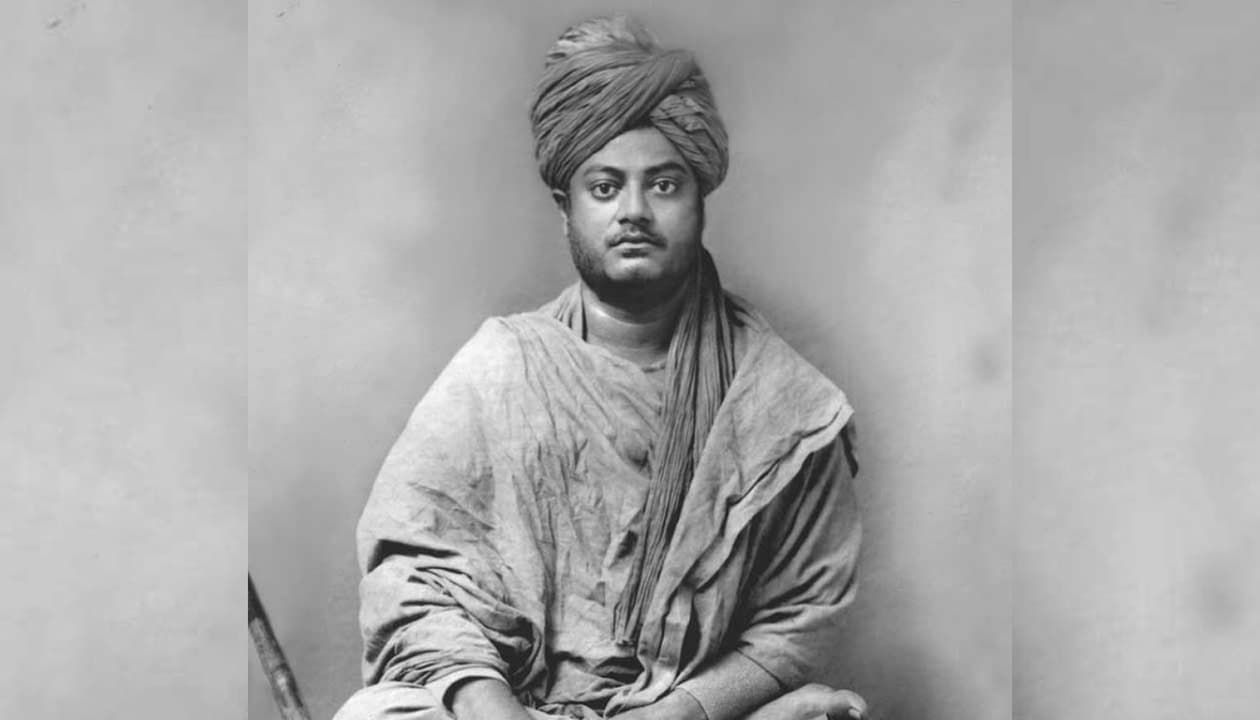
We love to talk of Swami Vivekananda as a youth icon. And I am asserting that were he to be here today, it is the youth that would resist him the most. When he returned from the United States, a huge procession greeted him, right at the port. But when he asked for just a hundred people who could be his soldiers, he was denied. Nobody wants to accept a Swami Vivekananda. He was resisted then, he would be resisted even today.
You can tell someone, “Kid, this is the path of destruction. Leave it!” But you cannot forcefully pick the kid up and take her away. You know something is not right for the other person, and yet you can’t help her from doing it. You can’t give up, you can’t get angry, and you can’t stop what is happening. Great powerlessness. That’s how a Teacher feels.