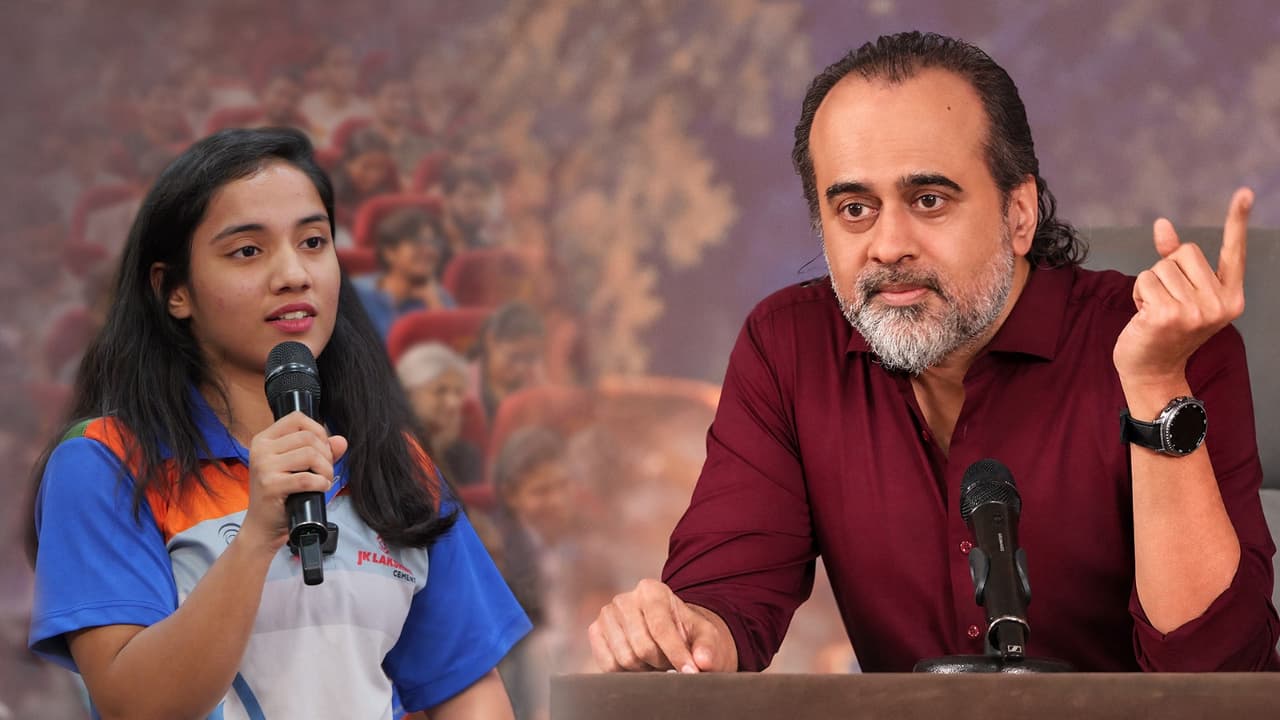
Beyond Self: Cricket, Consciousness, and Collective Survival

Acharya Prashant

50 min
310 reads
Beyond Self: Cricket, Consciousness, and Collective Survival
Saurabh Netravalakar, a software engineer and cricketer, discusses balancing multiple pursuits with Acharya Prashant. They explore how hidden wastage of time and energy prevents genuine progress. The conversation extends to team sports teaching ego-dissolution, broadening identity beyond self-interest, and addressing planetary crises through inner transformation. They examine how religion's core purpose—freedom from suffering—unites humanity despite different practices, and discuss practical solutions to environmental exploitation through proper pricing and intent. This summary is AI-generated. Please read the full article for complete understanding.

Acharya Prashant: Your time was quite competitive also.

Saurabh Netravalakar: Yes.

Acharya Prashant: From your own area, Zaheer, Agarkar, these guys.

Saurabh Netravalakar: Yeah. I used to be in and out of the side. I played for Mumbai Ranji Trophy. Under 19, I played for India in the 2010 World Cup. But then engineering I was doing 2009 to 13, that was very exactly clashing with my peak under 19 days. Somehow I balanced both and juggled.

Acharya Prashant: In fact, it's an interesting background. Most professional sports persons do not have the kind of academic pedigree you have. So to have managed both is remarkable.
Saurabh Netravalakar: So Acharya ji, my question was essentially, I'm tying down my journey to the teachings now that I can look back to it. So I've always grown up having a deep existential crisis. What's going on in the world? How does the world work? So I naturally gravitated to math and science. And in my community, it was cricket-crazy. So I've always, day and night, used to play cricket in the building, and that's how I grew up with these two loves. And somehow came through the grind, age groups and all that.

But, like, you know, in India both fields are so time-demanding, you need to practice four, five hours and then there is the travel time. I grew up in Bombay, so I used to go into the local trains of Mumbai after school and all that. So somehow, through the support of my parents, who used to help me do my homework on the train and all that, and then my coaches also helped a little bit. But it tested my passion and my love for the game.

Engineering time and my 11th and 12th were the hardest years. I was actually preparing for IIT-JEE as well. And when the JEE was there, I got picked for the Indian under 19 team, and I couldn't give JEE. I played in the World Cup. I came and I gave the state entrance exam, and then into the four years of engineering again, journaling five hours attendance with the tournaments and all that.

Somehow a path treaded. But certain things got lost as well. For example, I didn't have the cushion to spend extended time with friends and family. But still, the true friends that had to stay, stayed.

And the teaching that came to mind now, that I look back, is the Ishavasya Upanishad first shlok, where you say, “īśāvāsyam idaṁ sarvaṁ yat kiñca jagatyāṁ jagat.” If you're fully devoted to the Truth, the Truth shows you some kind of a door and something opens up. So I'm really grateful for that. But I see in India especially, I've seen both sides. On the engineering side, talented cricketers who, under either the pressure that they won't be able to manage both, they dropped the sport. Or guys who are really good in sport, they dropped out of school and they gave their best. But in cricket especially, there's a very low rate of success because there are just a few seats in the Indian team and you don't get grades all the time. And then I see them now struggling to make ends meet.

So what's your take on how one should approach it when one loves something? And how do they take that leap of faith? I myself was at least adamant that I had a deep interest in this. I wanted to know more, so that kept me going. What's your take on that?

Acharya Prashant: Saurabh, one would like to frame it as an either-or kind of dilemma. It's cricket or studies. It's passion one or passion two. Responsibility one versus responsibility two or love. Responsibility and love. That kind of dilemma is how one would instinctively want to frame it as. But probably it's not that way.

There are probably more than two variables in the equation. We want to believe as if it's between X and Y. Probably there is S, T, U, V, Z all hiding somewhere and consuming our time, energies, resources, and commitment. And since we are not talking of them, therefore their allocation remains untested, unquestioned, untouched. So let's say out of the 100 units of my life energy, my attention, time, money, everything, all that I may command as a person, out of 100 units of that, there is some 30 – 40 that goes towards X, and there is a new Y calling me: a beautiful Y, a deserving Y. It would appear that I'll have to allocate resources to Y from the 40 units that I presently allot to X.

We do not question where the remaining 60 are going. That's the S, T, U, V, Z. They sit, they hide, and they very quietly steal our life energy. That's where the pruning is really needed. That's where we need to shine the light. Probably even 60% is an understatement; maybe more than that is consumed by unseen variables, unknown factors hiding silently in nooks and corners of our consciousness, but nevertheless extracting their share, extracting their amount, and we don't test them. We don't test them. So it's a false dilemma: X versus Y. It's a false dilemma.

Saurabh Netravalakar: I agree with you. I think while you were saying that, I connected it to my current life in the US where I am a full-time software engineer as well, at Oracle. So there I optimize in the sense our most of our local games are on the weekends and my training time. What I've done is we've made some life choices where I live very close to work. So if I'm done at 5:00, I'm home at 5:15 or 5:30. Then I have my whole evening to go to the gym or to train. The gym is in the office itself, so I hit the gym there. I take an extended lunch break and do my bowling practice there. So it's not like my work is getting compromised, but I'm finding these other low-hanging fruits where I can sort of squeeze in.

Acharya Prashant: The entire problem in this is psychologically: when we are wasting ourselves, then the register that can note the wastage stands deliberately closed. So the wastage would never be registered. Right? So out of the 100 units, we might be misspending or underutilizing let's say 50, 60, even 70. A lot of people, maybe they are misutilizing even 95, we don't know. But the more efficient ones, I suppose even they are not really putting themselves optimally to work. The result is we feel as if we are short of resources, energy, time, but we are not. And when a deserving candidate appears, it feels like a dilemma, like a dichotomy.

If I go towards X, then Y has to be lost or compromised. Whereas both X and Y can be maintained, entertained, and one can do justice to both, provided one can just edge out the undeserving ones. But we'll never know them because when we are indulging them, then the register stands closed. So that's the thing to notice. I mean, it's 5:00 p.m. Does it not happen? One does not even know when the clock struck 7 from 5, and that's a massive wastage. There is so much that could have happened in those two hours. I mean, imagine, I don't suppose most people gym beyond two hours. Even end to end, it is within two hours, right? But two hours can be just loafed away.

Two hours like, you know, one is in a reverie and one does not know. Looks: two hours. So two hours of gyming sounds like a lot. One has done so much. If two hours of gyming mean a lot, then two hours have equal value anywhere. Why do we not then acknowledge the wastage that happens when one is lying on the bed? When one is lying on the bed and then it's taking one and a half hours to finally sleep? One and a half hours is a lot. And one and a half hours happening daily, and if you can even then compound the wastage, that amounts to a substantial fraction of the life itself.

Saurabh Netravalakar: Yes, yes, definitely.

Acharya Prashant: But one doesn't want to look at it because that would mean questioning one's idle pleasures. And we want to call that as ‘personal time’ or ‘me time.’ Many things, you know, "that's about me." Do I always have to be productive? No, you don't always have to be productive towards others, but you always, yes, all 24 hours, have to be responsible and loving towards yourself.

Saurabh Netravalakar: Yourself. That's true.

Acharya Prashant: You don't have to produce something for others' consumption or social validation. But 24 hours, they all are your life, your time, and you have one single life. So every moment you are accountable at least to one entity, which is yourself. And if we can somehow do that inner accounting a little more rigorously, we'll find that it's not so difficult. A lot of cricketers, for example, would say that even getting into college is impossible along with a professional sporting routine. But you did it, you showed it, and India, then US, and now Oracle, Google?

Saurabh Netravalakar: I work at Oracle.

Acharya Prashant: Oracle. Full-time?

Saurabh Netravalakar: Yeah. Full time.

Acharya Prashant: Full time. Full-time student and a full-time employee at Oracle. And along with that, cricketing laurels. So it's possible.

Saurabh Netravalakar: It's possible. Yeah. It's possible for sure.

Acharya Prashant: And probably much more is also possible without really compromising on anything?

Saurabh Netravalakar: And yeah, the thing you mentioned that the personal time or the me time, yes, I did used to feel that I'm losing out on, say, going out on a college trip for friends, but actually if I now look back, the close friends are few, but I know they're there for me, so they are already there, so not like that got affected.

Acharya Prashant: The rule of thumb is: if something valuable or deserving enters your life and displaces away something else, then that something else by definition is undeserving. If something deserving, valuable, important, lovable enters life and because of that I have to compromise on something else, then I need not regret the loss of that something else because that something else by definition would be something that couldn't stand the weight of the deserving entrant.

Saurabh Netravalakar: Makes sense. No, I agree. I completely agree. So, while talking about sports, another couple of questions I had regarded how sports teaches you a lot of life lessons. So, two questions.

So first question is essentially as a sportsman it is a given that you fail more than you succeed and you have these, so I myself have a routine which I called as "prep, execute, and reflect," and I see that in the community as well, like you prep for your questions, you'll listen to the session, and then you post your reflections. And that process essentially, even if you do that to the best of your ability, like you prepare well, you eat well, you train well, still most of the time you might fail on the field, like you might still lose the game or you might still get hit. You hardly get five-wicket hauls in your whole career; the best guys, they would have got 15, 25 wickets haul, or 100 hundreds of the great Sachin sir, but you would have played more than a thousand games. So that is a fact.

So it ties down to the session we had a couple of days back where we were talking about checking the results of our actions, but I think we shouldn't just check the material statistical outcomes but the process outcomes, where: What did I plan to achieve in the session? Did I actually achieve that? Did I get 1% better every day? And if that is a check and you still get out on a zero, that's still a win for you. Right?

Acharya Prashant: Results are not in binary. Results at the vyavharic level, at the level of practical reality, are always relative to where you stand. So if your mental model, as we were discussing, if your mental model results in improvement over where you have previously been, then the model holds good. Result does not mean it's a binary between victory and defeat. Obviously, you might bowl a beautiful delivery…

Saurabh Netravalakar: Get hit for six.

Acharya Prashant: And it not only gets hit for six, it beats the batsman, beats the stumps, also beats the wicketkeeper.

Saurabh Netravalakar: Yeah. They say it's too good to edge it. Yeah. Yeah.

Acharya Prashant: And the batsman gets a four because it swung so viciously even the keeper couldn't gather it. And that's what you get for bowling a beautiful ball. It happens. And rank bad deliveries sometimes you get a wicket.

Saurabh Netravalakar: You get a wicket on a full toss a lot of time, especially in T20.

Acharya Prashant: Yeah. So it's not about a particular outcome relative to others. It is not about whether you could beat the other, the other in the form of the batsman. So yes, it is relative, but not relative to the other out there who is uncontrollable.

Saurabh Netravalakar: Who is uncontrollable.

Acharya Prashant: Who is uncontrollable. It is relative to this one (pointing towards oneself): Was this delivery actually better than the one I have previously bowled? Am I a better person? So that's the improvement, that's the result one has to keep an eye on. Am I getting better? Am I getting better? External results, frankly, no one has any control on, just no control at all. Therefore, it makes no sense bothering too much about them.

We glorious uncertainties, especially in cricket. You can get out the first ball. So much can happen. I mean, once this is, it's not even something that happens on the field in terms of numbers and stats and performances. You sprain an ankle as a fast bowler, your entire career is gone. Especially fast bowlers, they are prone to all kinds of injuries: shoulder, back, knees, ankles, just everything. So how does one control that? And one did nothing. I mean, one could slip. One's foot lands wrongly and the career itself is gone.

So it's not about variables outside of oneself. It's about the inner thing. Am I getting better? So I do something and then I must check whether this is genuinely leading to an inner improvement. Inner improvement in two terms: my own performance relative to myself, relative to my own previous performance. Second, do I feel more fulfilled?

Saurabh Netravalakar: Yeah, honesty to yourself is important.

Acharya Prashant: Do I feel more fulfilled?

Saurabh Netravalakar: Makes sense. I think this shift I learned from actually Ricky Ponting, who is my coach in one of the teams that I play for in the US. They are very process-oriented, like we have a proper data analyst the day before the game. We have our plans. If I execute my plans and if I get hit, they don't question anything. They're actually happy. But if I don't do what I planned, that's when you're held accountable. I think that's what I liked about them. It's very process-oriented, but it's still objective. It's not inner where you can lie to yourself.

So that's what I learned from the day before yesterday.

Acharya Prashant: That's the honest way of going about the business of life. One cannot take credit for random outcomes. There was no discipline, one didn't follow the process, one didn't stick to the script, and still one got three or four wickets, and I don't think that deserves to be celebrated. On the other hand, as you said, the thinking was right, the execution was disciplined, and then one returns without a wicket or even gets hit. I don't think one can be blamed. In fact, one deserves a pat on the back to stand by the discipline of the plan in spite of getting hit. So that, in fact, deserves a longer pat on the back.

Saurabh Netravalakar: I've learned that the hard way. I've been in that case where I've not done well, I got a five-wicket haul and thought that I did something great, and then next day I get a wake-up call. The sport humbles you soon. So I've learned that. Yeah, that's been great...

Acharya Prashant: And that's the typical way of the ego: doership. Doership;cClaiming credit where it deserves none and playing the victim where there was actually no external agency planning deliberate harm. And still playing the victim as if the entire universe has hatched a conspiracy.

Saurabh Netravalakar: I've been in that state as well. Yeah. So the other question that ties from this is at an individual level we spoke about; now at a team level.

So in team sport, the question is that basically we talk a lot in cricket like individual brilliance can at best win you a couple of matches here and there, but if you want to win a tournament, it has to be a team effort and you don't have to be the hero in every game. You can just do your role to the best of your ability and essentially collaboration is mandatory to actually achieve your goal, the ultimate goal. You might have randomness like we discovered, you might do individually brilliant here and there.

So extending that to two levels: one is at a human level where we see so many conflicts in the world, I think the main reason is because people are trying to have power and do good themselves rather than let good be done. So how can we extrapolate these learnings from sport to a general life level where we learn to collaborate with each other irrespective of our cultural differences and all that?

Acharya Prashant: Yeah. Great. You see, individual sport versus a team sport like cricket involves a broadening of the ego boundary. I am this body. When it comes to tennis, when it comes to tennis, who am I? The "I" will be defined as this body. When it comes to cricket, the "I" will be defined as 11 + 3 plus the support staff and coach and manager and maybe even the larger something. Do you get this?

So when it comes to tennis, this "I" has to win for itself. It has to take care of only this one (pointing towards oneself). When it comes to cricket, this "I" has to submit itself to the service of the larger "I," which is at least the 11 people on the field. Right?

So that demands a spiritual discipline as well.

Saurabh Netravalakar: And the captain who commands the ship.

Acharya Prashant: And the captain who commands the ship instructions. So, that demands a certain spiritual sense, you know, it's not about me; it's about this collective, this collective, right? The unit is not the individual but the team; the unit is no more the individual but the team. In fact, the individual has to give up the "I" and subsume it to the identity of the team. And this is spiritual.

Saurabh Netravalakar: I'm remembering Hanumanji basically, you're submitting yourself to Ram.

Acharya Prashant: Submitting yourself. No? It's as if the team is the body. The team is the body and let's say you're the left arm. If the left arm starts behaving as if it's a separate individual, then the body will collapse because this (right arm) does something, this (left arm) does something else. The heart does something totally different. The kidneys behave as if they are sovereign and the whole system gets dysfunctional and just collapses. If you extend the same analogy...

Saurabh Netravalakar: To the world.

Acharya Prashant: To the world.

Saurabh Netravalakar: That's what is happening I guess.

Acharya Prashant: Yes. The individual ego is anyway a myth, is anyway a myth, but in day-to-day functioning, it appears to hold some ground, hold some validity. In team sport, therefore, something beyond individual brilliance is needed. In fact, we know of many players who could have had longer careers, could they display better team spirit. We know of them. So, they retained their place in the team as long as they were individually very brilliant and indispensable. But the day their career came to a little slant, they were dropped not necessarily because they were performing badly but because they...

Saurabh Netravalakar: Didn't fit in the team.

Acharya Prashant: Didn't fit in the team and they didn't carry the team spirit. We also know of so many matches lost because the players didn't care about the interests of the team. We know of that and that appears very awkward and one sees through that.

Saurabh Netravalakar: Yes.

Acharya Prashant: Somebody trying to hit a six and getting out and where the six is not even needed. The bowler getting angry and bowling short-pitch stuff and getting hit for six, that happened on India's tour to England. Won the first test on the basis of; no, not this tour, the one prior to this one, won the test because of short-pitch bowling and got so excited because the pitches were favorable there (we don't get them in India) that they started bowling just too much short-pitch stuff and were hit all over the park and India lost that test and the series as 4-1 or 3-1.

So if we extend that to the entire planetary community, you see what will happen? I'll have to forget my little self, my little family, my little this, my little that. And forget it not in the sense of compromising it in the term, in terms of realizing that the interests of this one (pointing towards oneself) cannot be separated from the interests of everyone. And that's not a moral position to take. That's a reality. That's not a favor one is extending to somebody. One is just being real because that's the Truth, you know.

Saurabh Netravalakar: And it's necessary.

Acharya Prashant: It's necessary. One cannot fight with the Truth. One cannot dispute facts. We are a team. We are a team, and the definition of the team has to broaden progressively.

Saurabh Netravalakar: Acharya Ji, while you mentioned broadening the definition of ourselves like "I'm not just this, I'm not my family, I'm more than that," if we broaden it to the widest level, say towards the earth, we humans are one species of millions of species. And all us living beings and even non-living entities, we have mountains, oceans, we all are a team and our goal is to sustain ourselves, where I feel we as humans are trying to score our own 100 by doing extreme development just in human interest. What means good to us?

We are exploiting all the resources of this world and we are extinguishing other species. Can sport teach us that? I think like, how do we, right, convey that in a better way to the world?

Acharya Prashant: See, it's like this. 50 balls left to secure a draw. Last pair at the crease, 50 balls to face. And you'll at least land a draw. But there is this one superstar high-achiever ultra-confident one who's batting on 60 or something and he feels that his place in the team is uncertain, at stake. So what does he do? He says 50 balls left.

Saurabh Netravalakar: I'll go for 100.

Acharya Prashant: I'll go for 100. That's Homo sapiens.

Saurabh Netravalakar: We'll score 100, but the team is out.

Acharya Prashant: He would score nothing. He would be out. The team too would be out. That's Homo sapiens. That's our species. The team is planet Earth. What we now need from this last pair is some consideration. The one at the bowler's end is probably a decent individual, some other species, somebody. But the one at the striking end is just too ambitious for his own survival. He won't survive. And when he perishes, because it is the last wicket, the team perishes.

Saurabh Netravalakar: The whole earth perishes.

Acharya Prashant: The whole earth perishes.

Saurabh Netravalakar: It's very dark, but it's true.

Acharya Prashant: Yeah. The fall of his wicket means the fall of the entire team. And maybe it was a seven-Test match series. Very long drawn. Earlier they used to have seven Test matches. A very long drawn series. Right now standing tied at 3-3. So this last wicket actually means loss of a wicket, loss of a match, loss of a series, loss of a championship, and in the case of our planet, loss of existence itself.

Saurabh Netravalakar: That's where we are at, at the tipping point.

Acharya Prashant: Yes, this one is just too concerned about his own century. Can I enjoy a little more privilege, a little more comfort, more pleasures? Can I have them? And the crowd is cheering for him because the crowd are his type. So, if he just lets, if he just leaves a few balls, the crowd doesn't like it. The crowd consists of his friends, his family, his peers. They all want him to hit a six because that's how they have been all their life. So even if some sense descends to his mind, the crowd gets at him and encourages him, provokes him to do something stupid. Whereas what he needs to do now is just drop the anchor and then stay still, stay still and hold on, hang on.

Saurabh Netravalakar: So I guess that ties down to him getting the right message. I think that's what the community is trying to do, where the other coaches and the captains need to send the right message that we're looking for a draw and that only comes from self-knowledge. So the coaches, captain need to be trained and that's what we're trying to do I guess and slowly like I turn to the community I guess hopefully more people will join in.

Acharya Prashant: I don't see any other solution because the enemy is not outside of us.

We are cancerous from within. It's not as if an external pathogen has invaded us. Our own self is the enemy.

So we have become quite good and smart at locating external enemies and putting them down. We also in fact now have technology to shoot down threatening asteroids.

Saurabh Netravalakar: Asteroids. Yes. Yes.

Acharya Prashant: So you can fire rockets at asteroids probably coming towards Earth. But what to do when the asteroid is rising from an inner station? And we don't want to admit that. Why? Because we have no defense towards that. We have developed a lot of ammunition, a lot of armament that is directed externally. And since the armament is directed externally, therefore we want to situate all the problems externally.

Look at the inverted logic. As they say, when all you have is a hammer, then every problem looks like a nail. Since the entire capacity we have developed is externally directed, therefore even if we do get to faintly realize that the real problem lies within, we refuse to acknowledge it. Because if indeed the real problem lies within, we will have no method, no capability to cope with it. Historically, mankind has not developed any such capability. So we want to convince ourselves that all our enemies are out there somewhere. We do not have sufficient knowledge of the universe, or we still have not really mapped the oceans. Oh, the cosmos still remains unknown. Some pathogens are still hiding under the ice sheets or in deep forests; we do not know them. Hollywood, Hollywood for example, look at all the movies involving aliens. All the threats are coming from…?

Saurabh Netravalakar: Outside.

Acharya Prashant: Outside. That's just not true.

Saurabh Netravalakar: Star Wars and everything.

Acharya Prashant: Star Wars, that's just not true. The real threat is inside and we are blowing ourselves up. The doomsday clock: 85 seconds to catastrophe, final destruction. This January it has been reset, and it's not doomsday because of an alien invasion. It's doomsday because we are carrying our destruction inside us, as if the heart itself is a ticking time bomb.

The individual will have to be awakened and that's the role of the Gita community you're a part of.

Saurabh Netravalakar: So that leads me to one question where within the team, in the US team especially, I'm privileged to have interacted with or play with people from such diverse cultures. We have people from India, Pakistan, Australia, South Africa, England, West Indies who have very, very different upbringings and different practices that they follow. But we all have managed to come together for the love of the game, and we know each other as individuals, as work colleagues, as playmates, and we play together with all, and we know we respect each other's struggles and journeys to get here.

So I have seen beautiful instances in the team room. For example, I'm practicing my yoga asanas or pranayam, I'm chanting Om, and at the same time another person is offering a namaz. There an instance happened lately where I was reading the Ashtavakra Gita and they were having another discussion, and we've had conversations about the Bible and everything, but now we are open to hearing out their practices and everything with a blank slate. And I've come to figure out that everybody is essentially seeking peace and love, just that they're conditioned by their respective practices.

But when you don't have that common link, now because we have that bond of coming together for the love of the game, we trust each other or we understand each other that we are discussing for the good of it. We're really inquisitive. But when we are in daily life, we become a little bit hesitant to; what you would say, hear out or actually empathize with the other person's point of view or conditioning, and that is the cause of most of the conflicts in the world. It's your way or my way is better.

So what is that common thing in life in general, apart from the sport, that can bring us all together irrespective of our conditioning, so that then we tackle this larger issue of us being one team? I think the community through the teachings is doing the best at it. How can me at an individual, and what else can be done?

Acharya Prashant: You already mentioned that we all as one species are looking for one common thing, which is peace or freedom from the inner restlessness, freedom from the inner pestering noise, fear, and all kinds of psychosis, random thoughts, this, that, all of that can be put under one umbrella term: suffering. Suffering, that's what every individual is aiming at. But if your religion or your concept of religion does not really aim at addressing suffering, then as you said, religion for you is just a fossilized set of practices.

Having no existential use, it is as if you do not even expect religion to mitigate your suffering. That is the situation of most people. When it comes to religion, you ask them, "What do you expect to get from religion?" and you'll be surprised. Most people will not say that from religion we expect to get clarity or peace. Liberation? No.

Saurabh Netravalakar: Yeah. We talk about small desires, like we should get this, get that.

Acharya Prashant: What do you expect from religion? In fact, a lot of people will say, "Is something to be expected from religion?" It's just a code to be followed. Right? Are we supposed to have any expectations? They won't even know that religion is supposed to deliver something, that even with religion, we must have service level agreements. Religion too is accountable. If you are into something, there has to be a purpose, a quality check, and a delivery level. So for most people, then, religion is just about doing something. It's a deed. It's a thing of practice. Practice.

Saurabh Netravalakar: A daily practice.

Acharya Prashant: A daily practice. Outer or inner. Inwardly I practice my beliefs. Outwardly I practice certain routines. Outwardly routines and inward beliefs, that's what one usually practices as religion. There is not even the expectation that religion should lead to freedom from suffering. There is not even that expectation. So when religion is just beliefs and routines for me, then I look at you as well, and you do not happen to follow my label of religion, let's say. Then I look at you and all that I see is your practices and your beliefs, and they will never conquer.

Saurabh Netravalakar: That's where the conflicts arise.

Acharya Prashant: All you have then is a conflict. Whereas if you can look at the core of religion, you see: okay, all this paraphernalia, all these things on the circumference, they exist to give a clarity to the one at the center. And that clarity is important; that center is important. Now you are no more respecting the things on the periphery; now you know that the things on the periphery are just media, and are just methods to honor the one sitting at the center.

So when I look at you again, I'll have the sense to see that all that you have on your periphery as belief or ritual is just the periphery. At the center, you want the same thing that I do. You want freedom; so do I. You want the Truth; so do I. You want clarity; so do I. Right? You want to be relaxed; I do want to be relaxed. And now this relationship is center-to-center, and the centers are all one. At least in their potential. At least in what they deserve to be, at least in their purest form. The centers are all one, but the peripheries will always be different. If you identify with your periphery and I identify with mine, then we will clash.

Saurabh Netravalakar: So, the goal is to reach the center of the person.

Acharya Prashant: If you reach your center irrespective of what your periphery is, you may have one brand of periphery coming from Arabia, I may have another brand of periphery coming from Africa, but you reach your center, I reach my center.

Saurabh Netravalakar: Then we can talk to each other.

Acharya Prashant: And then we find that Arabia and Africa are not just talking to each other but just melting into each other.

Saurabh Netravalakar: They're actually the same one.

Acharya Prashant: They're actually the same.

Saurabh Netravalakar: Nice. So yeah, on that, just one thing came to mind. I think in one of your Gita sessions you were talking about a mathematical equation e raise to x and you were expanding in its infinite factorial series. So on that actually, after the session, some thoughts came to mind and you heard about the God equation eiπ+1=0.

So that is one equation which has all the mathematical constants and it ends at zero. So I sort of pondered and some thoughts came to mind where the derivation of that equation led to a good spiritual journey which ends at zero or shivoham, like we say. So I'm trying to write a book on that actually; I'd like to share with you.

Acharya Prashant: Wonderful.

Saurabh Netravalakar: So basically, i part, so x is our state. Our x is very like the labels that we follow in our life and outwardly we have infinite desires. That's the factorial series expansion, and then we realize that that's not fulfilling us. So then we try to develop a belief, or i, that is irrational, some irrational belief, and then we realize that each belief is taking us around in circles. Like you said, it's a daily routine that we do. We feel good for some time and then we go about our day and then back to square one. That's when we discover pi, which is the fundamental of a circle, and then sort of that's how I've used some kind of analogy to lead to zero, like a kind of play on words there.

Acharya Prashant: Not just play on words. There is a lot of clarity that just observation of physical nature…

Saurabh Netravalakar: It's very intriguing that these are mathematical constants and they are also called transcendental numbers: pi and e. So it made a fun fact like I built from the session that you had.

Acharya Prashant: Maths is the language of…

Saurabh Netravalakar: The universe.

Acharya Prashant: Prakriti

Saurabh Netravalakar: Yes, yes. And the prakriti is the gateway to the transcendental Truth. So insight into mathematics can become insights into human beings.

Saurabh Netravalakar: Yes, definitely.

Acharya Prashant: Much possible. In fact, that should be the proper purpose of mathematics: to not just take us to the geometrical nooks and corners of material physical reality, but also show us a mirror to who we are.

Saurabh Netravalakar: Because maths, you can see, measure it, and prove it, especially physics as well. And now if you see quantum physics, you can actually prove that the universe is dual in nature. So I took your advice. I think one advice you gave was that you mentioned that you read two, three books at a time of very different domains and suddenly one chapter starts making sense in another, and I think that's what happened with me. I was reading some math lectures, I was reading Puranas and physics, and some things came to mind and then just tried to connect the dots there and it just starts making sense.

So I think that's what drew me to your teachings.

Acharya Prashant: And that also disrupts the ego, because the ego wants to compartmentalize everything. This belongs to this region and that belongs to that region.

Saurabh Netravalakar: It's all one actually.

Acharya Prashant: Yes. The moment it starts converging, the ego will have to cope with it by reducing or by redefining itself. And that new definition, it's still the ego. It's still not dissolved. But the new definition is a better one. Better one in the terms of being less rigid, less narrow, less divided. So, it helps to look at many things all at once. And if one can see the connection between this and that, connection between a mathematical equation and a poem, connection between a man-made building and a natural structure, some hillock maybe or something in a jungle, helps drop the boundaries.

Ego loves the boundaries. If you can see through the boundaries, that helps you get wider.

Saurabh Netravalakar: Yeah. And it's very fascinating how small things can teach you a lot. Like I remember another koan I think you mentioned where raw fruit, if you pluck it, it takes a lot of effort and it damages the branch, but when the fruit is ripe the teacher will just give a push and it gets plucked out; it drops nicely. So small things, math, the physical things that you observe can teach you a lot. I think that's what I've learned as well: to just observe things, try to...

Acharya Prashant: The reason is the ego too is some kind of a physical product, even though it is unreal. Yet even that unreal construct arises out of this physical infrastructure. So laws of physics as well as observations about the physical universe, this physical nature, they all apply to the ego. That's the reason you can have beautiful wisdom tales and koans and all these Bodh stories, because by looking at something physical outwardly, they point at the ego inwardly. And that kind of mapping is possible only because the dimension outside is much the same as the dimension inside. You have laws of physics, laws of Prakriti, all operating outside. They are operating inwardly as well. The difference is not much, just that it is optically visible.

Saurabh Netravalakar: Our senses are outward.

Acharya Prashant: Senses are outwards. Inwardly it is subtler, but much the same thing is happening there. There is an outer clock; there is an inner clock as well. It takes time for the fruit to ripen before it can just, you know, fall from the twig. Similarly, if you see Ashtavakra Gita, you mentioned.

Saurabh Netravalakar: I'm reading it right now.

Acharya Prashant: You're reading it right now. One of the verses will talk of praudha virakti. And what does praudha mean? Ripe; mature; paripakva.

So even detachment is of two types; that's what Rishi Ashtavakra is saying: immature detachment and mature detachment. Immature detachment meaning you are detached only from the objects that you look at (externally).

Saurabh Netravalakar: Not internally.

Acharya Prashant: Mature detachment would mean 'I am void of myself.'

Saurabh Netravalakar: Then the right action happens.

Acharya Prashant: Then the right action happens. Otherwise, I can say I am there, I have detachment towards this, this, and this, but I remain attached to my own being. I am, I am. And I love that, I like that 'I am.' So the ego remains attached to itself while claiming detachment from so many other objects. No, that's not…

Saurabh Netravalakar: That’s not solve the problem.

Acharya Prashant: So, Astavakra would categorically talk of praudha virakti or *praudha vairagya, meaning the ego has to get separated from itself, just as the product of the tree gets separated from the tree itself. Where is the fruit coming from? From the tree itself. But in that sense, the tree itself is getting separated from the tree, because the fruit is coming from the tree. The fruit is the tree. Similarly, the ego has to get separated from itself. That’s praudha vairagya.

That insight you can get not just by closing your eyes, but by opening your eyes and looking at the mango tree.

Saurabh Netravalakar: That's the drishta bhav that we talk about in Yoga Sutras and all that.

Acharya Prashant: So when the intent is right, when you genuinely are considering your inner situation and want to sincerely be relieved of bondages, there, even a simple sight like a ripe mango fruit on a mango tree in the summer season can be very liberating. It turns into a koan, a visual koan.

On the other hand, if you are not ready, even the most determined teacher can't help you. The teacher can try not just teaching, but actually drilling it into you, and it would still not suffice.

Saurabh Netravalakar: So, Acharya ji, last two questions which are kind of like dilemmas I have. Firstly, as a vegan athlete who believes in the concept of ahimsa not a belief, that's a philosophy that is needed; the moment I pick up a cricket ball, I see that it's made of cow leather. The more I start delving into supply chains of the various products, not just limited to the sport but life in general, we try our best to be conscious, but it's a big rabbit hole where the entire society is deeply conditioned to have cruelty embedded in the supply chain. How do we deal with it? I mean, I love the game I play. It's given me so much, but if cruelty is deeply embedded in everything that we do, how do we tackle it at an individual level? What is your perspective on that? I don't have an answer for it.

Acharya Prashant: No, that cruelty is not an object that's embedded in an external process. It's not an external object intervening, interfering, dominating, or doing things of its own. No, that cruelty is there in the subject that is determining and running the process. So, irrespective of how you draw and define the process, if the doer is cruel, there would be cruelty in the process because I'm running the process. If I happen to be cruel, I'll run it in a cruel way.

Otherwise, getting rid of these cruelties would not even take months. Not even months, maybe weeks.

Saurabh Netravalakar: Now we have so much good tech to actually easily replace...

Acharya Prashant: Easily replace. I mean, we have rockets and their noses withstand temperatures of thousands of degrees, right? We have steel technology, and bombers are flying over thousands of miles and their cross-section is smaller than that of the smallest bird. We know material science. We also know manufacturing. We can't manufacture a damn cricket ball without using animal products? It's impossible?

What are all our labs for? Tell me one thing that would be needed in a nation's war effort and see how the labs just get together to produce it in no time.

Saurabh Netravalakar: So it's the intent then.

Acharya Prashant: It’s an intent, It's a choice. The way we are going, if an animal species goes extinct, won't we find a replacement for its products? We would. But as long as the poor species manages to stay alive, or is kept intentionally alive by forced breeding, or something, we won't put any money in R&D. We would say, “If it is so easily available, just skin the animal and obtain the leather and use it in whatever product you want.”

Think of tennis rackets, for example. The strings were called 'guts' for such a long time. All that is largely gone now. In fact, most of the sports involved animal cruelty products coming from there, even musical instruments. But now there are substitutes available because technically it was never difficult at all. All that was needed was the intent.

Saurabh Netravalakar: It's just that effort, if you talk in software terms, to migrate a legacy system into a next-gen technology. There is effort, we don't want to take that effort.

Acharya Prashant: We don't want to take that effort. Even though the legacy system is cumbersome and inefficient.

Saurabh Netravalakar: We still stick to that.

Acharya Prashant: Yeah. We would say COBOL would do just because somebody has done it and it seems to be running.

Saurabh Netravalakar: I did see an ad for a faux leather cricket ball. I hope it catches on, so I'll be following that. That was one thing that really meant a lot to me

Acharya Prashant: In fact, leather is to some extent going out of fashion. These days, if you go somewhere and they tell you “This is leather,” you must categorically ask, “Is it animal leather?” and they'll tell you, “No, it's some other leather.” I don't know the exact stats, maybe somebody can illuminate me on that, but leather to a significant extent has already gone vegan. We still call it leather, that's another thing. But, for example, the seats in most of the cars are faux leather.

In fact, premium brands, even Mercedes, since the last three years, have dropped animal leather altogether. That's what we come to hear.

(Pointing towards the listener) Can you check that? There were many important car manufacturers; they are not using animal leather anymore. What does it say?

Vegan leather market growing at a CAGR of 11%. And we are already in the middle of the forecast period, so the prediction seems to be holding true. How much is this out of the total leather products market? I mean, if it's even 10%, I would not be disappointed.

Saurabh Netravalakar: Tesla has Faux leather. is used.

Acharya Prashant: In fact, it has started sounding a little regressive and brutal. If you demonstrate animal products on your body or in your surroundings or as your possessions.

Saurabh Netravalakar: It hasn't reached food yet to that level.

Acharya Prashant: But it's slowly becoming a part of culture and consciousness. Shoes, so many brands, they first introduce vegan leather experimentally. Now, most of what they have is vegan leather because it's relatively inexpensive also. Belts, waist belts, again, it's easier to find a vegan waist belt now.

Saurabh Netravalakar: And easier to convince the people also because they're not forgoing their sensual pleasure for that. Like food is hard because taste is the…

Acharya Prashant: Yes, yes. Food is hard because the industry is much, much bigger and the corporate interests at stake are deeper, way deeper. Otherwise, even food can be challenged. If tastes are not changing, it's not so much because of individual resistance but because of corporate stakes and determined corporate resistance.

Listener: Traditional leather is 5.7 to 7. So it's 11.1 for vegan versus about 5 for traditional.

Saurabh Netravalakar: That's good to hear then.

Acharya Prashant: That's very encouraging. Very encouraging.

Saurabh Netravalakar: Okay, I'm glad. That's good to hear.

Acharya Prashant: So it's coming to the cricket ball soon.

Saurabh Netravalakar: Hope so. Acharya ji, last one. Being in a tech field, I work as a database software engineer. I work in search technologies and I've seen the boom of basically people wanting a sub-second result on the search. Now they're asking for 50 milliseconds, 10 milliseconds, 20 milliseconds. And LLMs, people don't realize while searching a query or asking a question to the amount of heavy lifting that goes on in the back end, or the amount of computation, or the amount of data replication that happens. All that is translating into a physical data center somewhere in the world which is using tangible physical resources, precious resources of the earth. So where do we draw a line?

At the same time, this podcast and great content also comes on the same platform. Where do we draw a line that we're good enough for? Now let's focus on the quality of the content that we spread on the internet versus trying to unnecessarily over-optimize or overkill as compared to the resource usage.

Acharya Prashant: We must know the value of something, real value. This is the way the equation must proceed. I must know what I need, truly need. Not a conditioned need, not a flimsy need, not an impressed need. My real need and what I really need is what must be taken as valuable. So, need determines value and value must determine price. What I really need is valuable. And if it is valuable, that must reflect in the price. And that which is not needed but being supplied.

Saurabh Netravalakar: And over-optimized for. Acharya Prashant: And over-optimized, must not be allowed to hold a market. Therefore, economics has to be intelligently used. There has to be the right kind of taxation. Why am I being allowed to use something, first of all, that I don't really need? Secondly, being allowed to use it without bearing the full cost of it?

Saurabh Netravalakar: The cost of it. Exactly. Because first we used to have storage, hard disks and all that, so we knew that space is getting used. Now we can take ten photos easily. Each of them is going to be replicated five to ten times and it's high resolution.

Acharya Prashant: The problem is not fundamentally that the photo would be occupying X space and then 10X space. The problem is I'm not being made to pay for it. If I really know myself and I really think that that particular pick holds so much value, I must pay $100 for it. Then fine, then fine. The thing is, I don't even really need it, but I am using it because it is being provided to me free of cost or at a highly subsidized rate. And whenever there is a subsidy, there is somebody bearing the brunt of that subsidy. And right now, who is it?

Saurabh Netravalakar: The planet.

Acharya Prashant: The planet. And the other species. And among human beings, the underprivileged ones. The poor are subsidizing the rich. Animals are subsidizing human beings. The forests are subsidizing the cities. That's how the equation is running and it's a very, very unfair equation.

Saurabh Netravalakar: Yeah, that makes sense. If we are made to pay for it, we'll automatically start using...

Acharya Prashant: If I'm being made to pay for it, I still think it's a genuine need.

Saurabh Netravalakar: You'll still do it.

Acharya Prashant: Then I'll do it. And then all the nonsensical usage will stop.

Saurabh Netravalakar: Automatically. Yeah, that's a good solution, I guess. Yeah, I agree with that. Yeah. Yeah, I guess that's all I can think of right now. Really grateful for this opportunity to get to talk to you.

Acharya Prashant: You're most welcome.

This article has been created by volunteers of the PrashantAdvait Foundation from transcriptions of sessions by Acharya Prashant
Comments
LIVE Sessions
Experience Transformation Everyday from the Convenience of your Home
Live Bhagavad Gita Sessions with Acharya Prashant
Categories