The soul is a myth. Even god is a myth. Spirituality has nothing to do with soul or gods; these are mental concepts. The mind itself is a myth. The experiencer himself is bodily, the experiencer and the body are one — how can there be an out-of-body experience? The reality is that you experience your own existence, and that is called the ego. The ego is an accumulation of influences, impressions and when those are cleared away, what you have is the freedom of the ego, and that is called the Truth.
Acharya Prashant: If one is living rightly, then youth is the permanent state of one's mind. The body can grow old. The mind cannot grow old if one has lived rightly. Youth, that way is your default state.
“The fact is that the mind is only a bundle of thoughts. How can you extinguish it by the thought of doing so, or by a desire? Your thoughts and desires are part and parcel of the mind, and the mind is simply fattened by new thoughts rising up, therefore
Simple living is: when I look at somebody, I do not look at the makeup, I do not look at the brand of the clothes, I do not look at the expression the fellow is wearing; I look at the essence of the person. Direct and simple.
If you are someone who cannot take care of herself, how will you be sure that your presence, your company is not becoming an influence of sickness on the other person?
Be very, very alert about cohabitation. Just don’t start living with anybody. Be very, very conscious of your personal…
It is not at all sufficient to talk of the Truth. One has to live the Truth. The Truth must not sit merely on your tongue but in all parts of your body. Your hands must express it; your legs, your eyes, your ears must express it; not merely your…
Superhero films appeal to our desire to escape inner inadequacy through external power. The fantasy of an ordinary, fearful person becoming extraordinary reinforces the ego’s belief that more strength, money, possessions, or status will bring happiness. Consumerism follows the same pattern, endlessly adding objects to fill an inner void. Real freedom does not come from becoming more powerful or acquiring more, but from honestly seeing and understanding the ego that feels incomplete.
Questioning pseudo-science and superstition is the first step toward genuine freedom. Beliefs such as *Vastu, Kundli,* and *Muhurat* should not be accepted merely because they have been followed traditionally. Fear and attachment to privileges often prevent people from questioning authority. A truth-seeker must be willing to challenge age, status, and authority. Human progress has come through curiosity, inquiry, experimentation, and reason—not through blind obedience.
Desires and beliefs may keep changing, but the deeper tendency to believe, think, choose, and seek fulfilment often remains unchanged. Real transformation begins by examining this constant inner pattern rather than changing superficial preferences. Instead of seeking conclusions about greed or desire, honestly observe recurring behavior and support the truth you already recognize. Expressing that truth can dissolve false identities, relationships, and habits, creating space for genuine change.
What is the relationship between quantum physics, consciousness, and the ego? This dialogue explores where scientific inquiry ends and self-enquiry begins. Through Vedanta, Acharya Prashant explains why the ego clings to its own existence, how beliefs and superstition shape our lives, and why lasting freedom lies beyond conditioned thinking.
Vedanta reveals that freedom is impossible as long as the ego seeks to preserve itself. Meditation may bring temporary calm, but real transformation begins only when the false sense of individuality dissolves. Whether through devotion or knowledge, every genuine spiritual path culminates in the complete dissolution of the seeker into Truth. Liberation is not the experience of Truth by an individual—it is the end of the individual who wants to experience Truth.
The mind is not an independent entity but a structure built and maintained by the ego through thoughts, memories, beliefs, and experiences. Most spiritual practices fail when they become distractions from examining the ego itself. Experiences, emotions, and preferences are often conditioned and unreliable. Real inquiry begins with observing the experiencer, admitting facts without distortion, and applying the same rigor to inner life that science applies to the external world.
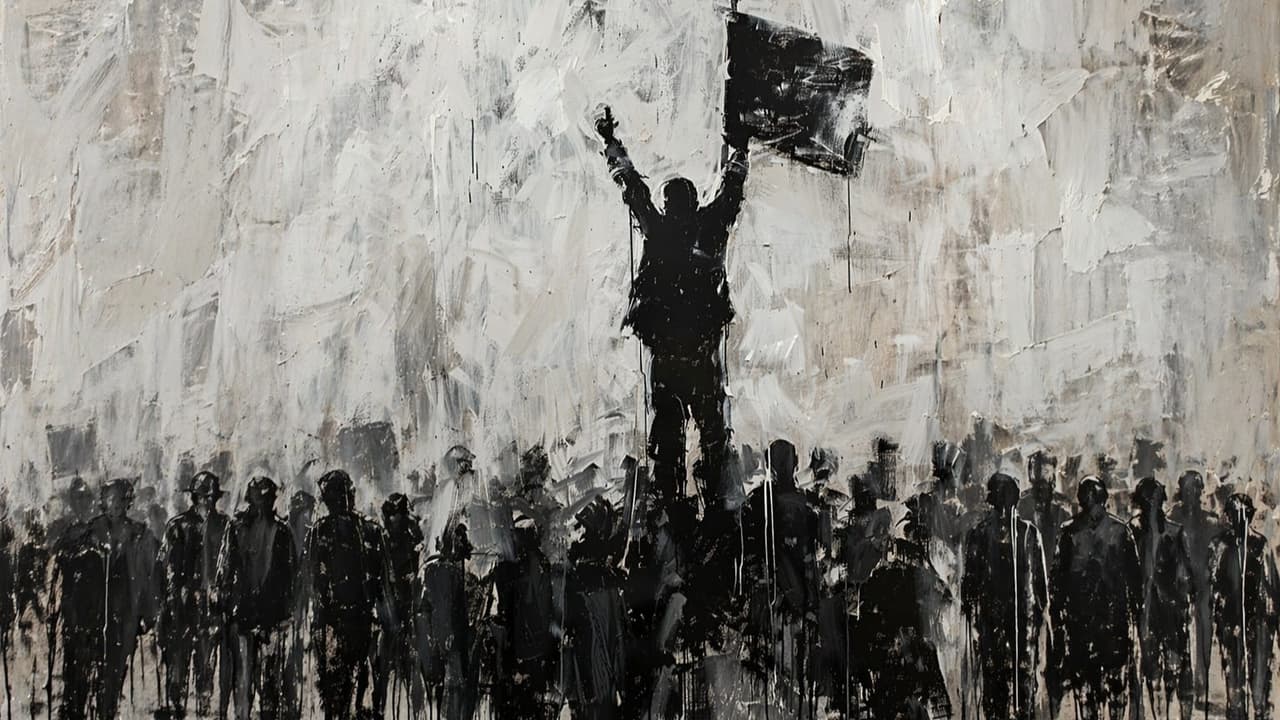
You look at Iran, at revolutions, and ask: can systems really bring freedom? Revolutions keep replacing one system with another, yet the chaos remains. The real question is rarely asked: what within us creates these systems? Real freedom is not political or social; it is inward. Without inner change, every revolution only rotates power, never resolves suffering.
Fulfillment is what you want, don’t you? There won’t be any fulfillment until you break your inner bondages. And the most central, critical, and primary bondage is body-identification.
Use everything that your birth, your body, and Prakriti (physical nature) have given you. Use all of that for the sake of…
Questioner: Would you please be able to explain to us the difference between the mind, the soul, the spirit, and consciousness?
Acharya Prashant: There is just consciousness; that consciousness requires physical support. That consciousness requires a physical support, right? That physical support is called: the man.
When we say consciousness,…
The 'Atma' has no age; it is ageless; the mind has the…
1
You are not born alone. You are born welded to the body. The two of you are born together, and the two of you cannot go together. Born together, but can’t live together, but have to live together. ‘Live together’ not in the sense of reaching a compromise—the two of…
Excerpts from Articles
Stuck Between Job Security and Your Real Passion?
Struggling to choose between a secure job and the path you actually feel drawn to? This isn't really a question about careers. It's about why other people's opinions have so much power over you in the first place. Real clarity doesn't come from finding the 'right' choice. It comes from honestly looking at your own fear, again and again, until it stops running the decision for you.
कई तरह के डर—अकेले पड़ने, छवि खोने या छोटा समझे जाने—की जड़ अक्सर अतीत में बनी पहचान और कहानियों में होती है। शरीर की हाइट जैसी चीज़ों को समस्या मानकर उनसे जूझने के बजाय उनकी अप्रासंगिकता को समझकर आगे बढ़ना चाहिए। अतीत को दबाने से मुक्ति नहीं मिलती; उसके करीब जाकर अपनी स्मृतियों, धारणाओं और पुराने पैटर्न को निष्पक्षता से देखना ज़रूरी है।
Climate change is more than an environmental crisis—it is a crisis of human choices. Our patterns of consumption, consumerism and endless pursuit of more are putting increasing pressure on the planet. But meaningful change does not necessarily begin with new technology or stricter policies. It begins with a deeper question: what are we willing to change within ourselves?
ज्योतिष कितना सच है? कुंडली, ग्रह-नक्षत्र: इनका क्या अर्थ है?
वेदांत को केवल इसलिए सही या श्रेष्ठ नहीं माना जा सकता कि वह किसी विशेष परंपरा से आता है। विज्ञान जहाँ भौतिक जगत की वस्तुनिष्ठ जाँच करता है, वहीं अद्वैत वेदांत सीधे मनुष्य के ‘मैं’, उसके दुख, बंधन और मुक्ति की पड़ताल करता है। इसकी कसौटी वैज्ञानिक प्रमाण नहीं, बल्कि अपने जीवन में इसकी सच्चाई को देख पाना है। किसी दर्शन को मान लेना नहीं, बल्कि उससे स्वयं को मुक्त करना ही उसका वास्तविक उद्देश्य है।
Justice Without Boundaries: Why Compassion Cannot Stop at Species
Oppression should not see caste, gender, creed or colour, and it should not see species either. The moral threshold is sentience, not intelligence. An animal feels pain as fully as a human does, whether or not it can explain its suffering.
Questioner (Q): Acharya Ji, as we know that we are not the body, then why there is such a strong association with the body?
Acharya Prashant (AP): If you are not the body, who is called Rishabh (the questioner)? The wall, the Sky, the woods? Who is Rishabh then?
Q:…
1
Question: Acharya Ji, my father passed away four years ago, but still I miss him and he is in my memory. I don’t know how to deal with this condition. What is this all about?
Acharya Prashant Ji:
You want to remember him as a body, as a person, and…
2
Questioner: In some books, it is written that body does not lie. If you are thinking of something, body shows some messages, some signs. Body is telling the truth.
Acharya Prashant: No, body is not telling the Truth; body is representing the mind.
Body is not telling the Truth; Body…
There is work that one needs to do to run the body, and such work even animals have to do. This you need not call as work; this you can call as labor of living. If you are alive then you have to feed yourself. This even animals have to…
…
I do not…
When you were asked, “Whom do you love?” you pointed towards the body. And now the person is dead—what do you do…
You very well know that you have an urgent task at hand, but the body is yelling for food.
You very well know that the fellow in front of you is a teacher, but the body…
1
Questioner: A few days ago, during my usual morning work commute, I was watching your video on Mansahaar – flesh consumption, you called that the biggest sin, and although I am a vegetarian, my heart cried. My eyes got filled with tears in the middle of the World Trade Center.…
7
वासांसि जीर्णानि यथा विहाय
नवानि गृह्णाति नरोऽपराणि।
तथा शरीराणि विहाय जीर्णा
न्यन्यानि संयाति नवानि देही।। 2.22 ।।
vāsānsi jīrṇāni yathā vihāya
navāni gṛihṇāti naro ’parāṇi
tathā śharīrāṇi vihāya jīrṇānya
nyāni sanyāti navāni dehī
As after rejecting worn out clothes a man takes up new ones, likewise after rejecting worn out…
2
Acharya Prashant: (Reading from listener’s notebook) Be poised, rock firm that you are not the body.
You are already poised that way. And if you talk of being poised that way then you are just dealing in petty change – 10 cents, 20 cents. Then, you are not dealing in…
Question:
Why does it happen that the movements and gestures that we make in our daily life is what others make perception of ours. For example in the past two hours I have been listening to you and I can’t stop noticing the fact that you are moving your legs?
…
Speaker:
What is sense gratification?
There are these senses; Eyes, Ears and all. Sense gratification is to provide the senses with what pleases them. The eyes like to look at pleasing figures, forms. The ears want to hear what they are programmed to be pleased with. The tongue wants to…
8
What is physical cheating? If the relationship exists purely on the physical domain, then you will be greatly offended if you find your partner sleeping around with somebody else, because that was everything that there was to that relationship—the body. The relationship was all about the body, and the body…
Share
Questioner (Q):
Morally, we are supposed to obey our parents for several reasons, we owe them a lot. Is there any point where it is okay to defy them and take an independent decision going against their will and liking, when does this realization come?
Acharya Prashant (AP): See, it…
We often feel that if we love someone, we must think of him or her. In fact, if someone tells us that we stay put in his memories, then we feel assured that the fellow loves us. Isn’t that which is taken often as a mark of love? “Oh! I
…
Acharya Prashant:
Never talk of pleasure and pain separately. Never think that one exists in the absence of other. Never say that pleasure is the absence of pain. In fact, language has played a nasty trick here,
…
Share
1
Most of the lovers, if you go to them and tell them point-blank that what they are experiencing is merely physical attraction, they feel offended.
They say, “No, it has something to do with the soul. My spirit is in love with her spirit. It is not merely bodily. I…
2
Physical weakness does not stay physical. It becomes mental weakness, and the ego, which turns everything into an identity, starts saying “I am weak” because that line brings support and spares it responsibility. Visible strength works even unused: it keeps the opponent outside wary and silences the one within, who can no longer claim to be helpless. Keeping the body strong is therefore a spiritual matter, not vanity. Are we holding on to weakness because it is convenient?
1
A world champion asks why she cannot sleep when a teammate outperforms her, and why even big wins leave her restless. The restlessness is not a problem but unspent energy, a sign that we have more to give. When every bit of our time and attention goes to what we have chosen, there is no surplus left to worry with. The right fight is never only against an opponent; it is against the ego within. What would it mean to fight so fully that nothing is left to celebrate or mourn?
1
We often defend a bad choice by pointing to a worse one: stay dishonest or starve, keep the wrong grip or stop playing. But the real trouble is not the option we picked. It is the option we never let ourselves see. Action does not need greed or attachment to find its energy. The third way begins by rejecting both false choices, without knowing what comes next. Which of our everyday choices are really false dilemmas?
True God is the Truth right now in your heart. That is true godliness, true bhagavatta. The problem is that people want to avoid the real living Truth in their heart. Therefore, they come up with stories that place an imaginary God somewhere up in the skies. God is wonderful, but the stories and the imaginations about God are all very disrespectful towards God. When there is love for God, God is held very close to the chest, and that God is called Truth. That God is the very purpose of philosophy and the very origin.
1
Climate change is more than an environmental crisis—it is a crisis of human choices. Our patterns of consumption, consumerism and endless pursuit of more are putting increasing pressure on the planet. But meaningful change does not necessarily begin with new technology or stricter policies. It begins with a deeper question: what are we willing to change within ourselves?
1
Science can examine material claims, but Advaita Vedanta deals with the subjective self, ego, suffering, bondage, and liberation—areas outside science’s objective framework. Vedanta need not be accepted because of one’s religion or tradition; its value lies in whether its insights can be personally verified and help free one from suffering. The ultimate responsibility is not toward any philosophy, but toward oneself: to live a truly free life.
2
Modern life is increasingly driven by materialism, social validation, and the desire to impress, leaving authenticity behind. When image becomes more important than substance, relationships, education, and success turn into performances rather than expressions of truth. Real transformation begins with inward honesty—the courage to stop seeking approval, confront inner emptiness, and choose authenticity over appearances, imitation, and external validation.
2
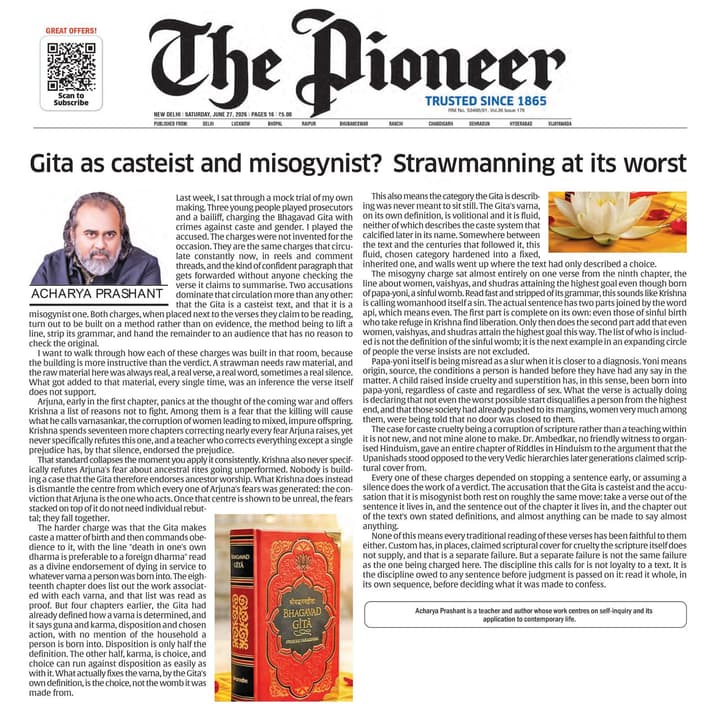
The Bhagavad Gita is often accused of supporting caste and misogyny through selective quotations that ignore context, grammar, and the text's central teachings. A closer reading shows that its emphasis is on inner qualities, conscious action, and spiritual equality rather than birth-based hierarchy or gender discrimination. Misinterpretations arise when isolated verses are detached from their broader meaning, while the Gita consistently points toward self-knowledge, freedom from ego, and the universal possibility of liberation for every human being.
3
Human beings are born into uncertainty, surrounded by beliefs, identities, and social conditioning that offer ready-made answers to fundamental questions. Real spirituality begins not with accepting collective or personal beliefs, but with honestly examining one’s own suffering, fears, and false identities. The journey is not toward comforting ideas, but toward self-inquiry, where truth is discovered through questioning, observation, and the gradual rejection of illusion.
Science and philosophy arise from different kinds of inquiry. Matter seeks continuity of state, while the ego seeks continuity of existence and constantly changes identities to preserve itself. Fear, danger, and suffering are rooted in the ego’s sense of “I,” not in material reality itself. Questions are valuable because they expose hidden beliefs, and genuine learning requires challenging assumptions through inquiry, dialogue, and self-examination.
The climate crisis is not merely an external environmental problem but a reflection of inner human greed, desire, and psychological disorder. Drawing from the Gita’s idea of yagya as desireless action, it says real ecological healing requires inner transformation. Outer pollution, exploitation, and destruction mirror the ego’s inner confusion, making personal consciousness and planetary health deeply inseparable.
3
The debate around nudity and movements like “Free the Nipple” miss a deeper issue: true freedom is not about clothing, but freedom from psychological conditioning and body-based identity. Clothes themselves neither oppress nor liberate. A truly free society is one where the body becomes ordinary and irrelevant, not a source of obsession, shame, validation, or social control.
6
Many so-called spiritual practices falsely promote intoxication as a path to higher consciousness. In reality, this only deepens confusion. True spirituality is about clarity and self-understanding, not external experiences or blind belief. Neither gurus nor media can offer truth. It must be discovered within by honestly observing and rejecting inner falseness, with awareness and sincerity.
Global conflicts stem not from geopolitical interests but from the ego's fundamental incompleteness. Nations are merely expressions of collective egoic consciousness. Leaders represent humanity's worst tendencies, not its average. The ego requires duality and boundaries to survive. True disarmament means detoxifying the ego itself. External wars reflect internal disturbance. No diplomatic solution addresses the root cause, only wisdom and self-knowledge can dissolve the ego's need for conflict and separation.
18
It’s far easier to sit on a greatly decorated stage and talk about the virtues of Rudrākṣa, and what kind of water to drink, and why copper is useful; and all kinds of pseudo-scientific nonsense. But to really speak upon a Kabir or an Ashtavakra requires a tremendous understanding which does not come to everybody. If you are a spiritual teacher and you are saying you have not read any scripture, that raises questions on your love for the Truth.
2
Question: A gentleman was saying that a person, who is drinking or is drunk, he still has got some kind of stability on mind, and he too, can judge. That is what I felt to be perhaps wrong. A person who is drunk probably loses his judgement and whatever we…
8
Acharya Prashant (AP): That which you call “Vipassana” today, is a very recent phenomenon. They claim that it comes from the Buddha, actually, it is not. The stream flowing from Buddha got extinct around the 8th or 10th century AD. This modern Vipassana came up in Burma, just around a…
The one who is religion-less. A real Hindu does not have any religion. To go beyond all religions is to be a Hindu. There are religions that are on one plane, and then there is Sanatan Dharma, which is another dimension — the eternal religiousness. Liberation from religion is religiousness. Sanatan Dharma is awakened intelligence.