Freedom Beyond Systems and Power

Acharya Prashant

21 min
507 reads
Freedom Beyond Systems and Power
You look at Iran, at revolutions, and ask: can systems really bring freedom? Revolutions keep replacing one system with another, yet the chaos remains. The real question is rarely asked: what within us creates these systems? Real freedom is not political or social; it is inward. Without inner change, every revolution only rotates power, never resolves suffering. This summary is AI-generated. Please read the full article for complete understanding.

Questioner: Good evening, sir. So, sir, nowadays protests are triggered in Iran. So, they have gone from economic grievances to an anti-regime protest, and external effects, like the EU has declared their military as a terrorist organization, and America’s military. So, what is your response regarding this situation, and how can there be a peaceful transition without chaos?

Acharya Prashant: You see, you can have a seemingly peaceful transition on the surface, but the chaos will still remain, because the chaos is much deeper than what you see on the surface. I call these 'rotating revolutions.'

1979: the same Iran, the same streets. They were protesting against the Shah, Mohammad Shah Reza Pahlavi, the Islamic Revolution. And many of the grievances that were held against the Shah, that dictatorial regime are interestingly very, very similar to the grievances that the protesters today have against the Islamic regime.

Then, there was the secret police. The Shah had a secret police. Today, you have the Morality Police. Then, there was a dictatorship that was seen as leaning heavily towards Western powers and the US. Today, again, you have a theocratic dictatorship that is seen as leaning away from the Western powers.

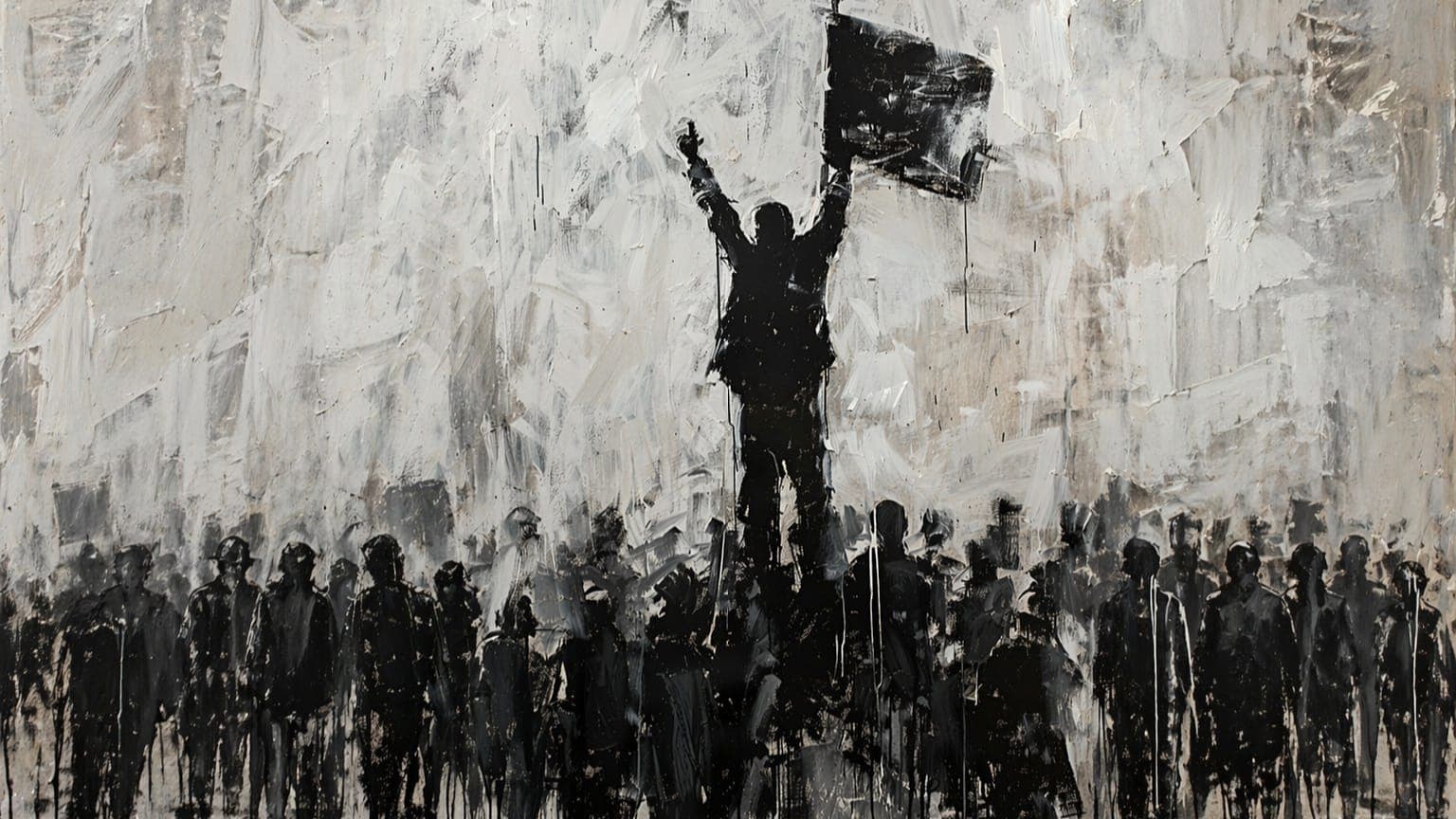
There were economic grievances then; there are economic grievances even today. There was a feeling of loss of national pride and dignity then, in terms of being subservient to Western interests. Today, again, there is that feeling, because all of Iran’s proxies in Gaza, Iraq, Yemen, Syria, many places, Lebanon; they have been demolished, and the US and Israel were able to bomb Iran with impunity just last year. So, again, there is that same feeling of loss of national pride.

So, what is happening? Something very interesting. Revolutions keep happening. Revolutions aim to demolish some external systems. But the revolutionary, the man, or in the case of Iran today, the woman on the street, rarely bothers to ask: “What in me, first of all, created this system?”

So, I am the ego. I create one system. It is dictatorial. It smells a particular kind. It wears a particular color. It chants a particular slogan. I am the creator. I am the ego. And that system serves me not. It cannot make me any better. It cannot bring me real peace, real progress, or prosperity, because the system is, after all, my own baby.

The leaves cannot change the roots, can they? The leaves cannot change the roots. If the revolution itself is a product of an unexamined ego, the revolution, no revolution ever, it’s not related to Iran, no revolution ever can bring lasting peace or freedom.

You look at the world around. The Russian Revolution: “Let there be power to the workers! Let there be power to the workers!” And we got Stalin. And there was a greater concentration of power in Stalin’s hand than even the Czar had. The number of people that were killed for political reasons in Stalin’s regime far exceeded anything that the Czar ever did.

Russia: they wanted power to the workers. China: they wanted power to the common man, the farmers. They said, “No feudal lordships, please.” So, they had the Chinese Revolution and they got Mao, and we know the number of the millions of farmers that were killed, not directly, but due to flawed policies.

So, that’s the game that the ego plays, and the ego is an expert at playing this game. First of all, clamor for democracy: “We want democracy! We want democracy!” Right? And then: “No, no, democracy is the root cause of all problems. We are suffering because of too much democracy.” Does that sound familiar?

When a colonial master is there, then you say, “We want to be the creators of our own destiny. We want democracy.” And once you have democracy, say, 'You know, we are lagging behind China because we have too much democracy.”

We keep playing the blame game at the level of systems, as if systems run people, as if systems make people. See, obviously, we understand systems have power. A woman, for example, living in the Iranian system experiences life very differently compared to a woman in, let’s say, today’s Germany. So, yes, the systems do have power. But out of these two, the ego and the system; the more fundamental one is the ego, and that’s something that the ego never wants to admit.

It would pretend as if the system is everything and changing the system would change life. So, it keeps rotating systems. Communist countries become capitalist. Traditional countries become modern. Right-leaning countries become left-leaning. Secular countries become theocratic. Dictatorships become democracies. Systems keep coming and going, the churn continues. And no system ever suffices because the ego, the producer of all systems, remains unseen, untested, unexamined.

Every time a system created by the ego fails, the ego will never admit, “I have failed.” It will say, “The system is at flaw.” Therefore: Death to the system! Death to the system! It will never say, “I am the fundamental culprit,” and, “Unless I look into the mirror, unless I look at my own flawed assumptions and hollow existence, I will keep producing one system after the other that serves no good.”

See, the ego clamors for freedom, right? In Iran today, we hear ‘Woman, Life, Freedom' and many such things. Equally, you see, when the ego is given freedom, it cannot handle it, because freedom implies responsibility. Therefore, when the ego is actually given freedom, it starts asking for support. It starts saying, “Oh, this is too much load to bear. I don't want so much freedom.”

When the ego does not have freedom, we know the Mahsa Amini case; and the ego has a legitimate urge for freedom that must be respected. Yes. But since the ego does not know itself, therefore it also does not know what real freedom truly means.

Real freedom is not just about having certain rights: social, political, judicial, etc. That's not real freedom. Real freedom is when you are inwardly free. And that is a freedom the ego neither wants to have nor would tolerate.

So, you give democracy to the ego, and what would it do? It would elect strongmen through the democratic route, like what you see in the US today. Because the ego cannot really carry freedom, therefore, it will vote those to power who limit freedom. It is so interesting: using freedom to vote for those whose very agenda is anti-freedom.

And then we keep blaming systems. We keep blaming neighbors. We keep blaming global conditions or economic cycles. We keep saying those things. A lot of people think that the Iranian turmoil is because inflation has touched 40%, or that unemployment is close to 20%. They think it's because of the external hardship that the people are out on the streets. No, not really.

The ego would always prefer to be out on the streets rather than in with the Truth, because it’s much easier to raise slogans, and roll down shutters, and stop traffic, and carry out processions. It’s much easier to do that. The far more difficult thing is to have some self-knowledge, and that self-knowledge is the biggest revolution. But that’s the revolution the ego would be deeply afraid of. In its place, it would go for all kinds of external, this and that.

It’s not about countries. It’s not about systems. It’s also not about politics or religion. It’s about the human being. When you are bored or restless within, do you actually attend to your inner state and want to find out what’s going on, or do you rather choose to stroll out to a mall, buy something, watch a movie, scroll Instagram, or endlessly gossip with somebody who can take your gibberish? The moment the ego finds itself in discomfort, it chooses to venture out. Whereas the root of discomfort is within.

Does that mean that I am being anti-revolution? No. On the contrary, I’m asking for a complete revolution. The revolutions we have had, the French, the Russian, the German, the British, the American, they have all only partially and superficially succeeded, if at all.

A complete revolution means an inner overhauling of the human being. That’s what is needed.

That does not mean that we should not challenge the outer systems. Yes, the outer systems, too, must be challenged. But just challenging the outer system would never suffice. It’s rather a distraction. It’s entertainment for the ego. It provides a kind of self-ingratiating consolation: “You see, I’m not weak. I’m not a coward. I did something.” And what did I do? I chased something on the outside. “I’m not a coward. I’m not dishonest, either.” I chased something on the outside.

And yes, obviously, we do want external change as well. Definitely, we don't want an external system in which women can’t even come out with their hair flying. Mahsa Amini had to die for it. We don’t want external systems in which basic social freedoms are curtailed. So, obviously, external systems too must change, but external change is less than half the job done.

A total revolution would mean the internal system has to change. And from that cleaned, renewed, refreshed inner point, great external systems would arise. We need not predict in advance what kind of external systems would arise. Maybe the need to have a strong structure, a binding architecture of a system would itself diminish. Maybe that’s possible.

It’s possible that when the human being awakens, the very need to rely on an external architecture diminishes. Even that is possible. But that may diminish; that may not diminish. We do not know, and we need not bother about that. The more important thing is: let the revolution start from here (inside) and then proceed inside out.

Our revolutions remain 'outside-out.' They don’t even proceed 'outside-in.' They just don’t touch the inner thing. Let the revolution start from the heart and then proceed to the streets, and the systems, and the parliaments. That’s fine.

Questioner: My question actually has two parts. Let me start with the first: we talked of Iran. We talked of freedom, revolution. Freedom actually means being inwardly free, and revolution is actually total revolution, and the ego never wants total revolution. Right? So, correct me if I’m right, if I understand it right.

We are talking of Iran. So, actually, we are talking of masses here, right? Although masses comprise individuals only. So, a day comes when the masses are awakened, like a 'freedom from' although it is an evolving process. But that day, the kind of suppression that we see in Iran today, the kind of violence or the kind of regime that we see today, and you also talked of systems that we cling to the systems, the system would be completely different. Maybe it would be a democracy; we don’t know. Maybe it would be something else; we don’t know. Or maybe it would be something that we know, but in some other way. But that would be the thing that would happen when the masses are a little awakened. Right? This is my first part.

The second is: but now we are living in reality. Now the condition is that, suppose we are here in India. You are in India; you are doing your work because you know what is right. I’m here in front of you because I know what is right. But if we see Iran; I was reading the news and their protests have been brutally crushed. We don’t know the exact numbers of people that have been murdered or killed. So, what could be the way, how the light would reach to them? In the present times, how would that awakening arise in them? What could be the way? Or, being here, we are talking, we should say that me and you, this event should be so loud, this conversation should be so successful, that the light reaches to them.

Acharya Prashant: Yeah. In fact, you have very nicely concluded your question as the beginning of the solution itself. You see, you and I are not outside what’s going on. Let not the mental model be that Iran is there, China is there, Russia is there, US is there, Europe is there. Even the Indian political system is somewhere out there. The entire flow of all the revolutions in history is out there, and we are standing here, observing all of that. No, no.

Today, we are having this discussion as a living response to what is happening across the world. Right? So, we are not outside of that. We are inside that. And this is the beginning of the inner revolution.

Yes. When we see that as a species, as human beings, we have been restless all throughout history, always. Why do you think that old man, that ancient one, chose to step out of the forest? Why did he take to farming? Why? And from farming, why did he come to industry? And from industry, why did he come to the internet? Why? Because we have always been restless. Right?

So, the revolution which comes from restlessness is not 'out there' somewhere. That restlessness is, in here (pointing towards oneself). And we are seeing how we are coping with that restlessness. What are we doing? We are trying one external solution after the other. So, what you are seeing in Iran today is a form of an attempted political solution. Right? It is an attempted political solution to human restlessness. Are you getting it?

When you say, “I want the kind of generative AI that is able to read even my heart and is de facto acting as my lover,” even that is an attempted solution to inner restlessness. I mean, we have tried all kinds of solutions. This entire edifice of culture, and civilization, and knowledge, and economy, and progress that we have built is nothing but a reaction to our restlessness. Sometimes it appears in the form of a political revolution; at other times, it appears in the form of exploration of outer space. But the basic restlessness is the same.

So far, so good. Should we not also see that the restlessness has not diminished, that we have tried virtually everything that we can try in the entire universe? Fundamentally, from here, we will only amplify what already exists. We will not do anything fundamentally different. And we have tried all of that. We have tried science. We have tried psychology. We have tried politics. We have tried organized religion. We have tried prosperity. We have tried various kinds of economic models. We have tried various kinds of relationships between human beings. We have tried all of that, and that is not succeeding.

Now, what do I do as an individual? I am not just the human being standing here in front of you X years old. I carry the weight of the entire history. I am Homo sapiens, and I have been trying all kinds of treatments to my physiological restlessness since eternity. I am born restless, and I’ve been attempting this, this, this, this: entertainment, adventure, thrill, wars, mercy, you name it. Art, culture, science, I have been attempting everything from the deepest kind of welfare to the biggest slaughters. I have been attempting everything, and I’m still restless.

So, what should be the first honest thing to conclude?

The external direction is not working out. Irrespective of what is done outwardly, the inner problem will not be solved.

Are you getting it?

And that is seen in the middle of the turmoil and the restlessness. There must surely be somebody in Iran who would be seeing this. They would be saying: “Iran has such a variegated history,” right? “It starts with theAryans, Zend-Avesta, Zoroaster, the great battles, then Islam arrives, the Parsis flee, and then the age of Persian dominance.” And all this has been happening. We have been changing everything possible: color, costume, religion, regimes. Then we had the Shah. We changed the Shah. We brought in Ayatollah Khomeini, and now, not even half a century has passed, and we want change? We want change once again.

Somebody within the entire turmoil has to be seeing this or at least honestly acknowledging this: all the external attempts that mankind makes are not succeeding. And that is what the man in the middle of the turmoil has to honestly see. We are not outside the happening. We are within the happening. Therefore, we must be able to see. We have been trying everything, everything, everything. But see where all that has brought us.

The Doomsday Clock was very recently reset, I think just this month itself. And you know how far it is from catastrophe? How many seconds? Just 85 seconds. That is what all our external efforts and revolutions have given us. No other species eats away their own home, their own planet. We have done that.

Look at the US. Look at how he has walked out of all climate deals. Look at how nations are again talking the language of nuclear testing and proliferation.

Obviously, whatever the human being has done in the outward direction to gain peace, freedom, whatever, whatever all the nice words, that has not succeeded. Far from succeeding, it has brought us to the very edge of disaster. Don’t you see where we stand? Youngsters here, most of you, don’t you know what the climate catastrophe means? You know that, right? Because you are the ones to face the consequences in your lifetime, very debilitating consequences, very unprecedented consequences. That’s what the external strife has done.

And once you see that, what do you do? You say, “Wait, wait, wait, wait. Before I take a step in this direction or annul this and move in this direction, I must first of all know who the mover is.” Otherwise, the fact is, I have tried all 360 degrees. There is no direction that the human being has never tried. We have tried everything, and yet we remain discontented within. Therefore, now I need to try out the only direction that still remains to be tested. And which direction is that? The inner direction. Who am I? And why am I so restless? Do I even know where I'm coming from? Why must I be a slave to my opinions or likes or desires? Do I have it in me to go to the root of my own instincts?

Right?

And a revolution, external disorder, is a great place to let these reflections be invoked within you. There was the Kalinga War, and that served as a mirror to Ashoka, because he sat there and said, “No, no. I’m seeing what is happening. I cannot deny it anymore. The consequences are right there in front of me, and this won't work.” Therefore, he was forced to turn within.

So, a new system came up. Did Ashoka resign? Did he run away to the jungle? No. He still remained the emperor. But the very nature of the empire changed. He still remained the emperor, but the whole imperial posture changed. And that’s how a new system arises: when you honestly look at the devastation all around you and say, I have tried out everything, and this is not the way it's ever going to work.

Maybe I have not tried out everything in my own limited lifetime. But when I look at the history of mankind, every possible thing has been tried out and this is not the way it will work out. And then you say, “Dhamam sharanam gachami.” That's the way.

And that does not mean, I repeat, that you have to abdicate the throne. That does not mean that you have to run away from the campus. That simply means that the normal territorial emperor called Ashoka becomes Ashoka the Great. He still remains the emperor. He still uses technology. He was still sending out missions and missionaries, but not to conquer, to enlighten.

Do you get this? I'm not saying one has to copy Ashoka's system or any other system. What I'm saying is: something beautiful arises from self-knowledge. What its nature would be, we cannot predict. But what is certain is we can dismiss that which is surely not succeeding.

What is not succeeding? The outer revolutions, the outer efforts. “Let us conquer new continents.” When we cannot conquer new continents, we want to conquer new planets. “Let us have more to eat.” In having more to eat, we have wiped out 75% of wildlife from the forests. You all know that, right? The rate of extinction of species is 100 times more than the natural rate. It is obvious; it is common sense to see that the external movement, that the external hustle, is very counterproductive.

And that's when you see that the inner revolution is needed. Sitting in the middle of the chaos, sitting at the center of the ruins, and seeing it all fall and collapse all around you, that’s when there is this unmistakable realization, this won't work out. Not on moral grounds, on very practical grounds. This is not succeeding. This is not working out. Something else needs to be attempted.

Questioner: Good evening, sir. Sir, as you said, don't blame the system. But once a person goes out of, tries to go out of the league, or tries to do something new, okay, the system tries to suppress them, or society. So, isn't it confusing? My question is: is society sick because individuals are confused, or is the individual confused because the society is sick?

Acharya Prashant: You see, it's a mutually reinforcing relationship. The ego builds systems to sustain itself. So, if you say the systems are sustaining the ego, you are right. But that does not mean that systems created the ego in the first place. The ego does not come from any external system. If you want to know the origins of the ego, the ego comes from your basic anatomical system. The ego comes from this physiological system, and then it creates a lot of systems outside: the family system, the education system, the political system, the religious system, and all kinds of systems, systems of trade, commerce, all kinds of systems.

If you want to know which one is more fundamental: the ego is more fundamental.

This article has been created by volunteers of the PrashantAdvait Foundation from transcriptions of sessions by Acharya Prashant
Comments
LIVE Sessions
Experience Transformation Everyday from the Convenience of your Home
Live Bhagavad Gita Sessions with Acharya Prashant
Categories