It has been a tradition in India that when you donate, you bow down to the one you are donating to, because he has done you a favour by accepting your donation. Being what we are, it is hardly possible for us to do anything for others. Kindly get over this notion that we live for others. That is the privilege granted only to a Buddha. Only in a state of inner fulfilment can one really do something for others.
No wise man will ever take your problem seriously, believe me. For the wise one, all your problems are bad jokes—not even worthy of a sound laughter. But then he says, "You know, I can see through. You cannot. So, I'll give up my right to laugh at you. I'll instead pretend to be serious." "Yes, yes, yes, of course! We have a problem!" He says, "You know, there was a time I was so much like you. These same things were big issues even to me. But I know they can be outgrown.
Just try figuring out where the thing is coming from. You'll not always succeed. It's a bit of a guesswork but it at least tells you that the thing is not original or authentic, it is coming from somewhere. So you find, for example, some descendant of an aristocratic lineage talking to you and he's talking in a particular manner and if you can see that the manner belongs to his great grandfather that brings a smile to you. Where is the thing coming from? That's not him talking, that's his great grandfather talking.
Acharya Prashant: By looking at one Vivekanand, you start imagining, or dreaming, or expecting that all youth can be like Vivekanand. And in this lies your ingratitude and disrespect towards Vivekanand. You do not know what kind of an impossibility a Vivekanand is. You do not appreciate him, so you
Acharya Prashant: You have to ask yourself what your primary identity is. If your primary identity is that of the body, then do what the body commands you to do. Good. The body has an inbuilt software of its own, and it’s a self-improving software. Its capacity to keep improving
Acharya Prashant: Love and responsibility have to be reasonless. They have to be mad. One has to be crazy enough to put in everything for a seemingly trivial creature.
Questioner: This is a paradox. So far, as I think, often people suffer because they are afraid of Truth. They would rather accept any kind of suffering than to seek into their life. It demands courage.
Shri Prashant: So, in fact, you see, another paradox is that while everyone is…
Questioner (Q): I have discovered that being a little altruistic, a little selfless makes me feel that I am elevating my consciousness. That is what works for me. But one problem associated with this is the problem of the violation of boundaries. So, suppose I want to help a person
The world is all yours if you are first of the world’s master. Have you gone to people who have dogs? If you are on good terms with the master of the dog, the dog comes and wags its tail in front of you. The dog says, “If you are
Question (Q): Dear Acharya Ji, pranam. Since the last few days, I have been sharing my learnings with my parents. Every time I discuss something with them, I have to deliberately attack their conditioned mind to make them aware of their conditioning. I feel sorry for them, and I
If the two of you could together shout and scratch and bite and tear and break—if all those things could be done together, why not meditate and be loving and compassionate together? Or is companionship only for biting into each other?
So, having been companions, now it is your responsibility…
Love is not about admiring somebody’s physicality, or using someone for some means. Love has to be an exercise in compassion. So, I often say, when you relate to the other, relate either to uplift or to be uplifted.
Only two kinds of associations are right in this world. If…
Acharya Prashant: The question is, if one wants to help, how does one go about helping? How does one create the right conditions for the other? Good, practical question.
Questioner (Q): Hello sir, Valentine's Day is coming and for the past few days in our College there has been a an environment of romance and every day there is a new celebration. There is Teddy day, then Rose day and then chocolate day and we often see that these
Many Indian parents keep their children, and especially their daughters, away from sport, even where coaches and facilities exist. The barrier is often not outside but in the parent’s own ideas: poor returns, uncertainty, and fixed notions of what a girl’s life must be. Blaming our own parents does not help either; our life is now our responsibility. Parenting is a decision of the greatest responsibility, and it begins with self-love. Can we love a child if we cannot love ourselves?
The balance between order and disorder should not be decided by personal likes or dislikes, but by what the task at hand requires. Sometimes a project demands discipline and order; at other times, more important work requires leaving things messy. The right action comes from responding to the actual need, not personal preference. Even sacrifice can be meaningful when it serves something important, but “staying backstage” should never become an excuse to avoid what one cannot tolerate.
True freedom begins when we question the beliefs that make us feel trapped. Most of our suffering comes not from circumstances but from unquestioned assumptions, attachments, and imagined obligations. By suspending our beliefs, even briefly, we allow truth to enter, revealing that life always offers choice. Transformation is born from love for truth, the courage to let go, and the willingness to step beyond the boundaries created by the ego.
True love is not a biological instinct, emotional attachment, or social conditioning. Biology and science explain the body's drives, but they cannot explain the self that seeks freedom. Love is the inner restlessness to move from ignorance and bondage toward truth and liberation. Religion is not rituals or inherited beliefs but this personal journey of understanding. Freedom—not possession or conformity—is the essence of both love and religion.
The Bhagavad Gita deserves reverence not because of inherited beliefs about its author, but because of its power to dissolve falsehood and reveal Truth. Real devotion is not ritual or blind faith—it is understanding, inquiry, and living the wisdom of the Gita. Through sincere study, one discovers the true meaning of Krishna, making the Gita the most authentic path to knowing and worshipping Him.
Truth cannot be forced upon anyone, but neither should falsehood be entertained. Genuine love is not about preserving relationships at any cost; it is about helping oneself and others break free from illusion, even if that means risking the relationship itself. Spiritual growth begins by questioning conditioning, examining falsehood without bias, and choosing authenticity over comfort. Real relationships are built on the courage to seek freedom, not convenience.
So the opposite of cruelty is not compassion. The opposite of cruelty is often either attachment or possessiveness or taking care of those who are related to you by way of self-interest. So that's the domain of duality. So yes, it is true that the mind wanders about in duality and then there is hope and there is hopelessness and then there is friendship and then there is enmity. So all these are aspects of duality but compassion does not sit anywhere in the dualistic framework.
4
When you are not bothered about the other, that is when you are totally compassionate. When you are not trying to change the other, that is when you become an agent of change. Compassion is not about thinking all the time of others. You cannot try to be compassionate.
When you are alright, then the sound of your footsteps is compassion. That is what compassion is.
Excerpts from Articles
Climate Change: The Solution Is a Choice
Climate change is more than an environmental crisis—it is a crisis of human choices. Our patterns of consumption, consumerism and endless pursuit of more are putting increasing pressure on the planet. But meaningful change does not necessarily begin with new technology or stricter policies. It begins with a deeper question: what are we willing to change within ourselves?
कई तरह के डर—अकेले पड़ने, छवि खोने या छोटा समझे जाने—की जड़ अक्सर अतीत में बनी पहचान और कहानियों में होती है। शरीर की हाइट जैसी चीज़ों को समस्या मानकर उनसे जूझने के बजाय उनकी अप्रासंगिकता को समझकर आगे बढ़ना चाहिए। अतीत को दबाने से मुक्ति नहीं मिलती; उसके करीब जाकर अपनी स्मृतियों, धारणाओं और पुराने पैटर्न को निष्पक्षता से देखना ज़रूरी है।
ज्योतिष कितना सच है? कुंडली, ग्रह-नक्षत्र: इनका क्या अर्थ है?
वेदांत को केवल इसलिए सही या श्रेष्ठ नहीं माना जा सकता कि वह किसी विशेष परंपरा से आता है। विज्ञान जहाँ भौतिक जगत की वस्तुनिष्ठ जाँच करता है, वहीं अद्वैत वेदांत सीधे मनुष्य के ‘मैं’, उसके दुख, बंधन और मुक्ति की पड़ताल करता है। इसकी कसौटी वैज्ञानिक प्रमाण नहीं, बल्कि अपने जीवन में इसकी सच्चाई को देख पाना है। किसी दर्शन को मान लेना नहीं, बल्कि उससे स्वयं को मुक्त करना ही उसका वास्तविक उद्देश्य है।
Justice Without Boundaries: Why Compassion Cannot Stop at Species
Oppression should not see caste, gender, creed or colour, and it should not see species either. The moral threshold is sentience, not intelligence. An animal feels pain as fully as a human does, whether or not it can explain its suffering.
Struggling to choose between a secure job and the path you actually feel drawn to? This isn't really a question about careers. It's about why other people's opinions have so much power over you in the first place. Real clarity doesn't come from finding the 'right' choice. It comes from honestly looking at your own fear, again and again, until it stops running the decision for you.
Questioner: We have a question by Pooja. So people who try to become self-aware and you know knowledgeable of themselves. They usually became the black sheep of their families.
Question by Pooja is what can we do if our loved ones, that is spouse, parents, friends are not receptive to…
…
…
Acharya Prashant: Leaving what is not, That is all right, but that leaving is not done with an objective to get joy. Had the thing been so transactional that you could leave one thing and as an exchange offer get another thing, then everybody would have taken the deal. Were…
2
Questioner: Good Evening Sir. My name is Tarun Singh from IIM Nagpur. Sir my question is this, actually we understand this thing that in life everything is temporary. Be it my existence on this earth, or any relationship, or my friendship, or any environment around me, everything is temporary. So,…
8
Who is most like you? You, yourself. So, be empathetic to yourself first. Then, who is most like you? Your mother, father, siblings; show empathy to them. Then, your neighbors, extended family, and finally, be empathetic to all. Lacking compassion for other conscious beings will only harm you. Kill the animal, and in some way the animal is liberated of its misery, at least in the physical sense. But you, having eaten the animal, will suffer. The flesh keeps you alive, and tomorrow awaits—a dark tomorrow as your punishment.
1
Acharya Prashant: The whole issue is because you have left the jungle and yet not reached where you set out to reach; you are stuck in between.
Man is in a very precarious position. Animals are well settled; the free ones, the Buddhas are also well settled. Man is unsettled.…
I don’t know whether you have heard this story from the life of the Buddha. One man was carrying a goat
…
1
*T***o personally meet or connect with Acharya Prashant: click here.**
Question: Sir, is it possible to help those who are deeply blind, even if they do not agree or acknowledge that they are blind? Is it possible to help such people?
Speaker: Alok is asking that…
1
Question: Sir, Do love and Compassion play a role in the process of awakening?
Acharya Prashant: Love and Compassion are not instruments. Love and Compassion are not stuff that can be used as a means or as a method. Awakening, Love, and Compassion are all synonyms. They are…
2
Acharya Prashant: When you do not realize, you constantly live in a feeling that you are a separate entity. You are asking, how does self-realization help others?
When you keep feeling that you are a separate entity and that others are separate, that others ‘are’, that there is an ‘otherness’,…
3
Veganism cannot succeed if you just keep talking of animals. You keep saying, “Oh, it is bad to look at animals as a commodity. It is bad to exploit animals.” If man is exploiting man, why will man refrain from exploiting animals?
So, veganism has to be holistic, comprehensive. You…
…
Before you gain health, must you not gain the wisdom to use health? Unfortunately, with the rise in income levels and the availability of knowledge and food supplements, the average height of human beings are rising across all nations, the average weight of human beings is rising across all nations,…
…
Acharya Prashant Ji:
‘Humbleness’ is required, or is meaningful, only in the context of an inflated ego. Because most of us live in stories about ourselves, and those stories cause us a lot of misery, therefore freedom from those stories is needed. A mind…
…
Share
Share
I have often and repeatedly said, that to help the other, you have to be a nobody. Now, that sounds quite…
3
Question: Acharya Ji, what is the reason which made you go vegan?
Acharya Prashant Ji: The same reason that makes you ask these questions, and makes me answer them – Wisdom, Love, Truth.
One is fettered, one is shackled, and consciousness is one’s only hope – deep, deep consciousness that…
Share
But such is man’s lot: he cannot do anything selflessly. If he talks of saving the rivers, he says, “Let’s save the rivers so that
…
To love is to see that the other is in trouble. To love is to extend a helping hand. Love is not about admiring somebody’s physicality or using someone for some means. Love has to be an exercise in compassion.
Only two kinds of associations are right in this world.…
1
Questioner (Q): I have a question related to work. You shared an inspiring story of Guru Kabir and his profession. I want to have the same level of inspiration and energy in my profession. Your teaching has helped me to understand a lot about my concept of work and getting…
…
The Present is not an object of thought. To live in the Present, first of all you must know what is really ‘Present’. You know what is meant by Present? What really is ‘Presence’? Living in the Present means living in the Truth, because only
…
Consider yourself unshakeable, and see the magic.
Consider yourself little, and everything will be big enough to tease you.
Consider yourself immense, and see whether the world can bully you.
But this thing that I am calling as ‘core belief’ or…
1
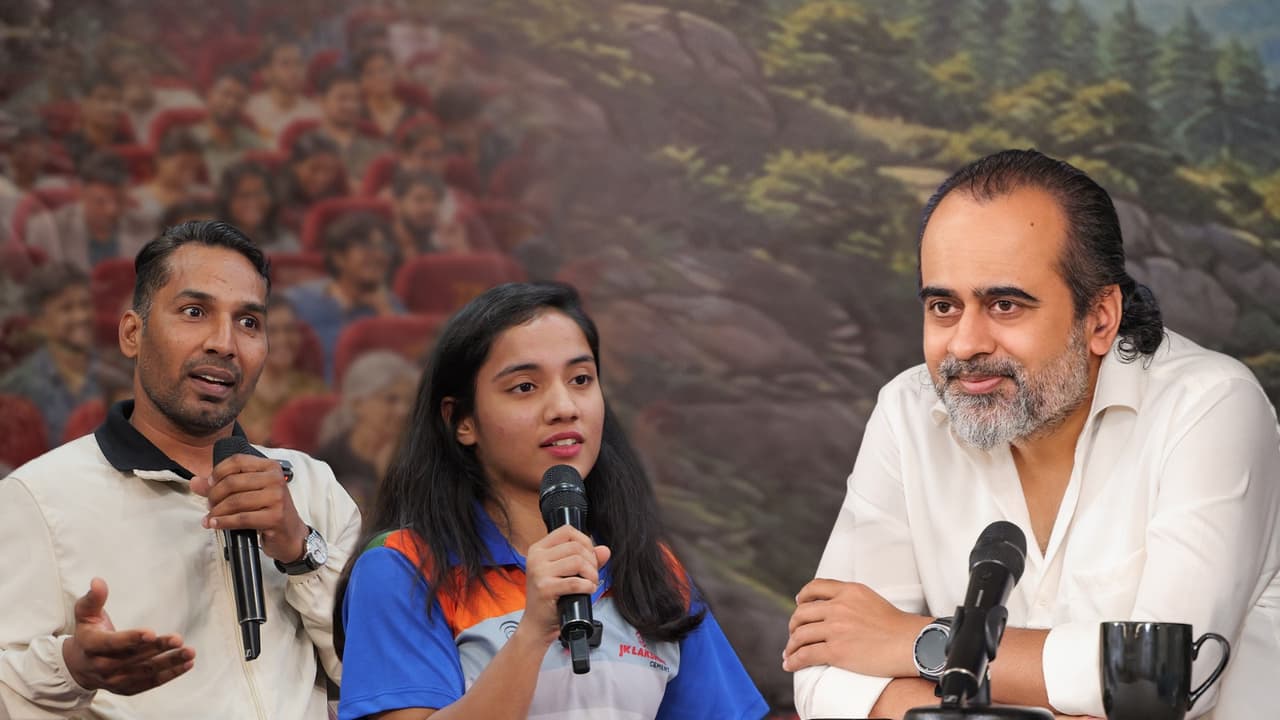
A young athlete says she knows she should not be attached to winning, yet she is, because her coach, family and country are invested in it. Wanting to win on the court is fine; that is what a contest is for. But we never know who the next opponent will be, and the one opponent always present is ourselves. She also fears that starting at 14 was too late. The past is fixed, so what is left is to play the cards we are dealt. Where does our real contest lie?
1
We often defend a bad choice by pointing to a worse one: stay dishonest or starve, keep the wrong grip or stop playing. But the real trouble is not the option we picked. It is the option we never let ourselves see. Action does not need greed or attachment to find its energy. The third way begins by rejecting both false choices, without knowing what comes next. Which of our everyday choices are really false dilemmas?
6
Oppression should not see caste, gender, creed or colour, and it should not see species either. The moral threshold is sentience, not intelligence. An animal feels pain as fully as a human does, whether or not it can explain its suffering.
2
Seen a bubble in the sea?
That is our story.
You came with the hands empty, empty,
and nothing will you carry.
So why be caught in misery?
Make merry, make merry!
Who is your family?
Who is a lover really?
You are deep in illusion, happily, happily
fooling yourself…
2
We often call something “help” or “love” while secretly expecting something in return. When that return does not come, we feel hurt, revealing that the relationship was a trade, not genuine help. The ego, being unfulfilled, cannot truly love or share. Likewise, desperation to be loved makes us controllable. Real love emerges when we stop seeking validation, work on ourselves, and become so inwardly fulfilled that we no longer need to be loved.
Victory is not decided by the trophy you hold but by the battle you choose to fight. Real strength lies in making the right decisions, staying true to your deepest values, and refusing to be ruled by fear or circumstances. When your actions arise from clarity rather than ambition, the outcome loses its power over you. The moment you choose the right path, you have already won.
1
True learning is not built on memorizing answers but on understanding reality. Memory may help in examinations, but life constantly presents new questions that demand clarity, presence, and intelligence. Education becomes meaningful only when knowledge is deeply understood and lived, not merely remembered. Real understanding frees us from dependence on rote learning and enables us to respond wisely to every new situation.
1
The Bhagavad Gita is not a separate spiritual path or an escape from everyday life - it is a mirror that reveals the truth of your present life. Real spirituality begins with self-observation, not rituals or temporary practices. Lasting transformation comes when work, relationships, career, and personal growth become one integrated life driven by awareness, love, and freedom rather than ego, fear, money, or social pressure.
2
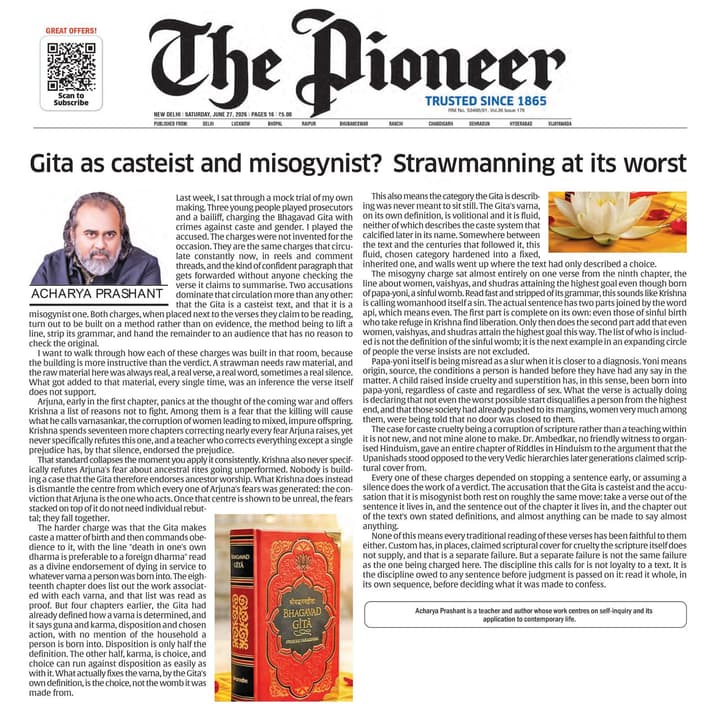
The Bhagavad Gita is often accused of supporting caste and misogyny through selective quotations that ignore context, grammar, and the text's central teachings. A closer reading shows that its emphasis is on inner qualities, conscious action, and spiritual equality rather than birth-based hierarchy or gender discrimination. Misinterpretations arise when isolated verses are detached from their broader meaning, while the Gita consistently points toward self-knowledge, freedom from ego, and the universal possibility of liberation for every human being.
6
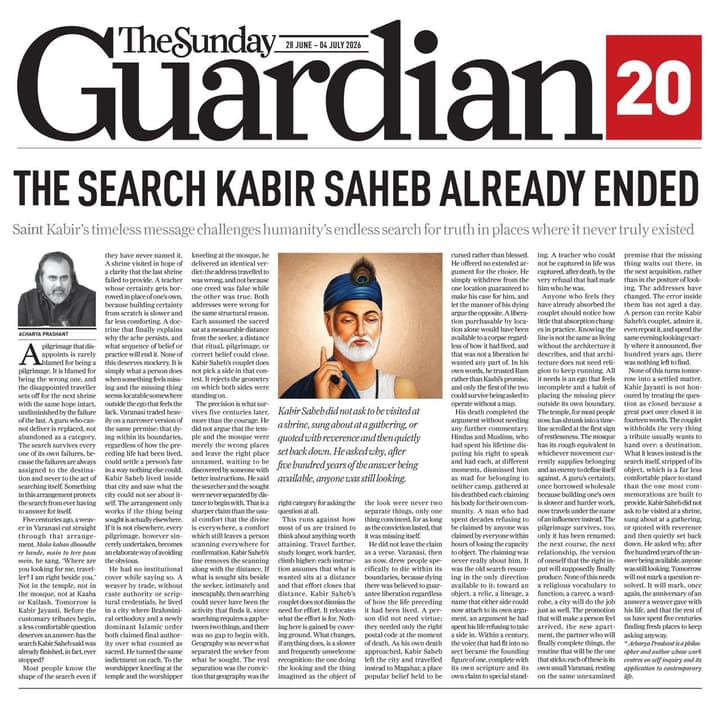
Kabir Saheb's message questions the very act of searching for fulfilment outside oneself. Whether through religion, relationships, success, possessions, or identity, people keep assuming that what is missing lies somewhere else. The problem is not the destination but the belief that fulfilment exists at a distance. Real freedom begins when the search turns inward, recognising that the seeker and the sought were never truly separate.