The Sunday Guardian
28 Jun '26

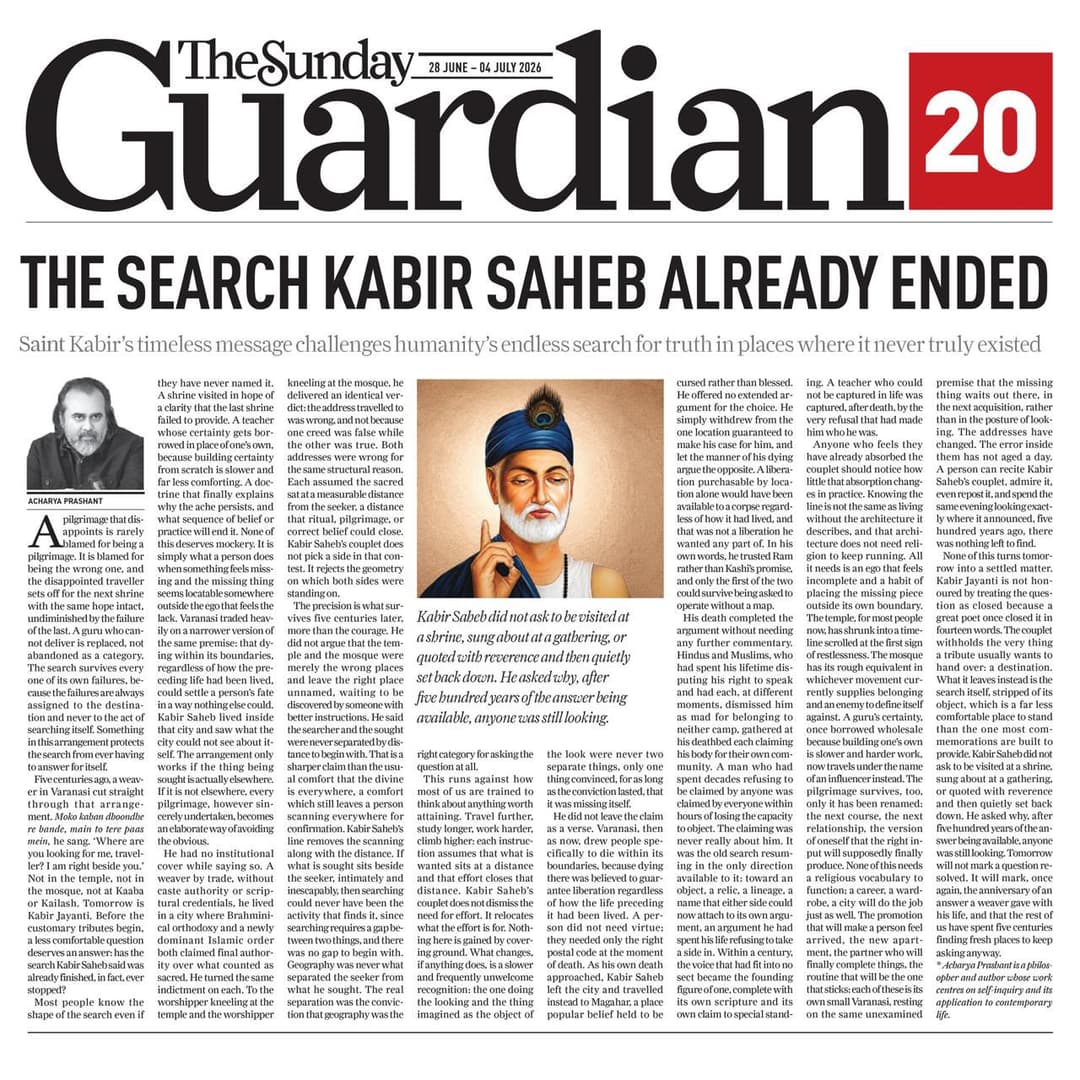
The Search Kabir Saheb already ended

Acharya Prashant

9 min
1.5k reads
The Search Kabir Saheb already ended
Kabir Saheb's message questions the very act of searching for fulfilment outside oneself. Whether through religion, relationships, success, possessions, or identity, people keep assuming that what is missing lies somewhere else. The problem is not the destination but the belief that fulfilment exists at a distance. Real freedom begins when the search turns inward, recognising that the seeker and the sought were never truly separate. This summary is AI-generated. Please read the full article for complete understanding.

Originally published in The Sunday Guardian

Saint Kabir’s timeless message challenges humanity’s endless search for truth in places where it never truly existed.

A pilgrimage that disappoints is rarely blamed for being a pilgrimage. It is blamed for being the wrong one, and the disappointed traveller sets off for the next shrine with the same hope intact, undiminished by the failure of the last. A guru who cannot deliver is replaced, not abandoned as a category. The search survives every one of its own failures, because the failures are always assigned to the destination and never to the act of searching itself. Something in this arrangement protects the search from ever having to answer for itself.

Five centuries ago, a weaver in Varanasi cut straight through that arrangement. Moko kahan dhoondhe re bande, main to tere paas mein, he sang. ‘Where are you looking for me, traveller? I am right beside you.’ Not in the temple, not in the mosque, not at Kaaba or Kailash. Tomorrow is Kabir Jayanti. Before the customary tributes begin, a less comfortable question deserves an answer: has the search Kabir Saheb said was already finished, in fact, ever stopped?
Most people know the shape of the search even if they have never named it. A shrine visited in hope of a clarity that the last shrine failed to provide. A teacher whose certainty gets borrowed in place of one’s own, because building certainty from scratch is slower and far less comforting. A doctrine that finally explains why the ache persists, and what sequence of belief or practice will end it. None of this deserves mockery. It is simply what a person does when something feels missing and the missing thing seems locatable somewhere outside the ego that feels the lack. Varanasi traded heavily on a narrower version of the same premise: that dying within its boundaries, regardless of how the preceding life had been lived, could settle a person’s fate in a way nothing else could.

Kabir Saheb lived inside that city and saw what the city could not see about itself. The arrangement only works if the thing being sought is actually elsewhere. If it is not elsewhere, every pilgrimage, however sincerely undertaken, becomes an elaborate way of avoiding the obvious.

He had no institutional cover while saying so. A weaver by trade, without caste authority or scriptural credentials, he lived in a city where Brahminical orthodoxy and a newly dominant Islamic order both claimed final authority over what counted as sacred. He turned the same indictment on each. To the worshipper kneeling at the temple and the worshipper kneeling at the mosque, he delivered an identical verdict: the address travelled to was wrong, and not because one creed was false while the other was true. Both addresses were wrong for the same structural reason. Each assumed the sacred sat at a measurable distance from the seeker, a distance that ritual, pilgrimage, or correct belief could close. Kabir Saheb’s couplet does not pick a side in that contest. It rejects the geometry on which both sides were standing on.

The precision is what survives five centuries later, more than the courage. He did not argue that the temple and the mosque were merely the wrong places and leave the right place unnamed, waiting to be discovered by someone with better instructions. He said the searcher and the sought were never separated by distance to begin with. That is a sharper claim than the usual comfort that the divine is everywhere, a comfort which still leaves a person scanning everywhere for confirmation. Kabir Saheb’s line removes the scanning along with the distance. If what is sought sits beside the seeker, intimately and inescapably, then searching could never have been the activity that finds it, since searching requires a gap between two things, and there was no gap to begin with. Geography was never what separated the seeker from what he sought. The real separation was the conviction that geography was the right category for asking the question at all.

This runs against how most of us are trained to think about anything worth attaining. Travel further, study longer, work harder, climb higher: each instruction assumes that what is wanted sits at a distance and that effort closes that distance. Kabir Saheb’s couplet does not dismiss the need for effort. It relocates what the effort is for. Nothing here is gained by covering ground. What changes, if anything does, is a slower and frequently unwelcome recognition: the one doing the looking and the thing imagined as the object of the look were never two separate things, only one thing convinced, for as long as the conviction lasted, that it was missing itself.

He did not leave the claim as a verse. Varanasi, then as now, drew people specifically to die within its boundaries, because dying there was believed to guarantee liberation regardless of how the life preceding it had been lived. A person did not need virtue; they needed only the right postal code at the moment of death. As his own death approached, Kabir Saheb left the city and travelled instead to Magahar, a place popular belief held to be cursed rather than blessed. He offered no extended argument for the choice. He simply withdrew from the one location guaranteed to make his case for him, and let the manner of his dying argue the opposite. A liberation purchasable by location alone would have been available to a corpse regardless of how it had lived, and that was not a liberation he wanted any part of. In his own words, he trusted Ram rather than Kashi’s promise, and only the first of the two could survive being asked to operate without a map.

His death completed the argument without needing any further commentary. Hindus and Muslims, who had spent his lifetime disputing his right to speak and had each, at different moments, dismissed him as mad for belonging to neither camp, gathered at his deathbed each claiming his body for their own community. A man who had spent decades refusing to be claimed by anyone was claimed by everyone within hours of losing the capacity to object. The claiming was never really about him. It was the old search resuming in the only direction available to it: toward an object, a relic, a lineage, a name that either side could now attach to its own argument, an argument he had spent his life refusing to take a side in. Within a century, the voice that had fit into no sect became the founding figure of one, complete with its own scripture and its own claim to special standing. A teacher who could not be captured in life was captured, after death, by the very refusal that had made him who he was.

Anyone who feels they have already absorbed the couplet should notice how little that absorption changes in practice. Knowing the line is not the same as living without the architecture it describes, and that architecture does not need religion to keep running. All it needs is an ego that feels incomplete and a habit of placing the missing piece outside its own boundary. The temple, for most people now, has shrunk into a timeline scrolled at the first sign of restlessness. The mosque has its rough equivalent in whichever movement currently supplies belonging and an enemy to define itself against. A guru’s certainty, once borrowed wholesale because building one’s own is slower and harder work, now travels under the name of an influencer instead. The pilgrimage survives, too, only it has been renamed: the next course, the next relationship, the version of oneself that the right input will supposedly finally produce. None of this needs a religious vocabulary to function; a career, a wardrobe, a city will do the job just as well. The promotion that will make a person feel arrived, the new apartment, the partner who will finally complete things, the routine that will be the one that sticks: each of these is its own small Varanasi, resting on the same unexamined premise that the missing thing waits out there, in the next acquisition, rather than in the posture of looking. The addresses have changed. The error inside them has not aged a day.

A person can recite Kabir Saheb’s couplet, admire it, even repost it, and spend the same evening looking exactly where it announced, five hundred years ago, there was nothing left to find.

None of this turns tomorrow into a settled matter. Kabir Jayanti is not honoured by treating the question as closed because a great poet once closed it in fourteen words. The couplet withholds the very thing a tribute usually wants to hand over: a destination. What it leaves instead is the search itself, stripped of its object, which is a far less comfortable place to stand than the one most commemorations are built to provide. Kabir Saheb did not ask to be visited at a shrine, sung about at a gathering, or quoted with reverence and then quietly set back down. He asked why, after five hundred years of the answer being available, anyone was still looking. Tomorrow will not mark a question resolved. It will mark, once again, the anniversary of an answer a weaver gave with his life, and that the rest of us have spent five centuries finding fresh places to keep asking anyway.

Originally published in The Sunday Guardian

This article has been created by volunteers of the PrashantAdvait Foundation from transcriptions of sessions by Acharya Prashant
Comments
LIVE Sessions
Experience Transformation Everyday from the Convenience of your Home
Live Bhagavad Gita Sessions with Acharya Prashant
Categories