The tiger chases the buffalo calf and brings it down. Does that disappoint you? No, because that was expected. Similarly, expect animal behavior all the time from everyone around you, including yourself. Everything we do comes from the jungle, so don’t be disappointed. Disappointment always arises from expectations. You really have to strive to be someone who is not an animal. And the first step in that striving is to address your own inner animal.
Questioner: Is it possible to live without a target in life? I set a target for myself so that I have something to strive for, so that I have a sense of direction, but the thought of not achieving this target also brings sorrow and fear. So how can a
Acharya Prashant: You might just say, “Well, no I am not looking for flesh, I am looking for money. I am looking for material success. I am looking to have another factory. I am looking to have a bigger house with better furniture.” You might talk of material things other
Acharya Prashant: If you look at knowledge that man has gathered in various fields, you will easily see that all of man’s knowledge is related to man’s desire. Man does not try to gain knowledge in fields that have absolutely no connection with man’s fundamental desires.
Acharya Prashant: Desire means that you are not alright with yourself and you want something else to happen, correct? So, we are anyway not living for ourselves. We are rather living to change ourselves. And are these not two very different things? If you are living for yourself as you
Acharya Prashant: The heroes down the centuries and history, I repeat, had clearly identifiable targets. You have to fight mankind. It’s a very helpless situation. Today's teacher or hero or prophet or messiah, whatever you want to call him, has to fight everybody. Just about everybody. He has to fight
Questioner: Acharya Ji, only sometimes do I consciously know that I really want Liberation. How to increase one’s quality, so that this want is continuous?
Maturity is when you can transcend your body, and by the body, I mean the bodily compulsions. That includes your thoughts, your feelings, and everything because they are all bodily. You very well know how chemicals in the body translate into thoughts and feelings. Read more...
Acharya Prashant: It's not about anger at all. Anger is a misplaced subject of discussion, and so much has been said about anger. People keep talking about therapies related to anger. Will keep talking of anger as some kind of affliction.
Acharya Prashant: ‘Law of attraction’, all such stuff is based on the premise that you know what is worthy enough to be attracted to. Who are you to know that? Do you really know that? And if you really knew that, would you really want to attract something? Wouldn't you
Acharya Prashant (AP): How can anybody prioritize anything over the other? To know whether one thing is more important than the other, you have to know whether one thing is more important for you than the other. Are you getting it? If I am feeling cold then the hot beverage
Questioner (Q): Throughout all these years I have faced a lot of self-doubt. I believe self-doubt is in some way important because it teaches us how to examine oneself. But many times this self-doubt turned into anxiety, and this stopped me from pursuing many of the dreams which could have
Questioner: Only sometimes do I consciously know that I actually want liberation. How to increase one’s quality so that this want is continuous?
Acharya Prashant: Only sometimes do you use the word ‘liberation’; at other times, you use a lot of other words for liberation. So, the mistake is mostly…
Many Indian parents keep their children, and especially their daughters, away from sport, even where coaches and facilities exist. The barrier is often not outside but in the parent’s own ideas: poor returns, uncertainty, and fixed notions of what a girl’s life must be. Blaming our own parents does not help either; our life is now our responsibility. Parenting is a decision of the greatest responsibility, and it begins with self-love. Can we love a child if we cannot love ourselves?
Many of us promise our parents high marks, and when the result falls short, the guilt can feel heavier than the exam itself. But no one controls results; they depend on far too many things outside us. What is in our hands is our intent, our effort and our honesty with what we study. The Bhagavad Gita says the same: our right is to action alone, never to its fruit. What if the only promise we made was to study honestly and with love?
Many of us look for role models of our own gender and hope to succeed as a man or as a woman, yet no one great was ever great as a gender. The moment we tie our aims to being a woman or a man, we tie them to the body, and much of our attention goes into how we look and how we are seen. So much around us keeps reminding a woman of her body, from songs to the fear of a street at night. But the body has never achieved anything by itself. What might we attempt if gender stopped mattering?
Detachment and ambition are not opposites. Both arise from clear insight into what is truly valuable. Detachment means naturally dropping what is seen as false, futile, or harmful, while ambition means pursuing the highest and most meaningful truth with complete intensity. Spiritual surrender is continuous: as understanding deepens, false attachments are repeatedly abandoned, until renunciation becomes natural and almost choiceless.
Success and failure matter less when your work is driven by love rather than outcomes. Setbacks are opportunities to reflect, not reasons to quit, and true failure comes only when you stop trying. Regret and guilt become meaningful only if they transform you into a different person instead of becoming excuses for self-pity. Real growth begins by questioning your assumptions, facing reality honestly, and living with awareness rather than mechanical habit.
True love is not a biological instinct, emotional attachment, or social conditioning. Biology and science explain the body's drives, but they cannot explain the self that seeks freedom. Love is the inner restlessness to move from ignorance and bondage toward truth and liberation. Religion is not rituals or inherited beliefs but this personal journey of understanding. Freedom—not possession or conformity—is the essence of both love and religion.
Truth cannot be forced upon anyone, but neither should falsehood be entertained. Genuine love is not about preserving relationships at any cost; it is about helping oneself and others break free from illusion, even if that means risking the relationship itself. Spiritual growth begins by questioning conditioning, examining falsehood without bias, and choosing authenticity over comfort. Real relationships are built on the courage to seek freedom, not convenience.
Vedanta reveals that freedom is impossible as long as the ego seeks to preserve itself. Meditation may bring temporary calm, but real transformation begins only when the false sense of individuality dissolves. Whether through devotion or knowledge, every genuine spiritual path culminates in the complete dissolution of the seeker into Truth. Liberation is not the experience of Truth by an individual—it is the end of the individual who wants to experience Truth.
Manifestation is simply an expression of your desire. You desire something, and then you imagine your desire has been fulfilled. What does the common man desire? ‘Give me more money.’ What will the politician desire? ‘Finish off democracy and give me power for life.’ We have very stinking desires. Do we ever desire anything that is really good for everybody? The question remains: Was that thing worth it? You gave it so much time, so much respect, did it deserve that?
You have to be dismissive of any talk of the afterlife. Only then the Gita will make sense to you. Those who have a battle at hand, those who are living in matters of the moment, those who are engaging deeply with the world as it is right now — present to them — they are the ones who will find the Gita useful, indispensable rather.
4
Once you know where you are chained, you already have the right desire. The right desire is to break the chain. It begins with an observation, and admission of your own state. The right desire is a desire to be free, to be at ease, to be able to flow. To be without fear, that is the right desire. But when we say the right desire is about being fearless, first of all you have to figure out where your fears are.
How is it surprising then that nothing really appeals to you, that you don't find anything worthy of—let's come to that word—love? And except for love, what is it that can hold you for long? Greed, attractions, good foods, good clothes, nice odor, prestige, excitement—these are small things that will not be able to keep you for long. However, to compensate for their lack of quality, they proliferate in quantity.
Excerpts from Articles
कद नहीं, अपनी कहानी बदलो
कई तरह के डर—अकेले पड़ने, छवि खोने या छोटा समझे जाने—की जड़ अक्सर अतीत में बनी पहचान और कहानियों में होती है। शरीर की हाइट जैसी चीज़ों को समस्या मानकर उनसे जूझने के बजाय उनकी अप्रासंगिकता को समझकर आगे बढ़ना चाहिए। अतीत को दबाने से मुक्ति नहीं मिलती; उसके करीब जाकर अपनी स्मृतियों, धारणाओं और पुराने पैटर्न को निष्पक्षता से देखना ज़रूरी है।
ज्योतिष कितना सच है? कुंडली, ग्रह-नक्षत्र: इनका क्या अर्थ है?
वेदांत को केवल इसलिए सही या श्रेष्ठ नहीं माना जा सकता कि वह किसी विशेष परंपरा से आता है। विज्ञान जहाँ भौतिक जगत की वस्तुनिष्ठ जाँच करता है, वहीं अद्वैत वेदांत सीधे मनुष्य के ‘मैं’, उसके दुख, बंधन और मुक्ति की पड़ताल करता है। इसकी कसौटी वैज्ञानिक प्रमाण नहीं, बल्कि अपने जीवन में इसकी सच्चाई को देख पाना है। किसी दर्शन को मान लेना नहीं, बल्कि उससे स्वयं को मुक्त करना ही उसका वास्तविक उद्देश्य है।
Justice Without Boundaries: Why Compassion Cannot Stop at Species
Oppression should not see caste, gender, creed or colour, and it should not see species either. The moral threshold is sentience, not intelligence. An animal feels pain as fully as a human does, whether or not it can explain its suffering.
Climate change is more than an environmental crisis—it is a crisis of human choices. Our patterns of consumption, consumerism and endless pursuit of more are putting increasing pressure on the planet. But meaningful change does not necessarily begin with new technology or stricter policies. It begins with a deeper question: what are we willing to change within ourselves?
Struggling to choose between a secure job and the path you actually feel drawn to? This isn't really a question about careers. It's about why other people's opinions have so much power over you in the first place. Real clarity doesn't come from finding the 'right' choice. It comes from honestly looking at your own fear, again and again, until it stops running the decision for you.
Who are the people who never understand Shri Krishna? The ones whose minds are full of Karmakand. If your mind is full of Karmakand, Shri Krishna himself has very clearly said, you will never understand the Gita because Karma Kand deals with desire, because whatever you do, you do for the sake of desire.
1
A mind full of desires gets blind. It comes to supremely stupid conclusions, and it refuses to see or acknowledge facts that disrupt or disprove its biases. It's just that the fulfillment of the desire stands zero chance of your fulfillment. But there is definitely some chance that the desire can get fulfilled. And if you are stupid enough and laborious enough, the chance of desire fulfillment can also multiply.
What is the most beautiful thing you can think of? And why is it not worth committing yourself to if it is indeed high and beautiful? Give yourself totally to it. And then even if you have to go to Netflix etc. you'll go with a purpose. It's not some kind of a heinous crime to watch videos or something but you will remember the purpose. You're not going there to waste your precious time. Even there, the mind somewhere is remembering what the purpose is.
6
Questioner: Why is there a difference of intensity and love for mukti (liberation) between different human beings?
Acharya Prashant: The differences that you are talking of all relate to time; therefore, they all will be resolved in due course of time. Time gave rise to all those differences, and those…
…
1
Acharya Prashant: What is the fact of life? How do you react to your own sweat? Have you seen how one reacts when one is sweating? The trickle can be quite unnerving. Have you seen the aggression with which one often wipes out his sweat? The aggression, the frustration, the…
…
There is a desire that gives birth to the worlds and then there is a desire that gets fed up with the worlds and returns to the pure, the original, the immutable. You have already come to a long distance, cannot undo the journey, you cannot un-travel the distance, what do you do then? Complete the cycle. Have the right desire that stimulates you into the right action. The right work, the right action that will lead you into immortality, that’s what you need to do now.
1
Acharya Prashant: You live for the sake of contentment. You are desperately looking around for contentment. You don't get it here, so you move to the next place. You don't get it there you move to the next place; you move to the next place; you move to the next…
Man desires, man gets…
You can never stop. As long as you are alive, the flow of action will continue. So, there’s no stopping as far as the limbs are concerned, as far as the mind is concerned. Till the last moment your body will be functional, your mind will be functional. Stopping can occur only in an inner sense. Your inner self is continuously moving to attain a certain contentment and when that is attained, wandering across the landscape of misery will stop.
1
Acharya Prashant: Where Arjun was standing, Krishna could see that the right action for him was to fight.
Remember that it is already a battleground. Remember that Krishna himself has tried the utmost to avert war. He himself has gone as a messenger to the court of Duryodhana and tried…
6
There is such great fun in leaving yourself behind and turning a servant to the Truth. It’s almost like Krishna advising Arjuna, “Talk in everlasting words and dedicate them all to Me—*mām ekaṃ śaraṇaṃ vraja, sarva-dharmān parityajya*.” And at numerous places in the *Bhagavad Gita*, he says, “Arjuna, you are not fighting for yourself, you are fighting for Me. As long as you fight for yourself, if you win, you suffer, and if you lose, you suffer. And when you fight for Me, then you are a victor even before the fight begins.”
…
…
Acharya Prashant: Only sometimes do you use the word ‘Liberation’. At other times, you use a lot of other words for Liberation. So the mistake…
2
When you have seen where your desires come from, you are very close to fulfilling your real desire. Your real desire is not attainment; it is liberation. That desire to be liberated unfortunately, it expresses itself as the desire for a thousand things. Read more....
4
There are far more important things in life to give importance to, and also if you are leading a truthful life then you can’t be too short of money. You will do something, right? Otherwise, you will gain weight. And if you are a little intelligent, a little creative, why would you not earn anything? You would earn something and that would keep you going. Fear about one’s financial future is proportional to one’s disbelief in one’s own worth. Otherwise, one says, “We will see when we come to that, will be able to manage something. We are not so very unskilled or stupid or useless, we will do something, we will manage.
If somebody gets angry, he is called psychotic. Is…
…
…
Acharya Prashant (AP):
Do not ask why does the will-o’-the-wisp or the ego or your personal center still exist. If you’ll ask why does it exist, the answer is your birth. It exists because you do. When was the ego born? When ‘I’
…
…
1
“He who cherishes desires and his mind dwells with his longings is by his desires born again wherever they lead him but the man who has won all his desires and has found his soul for him, even here in this world vanish away all desires.”
~Mundaka Upanishad
Questioner (Q):…
1
A young athlete says she knows she should not be attached to winning, yet she is, because her coach, family and country are invested in it. Wanting to win on the court is fine; that is what a contest is for. But we never know who the next opponent will be, and the one opponent always present is ourselves. She also fears that starting at 14 was too late. The past is fixed, so what is left is to play the cards we are dealt. Where does our real contest lie?
1
A world champion asks why she cannot sleep when a teammate outperforms her, and why even big wins leave her restless. The restlessness is not a problem but unspent energy, a sign that we have more to give. When every bit of our time and attention goes to what we have chosen, there is no surplus left to worry with. The right fight is never only against an opponent; it is against the ego within. What would it mean to fight so fully that nothing is left to celebrate or mourn?
1
We often defend a bad choice by pointing to a worse one: stay dishonest or starve, keep the wrong grip or stop playing. But the real trouble is not the option we picked. It is the option we never let ourselves see. Action does not need greed or attachment to find its energy. The third way begins by rejecting both false choices, without knowing what comes next. Which of our everyday choices are really false dilemmas?
2
Seen a bubble in the sea?
That is our story.
You came with the hands empty, empty,
and nothing will you carry.
So why be caught in misery?
Make merry, make merry!
Who is your family?
Who is a lover really?
You are deep in illusion, happily, happily
fooling yourself…
5
Struggling to choose between a secure job and the path you actually feel drawn to? This isn't really a question about careers. It's about why other people's opinions have so much power over you in the first place. Real clarity doesn't come from finding the 'right' choice. It comes from honestly looking at your own fear, again and again, until it stops running the decision for you.
6
Parental expectations, peer comparison, and academic pressure can overwhelm you only when you allow others’ desires to dictate your life. As an adult, you are responsible for discovering your own potential and making choices through your own understanding. Love is not about fulfilling each other’s expectations or keeping someone happy. True love requires freedom—giving others the space to live and grow, while living according to your own inner clarity.
2
We often call something “help” or “love” while secretly expecting something in return. When that return does not come, we feel hurt, revealing that the relationship was a trade, not genuine help. The ego, being unfulfilled, cannot truly love or share. Likewise, desperation to be loved makes us controllable. Real love emerges when we stop seeking validation, work on ourselves, and become so inwardly fulfilled that we no longer need to be loved.
1
The Bhagavad Gita is not a separate spiritual path or an escape from everyday life - it is a mirror that reveals the truth of your present life. Real spirituality begins with self-observation, not rituals or temporary practices. Lasting transformation comes when work, relationships, career, and personal growth become one integrated life driven by awareness, love, and freedom rather than ego, fear, money, or social pressure.
2
Wrong career choices, unhealthy relationships, and endless entertainment are often symptoms of escaping oneself rather than seeking happiness. Self-deception, ego, and inner dissatisfaction drive people toward temporary relief through social media, gaming, movies, and distractions. Real transformation begins with self-inquiry, honest awareness, and the courage to face reality instead of running from it, leading to clarity, freedom, and meaningful living.
1
Success achieved under pressure or conditioning is not true success because the goal was never truly one's own. Before chasing any achievement, one must ask whether the desire is authentic or borrowed from society. Real change comes not from becoming stronger but from gaining clarity and honesty about oneself. Young people are already capable; what keeps them trapped is the comfort of obeying external expectations. Life is too short to spend serving invisible masters instead of pursuing what one genuinely loves and understands.
2
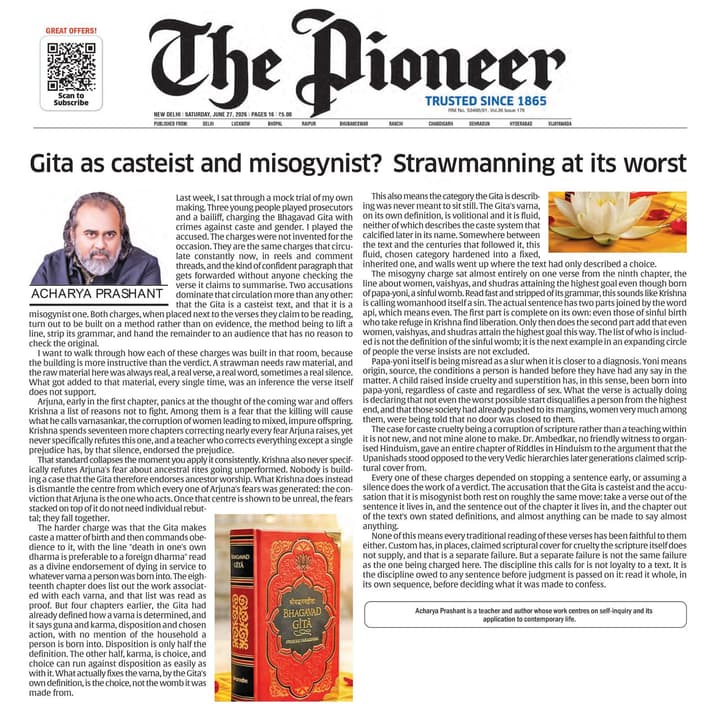
The Bhagavad Gita is often accused of supporting caste and misogyny through selective quotations that ignore context, grammar, and the text's central teachings. A closer reading shows that its emphasis is on inner qualities, conscious action, and spiritual equality rather than birth-based hierarchy or gender discrimination. Misinterpretations arise when isolated verses are detached from their broader meaning, while the Gita consistently points toward self-knowledge, freedom from ego, and the universal possibility of liberation for every human being.