Oxford meets Vedanta

Acharya Prashant

8 min
65 reads
Oxford meets Vedanta
Life cannot be transformed by knowledge of the external world alone; it also requires understanding the one who experiences it. Science, technology, and logic are powerful, but they remain incomplete without self-knowledge and inner honesty. Lasting solutions to personal and global crises emerge when the same rigor used to study the world is turned inward, examining one's motives, intentions, and consciousness with equal seriousness. This summary is AI-generated. Please read the full article for complete understanding.

Questioner: Acharya ji, my first question to you. Yesterday in Kathmandu, while receiving the Kalinga Literary Award 2026, Jnanpith Awardee Dr. Pratibha Ray described you as a son of Bharat. So, today you are speaking at Oxford, the world's top-ranked university. Do you feel the responsibility that comes with carrying India's civilizational voice onto such global platforms?

Acharya Prashant: First of all, that was very generous of Dr. Pratibha. Secondly, yes, I think it's a tremendous responsibility to be carrying the eternal message of Vedanta, the Upanishads, to global stages. Not just because it gives patriotic pride, but because today it's a planetary requirement.

You see, the West has already done well in all kinds of external endeavors. When it comes to exploring the universe, when it comes to breaking into the atom, when it comes to discovering the secrets of the body, the West has already done very well. And yet, today, what we are experiencing is something more catastrophic than mankind has ever seen. We are actually into the sixth mass extinction phase, and this is totally of man's making. This is not a natural phenomenon of any kind. We have done it, and we have done it using exactly the tools that we have acquired with our knowledge, with our endeavor, tech tools, and with our economic prosperity.
So, all that we are proud of is actually being used in the service of destruction.

I've come here with the message that, without self-knowledge and without mass-based education of the self, there is very little possibility of any kind of redemption.

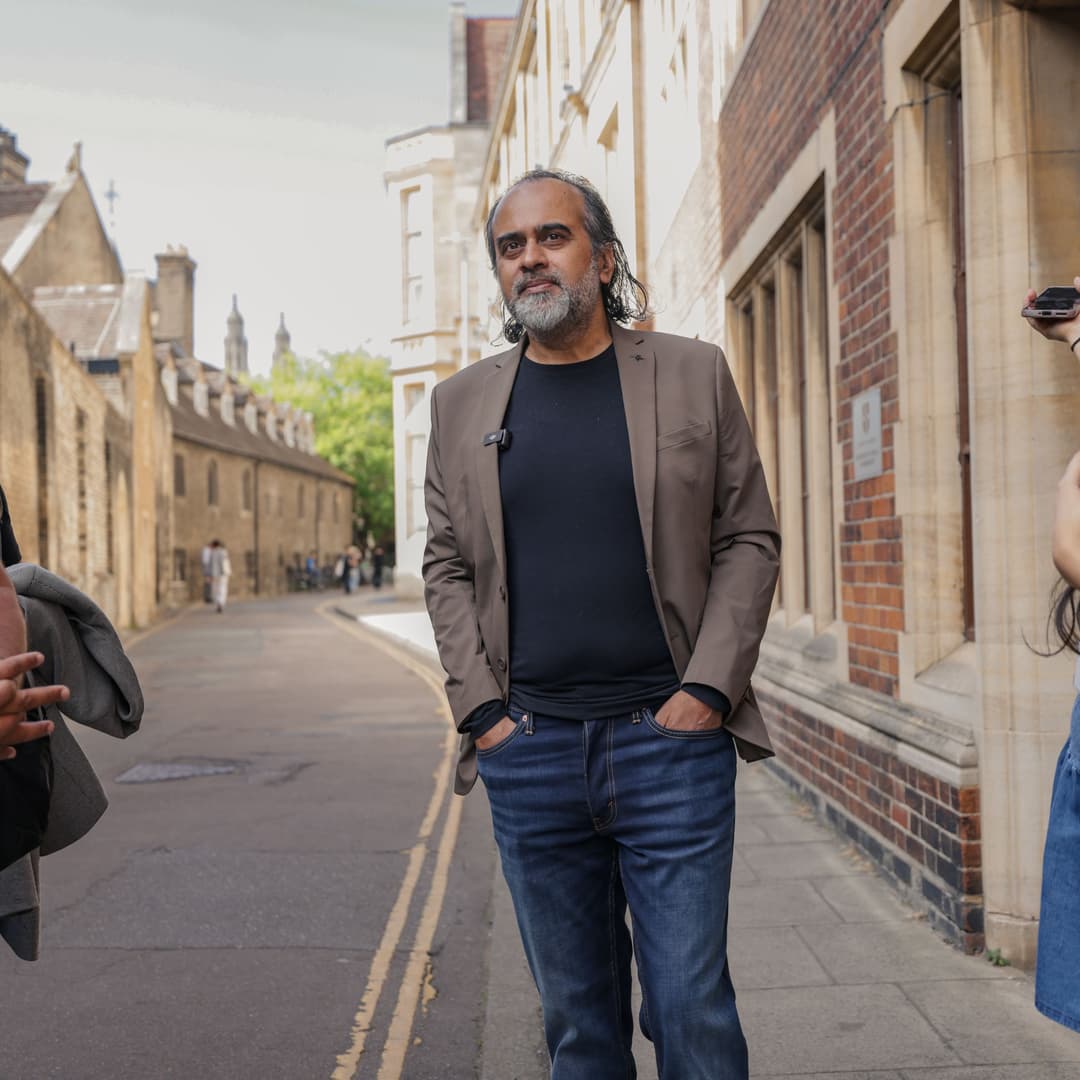
The Upanishads talk of Vidya and Avidya, both. And here at Oxford today, I'm going to discuss the second verse of the Isha Vasya Upanishad. That is quite symbolic because this also is the place. You see this Oxford University Press behind me? This is the place from where the Isha Upanishad came to English audiences for the first time. Max Müller did it when he was translating “The Sacred Books of the East.” The Upanishads. The book was published from here, and it contained the Isha Upanishad as well.

I will be taking up the Isha Upanishad, and the central message will be that Vidya and Avidya, both, are important. Avidya, which is knowledge of what is seen, what is experienced, we already have a lot of it, and we should keep progressing.

Obviously, knowledge and technology should see no limits. But knowledge of the seer is what we are lacking today, and that part remains to be addressed. And that's my message: that without addressing the self, without knowing one's self, and finally without mass-based education of the self, we will not be able to meet the challenges that we face today.

Be it sectarianism, be it the climate catastrophe, be it international divisions of all kinds, or be it the threat of an all-out nuclear war. All kinds of things. Or be it the prevalence of the mental health epidemic. All these can be addressed, not without mass-based education of the self. I'm parroting that phrase so many times because that's needed, and I cannot overdo it.

Questioner: Congratulations for this Kalinga Award, Acharya ji. And my next question: Oxford played an important role in introducing the Isha Upanishad to the West through Max Müller's translation. Today, you are teaching the same text here in your own voice and from within the Vedantic tradition. Max Müller brought the words. What are you bringing?

Acharya Prashant: Contemporary relevance. Contemporary relevance. Max Müller did a wonderful job in bringing the text to the West. But, you know, words must be brought to life, and life is this moment. Therefore, we need to see what the Upanishadic wisdom means to the world, obviously including the West, today. And that's what I'll be taking up strongly and deeply at Oxford this evening. It's going to be a detailed session, a deep session, a long session. I'm looking forward to it.

Questioner: For generations, Indians came to Oxford to receive knowledge. Today, you are here to teach Vedanta. Does this mark a shift from India being a receiver of knowledge to also being a contributor to the world intellectual conversation? And are Indians recognizing the value of their own tradition?

Acharya Prashant: You see, yes, political, ethnic, cultural, geographical boundaries divide us. But finally, we are one as a species, you know? That oneness is at the base of all wisdom. Oneness is not only in terms of species, but also in terms of how we look at the other species and how we look at the entire planet.

So, yes, there is a free exchange. Definitely, the West has progressed so much in the sciences and everything that has to do with the observed world. The West, we can say, has truly conquered the material and is still winning at newer frontiers.

And India, too, is freely exchanging and has been doing that since long. The Vedantic knowledge was never a secret. Anybody who wanted to learn could learn. And if he proves the mettle and has the required qualifications, and the qualifications, by the way, do not include birth and caste and all that, the qualifications were very clearly laid out in the Sadhana Chatushtaya, and that is very merit-based.

So, if one has the right approach, the right attitude, India has always been ready to share. India has shared. The West has shared, and as human beings, obviously, we have to be generous towards each other. And yes, there is a beautiful irony there, and we all relish that. And it's not just beautiful; it's very significant, very important.

India has things to teach. And yes, an Indian is here today at Oxford. And yes, he will be teaching at Oxford. And he will be teaching the Isha Vasya Upanishad at Oxford. And that is what India needs, that's what the entire world needs. And I hope what I speak is also listened to. I speak in a spirit of freedom and love, and I hope it is received that way by the hall this evening.

Questioner: Very good. My last question to you, Acharya Ji. Oxford is known for logic, analysis, and intellectual rigor. Vedanta explores consciousness, the self, and liberation. So, when these two traditions meet, what kind of conversation becomes possible?

Acharya Prashant: No, it's the same tools applied inwards, along with honesty. Because when you apply logic and rigor and analytics to your own self, the ego-self, then you meet resistance from within.

You see, if I want to study that wall or the molecules in the air, the air isn't going to resist. The air won't say, "No, no, I don't want to disclose my secrets because I would be hurt, because there is self-interest involved." Matter won't resist. At most, there would be material complexities that intellect can conquer. But when it comes to looking at yourself and using the same tools, then there is resistance. Because the observer now is the one who is being observed. Because the seer now is the one who is being seen. Right? Because the object now is the subject itself.

So, there is going to be resistance. And when there is that resistance, then internal honesty becomes much more important. Not that these two traditions, as you call them, are divergent. It's just that when it comes to self-observation, an additional factor kicks in. And that additional factor is inner honesty. You could be anybody and still be a very good scientist. But you cannot be anybody and still be a very good person. Right?

So, when it comes to internal observation, you have to be careful of your instincts, of your intent. Intent is a very powerful word.

And that powerful word does not kick in when it comes to regular science, right? Because that is objective in nature. The intent of the observer, the scientist, the subject, does not count there. But in wisdom, in self-observation, intent becomes very important.

Questioner: Thank you so much, Acharya Prashant Ji, for giving us your valuable time for IANS. Thank you.

This article has been created by volunteers of the PrashantAdvait Foundation from transcriptions of sessions by Acharya Prashant
Comments
LIVE Sessions
Experience Transformation Everyday from the Convenience of your Home
Live Bhagavad Gita Sessions with Acharya Prashant
Categories