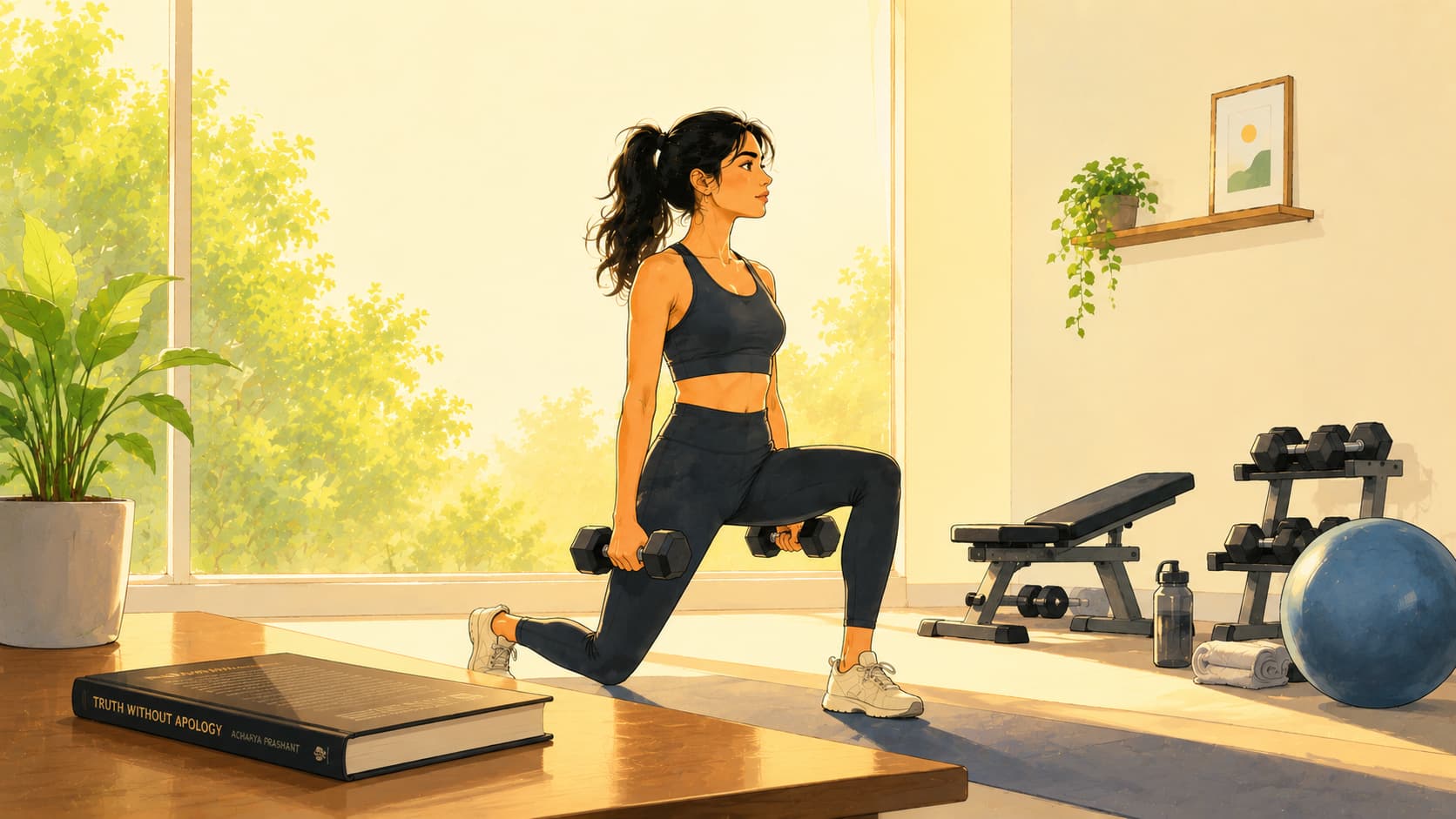
Questioner: Acharya Ji, today a movie trailer was launched featuring a top actress in an action role. Someone sent it to me. So, apart from all the other things, I'm not going to the quality of the movie or the trailer. But one thing that stood out was she was trolled very badly, apparently, for being too thin for the role. So, no one really saw that the actress would have had to go through intense training to perform that role. She also has a 2-year-old daughter, which is known, and most of the critics and trollers have probably not even gone to the gym.
Also, I thought that this would probably not have happened like this if it was a male lead. My question was: where are we going with this online trolling culture, which seems to be increasing every day and it's all over the internet? The first reaction that comes from people is trolling. The trollers are everywhere. So, just wanted to know, where are we going with this?
Acharya Prashant: They always existed, just that they now have a platform. That's all. Earlier, they ran the risk of being caught. Now, your account name could be “ninja123,” and you can troll the entire world from behind that cowardly, AI-generated DP.
Have you seen the trollers? They rarely show up in their own person. No name, no identity, no picture, just abuses. They always existed. It's not a new breed. But social media, especially, has given them a platform where their voice gets amplified. That's all. Not just amplified, sometimes mainstreamed.
Ideally, what should happen is that, since the social media profile is your de facto personality now, therefore every single profile must be personally verified. As simple as that. And you cannot hide behind some anonymous Twitter handle. That's what should happen.
Just as you cannot speak in a public place from behind a veil. Is that allowed? You'll say, "Come out, show your face. We want to know who's speaking and whom am I addressing?" And that's all that there is there.
The same person, you meet him in the marketplace, might be acting pretty nicely, decently, sensibly, humbly, because the fellow has the privilege of acting from behind a veil. Therefore, he misuses that privilege. That's all that there is. It's actually a regulatory issue. Simply have the right regulation, and this will drop by a lot.
Now, the thing about the woman's thinness. Women are not supposed to be thin. It's a man's world, and women are prized for the right amount of fat at the right places. A woman too thin for a man's pleasure is not to be accepted, let alone celebrated.
Even if that thinness makes her functionally more capable, even if that thinness; I don't know which movie you're talking of; I haven't seen the trailer. I'm proceeding on certain assumptions, a hypothesis. Even if that thinness makes her better suited to the role she is performing, she's still not going to be celebrated because women better understand that quickly and fully.
It's not about the excellence in your performance. A lot of the value that you hold is because of your womanness. Getting it? You strip your persona of that womanness, and the man's world will withdraw a big proportion of the value it used to give to you. A big proportion. So, let's say you are being praised in a professional meeting as a team lead for your annual performance, right? The typical kind of corporate gathering.
Yes, obviously, you must have done something right, and there are numerical metrics to prove that you have performed well, and that's fine. But still, lady, rest assured, a lot of admiration and adulation coming your way is because of your womanness. And that's none of your fault, please.
You have done your best as a professional, as a performer. You have done what you could do, what you're supposed to do. But still, from the side of the evaluator, there is a hidden percentage, in terms of weightage, that has been accorded to something that you, dear lady, do not know of. So, when he praises you, some part of that is for your performance, and some part of that is for your looks, your charm, your sensualness, and all that.
Some women do not see that at all. Some see that to some extent. Some see that fully. Therefore, more women than men take care to be presentable. That's not without reason.
If you conduct research today on office-going men versus office-going women, and simply, clockwork, measure the time each of these two groups take, on average, to set themselves up, to dress themselves up for their professional workplace, you'll find a difference of multiples, not 10–20%. If the man takes 7 1⁄2 minutes, probably the woman is taking 20 minutes. That's a multiple.
And that's not really the woman's fault. Experience and conditioning have trained her into believing that, irrespective of how she performs at the workplace, she's still going to be assessed on her looks.
I'm not saying 100% of the assessment would be on the looks. It varies, 20%, 40%, and if the boss is a creep, maybe 80%. But a minimum 20–30%, I would say. And the woman knows that. So, she says, "If only 70% of my evaluation would come from my performance, and the remaining 30% is going to come from how hot I look, I better take care to look hot."
She has been brought to the workplace, but at most workplaces, she is still, at least partially, a thing of demonstration, a doll to please the crowd of male eyes, the colleagues there. It helps keep the environment cheerful, you know. And a lot of HR managers would actually say that in private: "Yeah, there should be gender diversity. It keeps the men happy."
You are looking at an actress. The only rightful metric should be: Has she lived up to the role? Did she surrender herself fully to the role, or did she allow her ego to obstruct her role?
I don't know how the person in question, how much she thinned herself down. No idea. But, prima facie, this involves the ego challenging itself. The role desires me. The role requires me to thin down, lose weight. I don't know how much. And I'll do that because that's the job. I'm not here to play myself. I'm here to play the character in question. So, one should be applauded for that. But instead, it would be more about a size zero, this, that.
Equally, there are so many celebrated actresses, and they were very ordinary, very mediocre performers, not only in India, but in film industries across the globe. They still managed to have a reasonable kind of career because they looked good.
As actors, they were very mediocre, a lot of them. I'm not saying all actresses are mediocre, please. What I'm saying is that a lot of mediocre actresses had reasonably good careers just because they looked good. And women are seeing that every day. The little girl is seeing that every day. What lessons is she to draw? She's sensible. She draws her lessons.
It's a good middle-upper-middle-class family. The little girl is seeing mama do nothing, watch TV, entertain herself all day. But she still has so much hold over papa. Why? Because she's desirable to papa, physically desirable. The little girl draws her lesson.
And we are not talking of lower-middle-class households here, where the housewife has to slog the entire day. No. We are talking of affluent families. We are talking of women, and that's a sizable chunk there. Let's not close our eyes to that. I don't know whether there's research conducted there, but why are secretaries to CXOs mostly women? Not sure what kind of nursing is involved there.
See, the problem is not that this is happening. The problem is that this is happening with women's cooperation. And that's what I find very undignified. That's what I find appalling, genuinely pathetic. Women participating in this kind of system. Not just participating, furthering the system.
What stakes do you have? What are you getting? What is there in this for you? Why are you a participant? Why don't you drop out? Why don't you walk out? What holds you here? Those same systems, those same stupidities, and you are constantly participating, playing the good daughter, the good wife, the good mother, the good girl in the office, the mannequin even. And not just playing those dirty roles, also feeling proud of it.
"You know how much I'm admired."
Didi, do you know for what?
"Oh, you know, the meeting won't begin without me."
Yes, it won't. But do you know why?
"Oh! Nunu’s papa loves me so much."
Yes, there is something there. But do you know what exactly that is? Do you understand the difference between love and lust? You do. But you don't want to bear the cost of acknowledging that you do. And one very regrettable result of all this has been that now, when you assess a woman purely on merit, she finds it unjust.
You speak to her not as a woman, but as a human being, and she feels she's being insulted. "But where is that extra credit for my womanness?" No, I don't want to give you that extra credit. And that is the respect I pay you. I don't think you need to be assessed on your womanness. I don't think I need to give you extra points because you are a woman. And you do that, and women find you insensitive.
"No, but that guy, just be it you there, you know... he behaves so politely and sweetly."
Yeah, he does. But do you know why?
"But you're always, you know, just being so rough."
No, I'm not being rough. I'm behaving with you as a human being does.
"Bro code."
Yeah, bro.
"You just called me bro. You mean bro?"
Does it come to this?
That's respect. Not that I'm elevating you to manhood. No, not that. Just that I'm removing something that is unnecessary.
"Treat me differently. Behave nicely."
Why should I behave nicely? If I act stupidly, you slap me, and vice versa.
"You just slapped me."
I did. And that's a tribute. That's real feminism.
Questioner: I was just thinking, if it was a male actor doing all this, whatever be his physique, he'll mostly be called fearless and celebrated, like most of our superstars are…
Actually, the actress's name is... the movie's name is… just yesterday. She has earlier also been trolled frequently for her physique. But this would not happen, especially in so many movies in South India also we have seen.
Acharya Prashant: Have you seen, even in the spiritual field, when we depict the ancient rishis and tapasvis, at least sometimes we dare to show them physically unattractive? Have you seen that? For example, Muni Ashtavakra, right? For example, a certain sage who practiced austerity for so long that termites grew all over his body, right? And you'll find, when it comes even to spiritual figures, even to that field, women are still shown as attractive. I don't see what is going on.
Why must the woman always be shown as attractive? The answer lies in who made the sketch. Where is it coming from? What's the gender of the artist?
Even somebody who was as austerely ascetic as, let's say, Lalleshwari, look at the way she's depicted. I mean, I don't think she is going to look all that nice with the kind of lifestyle she chose for herself. But it's very important that, when you portray a woman, even in the spiritual field, she must look attractive. Why? The answer is unsettling, but the question must be asked: why?
I've been through that. I've spent six years on a college campus. I know how the male mind works, especially in a crowd. My batch at IIT had some 13 or 17 girls. There were some 18 dorms, out of which only two were women's dorms. So that's the kind of ratio, 1:9. In my time. Now it's probably a little more equal.
Yes, obviously, batchmates, colleagues, group members, all that. Yes. But, above all, women. Lots of identities? Yes, we understand. Lots of identities. Batch topper, maybe. Yes. There were these groups that were made, so group member, maybe.
And we acknowledge those identities. Those identities were functional identities. Yes, they existed. But along with those identities, there did exist an overriding identity. The extent to which that identity mattered depended on the specific individual. In some cases, 20% weightage; in other cases, 80% weightage. So that was the range. And that's a very unfortunate thing because even 20% is a lot.
It's like this: the Indian cricket team, and then the Indian women's cricket team. You see this? Yes, the Indian cricket team, but the Indian women's cricket team. Fine, just say Indian men's cricket team. But "men's" is omitted because that's understood.
Men owning a field is natural, a birthright. Women stepping into a field is a description to be added, a peculiarity to be highlighted. Therefore, the Indian women's cricket team, because it's an aberration, you know.
Again, no problems. You see, gender-wise, I belong to the privileged side. But when I look at the other side, there is this nauseating thing. Why are you participating in this?
Why are you upholding a system that oppresses you? As if some god up there in the skies made the system and it is inviolable. Nobody made it from above. It has been made here by making a fool of you, with your consent.
Withdraw that consent. Your status as a thing, as a possession, as property. You leave your places. You step into a stranger's house. You even drop your surname. I challenge you: turn me into a woman today. I won't do that. I cannot tolerate that. And maybe that's coming from my conditioning, my privilege.
Maybe that's coming from the male hormones themselves. I don't know where that's coming from. But I cannot see somebody successfully substituting my surname with something strange. You know, who the hell are you to change my name? And now, in the guise of feminism, it is Nikita Tajan tiwari. Even hypocrisy died a thousand deaths.
Questioner: It's almost as if they're telling the woman, "How dare you take our place and be an action heroine?"
Acharya Prashant: So that's fine. That's fine. In a beastly world, right, you expect the beasts to assert their authority and try to retain the status quo. My wonderment is at the half that consents to that kind of life. It's not about your surname, or your status, or your rights. It's about the one life that you have. And that life is...
Don't try to justify that life. Please don't say, "Acharya, how do you know? You're a man and you're a Brahmin. What do you know of the travails of the normal woman?" Don't give me that. In certain fields, I have been privileged. In certain fields, I've not. Not boasting, but I know things can be fought out. And the rot runs very deep.
This morning itself, right, there was this question on the Community app on periods. Today itself.
Veteran, vintage members of the community, they responded: "Oh, we don't agree with this. "Do you allow somebody to go and urinate in a place of worship? Then how can a menstruating woman be allowed in places of worship? You're defiling a sacred space."
This is coming from veteran members of the community. The discharge is a lot of dead cells from the uterus. So what's the problem with dead cells? They're not dropping the dead cells there. This arm is covered with dead cells. This is all dead cells. Don't carry this arm to the temple. This is dead cells. Is the hair here alive? Do you feel pain when your hair is cut? This is dead cells. Don't carry this to the temple.
Mucus. Everybody is carrying mucus here (nose). Saliva. All that is dead cells. What is the problem with dead cells? Yes, obviously, if you spit there, then it's a hygiene issue. I understand. But the woman is not dropping her blood there. And even if it is dropped, that would be, at most, a hygiene issue, not a moral issue.
The problem, again, is that some of those veteran members are women. That's the real problem. Women have internalized their own subjugation. They don't just internalize it. They glorify it.