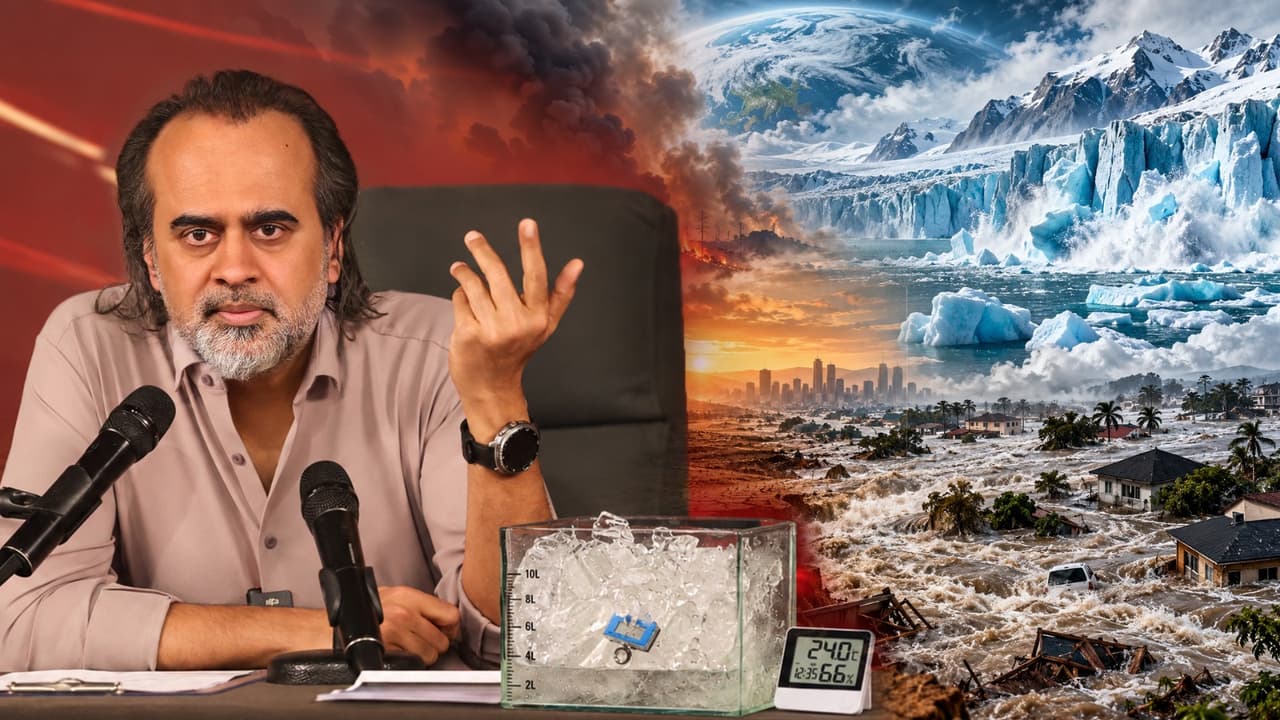
Questioner: When you say mass extinction, what do you really mean? We were just a few years ago, we were 6 billion people. Now we are 8 billion people. I mean, we've been continuously growing. What is mass extinction?
Acharya Prashant: There is a certain natural rate at which species go extinct every day. So, there is a rate. That rate has increased by almost a thousand times in the last hundred years. Even as we have been speaking over the last hour or so, thousands of species have gone extinct in just this time slot. I'm not talking of individual members of those species being lost. I'm talking of entire species disappearing forever. That's what is happening, and that's happening because of reasons that are man-made, anthropogenic.
So, we have raised the average temperature of this planet by 1.5° centigrade, and the temperature is increasing at an increasing rate. The carbon dioxide concentration in the atmosphere should naturally be around 280 PPM. It has shot up to around 450 PPM now, and all that has happened only in the last 5,200 years.
I said the sixth extinction phase. Of the previous five, three were caused due to an abundance of carbon dioxide, the same thing that we are seeing today. I have to speak of it because nobody speaks of it. Ideally, if we were a conscious species, this would have been all over the media. This would have been the thing that organizations, colleges, schools, governments, international institutions, all should have taken up as the topmost priority. But we are not doing that.
If you just read the kind of forest cover that we are losing every day, it would come as a horrible shock. And a lot of that is exactly because we have gone up from 6 billion to 8 billion. Every new addition, every fresh addition to our species, actually means a death warrant for at least 10,000 members of other species. The moment a human kid is born, several thousand other organisms, animals, plants, are condemned to death. That's where we stand.
And the global temperature that has risen by 1.5° is not going to stop at 1.5° or even 2°, or probably even at 3°. It might rise to 4 or 5° centigrade, and the results are going to be catastrophic. And all that is going to happen within our lifetimes. I'm talking of the next few decades.
Questioner: So, human species will be wiped out.
Acharya Prashant: Probably not. Probably a few would remain. A few would remain to lament.
Questioner: I noticed that you are simultaneously also lamenting that we are too many, 8 billion people, and at the same time you're saying mass extinction is on the horizon. Are we complaining about that?
Acharya Prashant: That's a natural fallout, that, and we are not seeing that the Earth simply does not have enough resources to sustain 8 billion or 10 billion or 11 billion of us?
Questioner: How many can the Earth sustain?
Acharya Prashant: Depends on the quality of life that you define for yourself. You see, we don't merely exist. We exist to consume, right? That's what a human being does.
If you look at a chimpanzee or a deer or a lion, its consumption footprint has not changed over the centuries or the millennia. A monkey today consumes as much, only as much as it used to several thousand years back. But human beings today, the existence of a human being means a very different thing to the planet than it did 5,000 years back.
So, it's not as if the Earth cannot sustain 8 billion human beings. It can, but not at the current levels of consumption. At the current levels of consumption, not even a dozen Earths suffice. And that's mathematical. That's not subjective. That's not something that I'm saying or fearing. That's pure arithmetic, right?
Anybody can work out the numbers.
Not only that, such a bad philosophy has been fed into us by our education system that we think that the purpose of life is happiness, and happiness comes through consumption.
So, not only are we consuming, we want to consume even more, and the more you consume, the more prosperous you are taken to be, and the more respectable you are. And if a nation consumes a lot, it is considered a developed nation, right? GDP has become the criteria of development. So, all that potent a lot of horror on the horizon.
Questioner: So, what should be the yardstick to measure development of human society?
Acharya Prashant: We live within ourselves, no? So, we require only as much stuff outside as would be conducive to inner development.
Questioner: So we don't need air conditioners.
Acharya Prashant: You do need air conditioners if you think that without an air conditioner, your meditativeness would be obstructed.
Questioner: All religions in the world claim to know this Truth. They claim to know the enlightenment, like Hinduism, Islam, Christianity. All of them seem to know. So, are we saying that religions across the world have failed to pass on this knowledge system or this awareness or this consciousness?
Acharya Prashant: See, when you say religion, what exactly do you mean? How many people read their religious books? In the name of religion, what you mostly have is culture and tradition. How many Christians are scholars of the Bible or have even gone through the Bible at least a couple of times? How many Hindus have actually even seen a copy of the Vedas? Forget about reading, forget even about touching. How many Hindus have actually even seen a copy of the Rigveda?
So, what do you mean by religion?
Religion is simply hearsay. Religion is a gray point. Religion is gossip and rumor. Religion is something that you have seen your parents and their parents do. So, of what good can be such religion? This is just rumor-mongering. Somebody says, "Oh, religion says this. Religion says that." Where does religion say that?
And to top it all, you have a class of priests who have their own vested interests, and that class exists across all religions. And they present religion to you as it would suit your ego and their interest.
So, there is no religion. Religion can possibly provide an answer if one can penetrate the outer shells of religion and enter its core. That's where you find stuff that is life-affirmative, that is joy-giving. But nobody is going there.
Questioner: So, in a way, are you saying that science has encouraged more materialism, more consumption, and taken us to the path of...
Acharya Prashant: Science is beautiful. Science is lovely. In fact, people are uneducated even in science. We need much, much more science. See, the problem does not lie in the fact that science exists. In fact, science needs to be strengthened much, much more.
Questioner: Than religion?
Acharya Prashant: Please understand, these are two different domains. In the external domain, if you want to know, you need science. If you want to understand how this screen functions, that camera functions, that gadget functions, how are these pillars able to hold the ceiling where it is, then you need science, right? So, science has its own legitimate domain.
We live within us, right? Third, fourth time, we must return to this fact. And that's a domain that science very respectfully refuses to enter. Science does not go into the state of the subject. Science studies the objective universe: this object, that object, that object. The subject that is me is something that science respectfully refuses to touch.
That's where spirituality begins. When you want to ask, "Who am I? Who is the one looking at science? Who is the one wanting to reap the fruits and rewards of science?"
So, science is a great thing in my hands, and what I'll do with science depends on my inner state. If you allow a madman to hold the keys to a nuclear arsenal, you know what you would get, right? And that's the condition of humanity: a lot of destructive potential, a lot of power in the external world, without any wisdom to know what to do with that power.
So, as would be obvious, we are using that power to annihilate ourselves and all other species along with ourselves.
Questioner: So, science and religion, as you rightly pointed out, pertain to two different aspects of mankind.
If that is the reality, I want to understand why does Acharya Prashant call himself, or as you are known to be, a practitioner of Advaita? What does that mean?
Acharya Prashant: In very simplistic terms, Advaita means that the two-ness that you experience that makes you rush again and again towards the world will be of very little use to you.
Advaita is non-duality, right? So, even non-duality is defined keeping duality at the center. Advaita, non-duality: we all experience duality, two-ness. There is me, I think there is me, and I think there is that banana, and that gold, and that something else, and that woman, and that, and that. There is this two-ness. There is me, and there are those goodies out there. And the natural biological urge is to say, "If I get those things, then my restlessness would be healed." That’s two-ness.
Advaita is to realize that the cure does not really lie out there. Your relationship with the world has to be founded on a different ground. It cannot be founded on the ground of desire. You cannot say, "I'm restless, and if I get that, that would give me peace. Hence, that constitutes, or that founds, my relationship with the world."
If that is a relationship with the world, then that's a very exploitative kind of relationship. And that's what we all have, right? An exploitative relationship with the world. And because the world consists of, as we see, other people, they want to exploit us back. So, mutually, it becomes a game of violence.
Advaita would mean my relationship with the world has to be in a way that helps me enter my interiority.
The world is not an end. The world cannot be my destination or target. The world can, at best, be a means to help me penetrate into myself, and that constitutes a healthy and fair relationship with the world. That's non-duality.
One can speak of non-duality in very sublime terms as well, and very esoteric, very mystical, but that would not be very useful.
Questioner: So, in this non-duality, science and religion, in a way, are one.
Acharya Prashant: In this non-duality, science finds its proper utility. Now, science does not exist to appease me. Now, science exists to help me fulfill myself. You see, this is a mobile phone, right? It's a product of technology. If I do not know myself, I'll use the mobile phone for all the wrong purposes.
And what do I mean by wrong? Not morally wrong, not legally wrong. Wrong in the sense that the use will decimate me. I'll be using it to just reduce myself to an animal, and that's what most of us do, right? Products of science, and we use them in very self-destructive ways.
On the other hand, that mobile phone can be used in very, very sublime ways, ways that elevate the consciousness. You pick up the phone, and there's the internet, and all the great wealth of wisdom is available on the internet. So, you could use the mobile phone for that as well. But we don't do that.
When you are clear inside, when there is non-duality inside, then you know what to do with science.