Questioner: Namaste Acharya Ji. Raksha Bandhan is coming in a few days, and I wanted to ask you something about it. What was the cultural or psychological need that led to the emergence of a festival like Raksha Bandhan? Why is this particular brother-sister relationship so important that a festival is celebrated across India, even beyond Hindu communities? Because if we see, for example, in the US, Mother's Day, Father's Day are quite popular. That's not something regarding brother-sister relationships. So how is it so important in India? That is what I wanted to understand.
Acharya Prashant: See, you can visit the history of the festival and you will get all the facts. So all that is quite well known beyond history. Straight away move into psychology, right? You will not say that, for example, millionaires or billionaires need to be protected. Will you say that? You'll not say that, for example, the US Army needs to be protected.
Special protection is needed only for someone who is weak, and if a protection day, Raksha day, has been needed for sisters, for women, that simply tells us that we have had a big section of the society not empowered enough and therefore in need of protection. That's all.
Rest, the historical details, they are all very easily available. You can go and, some would say there are pauranic roots to it. Then some would cite relatively recent developments from the Mughal era, and you have a lot of fables, anecdotes, mythology, history, right? All just baked into one.
But one thing is certain. If sisters needed to go to their brothers with this little thread of protection, it does tell us that the sisters actually needed protection, and the strong do not need to be protected. It's the weak ones that need to be protected. So fine, that is fine. At all points in history and at all places, you will have those who are placed in a weak position, and it is not just fine but actually the right thing to offer them due protection. Which is all good.
The question therefore is not so much about history. How did this festival originate in the first place? The question is about making it more contemporary and more relevant and more useful. If the broader spirit of the festival is about offering protection to the weak, is it women that are really weak today?
Now I could take, at this point, the discussion to a totally historical direction and discuss the reasons why women or a large section of women have been traditionally in a weak position in Indian society and all those things. We could dive into history. We could come up with facts and insights. But I think it's more important to see how things are placed today rather than how they were in history.
Today I do not think a great bulk of Indian women require a great deal of protection. We have not done very well, but we have still made significant progress. Yes, we know all the metrics that you can quote. We know of the FLPR (Female Labour Force Participation Rate). We also know of GER (Gross Enrolment Ratio). We know of the Gender Empowerment Measure. We know of the disparity in wealth distribution among the genders. We know of the huge lag and gap in representation, political representation, representation in corporate boardrooms, representation in religious institutions. We know of all those things. Yes. But still, we are doing well, and the trajectory is looking upward when it comes to empowering women.
Women, well, at least most of them are not so poorly placed that today they require to go to their 3-year-old younger brother and tie the Rakhi thread in the hope that the brother will one day offer them protection and sanctuary, and such things happen, doesn't it? And happens more frequently than we can imagine because in the Indian milieu, typically the youngest member of the family is a male child. Families do not stop before they get a male child. So the male child is the one that denotes the full stop. Before the male kid comes, either families keep producing girls in the hope of a boy, or they keep killing and aborting girls in the hope of a boy.
So the probability is loaded in favor of the sister being elder to the brother. There is always a higher chance that the sister is going to be elder to the brother, and sometimes the sister is elder by 10 years, and sometimes the brother is an infant, 6 months old. And the sister is, what, 12 or 14, but you know, “Bhaiya raksha karna; which probably made sense once upon a time, ceremonially it might look cute even today. So if you want to continue with that, no problem. Do that, you know, as a matter of a relic, a tradition, it's fine, nice things. And then, you know, the brother is also supposed to then offer gifts to the sister. So sisters too have a stake. So please continue with it, sisters.
But that should not distract us from the moot question. The moot question is, if protection is to be offered to a disempowered constituency, who is the disempowered one today? Who is the one genuinely in need of support and protection today? Who is the one? Not women, really. Not women, really. Not women of your generation. Not women of the generation that's coming after you. The 12-year, the 14-year-old girls, the Gen Alpha, as we know them. The girls there are almost as strong as the boys, and they know what to do with life, and they are all sturdy and tough, or that's the way I at least hope them to be.
But the sparrow has vanished. The sparrow has vanished. I don't know why the sparrow came to my mind just now. And the sparrow, to me, is such a moving metaphor for the weak feminine, for the exploited Prakriti, and the sparrow has vanished. A woman like you needs no protection, but the sparrow needs protection. The sparrow is the sister today. And both men and women must be brothers to this sister. You too must be the brother, irrespective of your physical gender. You too must be the brother to the sparrow going extinct. And Raksha Bandhan then becomes a beautiful opportunity to remind ourselves of those who genuinely need our support today, as the sparrow does.
I was reading a report, and correct me, verify the whole thing: 97% of sparrows are missing today from the urban centers. In fact, the more urbanized a place is, the more the sparrow has vanished from there. In places like Delhi and Bombay, just 3% of the population remains because they do not find places where they can build their nests, and everything has been laid with cement and concrete. So there are no insects, and they cannot feed their chicks, their little ones. They cannot fly, the little ones that have just hatched. So the mother has to bring some insects and give it to them, and there are no insects because there is no grass, because there is no greenery, because there are no trees. Plus, when you have all these walls, where is the sparrow going to build its nest?
I'm not talking of a species of bird in particular. Hope I'm not being mistaken. The sparrow, to me, is a very moving representative of something extremely saddening that is happening on this planet today. We are losing species at 10 to 100 times the normal rate of extinction. This devastation is entirely man-made. Climate change is definitely anthropogenic. We have done that. The rivers need protection. The mountains need protection. At this moment, I speak from Goa, and Goa needs protection.
Somebody was telling me it has been raining gradually a little less each passing year. I didn't verify the number, but the person looked genuinely concerned. When Goa is losing its greens and its hills, they are being sold away.
So Raksha Bandhan remains immensely relevant, very significant, but you will have to go to the root of what it means to offer support and who deserves to be protected. Now I have talked of physical objects so far. The sparrow, the mountain, the river, the tree, the species. Think of all that is disappearing from within the human being. That too must be remembered on Raksha Bandhan. That deserves a lot of Raksha.
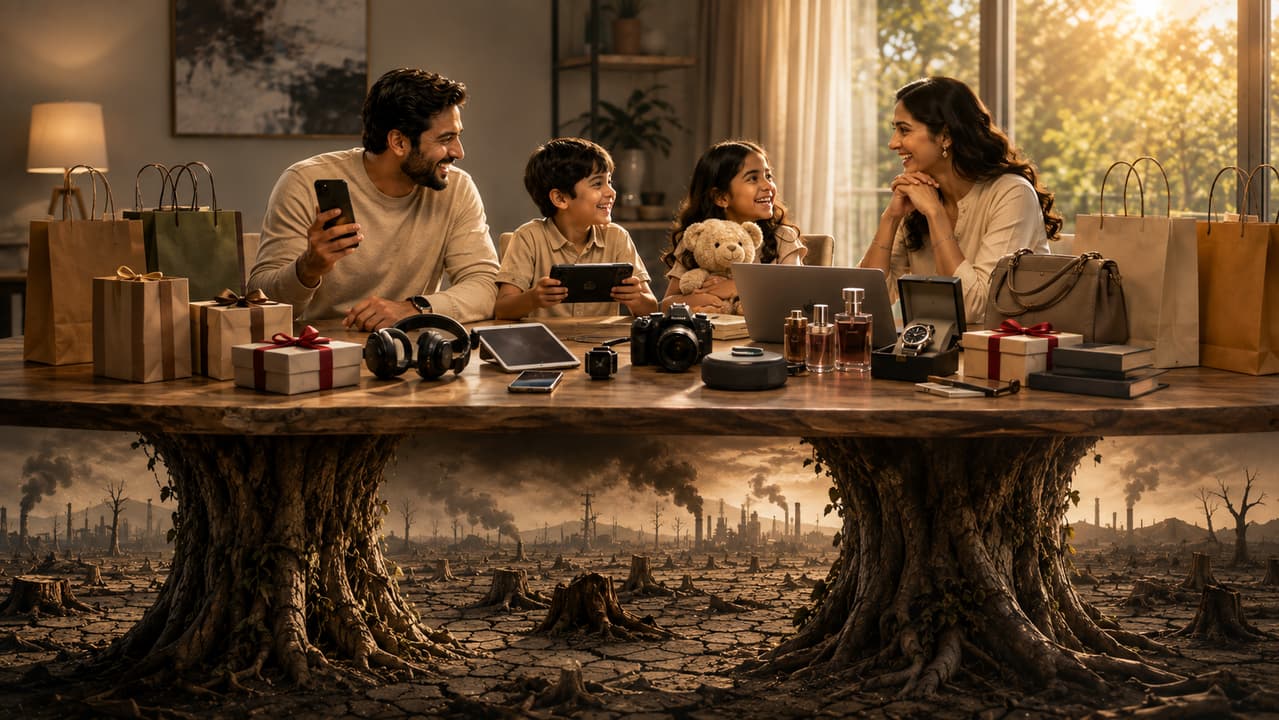
Increasingly, the shared ideal, the shared philosophy across the world is: consume and be happy. You exist to consume.
Simple honesty. The simple inclination to look at oneself is disappearing, going extinct. That deserves Raksha. That deserves to be secured.
The essence of religion has been traded away. Instead, more and more, what we have is either the sentimentality of cheap devotionalism or the mindlessness of mysticism and occultism. Real spirituality, which is self-knowledge, deserves to be protected.
The sacred thread is very much relevant even today. But you must discover the right wrist to tie it on. If your sister is nice, cute, lovable, obviously, you must help her out, and the sister must help the brother out. That relationship is nice and lovely, and the brother-sister duo must stand for each other and support each other, and all that is very fine. But the spirit of protection has to now extend beyond the brother-sister relationship. The circle of compassion must widen.
You cannot say, she is my sister, so, you know, I'm protective of her. Obviously, take care of your sister. That's all very fine. But why not take care of the sparrow as well? Why not take care of the river? And why not take care of the finer values without which we do not even deserve to be called human?
Do you know how much we are losing every single day, tangible and intangible terms, as human beings, as a species, at this point in time on this planet? Mother Earth should actually call aloud on Raksha Bandhan and approach every single living human being with the sacred Rakhi thread and say, please protect me. I am the divine female. I am the mother.
Over the last few decades, most of that which we call development across all nations of the world has been, to the extent of 70% or 80%, simply at the cost of destruction of the planet. The planetary assets have been destroyed, and that destruction has been counted as the income of nations. Now, how is that even honest accounting? Please tell me. You are destroying, trading away your inherited assets and turning that into cash flow. Should that be counted as a profit?
The entire planet deserves protection today. The oceans deserve protection, and we won't talk of that because we are concerned only with our little circles. We feel our responsibility is limited to two or four people in our ambit. Are you getting this?
This is a special festival where the one with capacity, with power, expresses an intent of responsibility. I have power. And as Spider-Man would say, with great power comes great responsibility. That's what humanity has to say today. I have power, and with power comes responsibility. And the responsibility today is to protect the planet. The planet has to be taken as the sister, as the female, as the mother, as the one in distress.
But what I'm saying would remain some kind of utopia. The day would pass away as another religious cultural festival. Boys would roam around with their arms full of Rakhis, and sisters would be happy about the gifts they have received.
We do not understand religion, do we? We do not know what dharma really means. We think dharma is about rituals, customs, observances, special days, festivals, food. You know, every household would cook something special on Rakhi. You think religion has to do with all these things? No.
Real religion is about seeing who you are and therefore what you are responsible for. There can be no religion without true responsibility.
When it comes to true responsibility, you cannot limit yourself to two or four within your family circle.
Questioner: Thank you, sir.