Doctors: Why Respect Is Disappearing

Acharya Prashant

21 min
160 reads
Doctors: Why Respect Is Disappearing
A society that loses its sense of sacredness begins to see every person and profession as merely transactional. When truth is replaced by the pursuit of happiness and consumption, trust erodes and cynicism becomes the norm. Doctors, teachers, and institutions are no longer respected but viewed with suspicion. The deeper crisis is not medical or social but philosophical: without self-understanding, people become consumers first and human beings second. True respect can return only when truth, integrity, and inner education become more important than personal gain. This summary is AI-generated. Please read the full article for complete understanding.

Questioner: Namaskar Acharya Ji. Mera prashn bahut simple hai, but I am expecting a satisfactory answer for that because mujhe kanhi nahi mila hai.

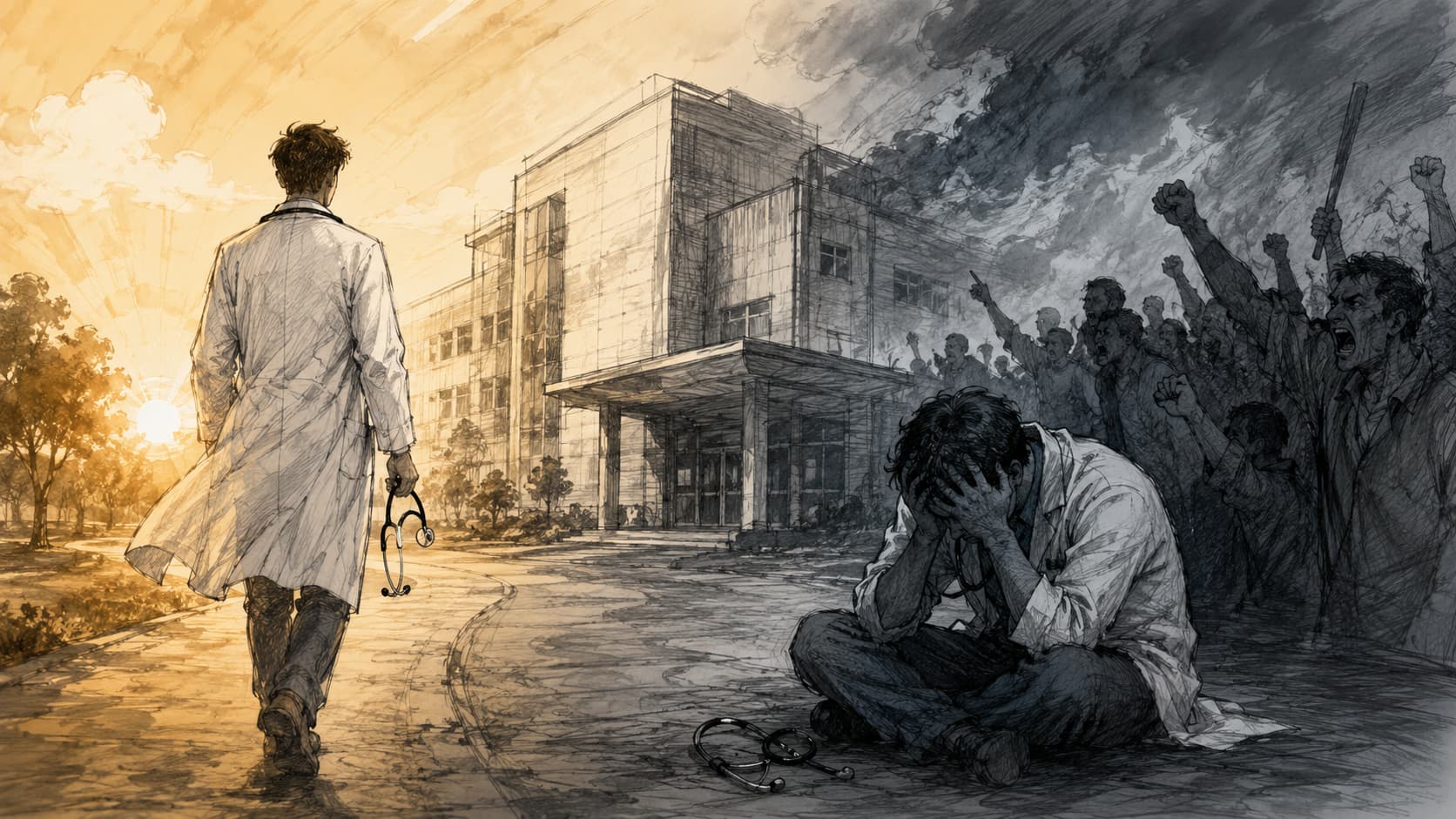
Recently there has been an increased incidence of violence against doctors. An estimated around 75% increase was reported as per The Times of India. It takes your youth to become a doctor. It's not that easy. 12 plus years of experience, and after that you are also practicing. One of the reasons which I find is that hospitals today are acting as if they're businesses, and we as doctors are being portrayed as the selling agents. So is it one of the reasons for the violence against doctors? And if this is the case, then the same thing was happening years before also. This is not the first time. Hospitals were there, doctors were there, but why are the violence cases increasing nowadays? What's the reason for that?

And again, my point would be: it takes your youth to become a doctor, and still, if all these things are happening, why would anyone go to this stream? Especially, it's not just about earning money. I would say medicine, like, you can get better options, much more money, in other streams for the amount of hard work which you have to put in. You have to go for 72 hours of shifts, and even after that, if you are being a part of that violence, then what's the logic behind this? And why are people not understanding all these things?
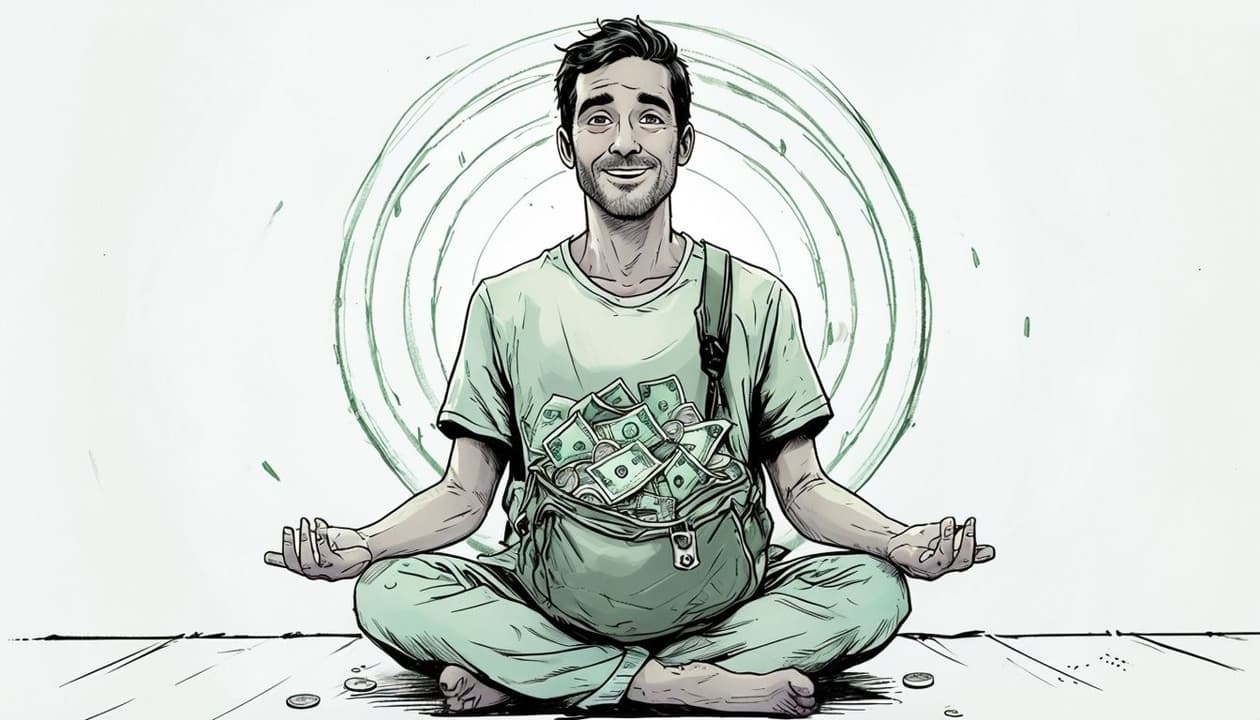
Acharya Prashant: See, there is a general, all-pervasive cynicism. Sacredness has stopped meaning anything. Nothing is outside the shadow of doubt, and very cynical doubt. Nobody is supposed to be taken as selfless. So if you're a doctor, it is assumed that you are working for petty, selfish motives, just as anybody else.

It has become unfashionable to take anything, any institution, any professional, any person, any relationship as having even an iota of selflessness. So the doctor is just as good or bad as any shopkeeper. You are providing me health services. You are just a service provider. The barber provides me a service related to my body and charges me something. You too provide me a service related to my body and charge me something. That's the prevailing pop philosophy, and when that's the underlying philosophy, that shows up in pop culture. So that's the culture.

Sacredness is out of the window. You understand what is sacred? Sacred is that which is taken as beyond the ordinary human tendencies, beyond the touch of ordinary human fallibility. That is what you call sacred. The sacred is something you are not supposed to touch and malign. No, there is nothing sacred.

The two sides of the ideological spectrum, think of them, left and right. Left anyway does not take anything as sacred. Liberalism consists of saying everything is within the purview of thought and mind. Therefore, nothing is to be left untouched. You're not just to question; you're actually to put everything in the dock and indict it. Right? So they are not going to give you the benefit of doubt and say, "You know, doctor sahab ne to puri kosis kari hogi." They'll not say that.

Then comes the other end. And why am I talking of these two ends? Because we have a polarized world today. You know of that, right? You know how the world is today. The two ends always existed, but today the population is getting more and more concentrated at the two poles, at the two ends. Earlier, there was a more uniform distribution between these two ends. Now people are concentrated at the ends themselves.

What about the right?

The right was supposed to be the custodian of sacredness, but it has sold it off. You can even talk of the highest names, but in the lowest way. You can talk of the gods, you can talk of the avtars. You can talk of holiness, you can talk of temples, you can talk of divinity, but it has become obvious to the common public, and the common public is a participant in it, so it has insider knowledge.

It has become obvious to the common public that all this talk of divinity is just marketplace nonsense. So, in their hearts, in their core, even they do not believe in divinity. They know divinity is for sale. There is nothing really unapproachable. There is nothing really transcendental. So then everybody is just a shopkeeper, and every relationship is just transactional. Do you get this?

So, you go to an ordinary shop, and you know that the fellow is trying to extract the maximum surplus from you by delivering the minimum service possible that will entitle him to the maximum surplus. You know that's the equation. And on the other side, the customer is trying to extract the maximum value from the goods or services he's buying by paying the minimum amount possible.

So there is that tension, that one is trying to maximize his benefit, and the one on the other side is trying to maximize his own benefit. There is a tension, and in that tension, it is likely that this party or that party feels duped, fobbed off, cheated, as they say, getting the short end of the stick.

But then the loss is limited. The loss is limited. So the tempers won't really flare beyond a point. You know, you paid rupees 100, and what you obtained was worth rupees 80 only. You know that there has been a rupees 20 kind of discrepancy. You'll be annoyed within, but you'll not resort to violence.

But when it comes to medical services, when it's a matter of human life itself, and especially if a near one loses his life, then you say that in this transaction I have been totally looted, absolutely cheated.

This fellow, first of all, attracted me by displaying massive hoardings and tempting advertisements. You have seen those hoardings and billboards and ads, right? How prominently the doctors are displayed there as models, with their degrees in bold and stuff. So you say, "You attracted me like a shopkeeper. You fleeced money, and then you are handing over a dead body. So I'll be angry. I have a right to get angry. And I know for sure you could have done better than that. I know for sure you have not done what you could have done."

And where does this cynicism come from? From the belief that every relationship is transactional. That the doctor has surely not given his best because no shopkeeper ever gives his best. If the shopkeeper starts giving his best and the maximum possible in every transaction, the shop would shut down. The shopkeeper is supposed to save a surplus only by delivering something below par. That's the common belief, no? Tabhi to paisa bachta hai.

So the common man says the doctor too is obviously doing the same thing, and because the doctor is doing the same thing, I'm entitled to be angry, furious, and sometimes even violent. So that does not necessarily have to do with the institution of medicine or the particular medical professional in question. That has to do with the prevailing culture. It has to do with an overall loss of sacredness. Overall loss of sacredness.

And loss of sacredness does not imply that persons are no more taken as sacred. It means that sacredness is now taken as something utopian. Everybody is, by default, assumed to be a thief. That's the default assumption. That's the deepest kind of cynicism that there can be.

Have you not heard the common man saying, "Sab chor hain"? And that includes the politicians, the priests, the engineers, the teachers, and the doctors. "Sab chor hain" means Sab chor hain. Nobody is exempted. And when nobody is exempted, then the common man gets the right, the inner right, the self-appointed right, to exercise violence when he feels that he has been hard done. You get this?

Now, how the doctors will protect themselves from physical assault is a different matter to consider. For that, you simply require security systems in hospitals. Especially when you know that something is probably brewing and there is some kind of a possibility, then the doctors need to take cover.

That does not sound good at all. That does not sound dignified at all. But that probably is the only way left. And healthcare systems have to consider this thing.

Even the common man knows that if you are covered by insurance, then there is a different kind of billing. If you are not insurance-covered, then there is a different kind of billing. So it becomes obvious to the common man that all this is being done just to extract the maximum from my pocket. Right? And when, after paying whatever he is required to pay, he finds that he still has to cope with the worst in the form of a death, especially then, it becomes very difficult to ask him to contain his temper.

The only way he can still remain patient, even respectful of the doctor, is if he gets to believe that the doctor and the system did their best. But that's something he won't easily believe because that's not something he sees anywhere. Is the teacher doing his best? Please tell me. Is the manufacturer doing his best? Is the politician doing his best? In your own house, are your relationships, people you are intimately related to, doing their best with respect to you?

We all know, we all are cutting corners. And that's the daily experience. Nobody is doing his best. The mechanic is not doing his best. The engineer is not doing his best. The moviegoer is not doing his best. The moviemaker is not doing his best. Everybody is perpetrating some kind of a fraud on everybody else.

Hence, I feel entitled to deduce that even the doctor is a fraud. Since everybody is a fraud, and I too am a full participant in the fraudulent system, therefore I feel entitled to believe that even the doctor is a fraud. Now, as the patient, or as a relative of the patient, I may know nothing about medicine at all. But just my impression, just my deep belief, everybody is a fraud. Sacredness is out of the window. Everybody is to be distrusted. Sab chor hain. That's how the whole thing has become.

And if that's the way things are, then everything is very fragile. Then violence can erupt anywhere, any time. Not just in a hospital setting; in a family setting, in a social setting, at a workplace, anywhere you can find violence erupting.

Because, you see, you cannot have tangible proof for everything. Systems have to work on a certain subtle trust, right? And if that is gone, then I have sufficient reasons to suspect that you are carrying a pistol there, or that she can, you know, shoot me with the mic itself. This is not a mic. This is a special instrument of assault. Speaking like this, she'll point it at me and press a button, and I'm gone. This is neurosis. But that's what, as a society, we have come to. Everybody is to be suspected. Nobody is beyond the shadow of suspicion.

Doctors used to be respected, no? "Doctor Sahab, Doctor Sahab." Gone. Finished. And that does not have to do particularly with the medical profession. It is gone from everywhere.

May I ask a question? In your hostels, you have hostels here on the campus, in your hostels, how do you refer to your professors? No, not in the classroom, not in front of the professor. In your hostels, how do you refer to your senior doctors, professors? How do you refer to them?

Fine. That's fine. We are supposed to be honest sometimes.

Okay. Late 90s, IIT Delhi.

“Kanha ja rha hai tu?”

“Kuch nahi ja rha hun, Gupta ki class me ja rha hun.”

And then you want the commoner to respect you, trust you, and give you the benefit of doubt even when somebody passes away? That won't happen.

Are you getting this?

“Bhai aaj to Tandon bhadak hi gya is par.”*

And I'm still not distorting their surnames. There were distortions as well. Tandon could be "Tunda." And that's how the budding professionals, these wannabe doctors, are referring to their professors. And then you want to be called "Doctor Sahab" by the patients. Will that happen? That won't happen.

And that doesn't have to do with your hostel or the campus. That has to do with the overall social situation, the overall condition in the world itself.

You don't feel like respecting even those who occupy the highest chairs. Look at the presidents of the world. Look at the one in the US. If they happened to enter your home, would you say, "Aaiye Sir, Dada Ji, aaiye baithiye"?

Respect is out, and for good reason. Most people are genuinely not respectable. There is nothing there worth admiring, respecting, or looking up to.

Questioner: So, you said there is a loss of sacredness. So what could be the reason for that? Is it like, from my personal opinion, the people who are not that well educated tend to be more respectful as compared to the ones who are more educated? So is it somehow related to being aware? As you said, not everyone deserves to be respected. I totally agree with this. But is it right to showcase that?

And you compared, you didn’t compared, you were telling, that the barber providing services is equivalent to a doctor providing services. But there's a marked difference between the two.

Acharya Prashant: Obviously there is. I was seeing how the common man perceives it. Obviously there is.

Questioner: So, sir, is the reason for loss of sacredness? Can you please tell me, is it…

Acharya Prashant: You see, this is a very intangible and very ineffable thing. Sacredness, you can't put it here on the table like the mug here. Can you? Show me sacredness?

Sacredness can't be manufactured. Sacredness can't be displayed as an object. Sacredness is visible only in the living radiance of a human being. You require more people who stay true to their core even in the face of adversities.

Those people are nowhere to be seen. It's a philosophical decline. The prevailing philosophy is: you're not supposed to live truthfully. Please understand. You are supposed to live happily. And there is a dissonance there. You're not supposed to live truthfully. The highest ideal is not Truth but happiness.

In fact, let's conduct a survey. Ask people here, "What do you want? Happiness or Truth?" If there is a choice, if only one can be had, what do you want to have? And most people will say, "We want happiness." And that's a problem because happiness is something you want, but happiness is not something you can respect. In fact, most people become even more unworthy of respect in their moments of happiness.

If a person is sitting calm, quiet, silently, normally, maybe you can kind of partially respect him. But observe the same person in his moments of happiness, and you will feel disgust. You'll feel like vomiting. Do you get this?

Now, this same happiness has become the overarching ideal of the entire world. You're born to be happy, and happiness is attained through, come on, come on, consumption. And consumption often, rather most of the time, implies exploitation, including exploitation of the human being, the other human being, the one in front of you.

If happiness is the ultimate goal, then exploitation will be the norm. What else is climate change all about? You're supposed to be happy. So consume more and emit more carbon. Where does carbon come from? Emissions. Why do you emit so much? Because you want to be happy. "I want to fly. I want to build. And I want to destroy because I want to be happy."

So when the pop philosophy is, "Please be happy, happy, happy, happy. Do whatever it takes to be happy," then nobody remains respectable, and nobody should remain respectable in that sense, no. Because for your happiness, now you can do anything, and anything passes.

"Am I not supposed to be happy? I am. And if I am supposed to be happy, I need money. And if I am to get money by fleecing my patients, so be it." It is philosophically sanctioned now because the top goal is happiness. That's the philosophical problem. And that's what has killed sacredness. The very cheap kind of happiness.

I'm not saying philosophy is against happiness, but there is a higher happiness. There is a happiness that comes from providing temporary relief to the egoic pain, and there is a higher happiness that comes from sublation of the ego itself. Now there is nobody to experience that pain. That's a higher happiness. Do you understand that?

There is a happiness that comes to you as if you have been sedated, anesthetized, so you can no more feel the pain for a while, and so you say, "Relief. There's happiness" of that kind. And there is another happiness that comes from the dissolution of the one who experiences the pain, who experiences and owns the suffering.

That's the higher happiness that real philosophy must point to. And if that becomes the goal, then people can realistically be respectable.

Yeah? You are coming to the core of the matter now.

So, this we are sitting at is an educational institution, right? In a broader sense, not just medical education, education. Do we study philosophy here? That's the problem. You'll say, "But we are supposed to study anatomy. From where does philosophy come in?" No, no, no.

When the angry patient attacks you, it's not his anatomy that's attacking you. Yes, he banged his fist against your nose. Yes. But the matter was not between his fist and your nose. It was between his ego and your ego.

Please understand this.

So all that you study about the human body stops somewhere. It carries you no further.

You're saying the patient attacked you. Yeah, the patient attacked you. The patient banged his fist against your nose. But was the fist angry at your nose? Was this fist angry at your nose? No. No way. There was an inner problem. And that inner thing is not at all in the curricula. Not in this institution, not in any other institution, not in schools, not in colleges, not in universities, nowhere.

If you do not teach philosophy of life to a doctor, what kind of doctor are you going to get? Same thing. When you do not teach the basics of life to an engineer, or to anybody else, to an accountant, to a lawyer, to anybody else, when you do not teach this to them, then the default philosophy is the pop philosophy of happiness. "I want happiness."

No, you are a doctor so that you can be a consumer. Do you get this? Why else do we want to be doctors or engineers or whatever in India? So that we can be consumers. When are you supposed to be a successful doctor? When you have a big bungalow of your own, right? When you get to move to the States. When you own five vehicles. When you can lay your hands on the sexiest girls. Then you are successful. So you are a doctor so that you can be a consumer.

No, you are no more a doctor. Then don't say that you are studying medicine. You are here to study consumption through medicine. Medicine is a means to secure consumption, and that's the default philosophy. Now, that default philosophy must be challenged in educational institutions, but that is not happening. That is not happening.

MBBS, five years. Why can't you have a few courses on education of the self? Please tell me. Just a few courses. And that's the most important thing in life. But we don't want to address this, and that's a deep disdain. We are saying, "No, no, no. We are very anatomical." Are we anatomical? Just anatomical? Seriously?

As if there is nothing within. And I'm not talking of ghosts or metaphysics. I'm talking of the ego construct, the "I-am-ness" that is there, right? That's not a belief. That's a working construct. It is there. It is functional.

Why is that not being addressed in schools and colleges? And if that is not being addressed, then you will have the concept of happiness, but not the concept of sacredness. And if there is no sacredness, anybody can be attacked, and anybody can be spit at. Do you get this?

Questioner: Sir I got the answer. So it's basically the consumer mindset which is making all these things happen, and also the loss of sacredness is because truthfulness is being overshadowed by the…

Acharya Prashant: See, please understand. When you start studying the ego, you realize that the ego is forever incomplete, restless. But its restlessness can never be addressed through material consumption. Irrespective of how much you give to the ego materially, it still remains dissatisfied.

The moment you come to this realization, the happiness principle goes out of the window because the happiness principle says, "Gather more material so that you can have happiness, and that's the highest thing."

The moment you investigate this in a logical, scientific way, the ego thinks, is it possible to silence it, satisfy it, by giving it more and more material stuff? You realize, no, that does not happen. And that can be experimentally seen. No, that does not happen. Then the root of consumption is gone. When the root of consumption is gone, then the doctor gets a chance to be something beyond a seller or beyond a service provider because all that a service provider wants is money. All that a manufacturer or a seller wants is money.

But once the doctor realizes that money cannot heal his ego, then he gets a chance to be a real healer. And once you become a real healer, you find the patient gets a reason to respect you.

This article has been created by volunteers of the PrashantAdvait Foundation from transcriptions of sessions by Acharya Prashant
Comments
LIVE Sessions
Experience Transformation Everyday from the Convenience of your Home
Live Bhagavad Gita Sessions with Acharya Prashant
Categories