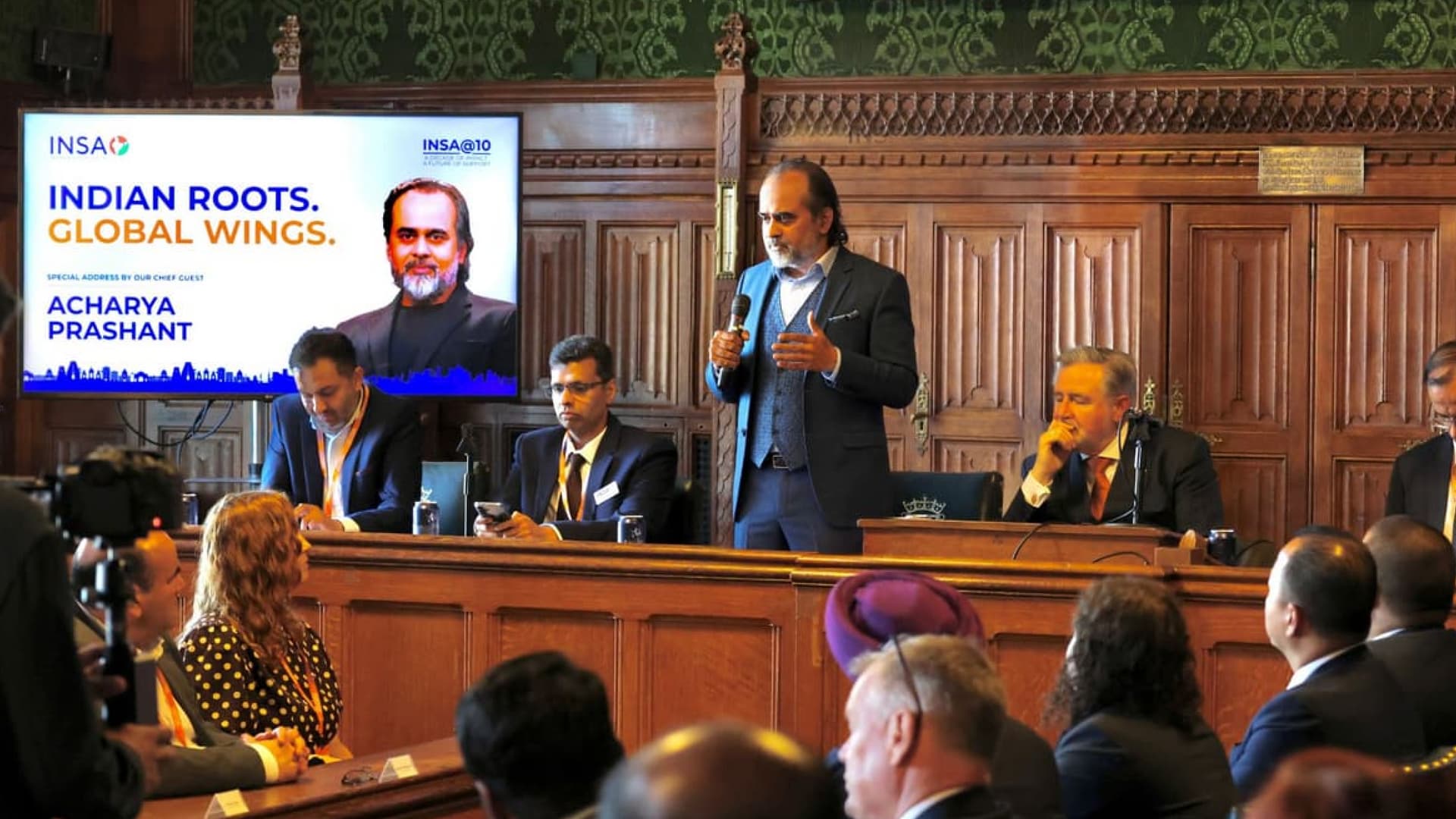
Acharya Prahant: The topic for the afternoon is beautiful: "Indian Roots, Global Wings." And because beautiful things charm us, we tend to nod in approval instantaneously. So, I thought I would begin with that because it's important to wait for a while and dig a little deeper into quick approvals.
I'll start with the topic for the afternoon, rather than the evening, this day.
So, when we say "Indian roots," Indian roots sound very nice, very nice to Indians, and very familiar to those familiar with Indians, right? And usually the connotation is festivals, culture, food, music, aroma, garments, and the typically Indian values. That's what we understand to be roots, right? But if we are talking of Indian roots, then it's better that the word root itself is defined in the Indian way. And in the Indian way, the word root does not refer that much to culture. It rather refers to clarity.
Indian roots are not about how we set up our plate, and how we respect our elders, and how we gather, and the family values, and how we celebrate our festivals. All that is fine. But when we say "Indian roots," there is the risk that we limit ourselves just to the cultural aspects. And that's what I seek to address in the little time I have this evening.
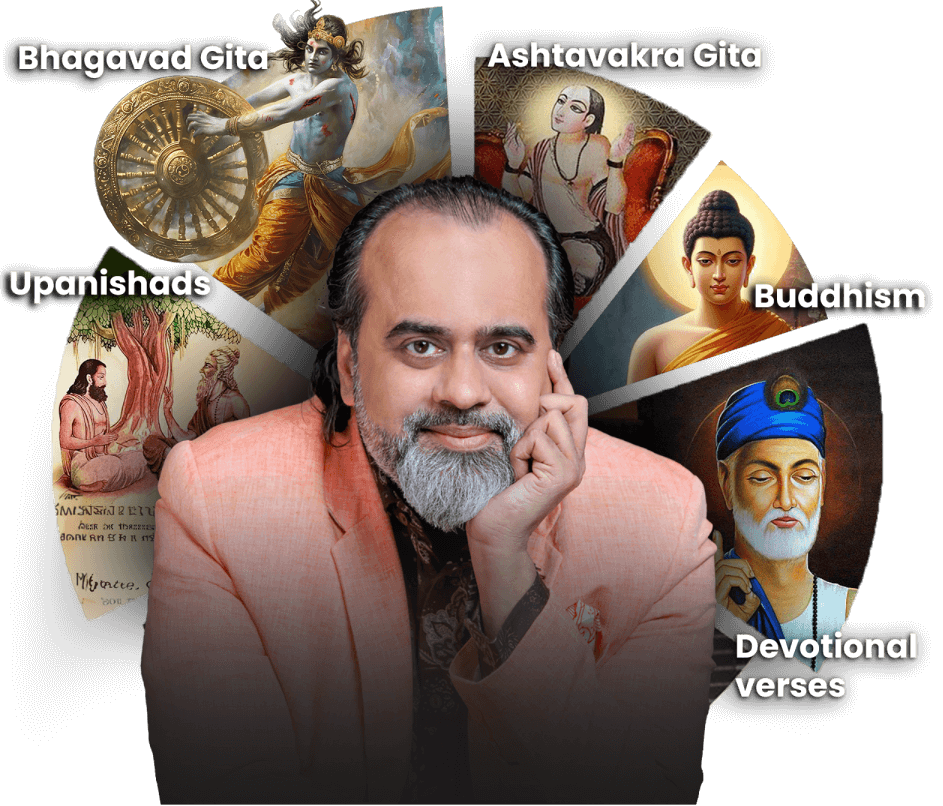
Roots, in the pure Indian sense, refer to the question "Koham?” the question, the matter of self-inquiry: "Who am I?" That's the root of everything that is distinguished as Indian.
Why do I say that is the root? Because every meaningful contribution of India to the world is actually downstream of that root. To make it a more organic phrase, it is actually an upward sprouting from that root. It could be Vedanta, it could be Mahatma Buddh, it could be Sant Kabir, or it could be anything that India values truly in itself, and the world regards India for. It actually comes from that one inquiry, inquiry into the self. And that is the root of everything truly Indian.
So, yes, especially when you are abroad, there is that sense of nostalgia. There is that craving, sometimes that desperate feeling, for connectedness. And then the first things that come to our mind as people of Indian origin residing abroad, the first thing that comes to our mind is the cultural aspect.
We miss the sights, and the sounds, and the familiar behaviors, and the tastes. Yes, all that is wonderful. But India, true Indianness, runs much deeper than that. It is less about culture and more about clarity. It is about ruthless self-inquiry.
Do I know myself? Am I assuming my roots? Have I really gone into them?
So, inquiry into roots is what rootedness would actually mean, right?
And then there is the next part, the little phrase, two words that follow: "Global Wings."
Now, seen in the usual way, or in a superficial way, global wings might sound like ambition. Global wings might sound like expansion of what you take yourself to be. But if the topic starts with India, even these two words, global wings, must mean something truly Indian.
And in the Indian sense, it is not ambition that takes wings. One rather requires freedom to take wings. And ambition is not necessarily an expression of freedom. One could be inwardly quite caged, and yet externally, outwardly, one could be flying business class to six continents. That is ambition, but not freedom.
One could be running very hard on the x-axis, the horizontal plane, on a treadmill, sweating it out in a big way, and the dashboard, the meter there, is indicating you have covered x kilometers. But the fact is, one has hardly moved an inch. So, that is not really the Indian way. And those who are venturing out of their homeland, flying across oceans to seek education and then growth as persons and as professionals, it is very important that we understand what it really means to take wings.
Because, yes, you have come here and you want more from life. But in coming here, here is a question I'm inviting all of us to ask:
Are we flying, or are we just running fast?
That's a very important question to ask.
The difference is, in running fast, you might be fast, you might be ambitious, you might even be accelerating, but you still stick to your own dimension. And that is not freedom. That is not freedom. Real freedom, which is coming from wings, and that's something that you gave me as something to speak on, real freedom lies in investigating yourself and seeing where your bondages are.
Isn't it obvious that we cannot talk of wings or freedom without having first seen, very honestly, very keenly, where our chains, and the cuffs, and the fetters are? If I do not know the ways in which I am held captive, the word freedom remains meaningless, and rather absurd.
So, that's what India invites us to do. India says, yes, first of all, go into yourself. Figure out where your limits are. And in figuring those limits out, you'll find that the limits do not survive the seeing, the inquiry.
So, we are talking of movement. Here is a beautiful verse from the Upanishads that talks of movement. It says, “Asato.” From asat…, from all that which is false, “Mā sadgamaya.” Then, “Tamaso mā jyotirgamaya," then, ”Mṛtyor mā amṛtaṁ gamaya.” So, you see, there is movement here, and you too want movement, and that's why you are talking of wings. Wings have a relationship with movement, you know.
So, that's the movement that India has encouraged Indians, and the entire globe, to have. Move from your darkness away towards light. Your movement cannot be an expansion of your darkness across continents. And that is very much possible. Similarly, move from all that which threatens you and kills you inwardly, daily, the fears, the old hurts that we carry, the insults we might be so apprehensive of, the insecurities, right? So, move from that towards that which is not vulnerable to random movements outside of yourself. That's what India invites you to move as, and move into, right?
And since I have quoted from the Upanishads, something else comes to my mind. The Upanishads say, “Uttiṣṭhata jāgrata prāpya varān nibodhata:” Arise, awake, and approach those who might help you learn. Learning is the purpose. Learning is what any movement must be for, whether it's the movement involving your flight from India to the UK, or the entire macro movement that we call life. That is the purpose.
So, my responsibility here is to ensure that these beautiful words that we have, and the Indian relation, the Indian roots that we have, we go deeply into them. We understand what real Indianness is about. And if we understand that, then we'll be giving the world satisfaction rather than striving. The world already has enough striving. What India can offer is something more, and something beyond that. And that's the message this afternoon.
Thank you. Thank you, all of you.
Questioner: Hello, you speak very beautifully about how we must be separate from the fruits of our actions, but still to act, and also to not be influenced by the material. If it's good, it's good. But when we're faced with a question of whether to be optimistic or pessimistic, this seems to be a separate question. And I've spoken with many this evening about how we look at the world right now, especially. But to act in the world, and to be tied to the fruits of one's actions, and to act with dispassion, where does something like optimism, or pessimism, or realism come into the frame?
Acharya Prashant: Nowhere. Nowhere at all. You see, I stand in front of you. I can, at utmost, bare myself to you. That's the limit of my power, my sovereignty, right?
Can I have any control over your receptiveness? Can I force you to acknowledge what I'm saying? My responsibility, and that's the very limit of it, is to lay bare the Truth. Right? What happens next to it is for you all to decide. It is for the universe to decide. So, who am I to decide the result of my action?
My job is to be utterly truthful, or whatever is the maximum possible within one's human limits. That's my responsibility. I can't play God and say, "Okay, I will change the future. I think if I act, something great will come out of it. I'm very optimistic."
Who am I to be optimistic?
My job is to act to the fullest, and act from the truest point possible, from the truest point, fullest action. After that, what happens, happens. Who am I to be optimistic about it?
And why should I be pessimistic about it?
To be either, I'll have to distract myself from the thing at hand and leap needlessly into the future. Right? And wander about hither, this place, that place, imagining what's going to happen next. And do you see this, optimism and pessimism both pertain to the future. And if I am to think of the future, I'll have to necessarily ignore the thing at hand, right? And that would be a compromise. That would be some kind of, if I may say, sacrilege, a disloyalty to what totally deserves my attention. Why should I be disloyal to this and be optimistic about that?
Questioner: So, like you just said something about not having any attachment to the result, right? Like, karam karo fal par adhikar nahi hai. But how do I get motivated to do something without having any expectations of the result?
Acharya Prashant: When that thing is very beautiful, what result can I expect from this act of answering your question? But just that this is so important to be answered, I'm doing it. Isn't that motivation enough? Does one need more? What is important is this thing, this moment, this occasion, this questioner, the burning curiosity. And I have been entrusted with the podium to do something that the audience thinks I probably can, and that is sufficient.
Who am I to imagine a future, evaluate it, and feel great or depressed about it? I don't know how you're receiving my answer, and that's not my concern because I'm invested fully in answering. Yes, I'm looking at you. Yes, if I find certain things in your body language, I'll respond to them. Yes, I'll do that. But ultimately, I have zero control over whether or not you acknowledge what I'm saying, right? And why should I bother?
I'm continuing the same example because you're continuing the question. Why should I bother?
And if I do start bothering, won't I be compromising with the Truth of what I have to say? If I start bothering about how you would receive my words, would I still receive the same man? Would words still come from the same source, or would they be diluted? Would they be customized to suit customer needs?
Do you want bespoke Truth? Do you want Truth tailor-fitted to meet your expectations so that you can feel good and optimistic about the universe in the next century?
Questioner: You graduated your bachelor's from IIT, and then you got your master's from IIM. What made you pursue your journey in philosophy? What actually changed in you to leave that? And I also got to know that you got into UPSC as well. That's a humongous task to do. You literally ticked all the boxes for an Indian child. You got into IIT, you got into IIM, you got into UPSC. What made the switch, in the shortest way possible, if you could just tell me that would be fantastic.
Thank you.
Acharya Prashant: Which river is this?
Questioner: Thames.
Acharya Prashant: Thames. Can you name a few points it flows through? Lots of points, right? So, what changed in Thames? What particular flash of enlightenment, or what particular strike of realization occurred to it that it moved from A to B, and then from B to C, and then to D? Nothing.
Ganga is my staple example, but here we have the Thames here. So, it would have been disrespectful.
Questioner: You could use Ganga.
Acharya Prashant: So, what has changed in Ganga? What new realization came to her when she moved from Rishikesh to Haridwar, and then to Kanpur, then to Prayag, and then to Patna, and then to Bengal? What changed in her? Nothing. It's one flow, one journey, and one center, right?
Just that when you are alive, when you are in this body, this is a universe of change, of continuous motion. Therefore, one day you would be found in an IIT, the next day in an IIM, then in a corporate job, then as an entrepreneur, sometimes as a teacher, sometimes as a manager, sometimes on the tennis court. The center has remained the same.
And what has that center said?
That center has said, "You know, I don't know, and I can't deceive myself by claiming that I do." That's a center. That's a center that has found it difficult to deceive itself. That's a center that has sometimes even tried on purpose being dishonest and not enjoyed it.
So, how do I settle in a tech role, for example, after IIT? Software was coming up in a big way, and as with most of my peers from my batch, I landed a software job.
How do I convince myself to stay there when I'm seeing that there is much more that needs to be done and addressed within myself, within others? And I'm not liking the shape of the planet. I'm not liking the way people lead their lives. I'm not liking my own internal situation. How do I convince myself to now pursue a tech career?
The same thing happened after my MBA. How do I convince myself? And I actually worked in three organizations post my MBA. Not that I came to quick and rash conclusions. I was giving everything due opportunity. But how do I force myself into unseen things that I was seeing, into unheard things that I could clearly hear? And the center has remained the same. I've kept moving on, “chairaiveti charaiveti.” thats Vedant. And I'm here. Tomorrow, I don't know. The Ganga might meet the ocean at last, or maybe the Ganga can discover that the ocean was within her all the while.
Questioner: Namaste, Acharya Ji. I'm a big fan. So my question today is, it's actually a continuation to the previous question, the ma'am asked about consumption and how you answered it. So mine is a bit different thing. It's about consumption of online content.
So we consume a lot of garbage every day. Why I say it as garbage is, like, you know, I'll give you an example. I watch a lot of India-Pakistan-related stuff, and you know that goes in a different direction sometimes. And I'm interested in it, very much interested in it, to watch because I'm a patriot. But at the same time, I get stressed watching that. Not India-Pakistan, I will not say it as stress, but other things which come as some algorithm pushes things to me and that gives me stress. You know, how to avoid it, or should we do something about it?
Acharya Prashant: The stress is coming at this moment. At that moment, it is pure dopamine.
Would you ask this question, the movement of the scroll? No, you won't ask this question. In fact, even if the opportunity to ask this question or receive an answer is there at that moment, let's say you are scrolling up and one of my videos comes up. I'm all over there, right? And that video contains the very answer to this specific question. Would you still watch? Unlikely. Because at that moment, that matter, whatever it is, right, India, Pakistan, or whatever you said, garbage, whatever it is, it is not garbage to you. It is food, delectable delicacy it is, at that moment.
It's only later on, when you get that upset stomach and an upset life, that you say, "Oh, it was garbage." Later on, in hindsight. And everybody is wise in hindsight. Retrospectively we are all philosophers.
Questioner: The point is how to avoid that.
Acharya Prashant: At that moment.
Questioner: I mean, I do change.
Acharya Prashant: At that moment, and remember, at that moment nothing can change because that moment is an extension of all your moments. The inner actor is the same irrespective of the moment. So your query in itself is self-defeating.
What you are saying is, "I want to change a particular segment of life. It's 1:00 a.m., it's 2:00 a.m., and I'm consuming garbage, and that's what I want to address."
That cannot be addressed because you want to keep all other sectors of your life unaddressed. You are assuming as if the disease lies only in a corner. It does not lie in a corner. It lies at the center. That moment at 1:00 a.m. is simply a very naked expression of all that you have been throughout the 24 hours of the day. And that is determined by the center you operate from. Therefore, you will need to be vigilant of yourself continuously. You'll need to watch your motives. You'll need to watch your desires, your relationships, your beliefs, your hopes. Do you get this?
And when you do that, even without your knowledge, the stuff that you do at night will change. Night is inseparable from the day, sir.
Be vigilant throughout, and then your nights will change. Everything will change. There are no sectoral solutions.
Otherwise what you get is, you know, a band-aid for the forearm, when the problem is in the heart. That won't help. That can console, though. But I'm not here to offer consolations from this podium, am I? No.
Questioner: Thank you. Thank you.
Questioner: In the last few years, the last 3 to 4 years, we've seen a lot of Indian students. They come here with a lot of dreams and baggages and all that. When they couldn't achieve that, we've seen very unfortunate situations, that they shouldn't be taking their steps. What happens next is secondary, but how do we, or what do we tell the students about taking the extreme step? And what is the message that you could give for Indian students here in the UK, which are like huge numbers? A lot of youth do follow you, so it's a very critical question, and the message that will come from you, and hopefully there'll be a change.
Acharya Prashant: Nothing in life is bigger than life itself. That's it. All these are objects, and objects, they move in a very random way. We like to assert that things are happening as per our plan, or sometimes a divine plan. We like to feel and imagine that way. But that's not the existential reality. The thing is that things move quite randomly, and those are all things in life. They are all objects to ego. They appear important only because there is the anticipation, the hope, that a few of those objects will be able to plug the inner hollow, and will be able to satisfy you thoroughly.
So there is that hope that one raises from those objects, and when those objects are not obtained, then one feels as if everything is lost from life. The uncomfortable and also amusing fact is, even if you had attained that object, probably you would have remained equally miserable. So there is no opportunity loss as such. There is nothing much to regret. Right? Irrespective of whatever object you are looking at, they are just things, the little parts of this vast universe.
Yes, we set expectations. We feel, "If I get that, then I'll be internally fulfilled. If I reach there, then such great things will happen in life."
Look at all those things you have already attained. Have they set you free, or are you still carrying the same hollow? And if all the previous accomplishments have left you at a place where you are still wanting more, why regret now not attaining what you want to attain next? Because you haven't always failed. Nobody has always failed. All of us do succeed in attaining the object of our desire at some point or the other. You try 10 times, you try with 10 objects, at least once you succeed, right?
So what has that success given you that now you are bemoaning your failure?
One can bemoan failures only if, first of all, one is living in delusion about the successes, right? As if successes have been really successful. When successes have not succeeded, when you didn't succeed in your successes, the redeeming part is you haven't failed in your failures. So don't get depressed. You haven't failed. But that to be accepted demands that you first accept that you haven't succeeded in your successes.
If you'll keep consoling yourself and patting yourself on the back, "Oh, I've had huge successes," then you'll be forced to regret your failures as well. So, when the successes are hollow, the failures are equally hollow. So, don't get desperate and don't take any kind of extreme or even semi-extreme measure. No need.
Questioner: How can we balance materialistic success and inner peace without compromising?
Acharya Prashant: No, materialistic success does not come at the cost of inner peace. So, I was discussing the Ishavasya Upanishad at Oxford, and these two verses were just so potent and so very revealing. The very two verses, first two verses.
So, the first one says that you can consume as much as you want to, but with renunciation. Renunciation of ignorance, which translates to: you can consume, and there is no limit as such, but with wisdom. Let your consumption come from wisdom. When you talk of material success, you're basically talking about being successful in consuming more. So, the Upanishad is granting you a full license, “Tena tyaktena bhuñjīthā.” Consume, fine, if that's what you want, consume. But consume with wisdom.
No morality attached to material success or material consumption. Go ahead. But if you are consuming in your darkness, the consumption is wasteful, not for moral reasons, but because that consumption is failing in giving you the result that you desire.
You don't consume for the sake of consumption. You consume for the sake of fulfillment, right? Nobody consumes, or nobody wants material, because material is good. We want material because material gives us the hope of fulfillment. But if you approach material, and the entire universe is material. The body is material. Everything is material here. But if you approach material from inner blindness, from darkness, then you get nothing. And even the material is destroyed.
You can approach the tree and hack it down, and think that hacking down the tree will give you something. You can burn the entire planet down, and still you will remain internally hungry. So, you don't have to balance. It's not an either-or paradigm. The whole thing is different. It's about something upstream and something downstream.
Wisdom is upstream of everything. Wisdom is the glacier. And from that, there is that entire stream of life.
And that's what the Upanishads are teaching. Let the entire stream of life flow from there. And that includes your material consumption also. Be wise in your consumption. That's all.
You don't have to suppress consumption because balancing is some kind of suppression. Okay, not 100%, 50% only. Rationed consumption. No, no, limited consumption. No, no, be a good girl. Not two apples, just one apple. No, not four cars, but only two and a half. No, not that way.
You can have 20 cars. If that's what arises out of your wisdom, chances are it won't. But if it does, proceed. You can have 20 cars. You can have 50 apples. You don't have to limit yourself. You don't have to sanction yourself. You don't have to draw boundaries of virtuosity or morality. You don't have to appear good according to some external scriptural standards. No, you don't have to. You can do whatever.
The second verse I referred to, what does it say? Oh, you live for 100 years. You live for 100 years and keep acting. But that action must again arise from your wisdom. Live for 100 years, consume for 100 years.
You know what it says about action? It says action should be such that the result of action leaves no mark upon you, does not smear you. Which means you should not be thinking about the fruit of action. Let your action arise spontaneously and keep acting and keep living. Keep consuming. Just don't expect that consumption can give you anything fantastic. No, it won't.
After that, see, material consumption is one thing. When we consume, it is psychological, not material. You're using the material for psychological gratification. Material added to material will yield more material, which is fine. But material added to mind will not yield more satisfaction. This is a dimensional mismatch. This is a category error. You are adding the material to the psychological and expecting a fulfilling union. That won't come about. Impossible. You see this?
So, it's not about balancing. It's not about saying, "Okay, let's all be good guys and use green technologies and EVs. Out of the two cars, one can be an electric one."
Not that. The scriptures don't prescribe action or balance of any kind, please understand. I's only in the pop religion that terms like balance come up. Real wisdom, true spirituality, is not about balancing at all. The word balance, santulan, of any kind does not appear anywhere in the spiritual lexicon. Nowhere.
It's not about balance. In fact, you can go to all extremes possible. Life is so that you go to all extremes. Please go to extremes. You don't have to restrain yourself. You don't have to withhold yourself. That's what most of the pop religion, the religion of the street is made of, and that does no good. In fact, that's the thing responsible for most of the crisis on our planet. Right?
Questioner: People do some good work. People praise. People put you on the top. And when you're there, you feel like you have conquered the world. Everybody is like, you know, but often people forget. We're all human beings. So, how at that time, there's a factor of ego? At the time, "Oh, like, I am the great, I am. I know everything," and all that. So, how do we continue to do good work, also control our egos, and all the extra pollution that we carry, and don't get impure, but stay pure and continue the work overcoming the ego?
Acharya Prashant: Ego is not something that can be overcome. Right? Ego is the first inner operator, the first, the most primary, the most fundamental with nothing below it. Nothing below it at all. Which means there is no one to overcome the ego. So, who would overcome the ego? The ego is the operator. The ego is the doer. When you say you want to overcome the ego, who exactly? Who exactly is the one trying to overcome the ego? Do you get this?
So, the ego cannot be overcome because the one who is trying to overcome too is just ego. And you cannot defeat yourself this way, can you? So, the ego trying to overcome itself, or overpower itself, or control itself is obviously doomed to fail. And that's a law. That's not a limitation. That's a law.
The ego can be seen through. The ego can be seen through, and that's the maximum the ego can do to itself. It can look at itself and honestly figure out its ways. That inner honesty is the maximum that the ego is capable of. What happens after that is not in the ego's province. So, after that, whether there would be dissolution, whether there would be action this way or that way, that is not for the ego to determine. We can at most be honest with ourselves.
Now, the question of good deeds, good actions.
Good actions, by definition, are those that proceed from the minimal ego. From the ego that has seen itself and has therefore reduced itself. Seeing has reduced the ego.
And from that kind of minimal actor, the action that proceeds can be called a good action. So, the paradigm has to move a little. Good action does not come from suppressing the ego, or controlling it, or overcoming it. Good action comes from seeing the ego. The ego decides to hold the mirror to itself. The ego decides to honestly face itself and acknowledge its intentions. And when the ego does that, it minimizes.
What does it mean that the ego minimizes?
The stories that it carries, they drop. The aims, the aspirations, and a whole lot of misery. And the ego is unburdened of all that. That is meant, that is what it means, you say the ego is minimized. From that minimal ego, whatever happens is good, auspicious, nice.
We see that most of the so-called good actions that we have are nothing but ego moves to gratify itself. And that's where that point comes in: the applause from the audience. You know, people praise you when you're doing good things, and you feel good about it. It's not that the people praised, therefore you felt good about your deed. The deed was calculated to be in a way that receives praise.
Praise was not incidental. Praise was the very motivation. The ego cannot do anything without that motive. "I have to receive something," because the ego is forever hungry and incomplete. The one who is hungry is not going to exhibit selfless action. The one who is hungry is going to carry his hunger to all places possible and consume all things possible. Right?
So, let's not say that the supply came from outside, that the influence came from outside and corrupted the ego. No. First came the demand from inside, and as long as that demand is there, supply will be created. Supply will be created, right? So, that demand has to be seen through. The one demanding has to be encountered.
Questioner: Namaskar, Acharya. And I'm quite delighted to invite you to our constituency. I'm one of the politicians here. You spoke very wisely about the wisdom that you just elaborated about. We have to act on wisdom. As a politician, sometimes we're not wise. I mean, we're not wise to some moral judgments because we are based on the interest either of the party, or the constituency, or in fact for the country, which should not be morally right.
So, as a politician, is my kartavya or kartav to deliver what my political ambition, or I wouldn't say ambition, the political judgment, or more the political inscription, you call it, you know, or is it based...?
Acharya Prashant: Tell me, sir, what are you in politics for? You are in politics to do some good, right? No good can happen outside. Just using legal ways. I don't mean you must use illegal ways. What I mean is legislation won't suffice. Legislation won't suffice.
So, basically, you require something here (pointing towards the inward). And that something cannot be the product of a structure, that cannot come from a method, that cannot come from a principle, that cannot come from an ideology. It is something very internal, very simple. Am I being honest or not? Am I admitting love or not? It's as simple as that. And that's something you have to remember.
When you say, "I am a politician," how is that entirely different from somebody who says, "I'm a grocer, I'm a barber, I'm a driver, I'm a teacher, I'm an actor, I'm a boxer"? How is that very different from any other field of action, right? So, it's not about the action. It's about the actor. You have to be inwardly true to yourself. It simply means looking at your facts as they are. That doesn't mean anything esoteric or mystical. You have to know that inwardly you are full of fear, insecurity, anger, jealousy, hope, optimism, ideologies, this, that, whatever, whatever, whatever. That's all.
Questioner: You were kind enough to answer my question earlier about optimism and pessimism, and how to view that in relation to the fruits of actions. Right now, all I have is a question, which is to say, if you are ever open to actually participating in some of the work in London, or in Scotland, or in India…
Acharya Prashant: All over the world. All over the world. You just contact. Already has the contacts.
Questioner: Then wherever there is a love of seva, then please do.
Acharya Prashant: The entire planet is crying for loving seva, right? So it's not just at a few spots. The entire planet is demanding to be healed.
Questioner: And so much of that healing, because we know that so much agriculture goes on, sort of farming factory animals, and that creates this repetitive terrible cycle of all these gases being emitted and this terrible work. And if only people were, we talk about ahimsa or ahinsa, and to actually reduce that, is that a negative thing? Is it merely to say what you're not doing, or is it to be positive to say what I should not do?
Acharya Prashant: Neither negative nor positive. Ahimsa is the direct and unneeded consequence of minimization of ego. Ahimsa is not a pattern of action. Ahimsa is not something that you do, or ahimsa is not something that you decline to do. It is not a particular way of living. It is not a set of thoughts. It is not a body of principles. It's not about dos and don'ts. Ahimsa is simply life without the needless. Right? Life without the needless burden of the ego. And there is ahimsa even without you trying to be ahimsa, you're not trying to be nonviolent. You just are.
Questioner: Hello, sir. I'm Arun, and I have this personal question. So I believe that when we become a person of a certain caliber and charismatic, and when we are doing certain good deeds, or we are just advancing in life, that attracts certain people in life and that also creates jealousy among certain people. So now, how do I deal with a certain situation where I have done nothing wrong, but there are just people who are jealous and they are just trying to bring me down and doing all the bad deeds? So how do I deal with it? I'm also a boxer by profession, but I never want to hurt anyone. I just play in the ring.
Acharya Prashant: Do what is dear to you. You didn't get into whatever you are doing so that people are not jealous of you. Was that the objective? Your objective is independent of whether they are jealous or whether they are not. That decision belongs to them. Let them exercise that. They want to be jealous. They can be jealous. How will you stop that? And why must you? Your job is to get into what you are doing and do it truthfully. Do it lovingly. That's your job. If their job, they feel, is to be jealous, right? That's their sovereignty. That's their decision.
And you cannot command others' lives and change their decisions for them.
Questioner: Yeah, I totally believe that. But when they are taking some extra efforts trying to bring me down, trying to...
Acharya Prashant: So now that's the real problem: what they are doing, you're allowing that to have some meaning for you. Now that's the problem. If your job, whatever you are doing, is truly important, why are you giving miscellaneous things so much importance? Right?
I'm talking to you, and there are other people who are having their own things and chit-chatting, gossiping, whatever they have to do, right? Must I say I'm getting distracted, therefore the quality of my response is suffering? Must I do that? Would you like that? So, I'm doing what I have to do. Others are doing what others have to do.
Questioner: I just have to ignore them.
Acharya Prashant: See, you don't have to ignore them. It happens. It happens. Are you conscious of that ship there?
Questioner: No.
Acharya Prashant: No, right? Though that is within your visual range, you don't have to ignore, right? You simply fail to register it. It simply does not get registered. Even if it is in front of your eyes, it remains unseen because your eyes are full of something else that is much more important and worthy.
Questioner: That's amazing. Thank you so much.
Questioner: Cambridge, Oxford, and now British Parliament. Scholars, students, and legislators. You have been addressing them all. Does your message change with the audience, or is truth the same for all?
Acharya Prashant: It does, and it does not. So, it's a beautiful evening in London right this moment. Does the sun change for different places, different people, different countries, different races, different ethnicities, or different campuses or different parliaments? No, the sun does not change. But yes, the clouds do change, and the weather changes, and the time of the day keeps changing. The Truth is all right with changing costumes because no costume can touch the Truth.
My responsibility is to present the Truth with utmost honesty and not count the applause, and obviously not the brickbats or abuses.
Questioner: Acharya Ji, congratulations. Moments ago, inside the House of Lords of British Parliament, you recited:
“Asato mā sadgamaya. Tamaso mā jyotirgamaya. Mṛtyor mā amṛtaṁ gamaya.”
"Lead me from the unreal to the real, from darkness to light." What does this prayer spoken in the heart of British democracy have to say to lawmakers and power holders?
Acharya Prashant: As a lawmaker, you are looking at people, systems, objects, and trying to put them in some kind of order, with the hope or objective that if I can do things with stuff as it appears on the outside, problems can be solved.
Please look at the structure of the verse:
“Asato mā sadgamaya. Tamaso mā jyotirgamaya. Mṛtyor mā amṛtaṁ gamaya.”
This is a prayer. And what does prayer, by definition, mean? It means there are things that you cannot do with power. And that's where something else, other than power, is needed.
Prayer here simply means honesty. Prayer here simply means, "I have surrendered when it comes to external pursuits because I've realized that there is something that cannot change by external chase." And who's that one? What's that thing? The chaser.
How will the chase change the chaser?
So, for this chaser to change, and this chaser is at the center of the most critical problems facing mankind today. For the chaser to change, what we need is prayerful intent, honesty. And that's what I hope the lawmakers all over realize.
Questioner: Parliament today, Oxford and Cambridge behind you, LSE, King's, London Climate Action Week, and Watkins ahead. If you had to sum up this UK journey in one sentence for people watching in India, what would it be?
Acharya Prahsant: I would request, and gently tease, my Indian brothers and sisters. Now Europe is listening. Now the academics are listening. Now the writers and philosophers are listening. Cambridge, Oxford and LSE are listening.
When will India listen?