Questioner: 2024 was the hottest recorded year. 2025, five months, have been declared as the hottest recorded. We are already heading into another very hot, difficult summer. When we talk about climate, and though there is a lot of conversation around it, do you see that awareness translating into something, or do you just see those as empty conversations, hot air?
Acharya Prashant: I see them largely as hot air that's only getting hotter each passing year. You see, even as we say 2024 was the hottest complete year on record, and 2025 has so far already exceeded that, 2025 is also the coldest year compared to all the years that are to come.
And we had the Paris Agreement, 2015. We said by 2030, going by each country's national deliverables, we'll be reducing our carbon footprint, carbon emissions by 44%. By 2050, we'll come to a net-zero situation. Instead of that, in 2025, we stand two or three percent above the level we started off. Instead of getting closer to minus 44, we are actually plus 3%.
It's not that we are missing the target by a little. It's not that instead of minus 44% we have been able to achieve only minus 35% or minus 15%, so the reduction has not been sufficient. Instead of reducing, we have actually been increasing our emissions, and the projection for the remaining five years till 2030 is that we will be increasing our emissions at an increasing rate, increasing our emissions at an increasing rate.
It is almost as if mankind has made a collective decision to go suicidal. If you see NCERT CBSE textbooks in India, we are dropping the chapters on environmental awareness, environmental science. The administration, they are blocking any social attempts to even raise the issue of climate, emissions, or environment.
Questioner: They have pulled out of the Paris Accord.
Acharya Prashant: They have pulled out of the Paris Accord. And they are saying they'll cut down on the subsidies given to cleaner vehicles and green energy. They are saying we'll dig deeper into Earth, we'll dig even into Alaska, and we'll bring out gas and oil, and we'll burn the fossil fuels and make America great again. So mankind has turned suicidal.
Also, we wanted that -44° limit by 2030 for a very specific reason. We wanted to keep the global average temperature increase to 1.5° above normal. We said, now why this 1.5°? Because science has it that after 1.5°, somewhere between 1.5 and 2°, feedback loops, positive feedback loops get initiated. Why are they called positive? Not in the sense of bringing about wellness or positivity; in the sense of being self-reinforcing and self-sustaining, which means that here onwards temperature rise will not depend on anthropogenic emissions. That means that even if we cease to additionally emit carbon from now onwards, still such cycles have been set in motion that additional carbon would be generated on its own, irreversibly, and that too at an increasing rate, and that cannot be stopped.
Questioner: It will be beyond our hands.
Acharya Prashant: It will be beyond our control. So you have done something, and now the thing has gone out of control. Even if you stop now, even if you desist now, even if you repent now, you cannot control it. So we have come to that point.
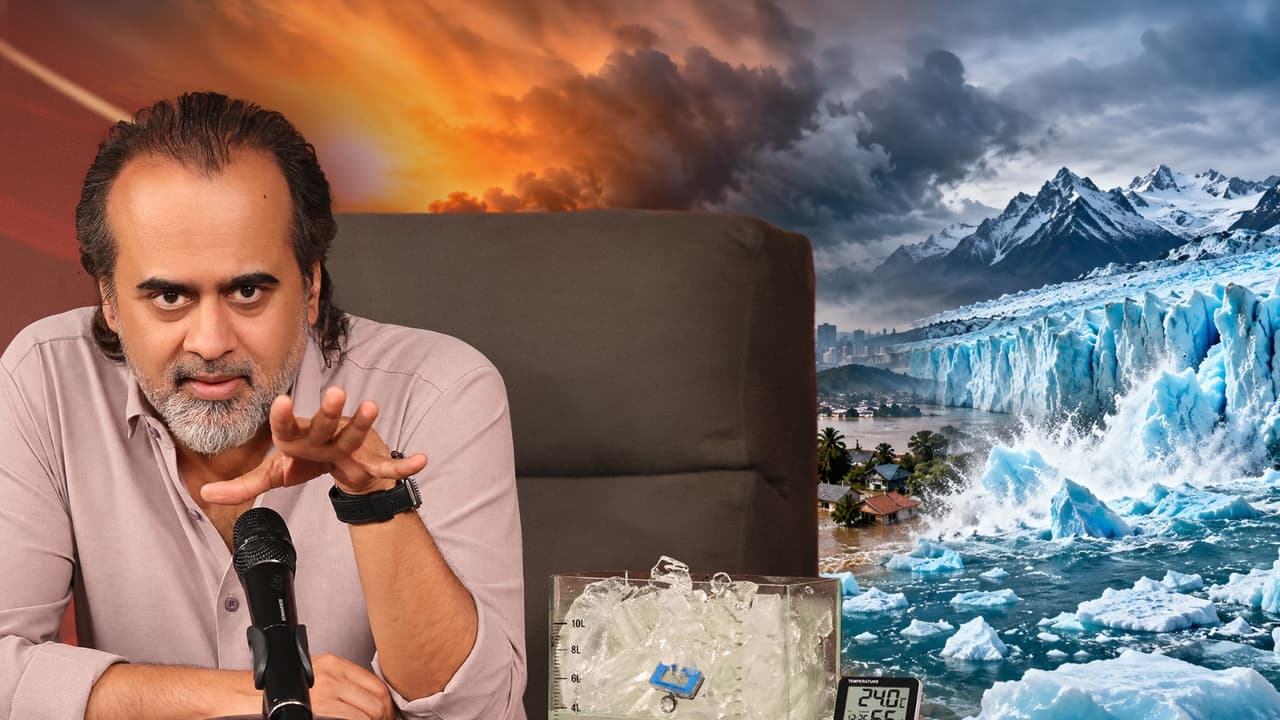
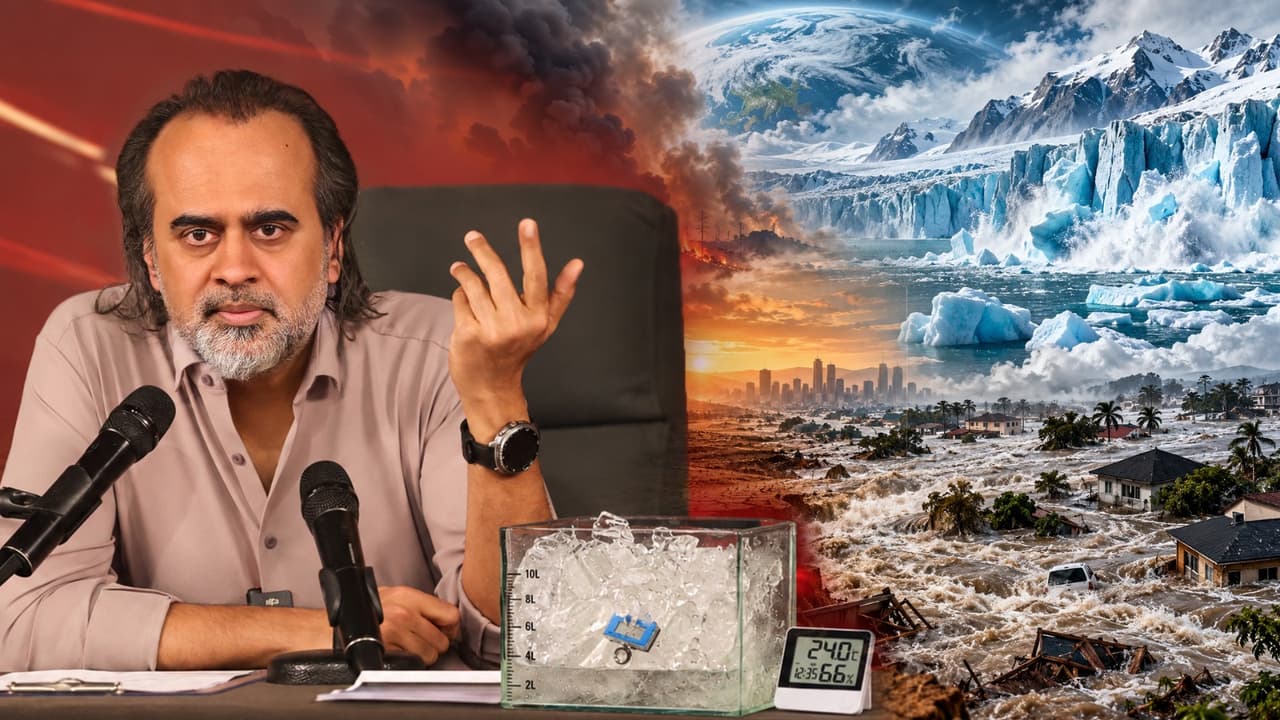
Feedback cycles are a very simple thing. Let me give you a very basic example. We talk of the glacial ice melting and the consequent rise of the sea levels, those things. So let me take that example. There is ice on a mountain. There's ice on a mountain. Broadly speaking, that's what a glacier is. There is ice on rock, and the rock is typically dark in color, and the ice is white. So when sunlight radiation falls on ice, it gets reflected back, because that's what white color does. But due to climate change, consequent global warming, the ice melts. So the white color is gone, and the dark rock beneath gets exposed, and that one absorbs sunlight.
When it absorbs sunlight, it gets heated. When it gets heated, more ice melts. When more ice melts, more rock gets exposed. When more rock gets exposed, more ice melts, and that's a cycle beyond your control now. You cannot control it anymore.
So, 450 ppm carbon dioxide in the atmosphere, feedback loops are well and truly activated. We started from 250–270 ppm pre-industrial levels, and we have come to a point, soon we'll be reaching double the natural levels of carbon dioxide in the atmosphere, and it's beyond human control now. So it seems we have already given up. At least, that is what is apparent from the attitudes of leaders and their societies, their electorates. No one seems bothered. We are paying lip service, but it is as if mankind has collectively resigned.
We are saying it is going to come, and the effort that it takes, the resolve that it takes to stop it, that we are unwilling to provide. So let it come. Anyway, the worst of it will not be seen by our generation. It will be seen 10, 20, 30 years later. Actually, it is being seen even today. But it's only going to intensify and accelerate, and the gravest results will be upon the coming generations. So why should we bother that much?
Questioner: But it's not a case of not knowing what can happen. There are certain events that happen where you don't know the consequences, and those consequences then take place. Here, like you are saying, and we have all been reading about it, whether there are deniers of that or not, but there is scientific evidence that all this is happening. It's irreversible. Why are people not scared then? Is it that you are too consumed by self right now? You don't care about…
Acharya Prashant: You see, think of alcoholism, think of obesity, think of substance abuse of any kind, think of any kind of compulsive obsession. Does the person involved not know what is coming towards him, what is in store for him? He knows that very well. With every morsel, you are aware that you are overeating, that this is beyond your calorie brief, and yet you take it in.
So that's what is happening, because there is a certain pleasure involved with emitting carbon. Our emotions are carbon, our celebrations are carbon, our feelings, our relationships, our happiness, our sense of progress, everything is carbon. So, to stop carbon emission, you'll have to have a different philosophy of life altogether.
And that's why I say that the only solution that this crisis can potentially have, even if a solution is still possible, is neither political nor technical. The solution will be spiritual, because carbon is not really emitted by a car engine, or a jet engine, or a power plant. Carbon, truly speaking, is emitted by the emptiness inside mankind. We do not know what we want, and hence we want everything, and that requires attempt and energy, and energy is emission, and energy is carbon.
You know, we want stuff, and that takes emissions, and that is carbon. Why do we want so much stuff? Because we do not know what we want, and that's why the crisis can only have a spiritual solution.
Questioner: Is that why you say, and I'm quoting from your book (Truth Without Apology) on page 14, that “Man's hunger is not so much in the stomach, it resides in his mind, and no fruit is enough when it comes to the mind. So man has been destroying everything he can touch, and climate change is the most recent, and the most devastating, and probably the most final symptom of it.”
Acharya Prashant: Most final symptom.
Questioner: Is that what, I mean, basically, you're alluding it's just not about cars and emissions, but…
Acharya Prashant: It's something. See, it's something so simple. When do you call a person successful or happy? Think of a person you are calling normally as successful or happy. Who is this person? This is a person whose carbon footprint has increased. So the person was riding a two-wheeler, now he's a four-wheeler. Or he had a smaller car, now he has three big cars, and you'll say he's prosperous, happy, successful, and all of that.
Questioner: Yeah. Big house, 20 ACs.
Acharya Prashant: Big house, 20 ACs. So everything that we associate with happiness is carbon, which means that our basic definition of happiness itself is very violent and very misplaced. We need a different, a real philosophy of life. We have been told that the purpose of life is happiness, and happiness is to be obtained through consumption, material consumption.
The purpose of life is happiness, and happiness comes from material consumption, and consumption is carbon So the purpose of life is to emit carbon. That's a corollary. If the purpose of life is to emit carbon, then we, all the 8 billion of us, and we'll be like 10 billion in a couple of decades, the 8 billion of us then exist just to emit carbon. So what else will we get apart from climate devastation? And that's what we are getting.
Questioner: What do you make of a lot of activism that you see around climate change, or people, those who are speaking about this? Because, you know, and it's something very interesting that you write in your book. It's when you say half-hearted or superficial measures are not going to work, now. You cannot have somebody set the AC to 22° instead of 16 and then feel proud that he's contributing to the climate movement. That is mere self-deception. What do you mean by this self-deception? I mean, why are we fooling ourselves, if it is self-deception?
Acharya Prashant: Just to feel good temporarily. It's like a dopamine spike. I'm a nice man. I'm a moral man. I'm a responsible man. You see, the top 10% of the global population by wealth, they are responsible for more than two-thirds of global emissions. That's it. And if you take the top 1%, they contribute to more than a quarter of global emissions directly. If you take all the indirect emissions also, it's only going to increase. That's what they do.
And that's not the only problem. The problem is that those who are not yet there in the top 1 or 10 percentile, they aspire to be there. Which means that our role models are those who emit the most. Our role models are those who emit the most, who devastate this planet the most. They are our role models.
So, on one hand, they are the ones emitting like mad. It was like this that one particular billionaire in the United States, the amount he emits daily, an average Indian will take 2,500 years to emit. The average Indian will take 2,500 years to emit the amount of carbon that the average American billionaire emits daily.
And that's only half the problem. The other half is this fellow who does not emit anything because he's simply poor, takes that one as his role model and wants to become that one, aspires to be that one, wants to be employed by that one, worships that one. Now, in this kind of philosophical ecosystem, how can there be any reduction in emissions? We are worshipping those who are butchering us.
Questioner: You know, it reminds me of, like you said, it reminds me of all these conferences, even the Paris Accord or anything, where every single individual or the world leader who is coming there comes in their own jet and then talks about carbon emissions needing to be lowered. So it's superficial lip service, while you're not putting that in practice for yourself as well.
Acharya Prashant: And also, you see, all these carbon austerity measures are preached to those who are anyway not emitting much.
If you go to an average Indian household, how big is the carbon footprint? How many tons of CO₂? The global average is close to four tons. The average Indian, if you remove the top 5 percentile of Indians, does not emit even one ton. And you go to that person and you tell him, you know, this electric bulb you should not be using when you're not in the room, you should not be having an AC, instead of using that little 60cc moped or scooter, you should be walking to the chauraha. All this is stupid, because even if he does all this, it's not going to make even a minor difference.
But instead of pointing our fingers to the place where the culprit is, we are being told to look at ourselves, as if the Global South is responsible, as if the normal poor person is responsible, as if the middle and the lower-middle classes are responsible. They have done nothing. The fact of the matter is, most Indians actually need to increase the size of their carbon footprint.
Questioner: Somebody will find it offensive and say why.
Acharya Prashant: I understand, I understand. But you think of a girl who does not go to school. If she goes to school, there would be some carbon emission. Now, that kind of carbon emission is welcome.
You think of a person who does not have sufficient power consumption, even enough power consumption to keep himself cool in summers and warm in winters. You cannot be stone-hearted and tell that you must not consume anything so that that particular billionaire can keep emitting like mad. So, when it comes to this part of the population, the lower half, the lower quarter percentile of the population, they are, in fact, going to increase their carbon emission and their consumption, and that is justified.
Where we should restrict is the top 1, 5, 10, and 20 percentiles. But they are the ones also holding power. They are the ones deciding the narratives. They are the ones controlling the media. They are the ones who also have political power at their disposal. They'll not allow this to happen. They set narratives. They are the ones who fund the kind of journalism that calls all climate change a hoax. And there is a very strong current of climate denialism as well. All that is being funded by those top 1, 5, 10 percentile people.
Questioner: You know, it brings me to a very interesting question to ask you then. Is it a class problem then, or this divide that we are talking about, this denialism that we are talking about? How do we then balance the obvious question would be, how do I balance my development, my need or will for a better life, with this whole climate change, because I'm also living in it?
Acharya Prashant: Beautiful questions, both of them. It is not a class problem, because irrespective of the class, there sits an animal within us that wants to consume. There are the haves who are able to consume; there are the have-nots that aspire to consume. So how is it a class problem?
Irrespective of the class, wherever the man or the woman or the kid or the Asian or the African or the Hindu or the Christian is located, this fellow wants to consume, and that is independent of the class. Right? So it is not a class problem. First thing, it is a philosophical problem. You need to have the right philosophy of life, the right understanding of life, the problem lies there.
What was the second thing you said?
Questioner: Then, how do I, if it's not a class problem, also want to, like you said, balance…
Acharya Prashant: How do I Balance my…
See, please understand, there is enough for you to consume without you becoming a climate convict. It is not necessary that if you make even minor emissions, that's to be counted as a crime. That's not so.
The Earth has natural climate sinks. On the land, there are the forests, and then 70% of the surface is ocean. Water absorbs carbon; so do forests. So if you are making emissions under a certain limit, that is all right, and you can be very well developed.
The problem is mad growth, not development. Development consists of looking at your real needs: the right to be educated, medical facilities, having a culture of equality around you, all that counts under development. But what we want is unlimited growth, and by growth we mean material accumulation. That's where the problem lies.
For development, if you emit carbon, that is all right, and that's not going to cause harm. But if growth is your objective, your philosophy is, “I have to keep growing endlessly,” like the pursuit of endless profits by MNCs, “I must grow endlessly, and only then I can call myself successful, otherwise I feel hollow inside.” Then there is a problem, and that's where the problem is.
Development is not the problem. Reckless pursuit of blind growth is the problem, and these two are distinct. These two must be seen as distinct.
Questioner: So basic comfort can't be seen as…
Acharya Prashant: A crime. No, that's not a crime. No.
Questioner: But overconsumption has to be called.
Acharya Prashant: Otherwise, we are climate culprits, aren't we?
Questioner: Yeah.
Acharya Prashant: There was some emission involved with the production of these garments. There's air conditioning on as we sit here in the month of May, and I think that is justified. That is very much justified. And this is not what is responsible for climate catastrophe. But the third world has been made to feel guilty. We are being told that the climate crisis is a result of your use of the air conditioner, or that 1000 cc car that you have, whereas you have real monsters, SUVs and gas guzzlers. You go to the US, you go to Dubai, that's where you find them. But you are being told you are the culprit, whereas you are not.
Questioner: So before you guilt people, those who are aspiring for a better life, give up your private jets and your…
Acharya Prashant: Yachts.
Questioner: Yeah, yachts, before you give people grief for their basic needs.
Thank you so much. We can go on and on on these topics, but paucity of time, thank you so much again for speaking to us.
Acharya Prashant: Most welcome.