Climate Change and Global Warming: The Hidden Carbon Emissions of War

Acharya Prashant

24 min
69 reads
Climate Change and Global Warming: The Hidden Carbon Emissions of War
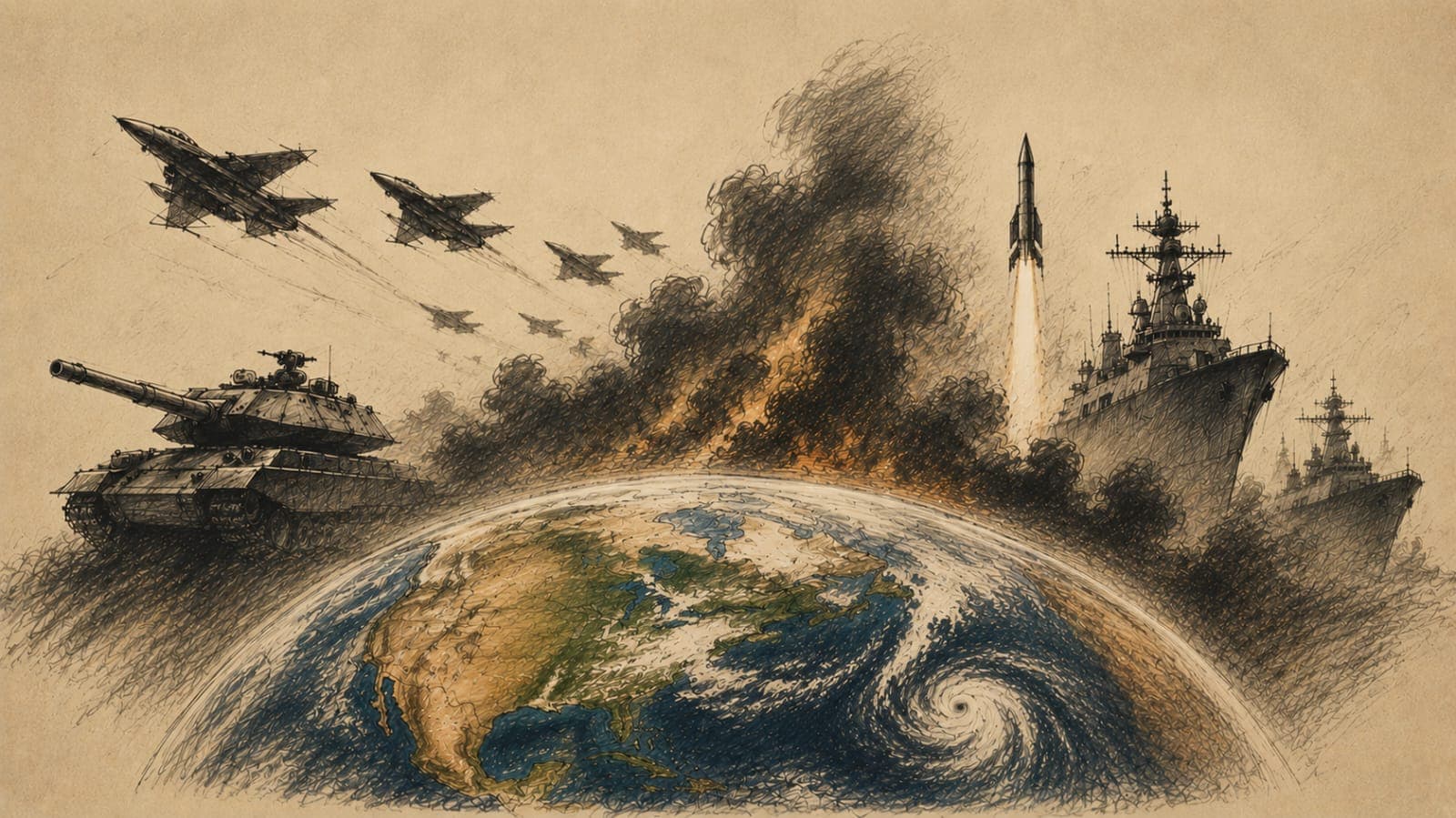
Climate change and global warming cannot be addressed honestly while the world's largest source of hidden carbon emissions—military activity—remains largely excluded from climate accountability. Wars, military expansion, and consumerism arise from the same psychological drive for domination and endless consumption. Unless the Paris Agreement includes military emissions and humanity addresses the inner causes of conflict, every effort to combat climate change will remain incomplete. This summary is AI-generated. Please read the full article for complete understanding.

Questioner: Namaste Acharya Ji, I was going through the article that you have written for “The Pioneer" this week. It's titled “The Climate Cost of the War Machine,” written in the context of the ongoing war. Some of the facts that I checked and read in the article were quite shocking for me, so I just wanted to discuss with you, regarding some of the main points that I thought I wanted more clarity on.

In the beginning itself, it says the world's militaries combined account for an estimated 5.5% of global greenhouse emissions. That is nearly three times as much as the world's commercial flights emit.

Acharya Prashant: Staggering stag.

Questioner: Just 2%.

Acharya Prashant: And it never beeps on our radars, never. We keep talking of air travel, often in a denigrating way, and we'll poke fun and throw taunts at someone who chooses to fly to Europe for a vacation. And it is astounding that the world's war machines are emitting three times as much carbon as the entire commercial aviation, that whole industry combined, and it never, never occurs to us.

You know, there is a reason it never occurs to us. In '97, when the Kyoto negotiations were on, the US lobbied hard to exclude military emissions from the account of total national emissions. And since that day, the world has decided, in a fit of collective amnesia, to look the other way. So we account for everything, except the elephant in the room, which is military emissions. And you have begun in a great way by putting a number to that, three times as much as the global aviation industry.

Questioner: And even this number is probably underreported.

Acharya Prashant: Underreported, because there is no legal mandate to compulsorily or accurately report. So reporting is either not done, or even if it's done voluntarily, there exists no mechanism to cross-check what the nations are reporting as their military carbon emissions. Mostly, it is not even reported.

Questioner: Yeah. It says if the world's militaries combined were a country, it would be the fourth largest emitter (source: Scientist for Global Responsibility & Conflict and Environment Observatory).

Acharya Prashant: Fourth largest emitter behind the US, China.

Questioner: And India.

Acharya Prashant: So that's the size of the emission, and the world's populations are given an egoic pill that helps them forget or ignore how much the war machines are emitting. And you know, the war machines are emitting not only in wartime, what you call as peacetime, what you call as the normal maintenance operations of the global militaries, they are not insignificant at all.

So even if you do not find a war raging, the extent of emissions in terms of the production of weaponry, the logistics, the shipping, the usual drills, the movement of military aircraft, and just so much more, that too is highly, highly significant.

In fact, the global corpus that is needed to offset the effects of climate change for the developing countries, for the most vulnerable nations among the developing ones, is just a fraction of the amount that is needed just to keep the war machine running. Not fighting a war, fighting a war is an entirely different proposition.

In the usual maintenance sense, I suppose 15% of how much the militaries consume is enough to take care of the climate funding needs of the developing world. But all that is never, never talked of. We just keep mentioning that we need to take care of our goals under the Paris Agreement, but funding is a problem. Is funding really a problem, or is the collective ego choosing to look the other way? We don't address that, and we take these as separate problems.

Funds are not available to address our climate needs. There is poverty, schools are not there, and then there is geopolitical trouble and there are skirmishes on the borders. We take all these as separate problems. We keep them in separate boxes, and that serves a very nefarious inner purpose.

You know what the purpose is? Keep all these problems in separate compartments so that you are exempted from looking at their common center, common source, common root, common origin.

The fact is that the climate crisis and man's need for territorial expansion or geopolitical domination, they arise from the same inner place, no? The ego's appetite to consume is endless. From there come wars, and the ego can never be satisfied with whatever it has. From there comes the urge for hegemonic domination. And from there also comes the urge of the individual consumer to stuff his house with more wares, more this, more that, even more kids, more vacations, more vehicles, more emissions.

So all of that is coming from the same center, and that needs to be understood. The same point within the human being that causes him to mindlessly consume is also the point that causes him to mindlessly fight. The origin is the same, and that's, I said, the reason why we want to treat these as separate problems, because if you look at them in totality, you will be forced to confront the fact that they are not separate problems; they are two branches of the same tree.

Questioner: You talked about looking away, so that's what I really found shocking. I mean, the numbers, shocking as they are, were less shocking than the fact that I had never known about this.

Acharya Prashant: Yeah, because nobody wants to tell you about this. Because this must be kept a secret. This must be kept almost sacred. Not just secret, sacred. You're not supposed to touch the sacred, right? You're not supposed to question the sacred. And that's why these things are not brought out in public, so that the ego's sacred idols are never put to question.

War is one of them. I need to fight. It's a necessity. I need to feel secure. Do you really think these things leave you more secure? We know for sure the history of mankind is also the history of wars. Has all that left us more secure? We know it has not. Still, the ego continues to lie to itself and tell itself that this is a present emergency, so you cannot waste your time in counting carbon, right now, you must count ammunition, tanks, planes, jets, frigates, submarines, and men. You must count all these things. You must count the number of soldiers, the foot on ground. Why are you counting carbon? Carbon is a thing of the calendar; it is for tomorrow.

Whereas we know very well that the climate crisis is a present emergency. It is not a thing of the future. But we want to pretend as if securing whatever we call our needs is more important than securing the existence of mankind itself and the existence of the millions of species that we are causing to go extinct.

Questioner: When you talked about the sacredness of the thing, so-called, I was just looking at the Kyoto Protocol you talked about in '97. The US pushed hard and lobbied so that this is excluded.

Acharya Prashant: Is that not very interesting, very interesting?

Questioner: Yes.

Acharya Prashant: And that fact is rarely mentioned anywhere.

Questioner: It is not mentioned, and the surprising thing is, in '97, the US had a Democratic government. The Democrats were there, who were supposedly pro-climate. And they are the ones who lobbied for this.

Acharya Prashant: Even from climate action groups, we rarely get to hear of this. Nobody mentions the military operations, peacetime and wartime, as one of the most important and catastrophic sources of carbon emission. We take that as something non-negotiable. We take that as some kind of existential rule that cannot be questioned or sought to be changed, some kind of a sacred decree that you cannot even dare to look at, let alone challenge.

Questioner: And the result of this not looking is, as you mentioned in the article, global military expenditure reached 2.7 trillion. It is a 9.4% increase from the previous year. The steepest rise since the Cold War (source: Stockholm international Peace Research institute).

Acharya Prashant: It has to be understood that global military expense is very directly correlated to global carbon emission, and the Paris Agreement says that you have to reduce your carbon emissions by as much as 44% by 2030, compared to the levels when the agreement was signed. Now, if you have to achieve that kind of reduction, there has to be some kind of a corresponding reduction in military spending as well. Instead, what we are experiencing, and you quoted, is the highest ever annual rise in military spending since the Cold War. That does not augur well. Not at all.

9%, 10% kind of global rise in military spending, and obviously you will have justifications. Obviously, you will say this is a national need. You'll say our very existence is threatened. The enemy will come and kill us. Therefore, we need to do all these things.

The enemy may or may not kill us, but what's certain is that our insecurity will kill us. And that insecurity is a permanent feature of the unexamined ego.

Don't examine the insecurity of the ego, and the ego will keep labeling it as the Truth. Yes, I am insecure, and that's the Truth. Therefore, I'm entitled to proceed from my point of insecurity. All my actions are justified because, you know, I'm actually insecure.

Questioner: Very interesting comparisons. I saw in the article it says the US military is the single largest institutional consumer of hydrocarbons on the planet. If it were a country, it would be ahead of Portugal, Sweden.

Acharya Prashant: I think that needs to be repeated with emphasis. The US military is the single largest consumer of hydrocarbons on the planet, and a lot of heft that the US enjoys as a superpower is because of its military, in other words, because of its military spending, in other words, because of its carbon emissions. So that's the world we are living in, right? The more you emit, the more you destroy, the bigger a superpower you are.

And all that can change very soon, because you don't have to do anything new. You don't have to scale mountains. You don't have to achieve feats. You simply have to stop emitting. Now, stopping something that you are already doing is far easier than accomplishing something new. So you simply have to pull the plug. You simply have to see the needlessness of what you are doing and withdraw, retreat. It's easy, but unfortunately it's nowhere on the horizon, and mankind is slipping fast on this slow, and actually accelerating.

Questioner: Yes. You mentioned here, “The ego that launches a war and the ego that cannot stop burning carbon are not two different egos.”

Acharya Prashant: Just the same.

Questioner: Same problem.

Acharya Prashant: Just the same. I cannot know where my urge to have more comes from. I do not know why I feel like consuming more and more. I don't know why I feel like running to a shopping mall every weekend. I do not know why I must have more and more. Similarly, I do not know why I feel like coveting somebody's territory or somebody's oil fields or somebody's farms, resources. I don't know anything. I just act on my urges, and my urges are not really mine. They belong to the ego, and the ego is some kind of a disease in the human being. And if you're operating from your disease, obviously the operations can't be healthy, no?

It's almost like getting infected with a virus. And the virus changes and controls your behavior. Now, your behavior is not yours. Your behavior belongs to the virus. Your job now is not to obey the commands of the virus, but to remove it. And that's what a sane humanity and conscious civilizations should be preferably doing. Instead, infected by the virus, we are busy carrying out the dictates of the virus, and the virus is the virus of incompletion. It says, give me more, give me more, give me more, give me more, and the entire planet will not suffice. Nothing is enough for the virus.

Questioner: And now we have come to a point when this is like a feedback loop. As your article mentioned, wars produce emissions. Emissions further accelerate climate change, destabilize the region, right?

Acharya Prashant: Wars produce emissions, and emissions destabilize the climate, and when climates are destabilized, entire populations suffer. Patterns of agricultural production get distorted, displacement of populations can happen, and all that creates tension, which again lays the foundation for war. So war will mean carbon emissions, carbon emissions will mean climate catastrophe, and climate catastrophe will create tensions that will cause more wars. So that's a feedback loop, and a very unfortunate one at that.

You know, just to put things in perspective, we keep talking of EVs, we keep talking of green energy and many such things, and it is good, yes. We also keep talking of planting trees, which is all very fine. But do we want to have some kind of idea of the quantum of emissions that one fancy bomb produces? The kind we find dropped in movies and celebrate, provided it's being dropped on an enemy. That one bomb that is dropped on an enemy, the average kind. We are not talking of the big ones. The Zar bomb and the fat boy types. We are not talking of those bombs. The normal, mediocre bomb, the everyday bomb. One such bomb produces emissions that are in the range of emissions produced by a car if it travels for a distance of 1,000, 2,000 or 5,000 kilometers, depends on the size of the bomb.

Questioner: I was going through this metric as well, and this is only regarding the explosion. If you include all the fuel of the jet plane and everything, it goes as large as 1.5 lakhs kilometers.

Acharya Prashant: You drive a car for 1.5 lakh kilometers.

Questioner: That is four times the circumference of the earth.

Acharya Prashant: The four times you go around the earth. And you'll still be emitting less than what you would if you drop a bomb on a built-up area. Because this construction, you know, this has logged-in carbon. You flatten it, and all that carbon is released back into the atmosphere. And after flattening it, you will rebuild, reconstruct, and use iron and steel. And these are two industries that are extremely carbon intensive.

So one bomb, that we often gloat over and even celebrate, one bomb is the equivalent of, taken comprehensively, a vehicle going around the planet four times. And then we say, you know, I'm a do-gooder because I use EV, but at the same time I vote for wars, at the same time I support governments that are belligerent and promise more aggressive policies. And then I'm, you know, I'm climate conscious and I want to save the planet and do many good things.

These are the questions somebody must ask the average American. What kind of inner hypocrisy is this? Obviously, there is a cross-section of the population that gives two hoots to the climate discourse, but then there are large numbers who claim that they care. Yes. So this question must be posed to them: if you actually care, how are you supporting a government that fights or that seeks to enlarge the military or enhance military spending? How do you support such a government? Do you not know what a fighter plane is made of, and what it consumes, or how a tank moves, or what happens when a single tank shell explodes? Don't you know about these things? We still talk of climate.

Questioner: And there are just so many aspects to it. Everywhere I look, here it mentions even about employment. Even if you look from that point of view, military spending produces an average of five jobs compared to 13 in education, nine in healthcare. You mentioned all this data in the article.

Acharya Prashant: We can keep that aside for the while, because it's not so much about employment. People will say our urgent security needs must override the shape the employment figures have, so that people won't want to really consider.

But from a climate perspective, not just war, but the entire war machine is catastrophic. It's not just about what Israel is doing in Gaza, or the US is doing in Iran, or Russia is doing in Ukraine. It's not just about that. Even the existence of militaries is a huge threat to climate sustenance.

But just as we love to feel insecure, similarly the collective bodies of human beings love to feel insecure. That gives us an identity, a common enemy. You know, I'm insecure, and what connects you to me, and how do I define myself as the enemy of my enemy? I got an identity, the enemy of my enemy.

Do you get to read of, I mean the Iran war especially started? But you, Russia has been fighting Ukraine for four years now. Do you get to read of the climate impact of the Russia–Ukraine war?

Questioner: Yes, you mentioned that, in the article.

Acharya Prashant: That has emitted carbon on a scale bigger than the annual carbon emissions of many important European nations, midsize European nations.

Questioner: Spain, Austria, Hungary, Czech Republic. Even if you combine all these small countries, it's more than what…

Acharya Prashant: But the war is never looked at from this perspective.

Questioner: That's one of the major…

Acharya Prashant: And that's when we are still not talking of rebuilding. Ukraine has been flattened to a great degree, and reconstruction would mean even more carbon emissions. We are not yet talking of that.

Questioner: And all of these huge amounts that you're spending on the military, on wars, as you mentioned, even a small fraction of this would easily solve a lot of issues that are happening in the developing countries.

Acharya Prashant: The thing is that wars are exciting, and what you are talking of is boring.

Questioner: A person in India watching TV and, you know, saying…

Acharya Prashant: War is hot TV. War is good TV. War is successful TV. Climate makes you fall asleep. Therefore, human beings will continue fighting because it goes back again to the ego.

The ego does not like itself. It's bored of itself. Therefore, it is continuously in search of fun, adventure, excitement, entertainment. Wars entertain, don't they? Wars excite, don't they? Though that's the worst kind of excitement one can opt for, but that's what humanity has traditionally done. Nothing else to do, go and fight, wage a war. Seen the number of war movies we have and the blockbusters. Can you imagine a scene movie on the climate catastrophe, raking up even a tenth of the revenue? That won't happen because wars are exciting.

When there is that loud explosion, you experience goosebumps, no? “Wow. Everything has been flattened, and men are flying, and buildings are collapsing.” In that moment, in that moment of excitement, in that moment of intoxication, in that moment of drunkenness, the ego gets what it has always desired, a cool excuse to look more and more away from itself. I'm looking at that because that is exciting. I'm looking that way because that's where the enemy is. What the ego hates is the mirror. What the ego never wants to look at is itself. Give it something exciting so that it can continue to evade its own face. That's all that it wants. And war gives the ego a good, nice, exciting object to look at.

Humanity probably deserves to suffer because that's something we have brought upon ourselves. What I don't like is the climate injustice. The poor usually don't have a big role in consumption or even in wars. These are feds of the rich and the elite and the powerful. But it's the poor who are going to suffer the most. Animals have no role at all, but all non-human species are not just suffering, they are being wiped out at a rapid rate from the face of the planet. That's climate injustice.

Do you care about forests or rivers or animals when you wage a war? Does that happen? We don't even keep a count of that. If somebody asks you how many animals got killed in World War II, you'll have trouble getting a realistic estimate from somewhere. But you will get the number of Germans and Chinese and Brits and Russians and Poles who suffered, all that is available.

Questioner: That's what I was thinking, how tragic it is for a person from India to say, I support the US or I support Russia. He's going to be one of the first victims, him and the environment around him.

Acharya Prashant: Indians who are enjoying the global wars, thinking that they are happening in somebody else's backyard, are making a fool of themselves because carbon does not honor national boundaries. Whatever carbon is being emitted when oil fields are set ablaze and refineries are struck in Iran or in other Gulf countries, all that emission is not going to stay there. That becomes a part of our shared atmosphere. And the Indian subcontinent is one of the most, probably the most vulnerable places when it comes to the climate crisis.

We are going to be the biggest sufferers. We already are. It is not a crisis of the future. We already are suffering. There is a definite impact on quality of life, on the medical bills, even on GDP. The impact is already there. The impact has even been quantified. We know that, but you don't want to talk of that.

Questioner: We can already see all the anxiety around the LPG cylinder. My father called me and said, get an induction cooker.

Acharya Prashant: Right. And it's just mid-March, not even mid-March yet, and yet we experience the temperatures. People are already anxious, thinking in the north of April, May, and June. And it's going to be bad, really, really bad. And when you will find birds collapsing on roads and daily wage laborers collapsing, you probably won't realize that that has a lot to do with the wars that humanity has waged with its fancy toys.

Questioner: What should be the approach of someone who is not directly related to this war, someone in a developing country?

Acharya Prashant: We are doing it. We are doing it, and we'll have to stop doing it. It's all arising from the center of ego within the human being. What is it that kills the ego? The mirror. Know where actions are coming from, and the actor will change. Know the center of the fighter. Know the place the fight is originating from, and the fighter might change. The fighter might find that he's no more. So you'll have to bring people to themselves. You'll have to have more discussions like this one. Where we get to see what it is within us that refuses to confront the facts, that weaves all kinds of narratives and fabrications and utter lies just so that it has, so that it can evade the naked Truth.

So, that's what is needed. Nothing fancy, nothing special. You don't have to do anything extraordinary to arrest the climate crisis. You simply have to stop being yourself. You simply have to desist from doing more of what you have done so far. And the way is self-knowledge. There is no other way. The article you are quoting from is built around that point, though I have substantiated it with a lot of facts, and that's necessary. Facts must be brought out, but the center remains self-knowledge.

You have to see what within you makes you fight your neighbor. Are the reasons real at all? What within you prevents you from keeping an account of the real costs? What within you makes you hide the climate cost of your belligerence? So that's something we need to confront.

Questioner: Mentioned here that, “The government that refuses to account for military emissions did not arrive from nowhere. They were elected by each one of us.”

Acharya Prashant: These are all elected governments. Yes. Obviously. Both the governments that initiated the war are elected governments, for name's sake even in Russia, there is an elected government. So even Hitler, came to power through a democratic process. So it's not as if an alien power is hypnotizing us. There is something within us that is dark and evil, and we need to look at it. The good news is, looking often suffices.

If you know you are operating from a bad center, the knowing changes something.

This article has been created by volunteers of the PrashantAdvait Foundation from transcriptions of sessions by Acharya Prashant
Comments
LIVE Sessions
Experience Transformation Everyday from the Convenience of your Home
Live Bhagavad Gita Sessions with Acharya Prashant
Categories