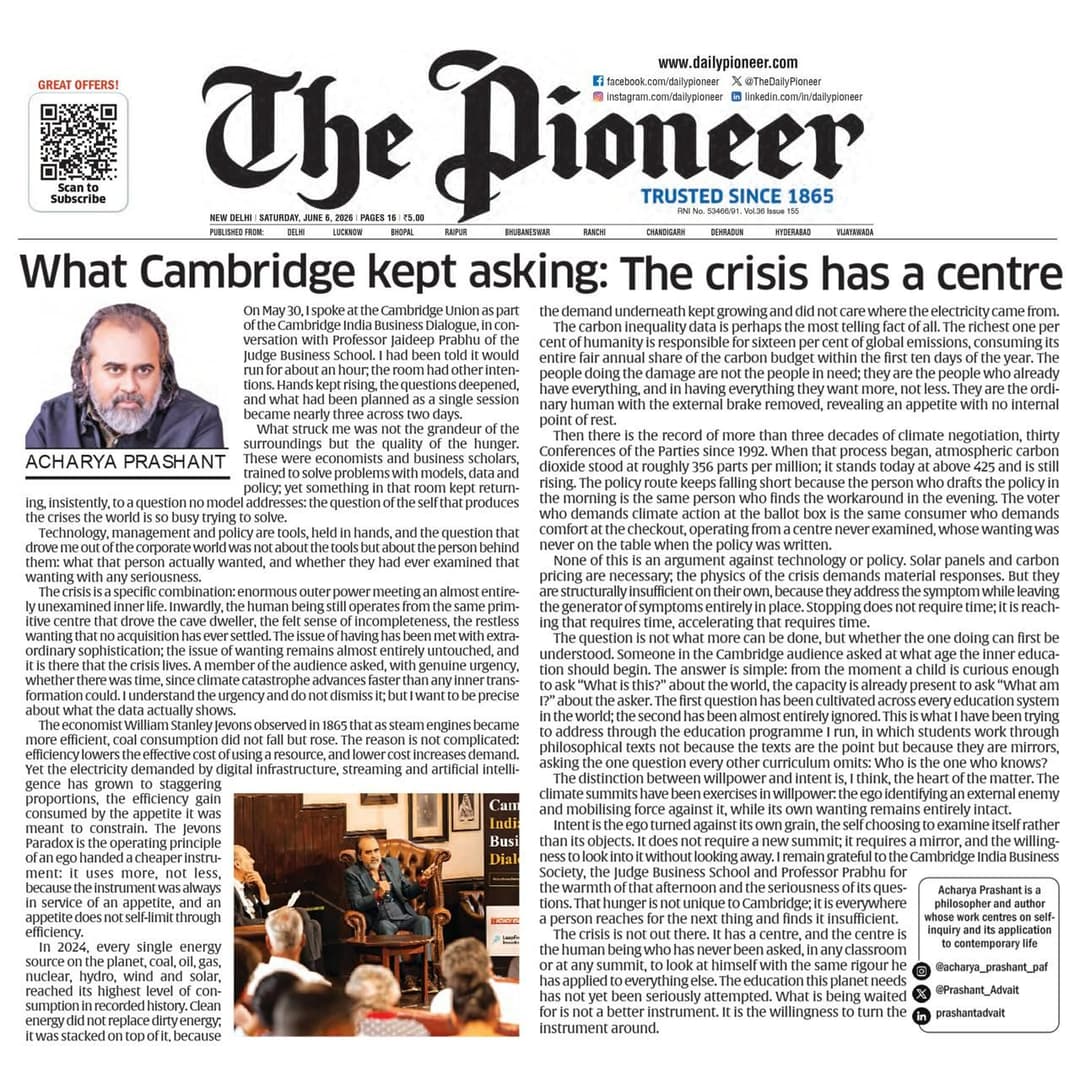
Technological progress has expanded human power, but the inner motives driving that power remain largely un-examined. Climate change, over-consumption, inequality, and social crises persist because efficiency and policy address symptoms while leaving desire untouched. Real change requires education that helps people understand themselves, not just the world around them. Without self-knowledge, better tools merely amplify old patterns, turning progress into a more sophisticated form of the same crisis.
This summary is AI-generated. Please read the full article for complete understanding.
Originally published in The Pioneer on 6 jun '26
On the 30th of May, I spoke at the Cambridge Union as part of the Cambridge India Business Dialogue, in conversation with Professor Jaideep Prabhu of the Judge Business School. I had been told the session would run for about an hour; the room had other intentions.
One after another, hands kept rising, and the questions did not repeat themselves; they deepened. A student asked about incompleteness, and whether desire itself is the engine of civilisational progress. A young professional asked about the tension between capital and inwardness, between building a career and attending to oneself. Someone asked about time, about whether there is enough of it left to change course before the ecological crisis becomes irreversible. Someone else asked about bridges, about how to connect the masculine with the feminine way of knowing, the Eastern with the Western, the old economy with the new. I answered as best I could, and the room produced another question, and then another, until what had been planned as a single session became nearly three across two days, the halls and streets of Cambridge unwilling, it seemed, to let the conversation rest.