The developed world often presents itself as clean by shifting pollution, waste, and environmental costs to poorer nations rather than eliminating them. Real cleanliness is not the absence of visible dirt but the absence of the ego that creates and conceals it. Laws, technology, and appearances can regulate behavior, but without inner transformation, societies merely relocate their destruction instead of ending it. A truly clean civilization is one that reduces consumption, acts from responsibility rather than image, and confronts the pollution within before claiming purity outside.
This summary is AI-generated. Please read the full article for complete understanding.
Originally published in The Pioneer on 4 July '26
I have been travelling through Britain these past weeks, speaking at Cambridge, at Oxford, and in the British Parliament on freedom, self-knowledge, and the climate crisis. Last Friday evening, at the London School of Economics, I sat in a long public dialogue with Professor Jonathan Birch on the question of animal sentience: how does one know whether very small creatures feel anything at all? It is a serious question, and Britain has taken it seriously. Professor Birch's research informed recent animal welfare legislation passed by the British Parliament, and in matters of animal protection, Britain is counted among the leading nations of the world.
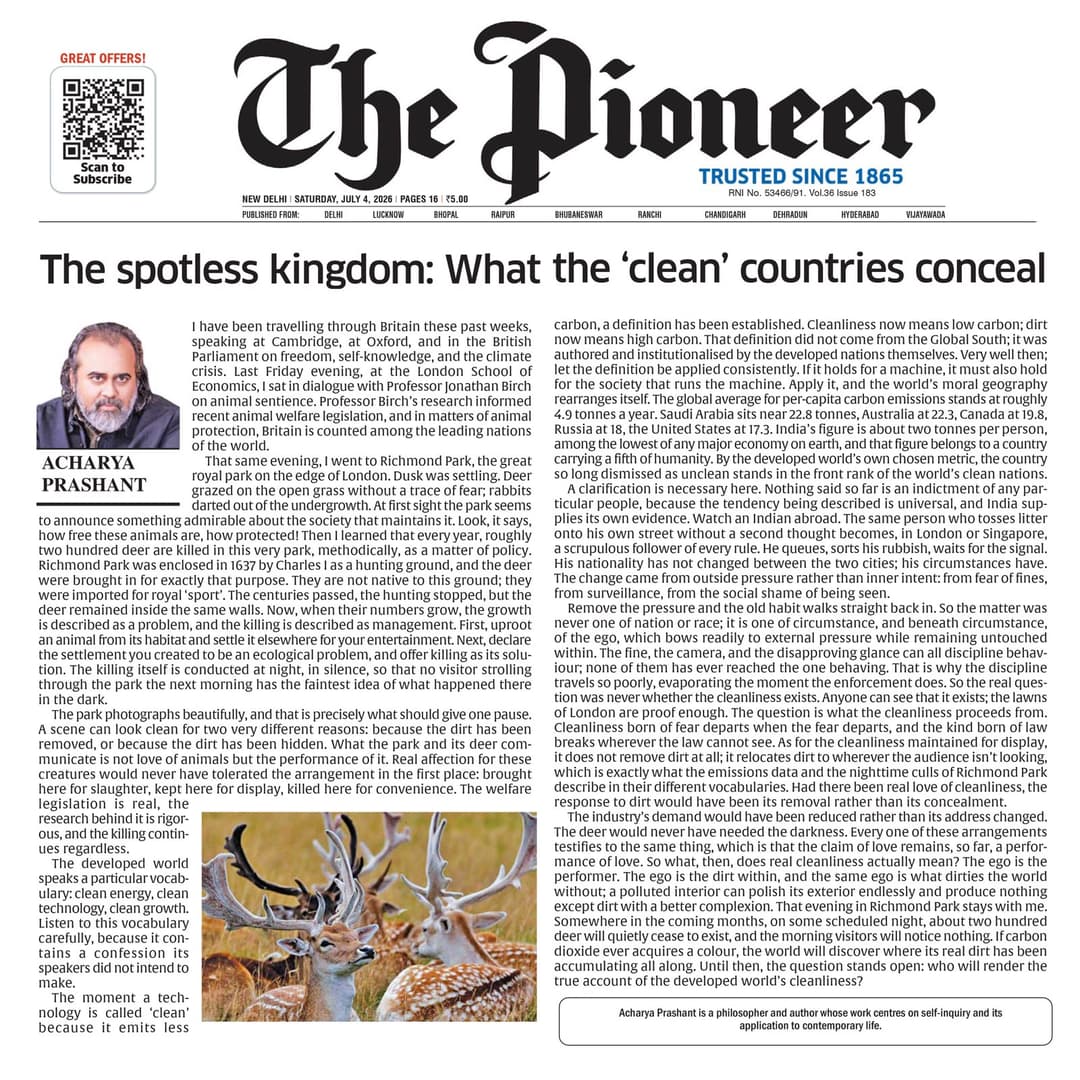
That same evening, I went to Richmond Park, the great royal park on the edge of London. Dusk was settling. Deer grazed on the open grass without a trace of fear; rabbits darted out of the undergrowth. At first sight, the park seems to announce something admirable about the society that maintains it. Look, it says, how free these animals are, how protected! Then I learned that every year, roughly two hundred deer are killed in this very park, methodically, as a matter of policy.