Deccan Herald
22 May '26

The Burden of Borrowed Expectations

Acharya Prashant

3 min
1.4k reads
The Burden of Borrowed Expectations
Many of the ambitions, fears, values, and feelings we call our own are often inherited from family and society long before we are capable of choosing them. Over time, borrowed expectations become personal identities, and inherited anxieties are defended as conscience or responsibility. Real self-understanding begins by questioning these internalized burdens and asking whether they truly belong to us, or whether we have simply mistaken them for ourselves. This summary is AI-generated. Please read the full article for complete understanding.

Originally published in Deccan Herald on 22 may '26

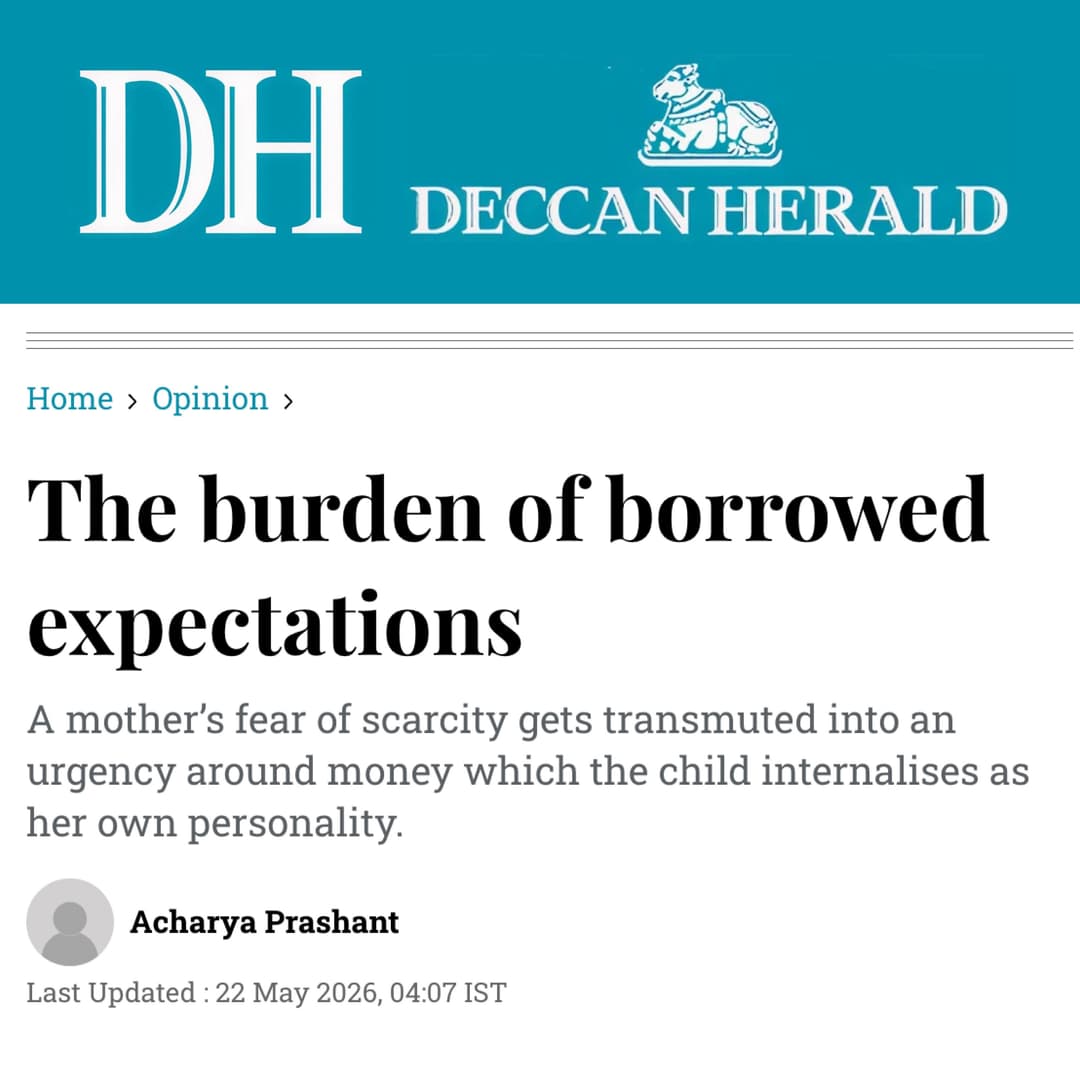
A mother’s fear of scarcity gets transmuted into an urgency around money which the child internalises as her own personality.

Somewhere between childhood and adulthood, an unannounced transfer occurs. A parent’s unspoken fear becomes our ambition, a family’s definition of what counts as a life well lived becomes our standard.

And the community’s old shames settle into the nervous system as something that feels indistinguishable from personal guilt. We do not remember accepting any of this. But by the time we are old enough to notice, the weight already feels like part of us.

The weight was placed before the question of consent was even available to us, and not all of it in the same way.

A mother’s fear of scarcity gets transmuted into an urgency around money which the child internalises as her own personality.

Similarly, a father’s equation of dignity with professional rank subtly shapes the child’s aspirations and perceived shortcomings.

And then there is everything culture did without anyone in particular doing it: the long instruction, absorbed before it could be noticed as instruction, about what a woman’s life is for or what a man is permitted to feel. None of it was chosen. It simply accumulated, the way things do when no one questions them.

Years pass, and the absorbed becomes the assumed, and what is assumed long enough, we defend. What entered us as someone else’s anxiety we now call our values. What was handed to us without our knowledge we now guard as conscience, as responsibility, as the shape of a good life.

We feel guilty when we begin to question any of it, as though the questioning is the betrayal rather than the original imposition.

But where did it actually come from? The weight was someone else’s unfinished business: their incompleteness, their fear of what might happen if things were done differently.

It was usually passed on not from cruelty, but from their limited understanding. We were not consulted, we were simply near.

The question is not what to do with the weight. That comes later, if it comes at all. What is worth sitting with first is simpler: have we ever actually looked at what we are carrying, and asked, honestly, when and why we picked it up? Or have we only carried it, and named the carrying our ‘selves’?

Originally published in Deccan Herald on 22 may '26

This article has been created by volunteers of the PrashantAdvait Foundation from transcriptions of sessions by Acharya Prashant
Comments
LIVE Sessions
Experience Transformation Everyday from the Convenience of your Home
Live Bhagavad Gita Sessions with Acharya Prashant
Categories