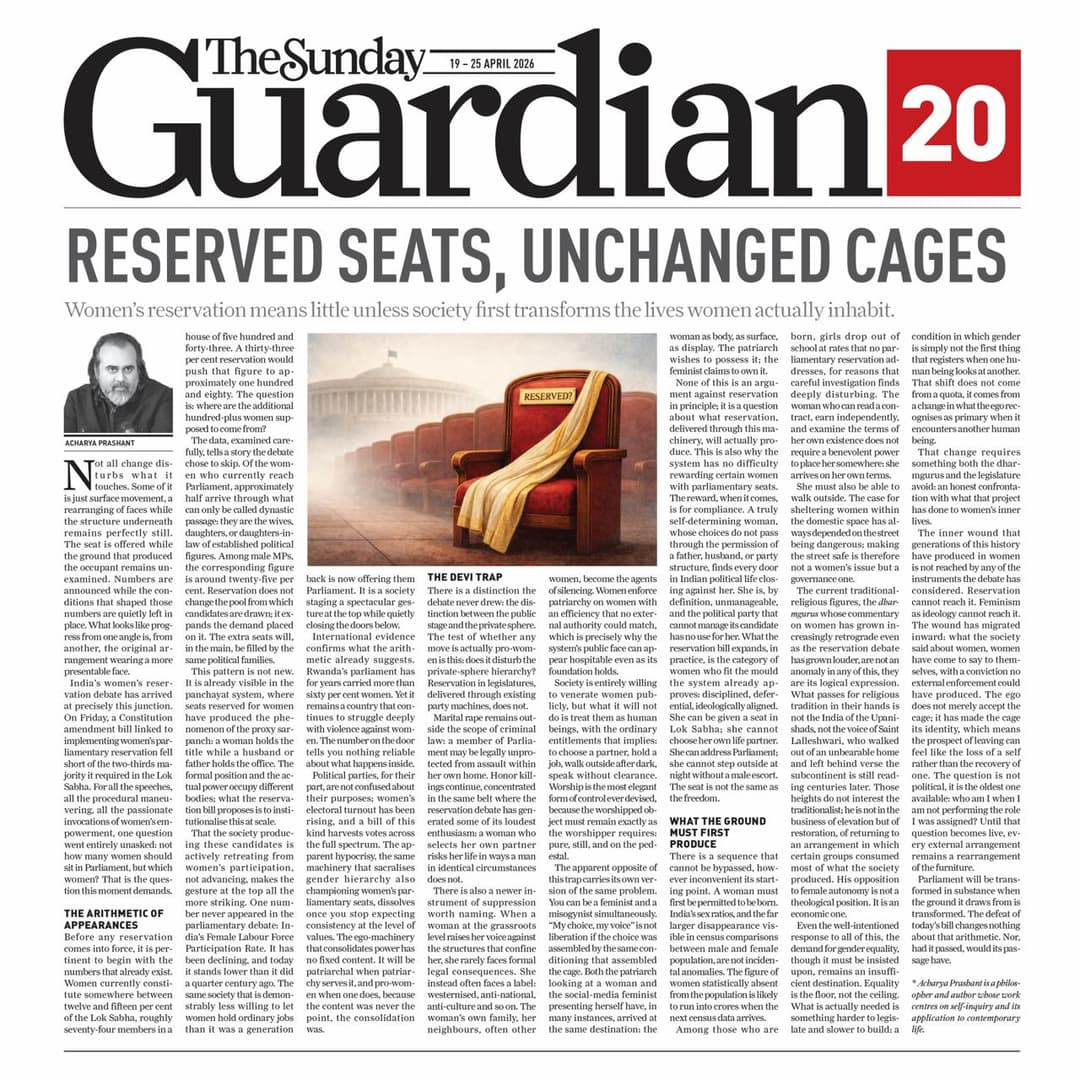
Women’s reservation means little unless society first transforms the lives women actually inhabit. More seats for women promise progress, yet the structure beneath remains unchanged. Representation grows, but the same families, same control, and same limitations persist. A woman may enter Parliament yet remain bound in her personal life. Without changing the ground that shapes her identity and choices, reservation risks becoming a surface shift, not real freedom.
This summary is AI-generated. Please read the full article for complete understanding.
Originally published in The Sunday Guardian on 19 apr '26
Not all change disturbs what it touches. Some of it is just surface movement, a rearranging of faces while the structure underneath remains perfectly still.
The seat is offered while the ground that produced the occupant remains unexamined. Numbers are announced while the conditions that shaped those numbers are quietly left in place. What looks like progress from one angle is, from another, the original arrangement wearing a more presentable face.
India’s women’s reservation debate has arrived at precisely this junction. On Friday, a Constitution amendment bill linked to implementing women’s parliamentary reservation fell short of the two-thirds majority it required in the Lok Sabha. For all the speeches, all the procedural maneuvering, all the passionate invocations of women’s empowerment, one question went entirely unasked: not how many women should sit in Parliament, but which women? That is the question this moment demands.