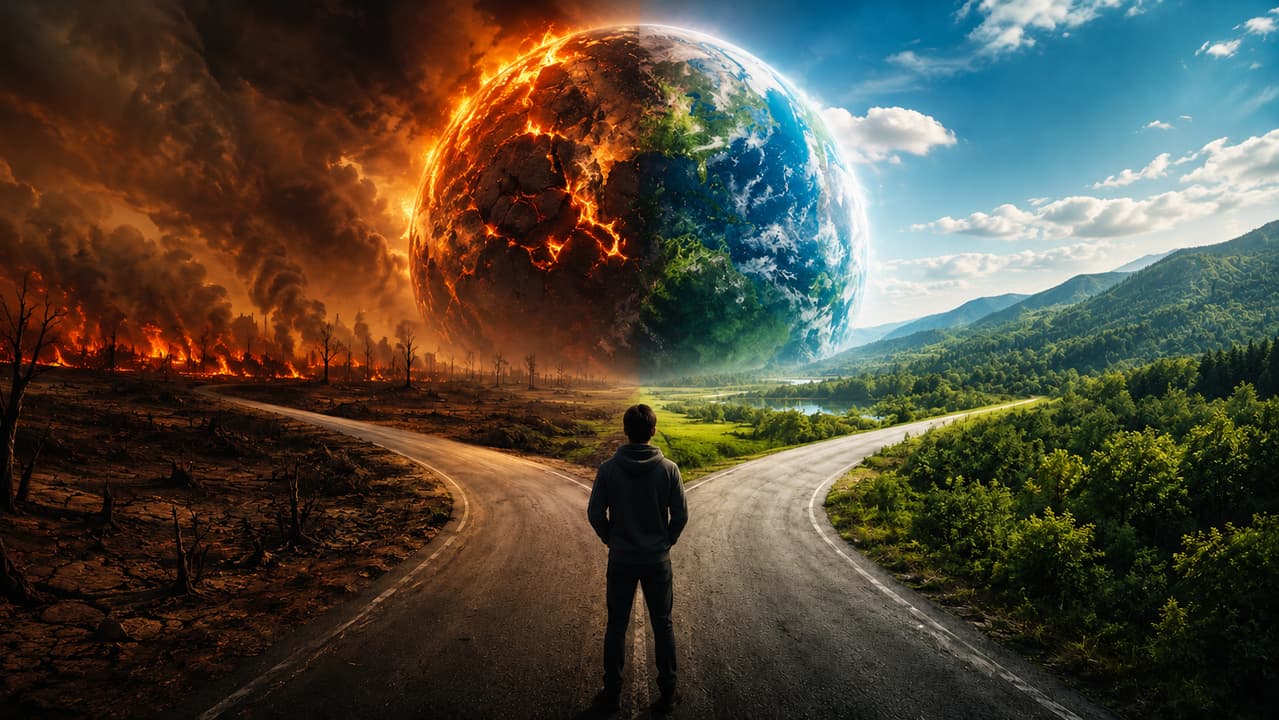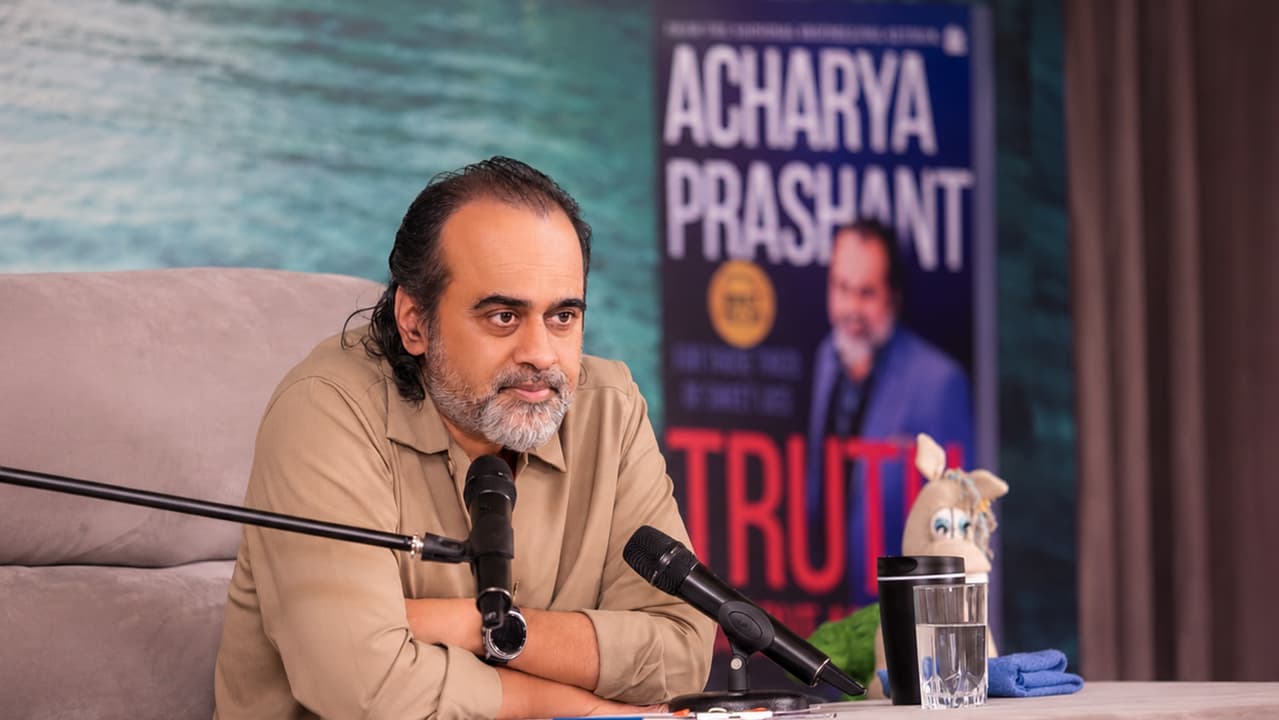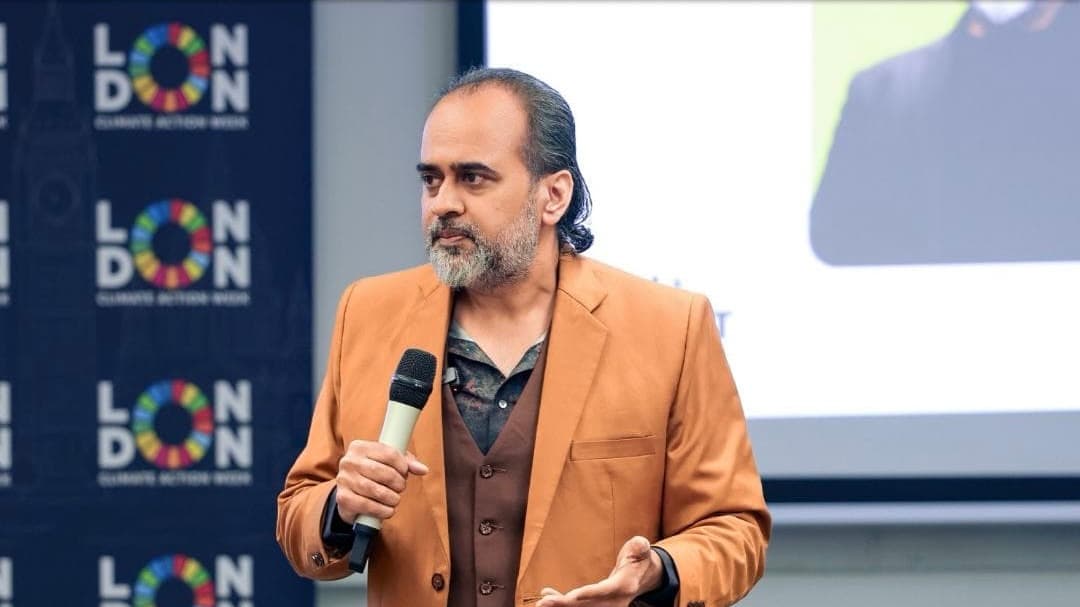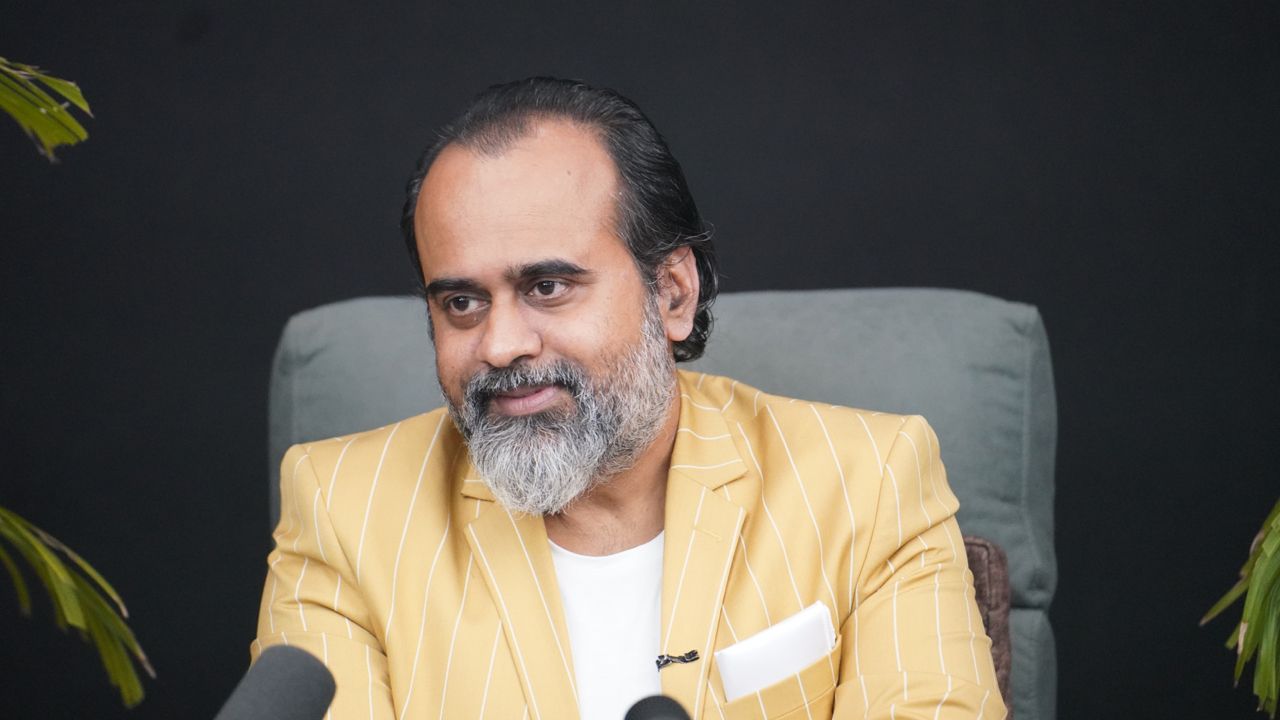
Divyanshi Sumrav: Hello and welcome. This is Divyanshi Sumrav. In this special NDTV program, we are going to address one of the major issues of today's time. Who is bearing the brunt of climate change? Is climate change just about changing weather, melting glaciers, and burning earth? Maybe it's also about people who are bearing the consequences of it all, who are causing it, and who are living the reality of these consequences. There's a major difference, and we want to ask this major question.
Today we have Acharya Prashant with us, who has been actively involved in environmental conservation, and he has been talking about the related subjects in a manner that reaches the masses and helps cultivate the inner consciousness that is needed to reverse the changes. A very warm welcome to this special talk, Acharya Prashant.
When we talk about climate change as it is generally being addressed in popular culture, in media, journalism, and all the other things that we have in relation to them, what we don't discuss generally is who is actually bearing the brunt of climate change. Who are these people who are actually suffering because of the greater challenge that we are facing?
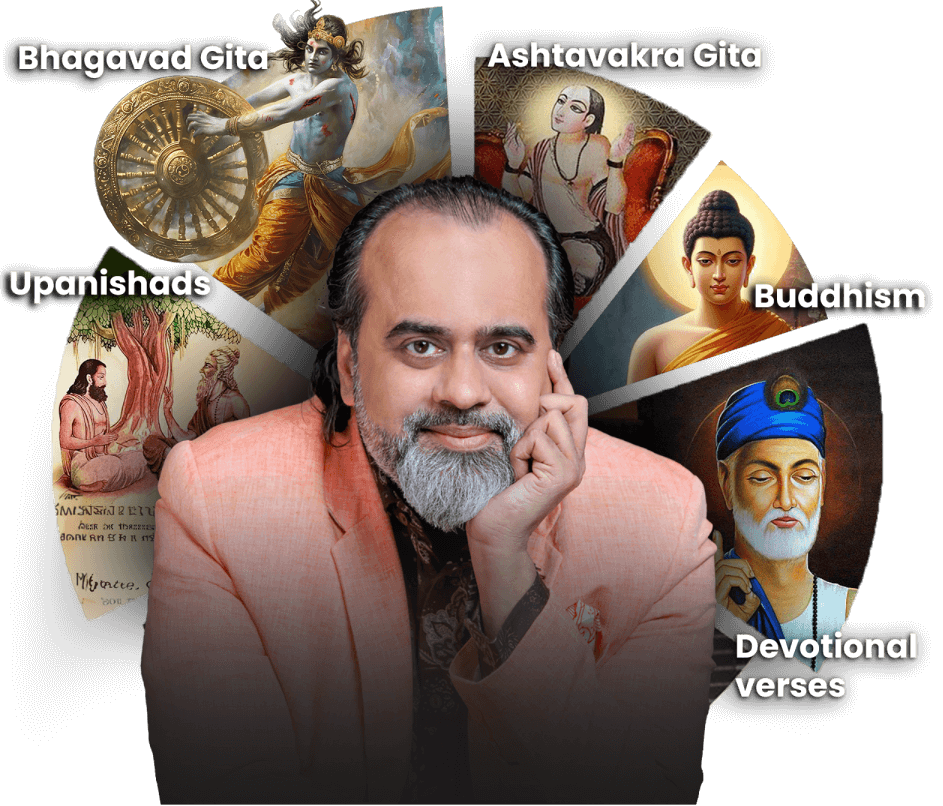
Acharya Prashant, who do you think is responsible for climate change? Who can be held accountable, and who are bearing the consequences of it all?
Acharya Prashant: This is one of the most tragic aspects of the climate crisis. The ones who are responsible are going to get away scot-free almost. They won't foot the bill. They won't bear the consequences. Who's responsible? The data is straight on that. The 5% richest people of the planet account for more than 50% of the global carbon emissions. And the bottom 50% account for 5 or 7% of the total carbon emissions. So it's the top 1%, the top 5% that are majorly responsible.
To make things more vivid, I was reading that the average Indian would take more than 2,500 years of his usual rate of carbon emission to match the carbon emissions of 2 hours of flight of a particular billionaire's jet. And that particular billionaire loves to fly his jet. So you could probably say that the average daily flying time might actually run close to 2 hours. And the average Indian would take 2,500 years to match that level. And yet it's the Indian who is going to pay the price.
Climate injustice is at several levels. So we talked about individuals. Those who will emit will suffer the least because they have the resources, the wherewithal, to get away. Then there are countries. The global north emits the most, and the global north will be the last one to suffer with the same intensity as the global south would suffer. Places that are dependent still on normal rainfall for their agriculture, for example, places that have great population densities and hence where the failure of crops would see mass migration. These specters do not belong to the global north even though the global north is responsible for the emissions.
If we look at the concentration of excess CO2 in the earth's atmosphere, ideally it should be around 270 parts per million. Right now it's close to 440 parts per million. Where has this excess amount come from? We find that the developed world today has contributed more than 80% of it. In that sense, in the aggregated sense, we might even say that the climate crisis is actually a crisis created solely by the north. I'm talking of the global north, which includes all developed nations, which are also the most emitting nations. Now you include China as well in that since the last 10 to 15 years.
So at the level of the individual, the rich ones are responsible. At the level of countries, the global north is responsible. At the level of corporations, there are just 100 companies. Of the millions of organizations, companies, and body corporates existing in the world today, there are just 100 that are responsible for 70% of the world's carbon emissions. Most of these companies are in the field of energy or agriculture. These are the two most carbon-intensive sectors.
Divyanshi Sumrav: How can we talk about net zero emissions then?
Acharya Prashant: That's a mirage. That's something we have given ourselves to remain entertained, to remain foolishly hopeful. That's not going to happen. Forget about net zero. Net zero is a far cry. We wanted a 44% reduction by 2030. We have achieved 0% reduction. Our emissions this particular year, 2025, are exactly the same as they were at the beginning of the duration of the Paris Agreement — 58 gigatons this year as well. We have achieved zero reduction. We are royally on our way to achieve more than 3° centigrade average global temperature hike.
Net zero is something just to make headlines and to regale the coming generations.
Divyanshi Sumrav: Ek khilona de diya jaata hai.
Acharya Prashant: That's all. And that brings me to the next level of climate injustice, which is intergenerational. We did it, but they will suffer, the coming generations. We did it, but they will suffer. So we talked about it at the level of the individual, at the level of the nation, at the level of the corporation. Now it's also at the level of the generation. The ones who were most responsible for it are either gone or will be dead by the time the consequences of the calamity strike with their full force. And the ones who will bear the brunt are the generations who have not done anything, or much, to deserve the punishment. But they will be punished. The ones who have just been born, the ones who are yet to be born, they are the ones who will receive the maximum punishment. And this is climate injustice.
Then there is another level of injustice. Till now we have been talking only of the human species. Apart from this particular species of ours, all the millions of species, the billions of species that exist or existed, have done nothing to contribute to carbon emissions. Nothing at all. But they are the ones who will pay not only with their lives, with their pleasure, with their normal lifespan, but with their very existence. It is because of the adverse climate changes that several species are disappearing every day.
Please understand, there is a natural rate of extinction of species. That's estimated to be 5 to 20 species per day. But what we have today is 100 or more species getting extinct per day. This is way beyond the natural rate, and this is coming from the climate crisis. What have those species done to get extinct? Nothing. Let this sink in. This is the great tragic irony of the climate situation. The ones who are disappearing forever do not even know why they are going extinct.
We, this one single species out of the billions that inhabit this planet, are responsible for mass obliteration.
Do we see?
So that angers me before it makes me sad. It's not just about the planet as a whole. When you look at the separate constituents, you say this is just not done, not fair. Bangladesh. How much does Bangladesh emit on a per capita basis? Up to 2 tons per capita per annum is within sustainable limits. The average Indian emits 1.9 tons per capita per annum (Source: Our World in Data). The average Bangladeshi emits even less. But Bangladesh is one of the countries that will partially disappear the fastest. It is already losing land.
And because it is very well known that this is happening, the rich countries pledged an amount of 100 billion dollars per year. They said, we will contribute this much as a form of reparation. We understand, we did it. So this fund will be for those who will suffer the most. How much have they contributed? Please guess. Nothing at all.
Divyanshi Sumrav: And when we talk about India specifically, this question has been raised several times. Should India cut down on its development at the cost of climate and the climate goals and climate targets that have been set by the global north after they have done the destruction already?
Acharya Prashant: See, it's not about what they have done in the past. Emissions do not respect histories or national boundaries. Wherever the molecule comes from — the US, India, China, or Ethiopia, it doesn't matter. That molecule affects the entire planet.
Divyanshi Sumrav: But it affects some people more, some communities and some lands more.
Acharya Prashant: And those who will be affected more belong to places like India. So if India chooses to participate in blind emissions, then India is doing itself a disservice. We of all people should be very eager to have a sustainable model of development.
It does not take much time to move from a small player when it comes to emissions to become a gigantic one. China is a case study. Today, China emits more than the US does purely by the dint of its population size. The same applies to India. Even if per capita emissions remain low, we will probably become the second-highest emitter in the world. And who will suffer? We will suffer. So we should be the last ones to be running this rat race.
In fact, what is it that we must do? We have to stop supporting those who have any kind of adverse climate mindset.
Divyanshi Sumrav: And how can we do that?
Acharya Prashant: By using whatever political and economic heft we have. You know, what happens in India is going to affect India the most? America will emit, India will suffer. And it’s not that you are a totally inconsequential player now. Use whatever might you have. That fellow there is saying, “I’ll make America great again by digging up all the gas and oil and exporting it (source: The Guardian),” and he is disallowing any kind of environmental or climate discourse. He is withdrawing subsidies (source: ESGtoday). He is saying, “No, no, no, the climate does not exist at all.” You have to realize that that kind of policy is totally anti-India.
What will you do if a nation, big or small, has anti-India policies? You will adjust your policies accordingly. Instead, we are behaving in the same way as America does. America is pretending that climate does not exist, and India too is deleting the topic of environment and the problem of climate from its own textbooks meant for kids. We too are turning a blind eye. Probably America can afford that. We cannot. We are the ones who are terribly going to suffer. Think of the monsoons. We rely on a particular temperature differential at a particular time of the year for the rains to happen in a way that will sustain crops and therefore our large population. Otherwise, there is no food security.
Divyanshi Sumrav: Recently experienced in May and June.
Acharya Prashant: From January to April, we had four of the warmest months in the last 125 years (source: Copernicus Climate Change Services). And then the fifth one was the wettest month. From warmest to wettest in a snap. That’s what is happening. And it’s not going to continue like this. The annual precipitation that we were to have, we have lost a big chunk of it in May and the first week of June (source: India Meteorological Department). We are in for horrid and hot times ahead.
Think of what that means for the farmer. 50% of our population is still directly or indirectly dependent on agriculture. Think of what that means for food security. And think of what kind of mass displacement.
Divyanshi Sumrav: It can bring, yes. And we don’t pay heed to such things. When we talk about climate change on the global level, when we are discussing the global north and global south, and we are talking in big numbers about what they might have done and who might have suffered because of that, we mostly ignore the consequential impacts that people suffer in their daily lives.
For example, when we talk about landfills in the Delhi NCR region, we talk about Ghazipur, we talk about Okhla, and a report says that the methane fires that happen sometimes, the level of pollution it causes is comparable to igniting the release of the same level of CH4 (methane) as from 24 million cars simultaneously running.
We are not experiencing the kind of dread we should experience in that case. We are turning numb towards this tragedy. A lot of people who live in those areas are suffering from deadly diseases. Their quality of life — no questions have been raised about that. What do you have to say about it?
Acharya Prashant: Thankfully, we are a democracy.
Divyanshi Sumrav: Yeah.
Acharya Prashant: That means the majority has a say, and it's the majority that's going to suffer because of climate change. What should be the natural corollary of this? If the majority has a say, and the majority is what is going to suffer, then the majority should vote in a government that pays heed to the climate. That's it. Simple.
One fellow is emitting so much, and 20 others are suffering because of that. What should those 20 do? They should bring in a government that taxes this person for his carbon emissions. It's as simple as that. But for that, those 20 must have some sense. If those 20 remain drowned in entertainment like IPL or religious extremism or all kinds of frivolous distractions, then they will not even understand who is their real exploiter, and then they'll not vote in the right way. Otherwise, it should be very easy.
When we say it is just the 1% or 5% population of the world that's responsible for the tragedy that's befallen us, then in some way it should be good news. If these 95% get together, raise their voice, realize their perilous condition, then things will change. But instead, what we find is that 95% idolize those 5%. The richest 1% or 5% are the biggest culprits, right? And if you ask someone among the 95%, they will say, “We want to become like the ones who emit so much.” And that's where the problem lies.
We are worshipping our exploiters.
Divyanshi Sumrav: For example, a common man — again power dynamics come into play. We think beforehand that we won't be able to do it. Just like you said, 95% of the population, if they just join hands and raise their voice and start fighting and start asking for their rights and start questioning their exploitation, their exploiters — but indifferently to what we have imagined, they worship them, just like you said. So the most powerful people in the world are that small percentage, that small chunk, and people just don't want to do anything against them.
Acharya Prashant: All their power is limited to what they can do outside of you. They can create certain situations. They control all the media. So they can beam in something through your TV sets. That's the maximum they can do, right? Your interiors are your own sovereign place. No power of the world, irrespective of how much political clout or economic prowess it has, has any indisputable or natural right to your inner space that you control. They can try to build a narrative, but whether or not you accept that narrative is a choice that you have.
Divyanshi Sumrav: But what choice do the people of Ghazipur landfill have? They are living in those conditions.
Acharya Prashant: Have they voted for the right candidates?
Divyanshi Sumrav: Probably some of them.
Acharya Prashant: Not some of them. That's what I said, there has to be a general awakening. You know we suffer, yes, but we do not realize where really the suffering is coming from. The good thing is there is always a way out when it comes to suffering, and the way out…
Divyanshi Simrav: is the way in.
Acharya Prashant: Is the way in. If you can see what you are doing wrong, there always is a beginning possible towards the end of your suffering. And we don't have an option anyway. What will you do? You look at the situation. Yes, the 1% — the richest corporations, the celebrities, the politicians, the billionaires, the media moguls, they control everything. Yes, they do. But still, when it comes to voting, nobody can force you to vote in a particular way. Right? And if you look at the biggest polluters of the world, they're all democracies. If you also look at the countries that are going to suffer the most, even they have democracies of varying kinds and to varying extents. But the people in general, to some extent or the other, do have a voice, do have a choice. Are we exercising that?
And if we do not do that, then the rich have their own plans. They are saying, “We will colonize Mars. Let this planet be exhumed. We are running away. Off we go. Let this planet go to dogs.” That's fine.
Divyanshi Sumrav: We can see the possibility of that.
Acharya Prashant: That's inevitable. If someone can manage a better life for himself elsewhere and has the resources to make it possible, why would he stay here? Do Indian celebrities stay in India? The moment they gain enough money, they find a residence abroad. You keep worshipping them here. Look at your cricketers. Somebody has a residence in London. Somebody visits India only when particularly needed. Even look at your spiritual gurus. They all have bases outside of India. It’s the poor, it’s the voiceless that would be left behind to suffer, and tragically die — and suffer a lot before dying. We don’t see this. And
We worship exactly those who are bringing the suffering upon us. That’s a central problem. Lack of awareness.
Divyanshi Sumrav: Rather, we are benefiting them in some way or the other.
Acharya Prashant: Obviously.
Divyanshi Sumrav: When it comes to consumerism, for example, a lot of things, even when we talk about the influencer culture.
Acharya Prashant: Who made them influencers? They all are standing on your shoulders. How can there be a leader if you are not the follower? Can there be a leader if you are not the one following him? Can there be an influencer without that 5 million, 10 million, the number of followers or subscribers written beside his or her name? Can there be a billionaire or an industrialist without an army of customers buying his shallow, trivial, nonsensical products that he manages to put in your mind through incessant advertisement?
Do we control our mind? We are allowing somebody else to dictate our actions. And this is how they are commanding us. That’s what the entire climate injustice is about. The poor are suffering. The voiceless are suffering. The next generations will suffer. The animal species are getting wiped off.
Divyanshi Sumrav: And the ones who caused it will run off to Mars, maybe.
Acharya Prashant: They are not even acknowledging that the climate crisis exists. They are in fact saying, “You multiply your numbers all the more so that the market for our products and services doesn’t contract.”
Divyanshi Sumrav: Or is it the case that the mess has been created like this? Maybe I’m just speculating what might be the reason behind this that there is no way left. For example, if I would say a billionaire or a millionaire who somehow knows and somehow feels responsible. If someone becomes spiritually enlightened in that way and has some kind of conscience he might get, the mess that has been created around, is it stopping him or her from acknowledging that this has happened, and this has happened because of me? And what can they do if they can acknowledge this?
Acharya Prashant: They fully understand that they have done this. If you’re talking of the real culprits, they very well know how all this has happened. They know better than the common man what they have done. They know it, and they want to perpetuate it. It’s not that they are in the dark. It’s not that their guilt is forcing them to take corrective action. None of that. They know very well what is happening.
The thing is, in absence of any spiritual center or spiritual compass, all that drives you is your untamed greed. If I can have more, I will have more. That’s it. And if the other person is ever so ready to get fooled, I will make a fool of him. You’re talking of this billionaire. Where do his billions come from? They come from you and me. How does he manage to extract money from your pocket?
By selling you something that you never need in the first place. How does he manage to make you feel that you need his products? By putting a bad philosophy of life in your mind, and all that is a big show being run by him. Please understand, the fellow parades his half a dozen or rather 1.2 dozen kids. Why? Because you become a bigger customer when you beget kids. So he wants you to have lots of kids. You become a compulsive buyer once you have a full nest. You cannot say, “I don’t want to spend.” You will have to spend. The kid is there. So he’s putting in a bad philosophy here (pointing towards the brain). Your life is unfulfilled if you do not become a mother once, twice, five times.
He’s not just selling you a product. First of all, he has successfully sold you a philosophy. That philosophy is coming from him. Do you get this? When you manufacture a product, you also have to manufacture a buyer. Why do we become buyers? Most of the stuff that they are selling to us is stuff that you pay for very needlessly. It is stuff that has negative value in your life. It has no utility. It has negative utility, not even zero. But we keep on taking those things.
What does the common man live for? Consumption. When do you say a particular person is successful? When you find that person consuming more and more. Who told you all this? Who told you that your life is good if you are up on the curve of consumption? That fellow who offers you goods and services to consume, he is the one who puts it inside you. And that’s where we can apply the brakes. That’s where I said our interior place should be our own fiefdom. We cannot allow him to rule here. I will decide what I need — not the series of your propaganda, your narrative, your advertisements. No. No. I’ll not allow that to influence me. Let me be sovereign.
It is that independence, that sovereignty, that freedom that comes from what you can call self-knowledge. Otherwise, you’re a puppet.
Divyanshi Sumrav: Is self-knowledge bad for business?
Acharya Prashant: Very bad for business. Very bad for bad business, very good for good business. How do you know something is worth the price you are paying for it? How do you know that particular piece of land is worth 2 crore rupees? How do you know a particular configuration of a particular metal is worth 10 lakh rupees? Please tell me, how do you know this particular ring here costs 10 lakhs? How do you know it’s worth 10 lakhs? Who told you?
Divyanshi Sumrav: The markets have told me.
Acharya Prashant: The markets have told you. Otherwise, there is no intrinsic value, please see. And you’re paying for it with your life, and that hard-earned money is going to someone who is continuously emitting carbon.
Have you really enjoyed that last vacation? Please ask yourself honestly. No, you didn’t. But you needed to tick that box. Who told you that you need to tick that box? Maybe the airlines, maybe the hotel industry.
Divyanshi Sumrav: Maybe the peers.
Acharya Prashant: Maybe all those who benefit from your money. They are the ones telling you to take that vacation. They are the ones selling you those businesses. They are the ones hiring the celebrities to pose on those beaches in those bikinis so that you are lured, “Oh, I too want to go there.”
They are running away with the money you earn — your sweat and blood and toil. And not only do they run away with your money, they use your money against you. That’s what climate injustice is about. Otherwise, these are not productive people. We are talking of the politicians. We are talking of the richest people. Are they really creative people? Are they really productive people? No. No. They’re not productive. They know how to loot. They don’t create value. They create illusions. They create very mesmerizing and tempting, lucrative illusions. And you buy into those illusions, and you pay for those illusions, and then they misutilize your money to exploit you.
Divyanshi Sumrav: Then it comes to this, a lot of it boils down to money also. If we look at money or the resources we have, markets won’t work. For example, if there is more self-knowledge, the awareness is there, we won’t think much about ambition or development. Would we say that our practical life would suffer in some way?
Acharya Prashant: Bad life would suffer. Good life would be promoted. Just as we put excessive value on worthless things, the counterpart is that you do not value worthy things. So the right kind of economy is being suppressed.
Divyanshi Sumrav: What is the right kind of economy?
Acharya Prashant: Think of it. Things that really add value to your life, you’re not valuing them. You’re not prepared to pay for them. You don’t want to work for those things.
Divyanshi Sumrav: If I can give one example.
Acharya Prashant: What is it that you love to do?
Divyanshi Sumrav:I love reading. I love writing.
Acharya Prashant: Yeah. Don’t you want beautiful places?
Divyanshi Sumrav: I’ve created one.
Acharya Prashant: Yeah. Don’t you want to spread the message?
Divyanshi Sumrav: Yeah.
Acharya Prashant: Yeah. That’s the economy we are talking of. That’s the economy we need, where the right things are valued highly. Let there be a big price tag. It’s worth it.
I don’t want to pay for that ring. I don’t want to pay the pundit for some silly astro thing. I don’t want to pay for that luxury vehicle because I know who I am. So I also know what I need. Not that I don’t want to have a vehicle, but I have an inner sense of value. I know when to start and I also know when to stop. Do you get this? Don’t you love places that offer solitude?
Divyanshi Sumrav: Yeah.
Acharya Prashant: Won’t you want to pay for them? But how will you pay for them if you have been squandering your money at all the worthless places? All the stupidities are commanding a fat price, and all that is valuable in life is going unappreciated. That’s climate injustice.
Divyanshi Sumrav: We have broadened the horizons. I also want to ask, it’s not like we don’t have sane voices out there. There are sane voices who speak about such things. They talk about a lot of things, maybe spiritual wisdom, self-knowledge and things. But when it particularly comes down to climate and climate injustice, which I think is a far cry even now, why aren’t spiritual leaders speaking about it more openly? What is the harm?
Acharya Prashant: They are the beneficiaries of all the nonsense. Where do they get their donations from? Most of them are funded by industrialists and politicians. Why will the spiritual leaders speak against their puppeteers? Don’t you know of the gurus? They are all heavily funded political projects mostly. Why will they speak against their own masters?
Divyanshi Sumrav: And on this note, one last question. How do you imagine a spiritually sane, climate-just world? What is your definition and how do you see it?
Acharya Prashant: There can be no definition as such. It is something so free. It takes its own course. It takes its own independent form. If we try to premeditate it, we are killing it. All that we can do is illuminate the people and then leave it to them. Just leave it to them. You must understand who you are and therefore what you need.
The climate crisis is itself a product of internal human ignorance. It comes, we say, from emissions. But why do emissions happen in the first place? Because we burn something. 75% of emissions are coming from our energy needs. But why do you need energy in the first place? Because you want to use energy to pursue your desires. But are your desires worth it in the first place? How do you determine the worthiness of your desires? Are your desires really fulfilling you? Even if the desires are fulfilled, no, they are not. So for the sake of these worthless desires, you are destroying the planet. That’s what the climate crisis is.
We need people who have some honesty, some courage to look at themselves in the mirror and say, “Why am I wasting my life running after nonsense? Why am I following the herd?”
Divyanshi Sumrav: We need radical honesty with ourselves.
Acharya Prashant: Basic honesty.
Divyanshi Sumarav: That can turn radical, definitely.
Thank you so much, Acharya Prashant. We talked about and touched on a major issue — climate injustice — which we don’t talk about much, and I think it is one of the major things, a very delicate thing but very important also, how the relation between consumerism and climate injustice came into play. Thank you so much for clearing a lot of my doubts, and I think a lot of people who are watching this would gain something from this discussion. Thank you so much once again, and thank you to our audience who have been with us all through this episode. We will meet next time with more interesting and enlightening topics, and until next time, goodbye.