Does Vedanta Hold The Solution To The World's Crises?

Acharya Prashant

7 min
139 reads
Does Vedanta Hold The Solution To The World's Crises?
A civilisation can achieve extraordinary success in technology, science, wealth, and exploration, yet still move closer to conflict, ecological crisis, and inner dissatisfaction. The missing piece is understanding the human being who creates, chooses, invents, and consumes. Technology and policy can improve efficiency, but they cannot resolve the endless psychological drive for more. Climate change, overconsumption, and misuse of innovation arise from an unexamined human center. Lasting solutions require large-scale self-education, honesty, and deeper awareness of human motives, because the root of global problems lies not only in systems and tools, but in the consciousness that operates them. This summary is AI-generated. Please read the full article for complete understanding.

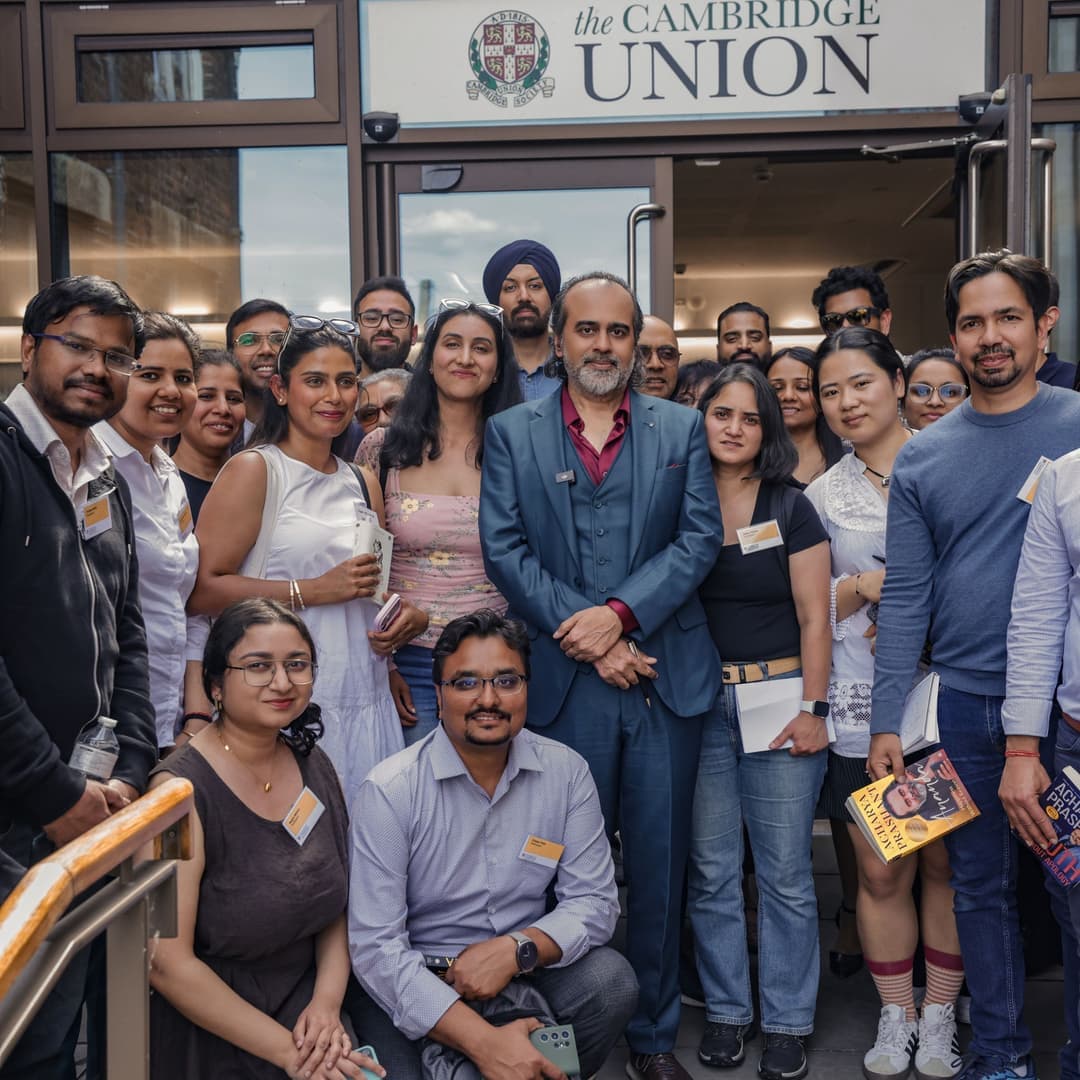
Questioner: Cambridge Union has witnessed discussions and debates that shaped empires, ended wars, and reimagined societies. Every great speaker who has stood in this chamber, Winston Churchill, Theodore Roosevelt, Stephen Hawking, came with a vision for the world. Standing in the Union right now, what is it that you most want the world to hear?

Acharya Prashant: See, the world has been trying everything, everything, and has done that very successfully over, especially, the last 200 years. What have these attempts been for? The attempts have been in the direction of technology, geographical expansion, space exploration, prosperity, and the West has been especially successful. The question today that we were dealing with was: what more do we need to do if where we stand seems to be a place of explosion, if all that we have done seems to have brought us just closer to extinction and eventual annihilation?

So, what more do we need to do? And it was glad that we could see that mass-based education of the self remains probably the only thing we have not yet tried. And that's where the solution lies. All else that we have done is not wasteful, not unnecessary, but just not sufficient. Right?

So, having done all that, now we need to put greater emphasis on asking the question: Who am I? Where am I coming from? What do I want? How much have I really attained? Will accumulating more give me what I'm hungry for, or is there another way? And we said, just to complete the response, the way is called honesty. Honesty, love, intent, all synonymous. They are the answer.

Questioner: Very nice. So, my next question to you: Cambridge Judge Business School has produced CEOs, central bankers, and Nobel laureates, and yet it has invited a philosopher to address them on inequality and global responsibility. So, what does Indian contemplative tradition have to offer to the world's greatest economic and business problems?

Acharya Prashant: This is not a divergence or dissonance or change of track of any kind. You see, there is the Nobel Prize for Science, for Peace. Science is for the human being, and it is the human being that craves for peace. So, ultimately, all of them have been working for the human beings. All the Nobel laureates, all the great scientists, thinkers, explorers, philosophers, adventurers, that's what they have been seeking: the welfare of the human being.

And we can see today that the welfare of the human being will be through a path that goes this side, inside.

The root is inward; that's the direction to take.

So, it's much in the same vein. Right?

One is seeking human welfare through advancements in medicine, discovering the electron or the neutron or the structure of the DNA. I'm standing here at Cambridge, so that's all that has happened here. And then, for the same purpose, towards the same goal, we now see that we have to look more keenly at ourselves.

And if we do not know who the chooser is, then the choices will all be not very sensible. If we do not know who the discoverer is, then the discoveries will not be put to good use. If we do not know who the inventor is, then the inventions can turn destructive. So, the spotlight has to be put back on the self because that's the place from where it all begins, and that's the place for which all of it happens. That's the beginning and the end. So, it's much in the same direction.

Questioner: I totally agree with you. Cambridge has been an incubator of science and technology and has produced innumerable Nobel laureates. In the context of the current heat waves in India, do you think technology holds the solution?

Acharya Prashant: Not really because, and we talked of it in the interaction we had today. You see, technology is for the sake of efficiency, right? How can I do more of what I want by putting in less of what I have to? Right? Technology is about improving the output-to-input ratio. Right?

The thing is, in spite of what technology can give to me, I'll keep wanting more and more. This is not just rhetorical; this is evidence-based. There is empirical proof. Right? The car that we have today, this automobile, is far more efficient than the one that we had in the '70s or '80s. Does that mean that overall emissions have gone down? No.

And we are relating all that to the heat wave we are experiencing in India, even in London. London was having a particularly unusual heat wave three days back. So, when we talk of a heat wave, obviously we are talking of carbon. We must understand that if there is carbon dioxide in the air, the fire that is producing that carbon is within the human being.

Now, we are counting the soot up there, and we are saying 280 ppm, now 430 ppm, without detecting the source of the fire. The fire is here, in the human ego, in the unexamined human center. And irrespective of what tech or policy measures you have, the fire will consume each one of them if the fire itself is not addressed.

You have to look at the fire. You have to ask whether it is genuine, whether its claims are well placed. And that is the way. You can talk of many other things also. Wherever technology has made things more efficient, more economical, consumption has just shot up.

We would think that if tech comes, emissions would reduce and everybody would have more for less. No, that's not what is happening. The moment things become more available, they also become more in demand. So, demand is increasing in relation to, in proportion to, availability.

What that means is that irrespective of how much you improve on the tech front, you'll never be able to satisfy human hunger. And these two things, taken together, mean that emissions will keep shooting up and up, and heat waves will become more intense and more frequent.

So, if we want to address heat waves, if we want to address the entire spectacle of the climate catastrophe, then we'll have to look at the human center. Just tech or policy measures won't work out. Policy makers are leaders; leaders are chosen by the voters; the voters are the consumers, the end consumers of everything that produces carbon.

So, why will the voter, who is the consumer, who is also the emitter, put a person at the top who will enact a policy that will suppress his consumption?

So, tech won't work; policy also won't work. It is mass-based education of the self alone that's going to work.

Questioner: Thank you so much.

This article has been created by volunteers of the PrashantAdvait Foundation from transcriptions of sessions by Acharya Prashant
Comments
LIVE Sessions
Experience Transformation Everyday from the Convenience of your Home
Live Bhagavad Gita Sessions with Acharya Prashant
Categories