Questioner: Good afternoon, everybody. It's such a pleasure for me to be here for so many reasons, but perhaps the most important one is I get to speak to Acharya Prashant. We have something in common. We both started our adult lives at IIT Delhi.
I think this is a bit different from that, but that is special in its own way.
Acharya Prashant: Definitely.
Questioner: So, so many questions to ask you. I will take some time to ask my questions, and then I will give the audience time to ask you questions. I know a lot of people here have lots of questions for you.
So, you started at IIT Delhi. You then went to IIM Ahmedabad, and like many of us from that kind of background, you went into a corporate life, but then you left that. Why?
Acharya Prashant: Because what I was trying to find and seeking to address was not downstream of the tech and management education. I could sense it was somewhere upstream. Technology and management both are tools, tools in the hands of the human being, and tools are used for a purpose. The purpose is inside. The tools are outside.
I could see there were several, so many qualified and very, very talented people around me in both these campuses and also in my UPSC batch, that cadre, a lot of them who were, in fact, I would humbly say, more talented than me. So, when it came to having the tool or sharpening the tool or wielding the tool, there were those who could do it just as well as I could, or better than me, maybe.
But what was tech or management to be used for? That was the question that was bothering me. What is it that a human being inherently wants? What is it that we are inwardly thirsty for? Because the flow of technology has been constant, and technologically and economically we are more prosperous today than we have ever been in our history. And yet we fight, yet we clamor, yet there is so much mental illness and all kinds of trouble. Inwardly, we have remained what we were since the cave, whereas outwardly there has been so much change.
So I wanted to invest myself in a direction that would probably matter a little more, and probably a direction that was not being addressed sufficiently by a sufficient number of people. So, I didn't know it with even this much clarity, though I won't claim I have a lot of clarity even today. But at that time it was all quite hazy. However, I tried to find my way through the haze, struggled, stumbled. I'm still doing that.
Questioner: You're so humble. So, was there a moment's realization, or was it a gradual process?
Acharya Prashant: It was all gradual, and the process has continued till date. So it was a series of questions followed by experiments, followed by observations, followed by insights, then fresh experiments. One would come to crossings. There would be just so many ways radiating out from there. One would proceed in a direction, figure out it doesn't work out, something branches out elsewhere, or just take a U-turn. All kinds of things were done. It's been a long journey now.
Questioner: So, it's a process.
Acharya Prashant: It's a process. It's definitely a process.
Questioner: The theme of our conversation is "Contemplative Thought for a World in Crisis." What do you think about these big crises we face? Climate change, inequality. What's at the root?
Acharya Prashant: The big crises that we face are a combination of the little ones we are on the inside and the big power we are now wielding on the outside. Take these two, multiply them, let them compound on each other over decades and centuries, and what you have is a big crisis.
Inwardly, we have remained small. Inwardly, we are still very primitive, very much the man from that cave I referred to. Inwardly, we are that, and outwardly we have big power, huge power. We are commanding not just this planet; soon we would be commanding our satellite and maybe the other planets as well. Very prosperous, very, very knowledgeable, very connected, very coordinated. We have all that, and all that is really big, especially when you consider the fact that the rivers haven't changed in their power, or the other species haven't developed so much cognitively or economically.
So mankind is tremendously powerful today and as small inside as he or she was long back. These two are a dangerous combo.
Questioner: So how do we make that inner weak self stronger to combat, to cope with this?
Acharya Prashant: Such a pertinent and beautiful question. You see, first of all, I'm not denying the importance of external progress, right? I understand tech is important, management is important, policy is important. I come from that background. I know what science has given us, and I deeply, deeply respect that. What I'm saying is, what we are doing on the outside is necessary, but not sufficient. Obviously, we need what is happening there. The problem lies upstream of the point we are addressing. The problem lies inside.
If the human being does not know his emotions, his motivations, does not know the source of his desires, then he will be using all possible tools just to feed the inner hunger more and more. And this inner hunger is insatiable. The entire planet can be exploited and depleted, and yet we will remain inwardly hungry. So, along with what we are already doing on the outside, all that is fine. Along with what we are already doing on the outside, we need mass-based education of the self.
The student, which is the kid starting from four or five years of age to the elderly one aged 90 or even 100, we all must learn to be students of the self. And that is one thing that has been thoroughly missing in our upbringing, in our schools, colleges, and universities. We are taught about everything except the one that we are.
What happens then is that all that we are taught and empowered with becomes just a tool, rather a weapon, to fulfill this internal want that we never have understood in the first place.
We address the issue of having. How can I have that? How can I have that? How can I have that? We don't address the issue of wanting. And that want is not a technical quantity. That want is a qualitative presence within that goes unexamined. No CAT scan, no MRI would ever reveal the want that sits within and wants infinitely. And yet, because of the want of that one sitting within, everything on this planet moves, everything made by man.
Is there anything that man has made and is not aimed at fulfilling desire? No, I'm not denigrating desire. What I'm asking is, if it is my desire, and I am to invest my one single precious life in chasing that desire, must I know where that desire springs from? Whether it is my own desire at all? Whether I am my own at all? Whether this thing called the self is mine at all? What is it that exists? What is it that we call the conscious human being?
So these are the questions. I'm not saying they have never been addressed. They have been. But what we need is a situation where they are being addressed in every classroom, every household, every conversation. That's the most important conversation this planet needs to have.
Questioner: And I know that, as you said, you believe that we need mass-based education of the self. I know that you have done that, and you are doing that. Tell us a bit about that. How is that happening? What are you doing?
Acharya Prashant: So, you see, because the regular, formal, official system does not address that education of the self sufficiently, what we are doing is in the form of an addition. So, it's mostly night school. It's an online night school. So we have regular sessions, regular to the extent of being 30 days a month. Even this day, before coming here, I was finalizing the examination for tonight and given the five-hour difference right now, the students in India would be taking that examination even as we speak here.
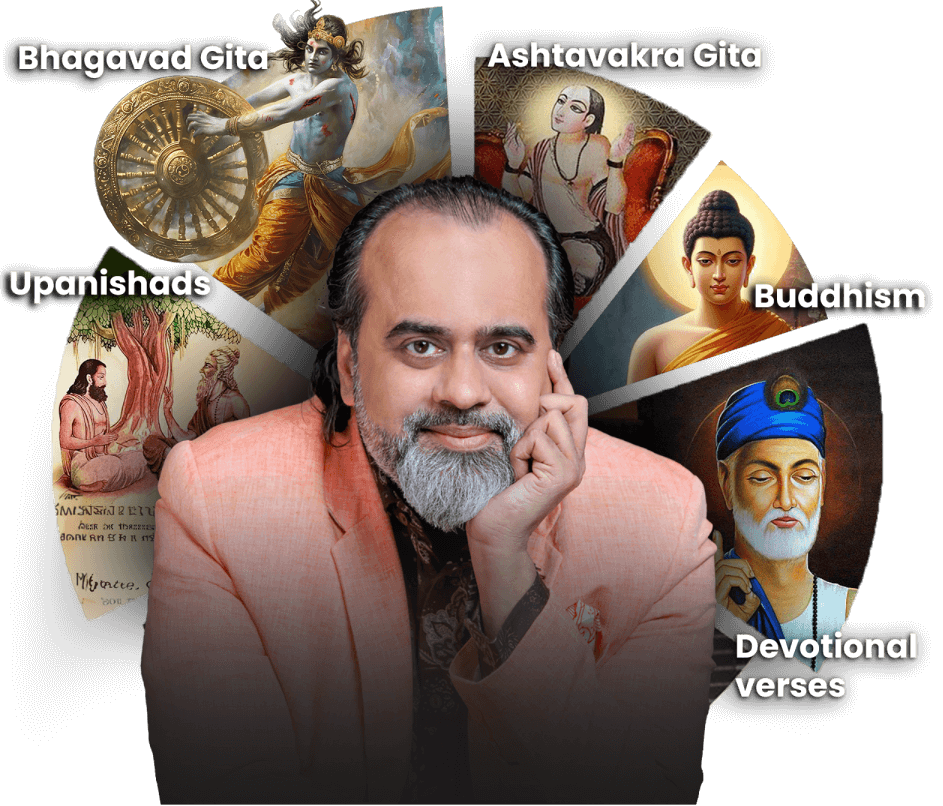
So every day at 9:00 p.m., we meet online. Some of them assemble physically as well, but the number is not much. Two hundred or five hundred, or a maximum of 2,000, can meet me in an auditorium. The others, all the numbers that we quoted, one lakh plus, they all meet me online. We talk about life in the context of philosophical works, philosophical works from the East, all Indian streams. So there are the Upanishads, we are addressing the Bhagavad Gita, then the works of the saints, so the devotional side. Then we are studying Acharya nagarjun, Madhyamika Buddhism, Sunyata Saptati, and then again from the East, Lao Tzu, Tao Te Ching, and then also works from the West.
So, for example, the existential stories, the plays, the works, our students find those quite interesting. But all that is the foundation on which we try to understand the building of life. All that is the context in which we try to understand ourselves.
So, who am I?
So it's not the work that we are interested in primarily. The works, in fact, are meant to show us the mirror. The works are meant to bring us back to ourselves.
So, if you ask me, "Are they students of Vedanta or Sankhya or Buddhism?" Well, yes. Yes. But a more accurate answer would be they are students of the self. So, mass-based education of the self. They are studying themselves through works of philosophy, wisdom, and the spiritual scriptures. But the idea is to see what I am doing, because if I do not see quite clearly what I am doing, I'll be doing more and more and more, and the planet can afford that no more.
Questioner: So I'm really struck by how serious this effort is, and you are very clear about that. I remember you told me last night that you had taught at IIT Delhi, but they were auditing the class, and that would not do for you.
Tell us about that. It's like an experimental science that people are learning and practicing together in a group, very rigorously, with exams. Just tell us a bit about why.
Acharya Prashant: So the way it proceeds is, first of all, we'll take up a verse or a sutra, and then we'll get into the exegesis. We will try to understand what is being said, how it was said then, and what it means today. And that would take around an hour and a half. After that comes the more lively part, which is the open interaction, the Q&A. So the participants, the students, come up with their open-ended questions. The questions can come from anywhere in life. The condition is, the thing must be important enough for you.
Which means we don't decide what the direction of the question should be. But you must decide that the question must carry depth, and let it come. It comes from the direction of economics, relationships, politics, religion, everything that matters to the common man and everything that we call life. Then those questions come. We answer those questions. We also try to relate those questions to the text at hand. Once that is done, then begins the reflections part. So the students come over and just say whatever they have to. Again, the only condition is: let it be authentic.
We don't mind if you say something very unexpected. But we do mind if the thing is superficial, not deep enough, not genuine enough. But that rarely happens. The students now know that this is the place where you can be truly yourself. So you can let go of your inhibitions and just speak your heart out. And that continues for another hour or two. And then we close because by that time it's already 2:00 a.m. If we have started at 10:00 p.m. And before I start, even before I arrive, people sing. We sing a lot because the wisdom corpus is so full of beautiful songs. We choose a song, and it is sung collectively, led, obviously, by those who know how to sing. The others join in.
So altogether, one session lasts upward of four hours, and this thing happens 30 days a month. Not that I am present there 30 days a month. I am present there 14 or 15 days. The remaining days they have examinations.
Questioner: I love that. I love that. As an academic, I like the fact that you're testing them on what they have.
Acharya Prashant: Yes. Yes. Yes. And the examinations, sir, give me a minute, please. The examinations are very rigorous. They are MCQs where, out of the five, rather six options, option F is what we go till. Out of all the six options, you could have one correct option, or two correct options, or six correct options, and sometimes no correct options at all.
You lose marks not only on taking the wrong option, but also on not taking the right option. So each single question is designed to be like life, you know. So many options, and you have to make the right choice or choices.
And life penalizes you not only for choosing what is not right for you, but also for not choosing what is right for you.
So that's what the questions are meant to simulate. Our students enjoy that. A lot of them get marks in negative. The average percentage is sometimes minus 10% or something. But we all love that. Yes, I love setting the question paper. They love attempting the questions, and it's a beautiful journey for all of us.
Questioner: So that's also interesting, that this is very serious. It's rigorous, but you also have fun. You have a lot of that. And it's also using tech. I saw the app, very impressive, that one of your team had developed. He showed it to me last night.
I could ask you lots of questions, I have several more, but I think it's only fair. There are lots of people here who want to ask you questions. So I'd like to open it up to the audience. Please raise your hand, and we will bring a mic to you.
Questioner: Thank you so much. It's very impressive what you're saying. My question was, you're bringing something to a culture where talking about self, individuality, isn't encouraged. And I'm just wondering that because, you know, in my journey growing up in India, then coming to Europe and understanding that you need to say what you want and not what others want. So how's that? Because it's beautiful what you're saying, the discovery of self. But how's it growing up in a very group-orientated?
Acharya Prashant: You see, ma'am, the self is the one center that cannot be hidden. So different cultures have different ways of dealing with the self, or I would rather say coping with the self, because the self is something that exhibits itself in all that you are, in every word that you utter, in every action, in every decision made. Everywhere, it is the center that is doing the heavy lifting.
So it is anyway being expressed. Since it is anyway being expressed, it is life. The liver of life is the self, the center that says, "I am." The ego-self, you know, the "I am"-ness. So that is everything anyway. We just encourage honest articulation.
The expression is anyway being made. Please understand. You spoke something. That was the self talking. This mic is an equipment in the hands of the self. The fact that we are present here, each one of us, is a choice made by the self. The garments we are wearing, again, are choices made by the self and reflect something about the self. So the self is everywhere. This building is the self. It is an expression of who we are. The roads, the model of education that we have, this culture that sometimes wants the self to be expressed and sometimes seeks to suppress it, this culture itself is a creation of the self. So the self cannot be repressed. However, the self can try not to look into the mirror.
The self is everywhere. But one characteristic of the self is it is outward-looking. Just as these eyes cannot look at themselves and the ears cannot hear their own sounds, but they gather everything that comes to them from here and there, similarly, the self is everywhere, but the self has a choice in whether it wants to look at itself.
What we are doing in our sessions, in our education program, is providing a mirror to the self. Providing a mirror to the self. You're looking at everything, and what you're looking at is your own creation. Since you are so fond of looking at yourself all around you, why don't you rather look at yourself directly? So the system of education that we are trying to come up with is just a mirror. It's just a mirror. It's nothing additional, and it's a thing of honesty. Just look at your own face in the mirror and be ready to face the reality. And if you find something is there in the form of a spoil, just wipe it clean. Simple. That's it.
Questioner: Can you hear me? Akshay from India, I have been benefited from the gyan that you have given over the last three years. Thank you, Acharya.
Acharya Prashant: Most welcome.
Questioner: My question is, you have talked about incompleteness a lot. And, you know, right from the time that we are born, we experience this incompleteness, and effectively that is the small "I" inside us.
I am from an engineering background, like yourself. So my context of the question is: isn't this incompleteness also spurring us towards development, you know, the scientific developments and also spiritual development? Because we always feel that emptiness, and we want to get more and more for everything. But spiritually also, we know that there is something missing, and that's what spurs us towards that knowledge. So if you could just talk a little.
Acharya Prashant: You're very right. But these are two very different directions, very, very different directions. Let me quote a statistic. The top 1%, the wealthiest population of the world, is responsible for 16% of carbon emissions. We know they exhaust their carbon quota in the first 10 days of the year. We also know that when it comes to the top 10% wealthiest population of the world, they are responsible for 50% of the emissions.
Please tell me, what does money do? When you talk of prosperity, when you talk of external achievement, does it make you satisfied, or does it make you hungrier? With money, do you feel satisfied that you have money, or do you embark on a reckless journey of even more consumption?
That incompleteness that you're talking of is real. It is empirical. We experience it in the form of loneliness, in the form of restlessness, in the form of a vague void that rivals us from within. Each one of us does that, right? We do not know what it is that bites us from within, but there is something. There is something. We don't feel at ease when we are lonely. We don't feel at ease when we are in a crowd. When we are defeated, we don't like it. And when we are victorious, we are not very secure about it. So that is there. But that void, is it successfully filled by external accomplishment? That is the question. And empirical evidence deeply denies that.
You see, you make a people prosperous, and it is not that they say, "Now that we are prosperous, we need to progress in another dimension." You make a people prosperous, they want to be even more prosperous. They want to be even more. You offer consumption to a person, he will not say, "I've had enough of it." He will say, "Now that I have this much, can I have three x more?"
So there is enough evidence to suggest that the external route does not work. And this is not coming from a moral or religious point. This is coming from data-based evidence. This is the nature of the self. External things you are putting into it, they don't belong to the same dimension. We do not understand hunger. And because we do not understand hunger but experience hunger, we are feeding all kinds of things to hunger, assuming that something or the other will work out, something or the other will satiate me. The result is that the planet stands deforested, depleted, but the hunger is nowhere close to being addressed.
Now the other side. You said we proceed on material achievement, and it is that accomplishment that also spurs us towards spiritual advancement. But these are two very different directions.
The spiritual dimension, real spirituality, not the traditional rule-bound kind, real spirituality is simply about being honest with yourself. Who am I? What do I really want? What is it that I present to myself and the world? And what is it that I'm actually on the inside? And then asking oneself the question: Am I benefiting inwardly by being what I have chosen to be? It is a common-sensical question. It is, in fact, a question involving the deepest kind of self-interest.
We are not talking selflessness here. We are talking real self-interest here. Am I really benefiting by choosing to be what I have become internally? And don't I have a choice? Do I need to compulsively remain this way? Must I? So that's the question. And that is the spiritual direction. That is not the same as the external direction. These two are not even complementary.
Again, in no way am I advocating renunciation here, or any kind of minimalism. No, that's not the point. The Ishavasya Upanishad very beautifully says, "tena tyaktena bhuñjīthā.* Do consume, but with wisdom." The literal meaning would be, "Consume after renunciation." Once you have renounced inner ignorance, now consume, because now it's no more the blindness consuming. Now it's nature dealing with nature, and you cannot even properly call it consumption. It's just harmony.
A wave meets another wave. The smaller wave can get assimilated in the bigger wave. That would not rightly be called consumption. But even if you call it consumption, that kind of consumption is very much justified, justified. But please, first of all, set aside your ignorance. Then it's beautiful.
Questioner: So, in a way, what you're saying is we have put the cart before the horse. We should have been spending much more time doing this, and that would have led to a more harmonious relationship.
Acharya Prashant: Yes. That's beautiful. Very right.
So it's not that technology is a problem. The builder of the technology and the user of the technology do not know what to build and what to use it for. Technology is wonderful. We are, in some ways, a gifted species. There is this priceless natural instrument here. We have a specialized brain. Obviously, science and technology must progress. There is beauty in that. But do we know what kind of technologies we need, where to put them, and what to do with them? So that's the question.
Questioner: Acharya Ji, thank you. I've been a big advocator for women. And voicing a lot of problems that we don't get a voice for a lot of times. Thank you for that. And my one very small question is: at what age should we start? And I resonated with your thought process that we are not starting, and we're missing a big chunk of education in people which should have been given and imparted. It used to be done a long time ago, but not anymore.
What age should it start, and what can be done to kind of do the mass education in students? Because the world is going crazy. So if we keep doing this, and rather than doing it at the graduation or postgraduation level, by that time my ideas are already formed and accustomed to the society around me, it's best to start at a much younger age. So what are your thoughts on that?
Thank you.
Acharya Prashant: Beautiful question. And to all those who are in touch with kids here, parents, guardians, teachers, elder siblings, anybody, here is the hint. If the kid can ask, "What is this (pointing towards the water bottle)?" You must understand the kid can now also ask, "What is this (pointing towards oneself)?"
If you find your kid now curious enough and intelligent enough to ask, "Mama, what is this (pointing towards the water bottle)?" That indicates that the kid now has enough cognitive development to also ask, "Mama, who am I?" But the finger will have to be shown the way. The tendency of the ego is to avoid itself and, as a compensation, look at everything around, to keep itself busy, to keep feeling purposeful, to keep feeling sensible and occupied.
So the kid starts demonstrating that very early. "What is this?" And you picks this up and puts it in her mouth. And the kid is now getting curious about the world. The same sense that can get curious about the world can also get curious about oneself. So now is the time to guide the finger. Now is the time to hold the mirror to the kid and say, "Hey, you have looked enough at all this, and all this is surely wonderful. But won't you want to look at the looker? Won't you want to know the knower? There is so much beauty in that butterfly, and I understand the butterfly is charming. But, kid, you too are so charming. Let's look at you now." So that's the time.
Questioner: So thank you, Acharya Ji. It's great to see so many people from so many different places who have traveled to listen to you. While growing up in India, I've been repeatedly told the most difficult thing is to conquer the inner self. And I never understood the significance of it. Now that I've done other things, you increasingly realize the importance of it.
So the more you focus on your inner self, the more you tend to detach yourself from the capitalistic point of view and the society and the things that you want to build for yourself. Or the more you focus on the capitalistic part of it, building the outer self, you tend to focus less and less on the inner self, and it even mellows you in some ways if you focus more on yourself.
So what are your thoughts on that? Is that a compromise that needs to be handled between both managing the inner self and outer accomplishments, or can we maximize both? Or how should we manage that?
Acharya Prashant: Great question. Please see, capital too is an object to the self. The self is the one subject of all objects in the universe. Capital is an object. Lack of capital is also an object. And the ego would want to entertain itself with all these objects so that it does not have to look at itself. And when you look at an object, one way of engaging is, "The object is great. I want to chase it." The other mode of engagement is, "The object is evil. Let's avoid it. Let's drop it. Let's shout against it."
Capital is just capital. Capital is an object. Capital is a resource. Use it wisely. Use it wisely, and life would be beautiful. Use it unwisely, and you have destroyed yourself.
There is nothing glamorous or spectacular or spiritual or sacred about poverty. Right? These are not opposites. And that's the model that has done the entire field of wisdom a lot of harm, when we pit these two against each other, when we say, "Oh, spirituality and capital do not go together." No. Not true.
Capital, please remember, is just another object, just another resource, just like a car. You must know whether you need a car, and if you do, how many cars you need. And if you do need a car, what place to drive it to. That's what you need to do. And if you drive the car wrongly, or own an unreasonable number of them, or you go and bump your car into a divider, that's none of the car's fault.
But if you find a driver blaming the car for his rash driving, chances are he wants to preserve his rashness. He wants to remain the rash driver that he is. And therefore, he is instead blaming the car.There's nothing per se wrong with capital. There is nothing wrong with anything in this universe. Nothing in the universe can be labeled as good or bad, right or wrong, sacred or profane. All these are needless labels invented by the ego just for self-preservation.
So drop these labels. Focus on the one thing. Who am I? What have I become? That which I call myself, how much of it is real? How much of it is just pure conditioning? Why am I so afraid? And why am I trying to give lovely colors to my fear? Why do I want to be respected? What is it that I want in lieu of respect or being respectable? So these are the real questions.
Instead a lot of the field of spirituality and religion has come to be about doing this thing, dropping that thing, “Oh! drop money, pick that up, travel to that place, live this way, avoid thinking that way, these are great thoughts to have, that's the ideology you should avoid.” No. All these are objects, please remember. Thoughts are to a thinker. Deeds are to a doer. Sights are to a seer. Focus on the one at the center of it. Not on the action, not on the deed, not on the choice. Focus on the chooser.
Questioner: Hello, Acharya Ji. It's an honor to be with you today. I have been with Gita Samagam for two years, and I stay in the Netherlands. My question is, what you're doing is incredible, but what we see with climate change and how it has affected people across the world is humongous. We probably don't have enough time to bring about the revolution which you are trying to bring about. So what is the way forward?
Acharya Prashant: The way forward is exactly what we have been discussing so far: mass-based education of the self. Also, please remember, you need time if you have distance to cover. You don't need time to see where you are already standing. So it's not that we are short of time, please understand. Time is needed when there is a task to be accomplished. When something additional needs to be done, then you need time.
The entire problem of the climate crisis is that we have been doing too much of additional and unnecessary things. So it's not about doing something more. That's why all these 30 COPs have failed. That's why the PPM stands today worse than where it stood 30 years back, because we think the solution lies in doing something more.
"Oh, the climate crisis has been imposed on us by aliens. Now let's do something to fight it."
No, sir. The climate crisis is something of your own doing. The doing needs to stop, and stopping doesn't take time. Reaching takes time. Acceleration takes time. How much time does it take to stop right where you are? To avoid the climate catastrophe additional steps are not needed. What is needed is that we just stop doing what we have been doing. And please tell me, does it really take a great deal of time to just stop? Just stop. Now, what it rather takes is intent.
And also please remember, if you think in terms of doing more to stop the climate crisis, doing requires energy, and energy itself is emissions. So in the name of stopping emissions, we say we need to do more, and in doing more we emit more. So all that is not very sensible.
Questioner: First of all, I think you are doing very important work. I'm currently focusing on leadership coaching, and so it's kind of going to some of the essence that you are trying to accomplish at a broad educational, systemic level. But targeting these critical nodes of people who are in positions of power and under the highest pressure of decision-making, who are making the most important decisions, influencing the systems kind of from the top. If you are going from the grassroots, going the opposite direction, we should meet somewhere in the center, I guess, and hopefully make it work together.
In my mind, there are three bridges that need to be built. So I need to mention the three bridges. So, the first bridge is between the masculine and feminine way of experiencing reality and contributing to the world, or being in the world. The second one is between the Western and Eastern way of looking at the world and experiencing it. And the third one is between the old political economy, which was based on scarcity and power, and the new economy, the digital economy and AI-native world, where more abundance is possible.
Maybe the question then is just: how, in your mind, can we start building these bridges in a more sound way than we are currently doing?
Acharya Prashant: It's a very broad-based question, bridging the masculine with the feminine, the old with the new, the Occidental with the Oriental. Let me reply with a simple question. Who is it that will cross the bridge? And in crossing over, does this one really intend to change? I can very well remain the same person on this side of the bridge as I would be when I cross over. So is the intention really there? And without that intention, nothing works. Nothing at all.
These bridges might all be very useful, but much more important is the fact of inner honesty. Do I really intend to change?
Otherwise, I can apply all kinds of intellectual, technological, and spiritual practices, put in jargon, and still I'll successfully remain who I have been.
Please see, we know of the Jevons paradox, right? We have been thinking that we can contain, for example, emissions, pollution, and all kinds of dirty things through tech and policy means. And tech is one of the things that you mentioned in your question. Does tech succeed? More than 150 years back, Jevons, what did he figure out? As in the UK, as the steam engines became more efficient, the consumption of coal only multiplied.
The same thing we have seen with respect to computers. The computers' processing speed is much better today, but the electricity consumption that goes into computing today is manifold compared to the 1980s or 1990s. AI, digital stuff, surveillance, all that is consuming many times more electricity, even as processing power has multiplied so many times. The same thing we see with LED bulbs. They consume only a fraction of the power, but now buildings are being lit up as entertainment. So the consumption of electricity has increased.
The same thing applies to automobiles. Today's automobile is much more fuel-efficient. But efficiency only makes the input less pricey, and that increases the demand because the demanding one is the self sitting here. So the self has to be known.
The same thing applies even to EVs, you see. EVs are more efficient. Yes, they are. But then what about the number of vehicles that are multiplying? That will require roads, and that will require cobalt, lithium, and nickel to be mined, and that will require forests to be cleared, and that will also facilitate urban sprawl.
So methods are not going to work. Policies too are not going to work because the one who will set the policy in the morning is exactly the one who will work his way around the policy in the evening. The policy-setter and the consumer are the same entity. The leader has been voted to power by not the voter, but the consumer, because the voter is the consumer. So the voter is never going to put a leader into power who makes policies that suppress consumption. Or maybe the policies will be there, but workarounds would be invented.
Intent is the only way, and that requires, I repeat for the nth time, mass-based education of the self. That does not mean, in any way, that the old ways, the old methods of meditation or realization, are worthless. That also does not mean that the new methods of policymaking and technology are worthless. None of that is worthless. All that is very, very, very necessary. The Upanishads talk of Vidya and *Avidya, * worldly knowledge and internal realization, together. These two have to move together. The balance is missing. The attention is missing. We have done too much on that side and too little on this side. That's what the whole thing is about.
Questioner: I think that's a wonderful place to thank you. Thank you so much. Thank you for helping us get the balance right, both in this dialogue and also in this discussion. Thank you so much.
Acharya Prashant: Thank you so much for it.