Questioner: Pranam Acharya Ji, my question is related to the chapter The Jungle in a Necktie (Truth Without Apology): “Is education about making a living or having a life worth living?”
I am from the medical stream. After a person clears the MBBS examination and is opting for further courses, when the person is scoring some rank, everyone is so deeply conditioned that they will be opting for, let's say, the branch like orthopedic surgery or medicine which are selling in the society. During the journey of their five and a half years, maybe there were some nonclinical branches, research-based branches they were very much interested in, and the market, the society, the motivation industry, everyone says, "Okay, this rank, this branch; you should take this rank, this branch." In the West, the branches which are research-based are given to the toppers; in contradiction, in India.
Acharya Prashant: We want to become neither doctors nor engineers or anything else. It's not as if we like a particular field or a certain branch. We like nothing. Nothing at all. I am talking of the way our beloved country is. We are just so afraid that we want to get away from our current position. Right? That's the way our upbringing, our culture, our education is, the media, the society, everything.
So, you're a kid, right? You are given an image to pursue, and that image is a distant one, far off in the future. Let's say that image shows you enjoying life in the States, The United States. A villa of your own, two nice cars, two cute kids, a light-skinned wife, such things. And that's the usual image that we are supposed to pursue. That image is everything. And where does that image come from? That image comes from a deep-rooted fear. Deep-rooted. That fear is who we are. That fear has become our primary identity.
When you are afraid, you can't love. When you are afraid, you can't be creative.
So how is it that our internal processes move? Please understand. So there is that image there, (pointing towards the outside) right? So, at the age of 30, that's where I want to be. Now, from that place, we reverse engineer our entire life. So, if you have to reach there, then you have to reach there. And if you have to reach there, then you must reach there first. To reach there, you must step on that one first. To step on that, you must step on that. To step on that, you must take a step in that direction. (Pointing towards the outside in different directions and explaining).
And that's the way we calculate what's the next step to take, which basically means there can be no love for the next step here because this next step here, according to us in our calculation, means nothing at all. It is just a passage towards that ultimate image that we must reach. And where is that ultimate image coming from? A deep-rooted sense of inferiority.
Somehow, I want to feel secure, and I'm told I'll be secure when I'll have x,000 in my account, a new passport, a green card, or something. Social security, this, that, that's when. And it's not as if I really know whether that image deserves to be pursued, but that's in the air. That's the social message. If you reach there, you are good, you are doing well, you are successful.
But life is not that (pointing to a distant far-away place). That may actually never be achieved, and one does not know what happens if at all that is achieved. Life is all this (creating a gesture of pathway to show the present). We have a certain ambition for that. We have a certain ambition towards that. Even that is just ambition, nothing more than that. But towards all this, which really is life, we have no affection at all. Because this is supposed to be just the pathway, the route, the rites of passage.
Why are you there pursuing this particular degree? “No, nothing. If I pursue this degree, then it will be easier to take admission to the next one.” Why the next one? “Because that will make it easier for me to get an internship there.” Why there? “Because from there I can pursue that stream.” Why that stream? “Because from there it is easier to migrate to the US.”
If that is how the logic is, what love can you expect for all the intermediate status? The intermediate will remain intermediate. Something that you are just somehow tolerating. Something that is not meant to be lived or enjoyed. Something that is meant to be wished away speedily. Can this part of it just vanish?
So it's not as if those who opt for computer science. Tell me one of the preferred branches in medicine?
Questioner: Derma, radiology, medicine.
Acharya Prashant: Derma is the preferred branch?
Questioner: There are two basic reasons.
Acharya Prashant: Give me just one preferred branch.
Questioner: So derma is my preferred branch.
Acharya Prashant: Somebody opt for computer science in engineering or derma in medicine. This surprises me, dermatology!
Questioner: Because of the relaxed lifestyle.
Acharya Prashant: Oh! A relaxed lifestyle.
Questioner: That is a different reason.
Acharya Prashant: Okay. Everything is skin deep, it seems, in life.
So there, somebody wants derma. It's not as if he loves to lick skin or something. Here, somebody opts for comp. science, it's not as if he loves chewing chips. Just that, that's the route you need to take to achieve that, and that may actually never be achieved. Worse still, even if that is achieved, it may prove to be a disappointing mirage. You reach there, you got it, and now you discover it is none of what you assumed it to be.
Now look at the whole deal, that would disappoint you almost definitely. But in the end, the bigger disappointment is all this, because you were anyway choosing to pass through all this without being touched, without putting any heart into any of this, because your heart was reserved for that. Actually, not even for that, you don't have a heart. We are very loveless people. Where is the heart? All we care for is security, and that's why there is so little creativity and innovation here.
Even Indians who are doing well abroad, very few of them are innovators or creators. We do well in operations roles. We are very disciplined and diligent people. We are called the model minority because we get assimilated, we follow rules, and all that makes us very good operations people. We are status quoists, or at best, we can be useful in terms of incremental improvement. But when it comes to being disruptive, you won't find Indians there. Are you getting it?
All that we want is a safe and settled life. Safe and settled. “To beta, aage ka kya socha hai? Nahi, ye sab to thik hai, beta, settle kab ho rahe ho?” And what does settlement mean? “There was this tiger pursuing me, and now I can relax. I've somehow managed to dodge the tiger. Now, settle down.” What does settle down mean?
That's the worst concept you can subscribe to in life, settling down. What does that mean? Not changing anymore, not improving further, not having the guts or the stamina to be disruptive anymore. What does that mean? And if you go into where all of that comes from, it'll become even more interesting.
You see, when your very concept of the highest power is one of somebody outside of you in the higher skies, then how will you ever believe that you have the power to write your own destiny? I thought it was a thing of the last century, but look at how Gen Z and the younger lot are flocking to subscribe to Astro apps and things. And where is that coming from? There is a divine power out somewhere controlling my life. So who am I to try too much? Who am I to walk against my fate, to swim against the stream? The best I can do is, therefore it pains me to say this, but we are very great at sycophancy. Any organization, public, private, Indian, international, Indians are very, very good at it, because that's almost there in the foundation of our culture.
“Pray, and your wishes and dreams and desires shall be granted.” What do we pray for? Fulfillment of desires, right? Manokamna ki purti. So look at the message you are giving to the kid. “If there is something that you want, don't be rebellious, don't be disruptive. Simply bow down to those in power, praise them, keep them happy. If you praise them, if you keep them happy, they'll grant you what you want.” And that gets so deep into us, feels like almost into our DNA that has gotten here inside.
We are not people who can really weather the storms. We are not people who can craft their own identity. We prefer to go with the flow. The US has been attractive for so many decades, so we went there. Now Indian students are going to China. That's the emerging superpower. Schools are teaching Mandarin (source: THE PIE). Soon the English speakers will be considered obsolete chaps, colonial era remnants, Mandarin schools like K-pop. Go with the flow. Kou nrip hoi hamai kā hāni. How does it matter who is the king? Nrip is king. My job is to just…, and this has do.ne us tremendous harm.
And that is even more lamentable when you consider that our fundamental philosophy (Darshan) was extremely uncompromising. I will not accept anything. All that I have is a Neti-Neti for whatever the world is. My job is to negate. My job is not to accept. That's Vedanta Darshan. And from there, we became this (Joining both hands). So if comp. science is on top today, then this to (Joining both hands) comp. science.
Tomorrow, if some other branch in engineering, let's say ceramics technology, somehow just a lot of jobs are created in that field, you'll find JEE top hundred getting into ceramics. That's all. It's not as if those are getting into comp. science loves comp. science. It's not as if those getting into derma love the skin.
In the Hindi heartland, which lags behind the south in many ways, engineering colleges came up after a phase lag. The south was already ahead. Then the north tried to catch up, and suddenly thousands of seats were created. Several, several thousands of seats in IT and comp. science. These were the two branches. In fact, there were so many private colleges that had just two branches: comp. science and IT. And everybody wanted to be admitted there. Why?
Because the legend came riding the winds. There are these three, four, five companies: TCS, Infosys, Wipro at that time, Satyam also, and a few others, Tech Mahindra and all. They hire in droves. They bring huge trucks and carry away the entire lot. And then came the Lehman crisis of 2008 (source: Wikipedia).* After that, there was an IT shock. So all the capacity that was created between the years 2000 and 2008 was now laid waste.
I have seen how students ran away even without completing their four-year course because it was not as if they loved coding. They went there thinking that that would somehow enable them a route to Bangalore, at least if not the Silicon Valley. When they found that this is not taking them even to Bahraich let alone Bangalore. They ran away, and the colleges were chasing them to deposit the fees, at least for the two years you were there. The fellow was better. He said, "I'll do some diploma in plumbing or something, because that's where some money is.”
From an angle, it looks perfectly normal, but from where I'm looking at it, it looks very loveless. Yes, I understand money is a basic need. But we also know that the point where money stops mattering in a big way anymore comes pretty early.
If we were to plot welfare on the y-axis and incomes on the x-axis, then very soon you come to a point after which the marginal utility of money becomes very small. Meaning, you can keep adding money to your life, and yet your welfare won't improve. In fact, I suspect beyond that, there is a point of negative marginal utility, which means if you add any more money to your life, you would actually compromise on your welfare.
So yes, we need money, but fear has seeped so deeply within us that we just cannot see beyond money. Forget about the fields that require a lot of R&D expenditure. Think of the arts. Are we creative even there? Think of music. Think of movies. Are we creative? We are picking, copying, plagiarizing. This book is just out of the press, and I shouldn't be telling you this, but pirated copies are already freely available, and many of you would now suddenly have thought, "I just wasted money."
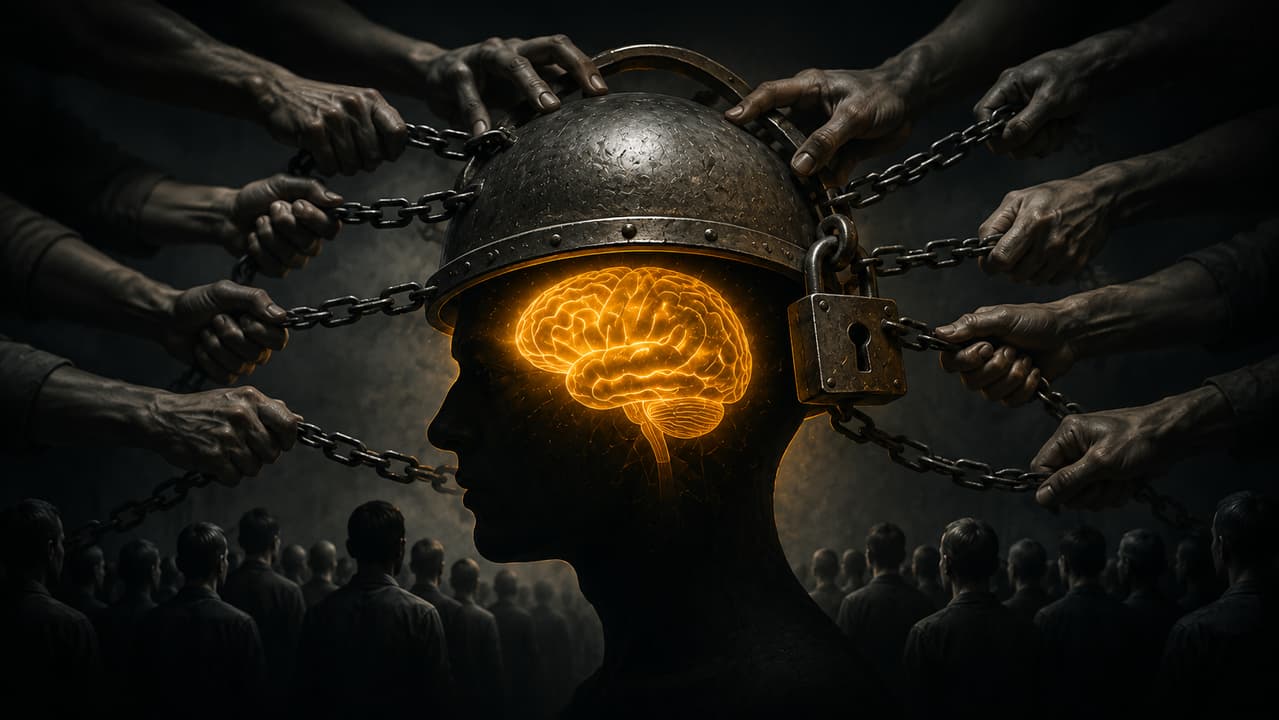
That's what we are very good at doing, not creating stuff but copying it. Creation is rebellion. Do we see this? But when this (Joining both hands) becomes your life, how will you rebel? Who has ever rebelled with folded hands? Ever seen a rebel standing like this?
Rebellion is a clenched fist, not folded hands; mercenaries.
Which are some of the least preferred branches?
Questioner: Not preferably our own, opt for physiology, biochemistry.
Acharya Prashant:** Biochemistry. Tomorrow, if the job market in biochemistry heats up, all the toppers will be rushing towards biochemistry. Where is love? Where is the heart? We are up for sale. "Come, come. I'm available. This is the price tag."
In personal matters also, I mean such an intimate thing, picking a partner, sometimes for the entire life. No place in the world does it the way we do. We literally sleep with strangers. Love is considered immoral, but sleeping with strangers is all right. Yeah. No, not here in Delhi. But just travel a little into the interiors, and that's what is still happening, 60 to 70% of our population. Yes, we have become progressive. So the girl and the boy get to meet on the terrace for five minutes,
"Han ji, to ji, aap kya karti ji?"
"Main to ji bhindi banati ji."
And then you sleep with the stranger. What does that leave you with? Does that leave you with any heart?
Think of what it does to the mind, the very spirit of those two persons. They are crushed. If you can't have freedom even in such an intimate matter, why will you ever now rebel against anything? As a woman, if you are carrying a stranger's germ in your womb for nine months, can there be a greater indignity? Somebody touches your arm and leaves a mark, a blemish. You don't like it, do you? And somebody has penetrated your body and left his seed, his cells there, and now you will be carrying them and then bringing up that thing as your own baby your entire life. Is that not humiliation? Where is love?
Questioner: Acharya Ji, In this very interestingly, the supposed love also blooms, and the marriage prospects are also between certain branches. It's just like a business venture. So if a person is in OB/GYN and pediatrics, they will marry.
Acharya Prashant: You know, I'm in Ahmedabad. Major Sahab is here, so he'll attest. We had a very interesting episode. We too have affairs galore on the campus, and it's usually the top rankers that walk away with the girls. That's the way the girls decide, not the top rankers, because everybody is available as an option, but only the top rankers are chosen.
We entered in 2001, and just the year before that, in 2000, there was this massive earthquake, you remember Bhuj (source: Britannica). So you have seen how the buildings and the domes at IIM Ahmedabad, that old architecture Louis khan, brickwork, and it's pretty old, 1960s. One of the bricks at the top of a dome was loose. And not one brick, two bricks. And the bricks fell because the building was shaking. One of the bricks fell on the topper and another brick fell on the topper from the other side, the bottom that is.
And then the joke on the campus was, “Even God does not discriminate on the basis of rank, then why do these girls do?” Even God does not discriminate on the basis of rank. The topper got hurt and equally the trailer got hurt. So why are the girls being so discriminative? But that's how it is. Where is love? You pick a man based on his earning potential or current salary or inherited wealth.
Actually, there is a very stinking word for that. No? If you sell yourself off for money, we don't need to actually spell it out, but we know what we are doing. And the same thing applies to the men who sell off their brains and brawn for money. The brain is as much a body as any other part, right? If you are saying, "I'm selling my brain to the highest bidder, to the topmost recruiter," how is that not prostitution? I'm asking, wherever there is a relationship that does not involve love, what else do you call it? It's an exchange. Barter.
And when that is happening, there is no spirit here, and then you cannot do great things, and then that nation can never be great. And I repeat, that's such a sorry thing because our fundamental culture is of freedom. The highest virtue is Mukti. When you go to the Shat Darshan, the highest virtue is freedom, Mukti, liberation. And yet we became a nation of bootlickers.
Was there a colony as big as India ever? No. I have been a student of the Second World War, and there are just so many aspects and micro details related to it I enjoy reading. One of the things I was recently going into was Hitler's attitude towards India. Hitler said, you know, Hitler loved the Brits in the sense that they are pure Aryans. He said India deserves to be ruled by the Brits, and when the Brits are gone, then the Germans will take over. He looked down upon India, and that's why the alliance between Hitler and Subhas Chandra Bose was doomed to collapse.
He said, “These are very inferior people. Yes, they had an Aryan past, but look at them now, they are incapable of self-rule." He said, “It is fine if the Brits are ruling them. They should not be independent, and once the Brits are defeated, then the Germans will rule them.” That's what he intended. He didn't intend India's freedom. He said, “Once Russia is conquered, the USSR, then the Germans will cross the Caucasus, the Caucasian mountains, join the Japanese, link up with the Japanese from the east, and then divide India into two parts, two spheres of influence, German and Japanese.”
The reason was simple. I mean, 40 crore people, we were there even at the time of World War II (source: census of India 1941). It was inconceivable for anybody outside India to imagine how such a large number of people could be controlled by those coming from tiny isles northwest of continental Europe. Can you imagine? And when they first came here, think of the 16th and 17th centuries, when the Europeans were first coming here, they didn't have engines, really, no steam power. Yet they traveled all the way from there. Think of how they would be traveling first of all.
They traveled, and they still conquered. The reason is just one: the Brits didn't conquer us. We did this (Joining both hands). This has defeated us. Can you let this sink in? Is it believable?
With no source of energy, forget nuclear power or electric power or fossil fuel. They didn't even have steam engines. And they were coming all the way from their Cape of Good Hope around. And they come here and they are such a tiny nation. But they were innovative. They were creative. And they were daring.