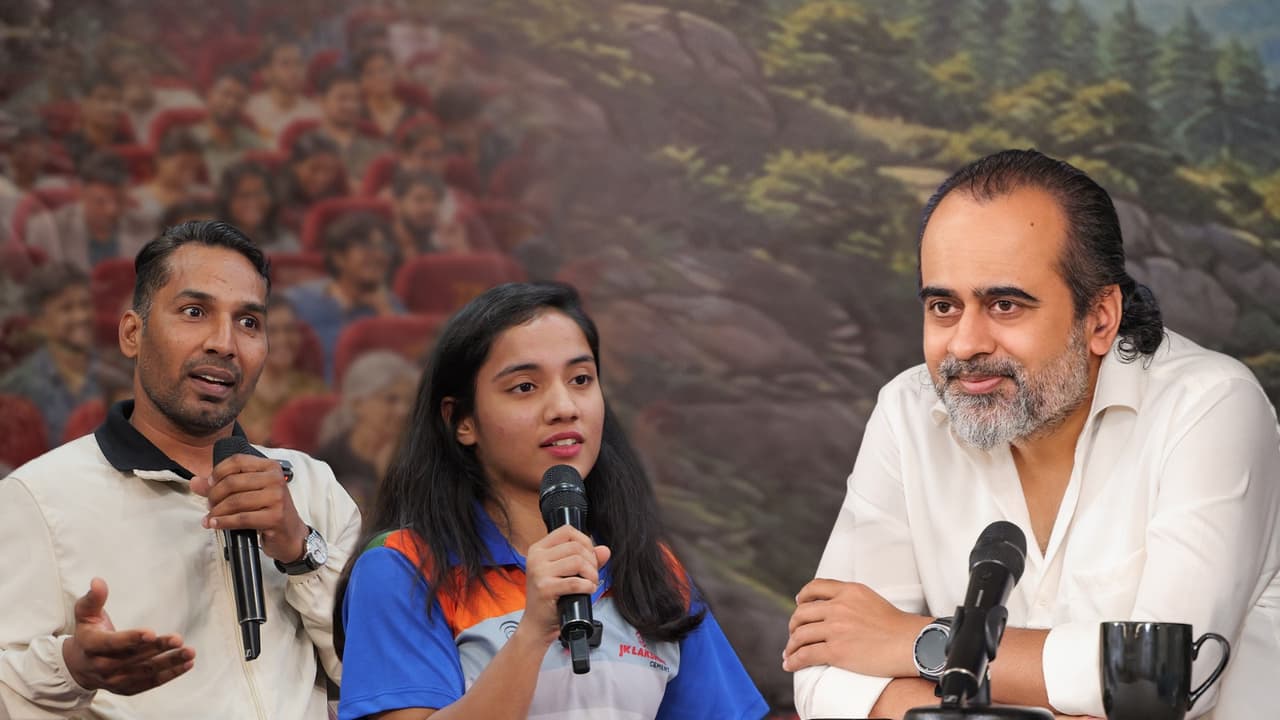
Questioner: Good evening, sir. I am Meghna. I feel that we are not women or men, but we are scripts. So, could you please explain how our conditioning has turned us into scripts?
Acharya Prahant: It's there to be seen. It's everywhere. If we were not told, let's say hypothetically, thought experiment, what kind of clothes to wear, would we still wear these same kind of clothes? If there were no one to tell you that these are the right kind of clothes or the prevailing custom, would you still wear the same kind of clothes? So, it's scripted.
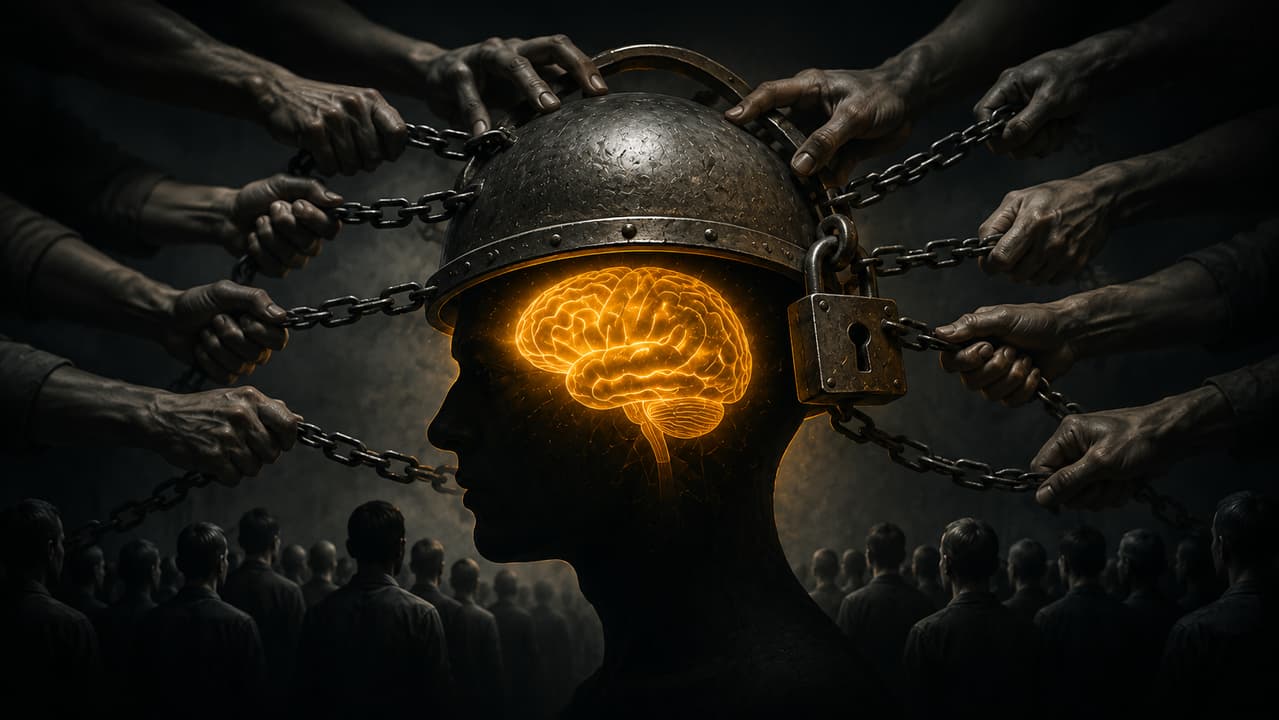
Now, take it deeper, and it starts getting dangerous. If you were not told, would you do anything that you do throughout the day? And let's make it scary, really scary. If we were not told, would we have done anything we have done till this point in life? Would you be found in this institute? Would you be speaking this language? Would you be holding the kind of dreams you do?
Even our dreams are scripted. Our dreams are not our own. Think of it. How come most of us have similar dreams? If we were to jot down our dreams, you will find that the differences are very superficial. Essentially, the dreams are the same. They'll revolve around money, family, kids, reputation. Only, only these things, right? How come all of us have the same dreams? How is it possible? If we are individuals, how come our dreams and desires are all so similar? Surely, the script is coming from somewhere else. It's not our own.
Just as our languages are similar, right? Which means none of us invented a language. Only then can there be such uniformity and similarity. Right? If I use the word water with a particular meaning, you two use the word water with the same meaning. That means neither me nor you invented this word. The word pre-exists both of us and is present in some dictionary, and that dictionary is where both of us are drawing the meaning from. Right?
So, similarly, if all of us have the same kind of dreams and beliefs, surely those dreams are not yours, they are also not mine. They are somebody else's. What kind of life is this? Scripted.
Questioner: But the way we achieve our dreams is something individual.
Acharya Prashant: No, that too is determined by the conditions. That too is determined by random chance. I'll give you an example. Your dream is that camera. Let's say that one. The tall one. Tall, dark, handsome. The one in the middle. And you two have the same dream. But if you were to attempt it, you'll move that way. And if she were to attempt it, she'll move this way. She'll go right, you'll go left. And then you can say, "But our ways are different." No, your ways are different only because of random chance. It happened that you are sitting here, and it happened that she's sitting here. So, it will appear as if the ways are different.
So, even the ways are being determined just by chance, not by something that is pure, individual, untouched, intimate. It's not coming from anywhere. Somebody is born in a doctor's family. That person wants to achieve money and fame through MBBS. Somebody is born in a Bollywood family. That person would want to achieve much the same things through an acting career. And you'll say there is a world of difference. One is becoming a doctor, the other is becoming an actor. But that's situational, that's circumstantial. The fellow was born at one place, the other one was born at another place, but essentially they want the same thing, and it's scripted.
So, that begs the question, what is our own? Do I even exist as an individual, or is it just a lot of scripts running in my name? Physical scripts, social scripts, religious scripts.
When you are 6, you don't fall in love. When you are 16, you almost necessarily fall in love. How is that happening? Is it not a physical script? Did you decide? No. Do you decide your desires? No. Do you decide to get young? Do you decide your adolescence? Do you decide to get hungry? Do you decide your thoughts? They just come. Do you decide to get angry? No. Anger also just, which means somebody else is writing the script. The body is writing the script. So, that's the physical script.
Then there is a social script. You are a woman, so you should behave in one way, and you internalize that way. That's the social script. You didn't write it. Society wrote it for you, and you just meekly accepted it. And you are a man, so you must be the provider of the family. And you two just accepted it.
Then there is a religious script. You belong to one religion. She belongs to another one, or caste, or whatever. And you accept the script that comes from there.
Now that you are 28, where are the kids? On one hand, the body is pushing you towards it. On the other hand, the social script is demanding the same thing. The question is, where are you in the middle of all of this? Do you even exist?
Questioner: Sir, I think my question will be a question that everyone might have. So, what exactly is going off script then? Because when it comes to desire, every individual has different desires. And now that we heard so much about hollow desires, how do we look into actual inner desires?
Acharya Prashant: You see how impatient this is. Keep the discussion aside. Just tell me what lies beyond the script. Quickly, let's come to the point. And if I tell you what lies beyond the script, whose script would it be? And then she'll emulate it. So, would that really be beyond the script then? That would be another scripted thing.
The question boomeranged. What to do now?
Listener: Sir, but if we don't have...
Acharya Prashant: I thought only she was impatient. No need to ask what lies outside the script.
First of all, acknowledge the absolutely pervasive presence of scripts. Maybe in that acknowledgement, something new, something beyond the scripts will open up.
At this point, you don't even know the extent, the depth to which scripts control you. First of all, that has to be seen. No? First of all, it has to be seen how deeply scripted we are. And in that seeing, maybe some other potentiality will just get activated.
So, the heart attack and the cancer, should I ask what would health look like once I am cured? I'm taken to the doctor and I tell him, you know, I don't feel all kinds of things in the body are happening. Strange things here, there, everywhere. So, but doctor, wait, don't rush. My question is, when I get well, what would it feel like? What could the doctor do? You don't deserve to get well. You remain this way.
When you go to a doctor, you don't discuss health. You discuss disease. And when you have known the reality of your disease and the severity of it, then it is possible that there can be freedom from the disease. But you don't cut the doctor short and say, "Okay, just too much discussion on disease. This fellow came an hour back and he's been continuously talking of tuberculosis and HIV and cancer and heart attack and all kinds of ugly stuff he's discussing. Let's cut it short. Let's come to beautiful things. Rainbows and teddy bears. What does health look like? What does it mean to fly free outside the script?"
Visualize this. You are a bird and there is open sky. And there are some little, few cute, pretty clouds, and you're flying through them. Will all this give you freedom from disease? I can give you an idea. Yes. And that idea will just be imagination, right? How does it help to imagine what lies outside the script? Does it help?
The bird has seen only the cage since her birth. Just the cage. And outside the cage is another cage in the form of the four walls of the house. That's the reality of that bird. And I speak to the bird of freedom. And what does she tell me? "Don't, don't, no, no more facts, no more reality. Just tell me what the sky looks like." Will it help? What must the caged bird talk of? Please tell me.
Listener: The cage!
Acharya prashant: The cage! The cage! The cage! But she will not like talking about the cage because it hurts. It hurts to acknowledge that she is caged. So she'll want to talk about the clouds and the rainbows and the fellow birds and the chirping and the sunset and the beauties and the great freedom. Whereas all that she really knows of is the cage and the wall.
Therefore, we should start from where we are. If we are in a cage, we should talk of the cage. If we are engaged by the script, we should talk of the script, and we should examine the cage very carefully. Tell me why? So that we may find some little spike fractured somewhere. Right?
So, you don't have to dream of freedom. You have to examine your bondage. You have to figure out what keeps you within that cage, and maybe then there is some possibility of freedom.
Questioner: So, sir, what I feel like, following the scripts is not harming us, right? So, while following the scripts, we are getting the success, right? Why should we not follow the script?
Acharya Prashant: Obviously, the bird is not being harmed. Regular supply of food. Protection from the eagles. And the unknown dangers of the sky. Freedom itself is such a big threat. The bird that flies free is also vulnerable, is she not?
So, the bird obviously does like the cage. And now you know why we remain within the scripts. It is convenient because there is a master that comes and says, "Oh, my little pretty bird. See how sweetly she sings." And the bird says, "Yeah, yeah, I am free to fly within the cage. I have all the freedom within the cage. Have all the freedom within the cage."
And I'm not denying. You see, if you look at the average lifespan of free birds versus caged birds, caged birds would live longer. You know, animals in captivity, like in the zoos, live much longer than animals in the wild. That's the benefit you get. Regular supply of food, security, and a lot of people also pampering you, "My sweetie, my birdie." And she's also so obedient. Whatever we say, she follows. Not a bird, she's an angel, pari hai.
Do you see why we stick to the scripts? Because the scripts have something for us. What is it?
Listener: Convenience.
Acharya Prashant: Convenience. Little securities. Petty comforts. And for the sake of all that, we prefer to sacrifice our birthright, the infinity, the sky, Truth and freedom, and the opportunity of love. We say all that can be bartered away.
Now the questions are fresh. These are not scripted questions. Am I right?
Questioner: Yes, sir.
Acharya Prashant: This one is spontaneous. Do you see where it is coming from? Because we talked of script with script so much. So now she's able to move outside the script. That's why you should talk of disease a lot, because that's the discussion that will enable you to move into health. Suppressing it, willfully ignoring it, deliberately cornering it won't help. That's self-deception. And you see that being actualized right now. This is a spontaneous question. And I know by the looks of it. Yes. Come up, please.
Questioner: These scripts also somehow give us a purpose. So it also the desire to have some kind of purpose in our life also.
Acharya Prashant: Vent it all out. Let it, let it.
Questioner: So, sir, these scripts also give us some sort of purpose. Maybe for that reason we don't...
Acharya Prashant: What's the purpose of the caged bird? Please the master, “Mithu bolo ram-ram,” that's what, that's what that's the purpose. Please the masters, do as they say, and in return you will get things. Not that, you know, it's not that you, you are being asked to do what do they call that begaar? Basically, work without pay. Yeah, slavery. But there's a specific term for that. A very, very common word. I'm skipping it. Yeah?
Listener: Unpaid labour.
Acharya Prashant: Yes. Unpaid labor. Yes. But there's a word for that. So, you get that, right? Something you will be given. The question is, are you worth only that much? That's the question.
Obviously, the script does have something for you. The question is, are you worth only that much? Yes, obviously, even within the cage, the bird can fly to this height. The question is, are your wings worth only that much, or are you meant to scale the sky?
Questioner: What would be the consequences, sir, if we choose to deviate from the script, like…
Acharya Prashant: Now somebody wants to come to the deal? What's the deal really like, yeh bataiye? What price must the bird be ready to pay for freedom? Please tell me. It depends on the intensity of your love for the sky. It depends on the intensity of your love for the sky. And if we are loveless beings, then the cage is home. No problem at all. Stay there. Enjoy all your life.
Cages of all kinds. All scripts are cages. There's a physical cage. There's a social cage. There is a cultural cage. There's an economic cage. There is a political, there is a religious cage. All kinds of cages exist. There is a psychological cage. And all cages have something for you. They capture you by tempting you. They capture you by way of greed and fear, obviously. If you stay here, we'll give you something. If you venture out, we'll attack you, destroy you, take away something, right?
So, something will be taken away. That's for sure. But whether you want to give it up depends on your love for the sky. And that's something only you can answer. Nobody else can do it for you. Right? It's a very personal, very intimate thing. How much love do I have for freedom? That's a question you have to answer.
India's population was around 40 crores when Bhagat Singh was hanged. Not everybody had the same intensity. There was somebody who had that kind of burning love. So he said, "I'll pay the ultimate price." And then there were those who were comfortably settled within their scripts and cages and the regular lives, even doing government jobs. They didn't have that love. They probably can't even be blamed. But if you are someone who does have a beating heart, if you are someone who does have love and still you have chosen the cage, then there is a big problem.
Questioner: Sir, people say generally that society is structured when we come to the real deal. Society is structured in a way where we have to follow the script. So somehow it's also necessary to fit in. And why do we have to fit in? Because if we need to live in a society peacefully, we need to follow the norms, the cultural cage, as you mentioned, or the societal norms, as you mentioned. So, yeah, for a person to get out...
Acharya Prashant: I came to your institution, right? I followed all the norms, didn't I? Please understand. I'm sitting on a chair appointed by you. I didn't choose my own chair, and obviously I didn't bring my own chair. You provided this chair and you said, "Sit." I sat. I didn't choose. I didn't decide. And I would have been okay had you said, "Sit there." That would have been equally fine, right? You gave me this mic. I'm okay with it. This cup, I don't know whether my team brought it or what. Fine, okay. But wouldn't have mattered had this been something from your own mess or canteen. Equally fine. No problems.
So, there are these things that are peripheral, and one agrees to fit in. And then there is something of the heart where no compromise can be accepted. So, I'll accept this mic that you have given me, but I'll not speak anything that you want me to say. The mic will be yours. The words will be mine, and that's the line that you have to draw.
If you have a house, the local authorities, the government, the administration, they decide the number of your house, right? 29A, something or another. You don't decide that, do you? Similarly, your vehicle registration number, the authority decides. You don't decide, do you? But you must decide where to take that vehicle. That you cannot let society decide.
You must decide what to do with your house. What's happening inside the house, that you cannot let the neighbors decide. But that's what happens with us. The number of the house comes from the authorities. And what's happening inside the house comes from all kinds of scripts. Right? That's the problem.
There has to be a distinction. Externally, you can behave as per the norm, the culture, the society. Only externally. Look at the clothes you are wearing, or he is wearing, or I am wearing. All these are as per the current culture, right? These are as per the current culture. So, we accept these things. That's fine. The language I'm speaking, this is not Bengali. This is not French. This is not Hebrew. This is not Greek. This is a language that would be acceptable to everybody. So, I'm fitting in.
The mic is social. The language too is social. But even the words, right? The construction, the syntax, everything. Everything is social. But there must be something that remains untouched by society, by body, by culture, by convention. And that is something you can call your true self. Your true self. That's who you are. And if that doesn't exist, then you don't exist.
Yes, I will compromise to an extent. That can't even be called a compromise. That's the way of existence. Right?
Questioner: First of all, sir, I would like to introduce myself. I'm Pranit. I did not introduce myself when I asked the first question, and it's a pleasure to meet you.
So, now you have been talking about scripts. Right now, we are living in a highly liberal world. There is so much freedom, and what's happening is we all are choosing to be independent, choosing to live life according to the way we want. No, we are, like, challenging the existing norms, the hierarchies.
So, is this also the reason why there is growing instability in the world, the growing chaos, because the age-old institutions are collapsing, like marriage, relationships. Now these are now losing meaning, real meaning. So, you know, is it because we are becoming overly liberal? We are choosing to move away from the script. Script is that the reason why the world is plunging into chaos?
Acharya Prashant: See, the center of the question is misplaced from a bright point within. You may follow tradition or not follow tradition, everything will be good and auspicious. And from a dark point within, you may follow tradition or not follow tradition, everything will fall apart.
So, it's not as if you follow tradition, there will be stability. And if there is stability due to tradition, it is the stability of the dead man. The dead person is very stable, or is he not? Very stable. Similarly, you could have great deadness, great traditional deadness, and you will call it stability.
The man is in a coma, let's say, since centuries. There is a person in coma since centuries. And how does he look? Very stable. Very stable. Doesn't disturb anything at all. Perfect equilibrium. And you'll say, "This is model stability. Look at how our people are." But the fellow is comatose. The fellow is next to dead.
Now, let's say he starts recovering and waking up. What would happen? A lot of instability. But that instability is life itself. That instability must be welcomed. It is auspicious because it denotes the fellow is now coming to life after centuries of coma. Are you getting it? So, it's not that you cannot follow tradition. I said, follow tradition if you have to from a bright point. If your discretion, your consciousness tells you tradition is wonderful, go ahead. Nothing stops you.
But more often it would happen that when in the light of your own understanding you will look at what has been going on, what has been flowing to you, you may feel like you may decide to reject it more than accept it. That's much more likely, though that's not cast in stone. That's not really a rule. If there is a tradition that really helps you be awakened, if there is a tradition that helps you see things in clearer light, let the tradition remain. Let's respect that tradition. But mostly, that's not how traditions are. Most of the traditions come from collective unconsciousness. They are the flow of the crowd where nobody dares to question why a certain thing is being done.
Questioner: Sir, could you expand more on this point within that you were talking about?
Acharya Prashant: This is spontaneous, right?
Questioner: Yes.
Acharya Prashant: Good. So, we are, we are not just talking, we are demonstrating. Right? So this is not a lecture, this is a workshop. Good, yes. Repeat your question, please.
Questioner: The point within that you were talking about, could you expand more on it?
Acharya Prashant: The untouched point?
Questioner: Yeah, the point from where the bright light comes or the dark place comes, that particular point.
Acharya Prashant: To see something, you must be free of it, right? To see something, to understand something, you must be free of it. If you are attached to something, it becomes very difficult to know its reality.
This inner illumined point I'm talking of is the point that sees. What does it do? It sees. Sees without fear of consequences. Sees without desire. Just see. Almost like a scientist looks at an experiment being conducted. You don't know in advance what's going to happen. So, you are just observing very, very attentively.
It is that point that sees. It doesn't project. It doesn't ask for a favorable result. It just sits and says, "What really is going on?" And I'm not asking because I want to stop what is going on. And I'm also not asking because I want to continue what's going on. I just want to know what's going on. That's seeing. Fearless, desireless. I just want to know what's going on because it's my life, and I'm young, and I can't waste my life. I have only one life. I want to know what is really going on. That's seeing. That's the untouched point.
So, this is something that your body is telling you. All kinds of impulses arise, especially in youth. This is something the society is telling you. This is something the campus is telling you. This is something the priests are telling you. There's something the movies are telling you. Then the politicians are saying something. And you are saying, "I'll not get blindly carried away." That doesn't mean I'm rejecting anything. I want to consider everything without committing to anything. Consideration without commitment. That's seeing. Are you getting it?
Consideration without commitment. Awareness without attachment. Like one looks at anything new that's come. What is this? I want to understand what's... If you have expectations, you'll not know what's here. Or if you are afraid, you'll just throw it away, and again you will not know what's here.
I want to know what this entire game called life is about. One is born, then this happens, then that happens, then one gets educated, then one is supposed to do some socially constructive thing and also get paid, then one gets kids, then this happens, then that happens, one gets old, one gets sick, one dies. What exactly is going on?
Why are people different? Here something is considered absolutely important. This country, this place, this culture. You look at other countries, other places, other times. Something else was absolutely important. Is there anything absolute then in all of this? What's going on? What's going on?
Somebody comes to you, says something, gets hurt, right? How exactly did this happen? What was the process? What did the person do? And how did the blind reaction arise, and how am I carrying that feeling, that memory? This is seeing, right? Not deciding not to be blind. That seeing. Having faith that life is something you can know and live in discretion. That seeing. And the guts to ask uncomfortable questions. The guts to ask questions that people don't want to answer. Guts to ask questions that are almost prohibited. That seeing.
Questioner: Sir, one last follow-up on this.
Acharya Prashant: Are you sure it would be the last one? If you already know, then there is a script.
Questioner: I'm not sure, sir.
Acharya Prashant: Being outside the script means things can be unpredictable, and we are glad that they can be unpredictable.
Questioner: Yes. So, so we as individuals and as society, are we ready for such sort of liberation, such sort of thoughts, or to reach such a point? Are we ready? Because it will erupt into chaos, as my fellow friend was mentioning.
Acharya Prashant: You're just afraid, that's all. Nothing. You never say, "Are we ready for liberation?" You declare, "I am ready for liberation." We is never ready. As long as you remain we, you will never be ready. You never get liberated in groups. Ever heard of a liberated crowd?
But good girls speak in Vs, you know, in the collectiva. And that's a problem. The unit of liberation is the individual. And such an individual proves to be a blessing for the society. He doesn't aim to do social good. And yet he is the one that brings about the maximum good to the society without desiring, without explicitly trying. Are you getting it?
So when you say, "I'm dying for liberation," that's when it happens. It attracts, extracts the maximum price. The moment you say, you know, if we all have a consensus, then let's the five of us move together into liberation. There would be security in a group, you know. Girls especially must not go out alone. Four of them are going out in a group towards liberation. What kind of liberation is this? Will it ever happen? No.
Questioner: Then we’ll be bad girls, sir.
Acharya Prashant: That's all. That was the statement I ended yesterday's open session with. Who all were present there? What was the last statement? “Be a bad girl.” And that video happens to be already published at around 2 p.m. on the English channel. So you can go there and figure out why I said, "Be a bad girl.”