Nations often behave remarkably like insecure individuals. Every new weapon is the ego trying to insure itself against its own fragility. When the boundary feels violated, nations behave the way any organism does. On the collective level, it becomes nation against nation. The collective reacts rather than reflects. No realignment of alliances, no new world order will resolve what is fundamentally a crisis of self-knowledge.
This summary is AI-generated. Please read the full article for complete understanding.
Originally published in The Sunday Guardian on 8 feb '26
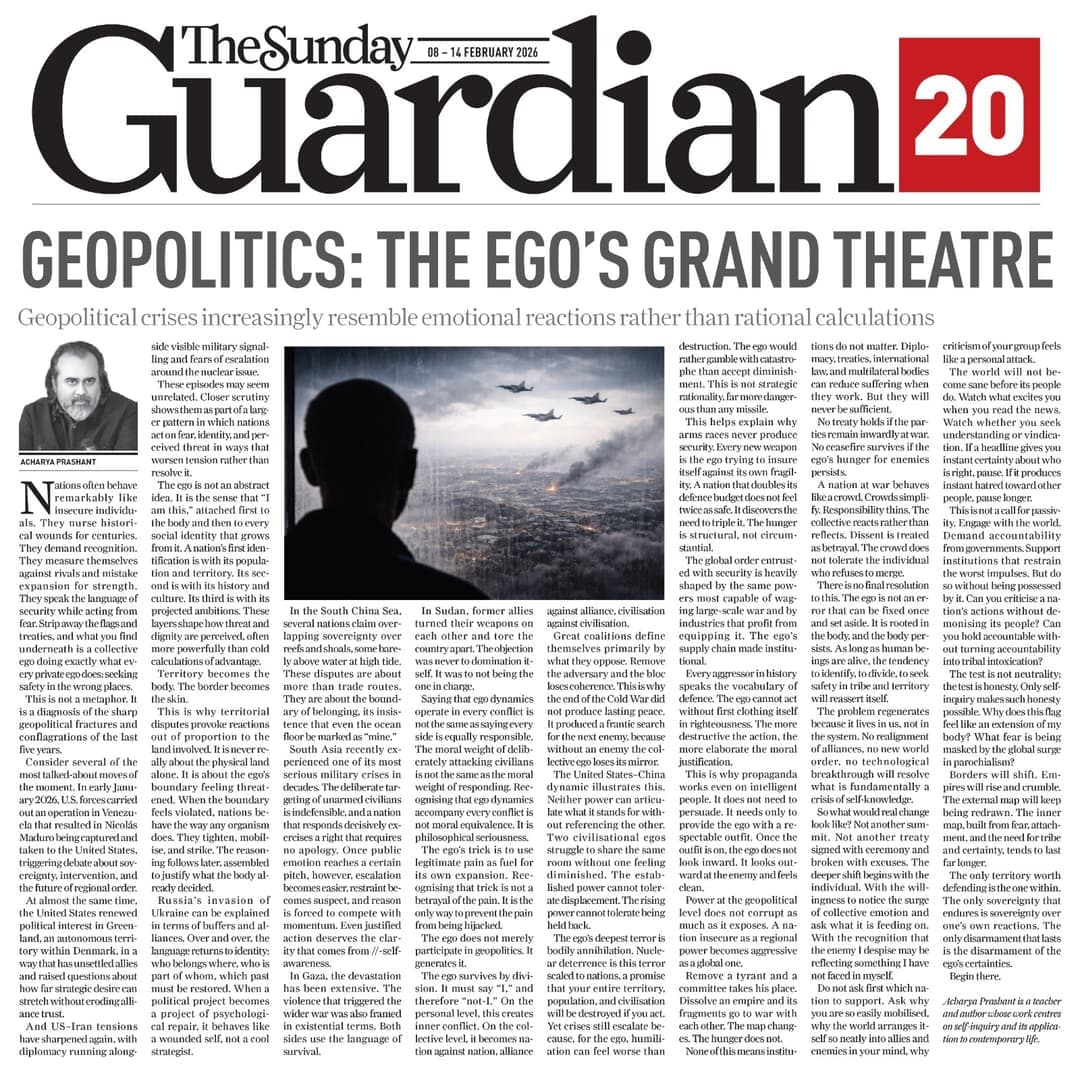
Nations often behave remarkably like insecure individuals. They nurse historical wounds for centuries. They demand recognition. They measure themselves against rivals and mistake expansion for strength. They speak the language of security while acting from fear. Strip away the flags and treaties, and what you find underneath is a collective ego doing exactly what every private ego does: seeking safety in the wrong places. This is not a metaphor. It is a diagnosis of the sharp geopolitical fractures and conflagrations of the last five years.
Consider several of the most talked-about moves of the moment. In early January 2026, U.S. forces carried out an operation in Venezuela that resulted in Nicolás Maduro being captured and taken to the United States, triggering debate about sovereignty, intervention, and the future of regional order. At almost the same time, the United States renewed political interest in Greenland, an autonomous territory within Denmark, in a way that has unsettled allies and raised questions about how far strategic desire can stretch without eroding alliance trust. And US–Iran tensions have sharpened again, with diplomacy running alongside visible military signalling and fears of escalation around the nuclear issue. These episodes may seem unrelated. Closer scrutiny shows them as part of a larger pattern in which nations act on fear, identity, and perceived threat in ways that worsen tension rather than resolve it.