The Sunday Guardian
14 Jun '26

A prayer in British Parliament: The one Question no law can reach

Acharya Prashant

10 min
2.9k reads
A prayer in British Parliament: The one Question no law can reach
India’s deepest contribution is not culture, ritual, or tradition, but the inquiry into the self. Laws, technology, policy, and economic progress can improve external conditions, yet they cannot resolve the inner hunger that drives conflict, consumption, and ecological crisis. Real change begins with self-knowledge, honesty, and awareness of the one who chooses, desires, and acts. Without understanding the self, progress remains incomplete, no matter how advanced society becomes. This summary is AI-generated. Please read the full article for complete understanding.

Originally published in The Sunday Guardian on 14 jun '26

At Britain’s Parliament, an ancient Indian question challenged the limits of law and power

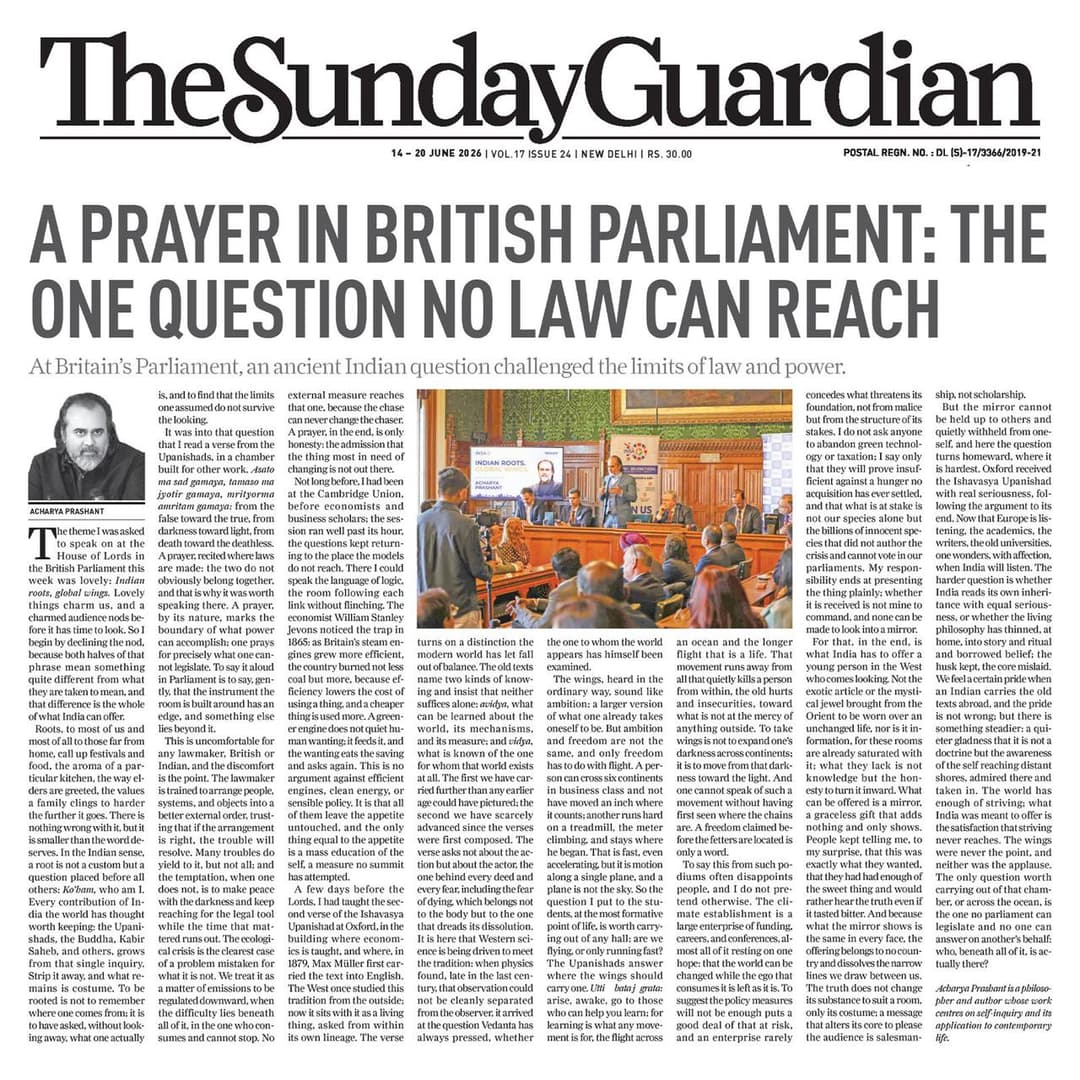
The theme I was asked to speak on at the House of Lords in the British Parliament this week was lovely: Indian roots, global wings. Lovely things charm us, and a charmed audience nods before it has time to look. So I begin by declining the nod, because both halves of that phrase mean something quite different from what they are taken to mean, and that difference is the whole of what India can offer. Roots, to most of us and most of all to those far from home, call up festivals and food, the aroma of a particular kitchen, the way elders are greeted, the values a family clings to harder the further it goes. There is nothing wrong with it, but it is smaller than the word deserves. In the Indian sense, a root is not a custom but a question placed before all others: Ko’ham, who am I. Every contribution of India the world has thought worth keeping: the Upanishads, the Buddha, Kabir Saheb, and others, grows from that single inquiry. Strip it away, and what remains is costume. To be rooted is not to remember where one comes from; it is to have asked, without looking away, what one actually is, and to find that the limits one assumed do not survive the looking.
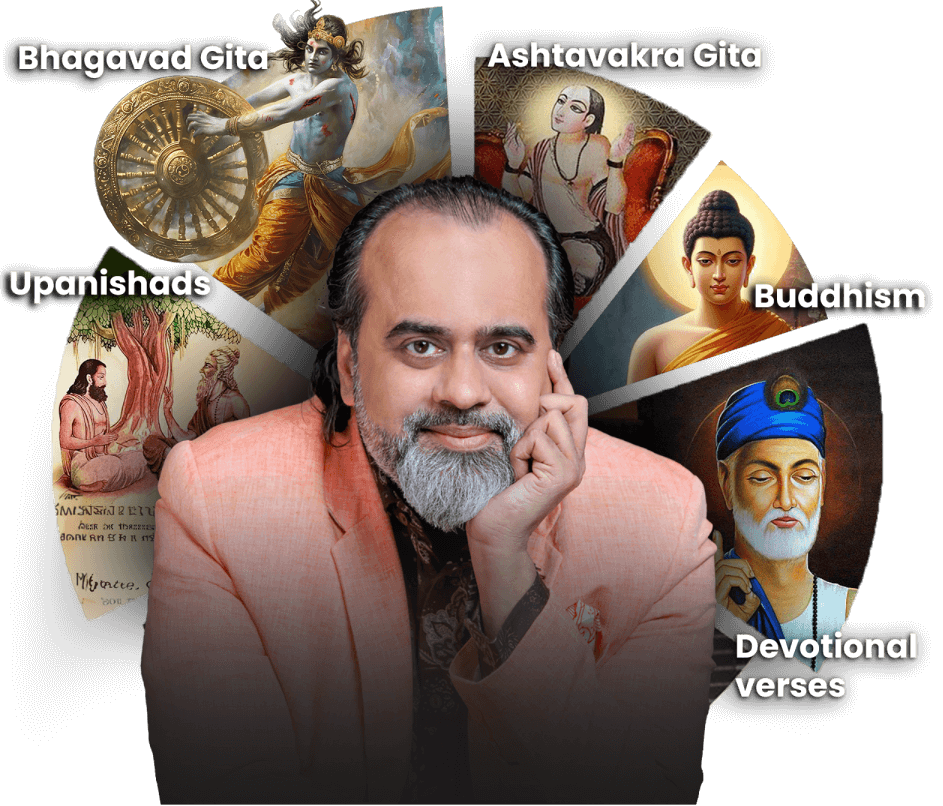
It was into that question that I read a verse from the Upanishad, in a chamber built for other work. Asato ma sad gamaya, tamaso ma jyotir gamaya, mrityorma amritam gamaya: from the false toward the true, from darkness toward light, from death toward the deathless. A prayer, recited where laws are made: the two do not obviously belong together, and that is why it was worth speaking there. A prayer, by its nature, marks the boundary of what power can accomplish; one prays for precisely what one cannot legislate. To say it aloud in Parliament is to say, gently, that the instrument the room is built around has an edge, and something else lies beyond it.

This is uncomfortable for any lawmaker, British or Indian, and the discomfort is the point. The lawmaker is trained to arrange people, systems, and objects into a better external order, trusting that if the arrangement is right, the trouble will resolve. Many troubles do yield to it, but not all; and the temptation, when one does not, is to make peace with the darkness and keep reaching for the legal tool while the time that mattered runs out. The ecological crisis is the clearest case of a problem mistaken for what it is not. We treat it as a matter of emissions to be regulated downward, when the difficulty lies beneath all of it, in the one who consumes and cannot stop. No external measure reaches that one, because the chase can never change the chaser. A prayer, in the end, is only honesty: the admission that the thing most in need of changing is not out there.

Not long before, I had been at the Cambridge Union, before economists and business scholars; the session ran well past its hour, the questions kept returning to the place the models do not reach. There I could speak the language of logic, the room following each link without flinching. The economist William Stanley Jevons noticed the trap in 1865: as Britain’s steam engines grew more efficient, the country burned not less coal but more, because efficiency lowers the cost of using a thing, and a cheaper thing is used more. A greener engine does not quiet human wanting; it feeds it, and the wanting eats the saving and asks again. This is no argument against efficient engines, clean energy, or sensible policy. It is that all of them leave the appetite untouched, and the only thing equal to the appetite is a mass education of the self, a measure no summit has attempted.

A few days before the Lords, I had taught the second verse of the Ishavasya Upanishad at Oxford, in the building where economics is taught, and where, in 1879, Max Müller first carried the text into English. The West once studied this tradition from the outside; now it sits with it as a living thing, asked from within its own lineage. The verse turns on a distinction the modern world has let fall out of balance. The old texts name two kinds of knowing and insist that neither suffices alone: avidya, what can be learned about the world, its mechanisms, and its measure; and vidya, what is known of the one for whom that world exists at all. The first we have carried further than any earlier age could have pictured; the second we have scarcely advanced since the verses were first composed. The verse asks not about the action but about the actor, the one behind every deed and every fear, including the fear of dying, which belongs not to the body but to the one that dreads its dissolution. It is here that Western science is being driven to meet the tradition: when physics found, late in the last century, that observation could not be cleanly separated from the observer, it arrived at the question Vedanta has always pressed, whether the one to whom the world appears has himself been examined.

The wings, heard in the ordinary way, sound like ambition: a larger version of what one already takes oneself to be. But ambition and freedom are not the same, and only freedom has to do with flight. A person can cross six continents in business class and not have moved an inch where it counts; another runs hard on a treadmill, the meter climbing, and stays where he began. That is fast, even accelerating, but it is motion along a single plane, and a plane is not the sky. So the question I put to the students, at the most formative point of life, is worth carrying out of any hall: are we flying, or only running fast? The Upanishads answer where the wings should carry one. Uttiṣṣhata jṣgrata: arise, awake, go to those who can help you learn; for learning is what any movement is for, the flight across an ocean and the longer flight that is a life. That movement runs away from all that quietly kills a person from within, the old hurts and insecurities, toward what is not at the mercy of anything outside. To take wings is not to expand one’s darkness across continents; it is to move from that darkness toward the light. And one cannot speak of such a movement without having first seen where the chains are. A freedom claimed before the fetters are located is only a word.

To say this from such podiums often disappoints people, and I do not pretend otherwise. The climate establishment is a large enterprise of funding, careers, and conferences, almost all of it resting on one hope: that the world can be changed while the ego that consumes it is left as it is. To suggest the policy measures will not be enough puts a good deal of that at risk, and an enterprise rarely concedes what threatens its foundation, not from malice but from the structure of its stakes. I do not ask anyone to abandon green technology or taxation; I say only that they will prove insufficient against a hunger no acquisition has ever settled, and that what is at stake is not our species alone but the billions of innocent species that did not author the crisis and cannot vote in our parliaments. My responsibility ends at presenting the thing plainly; whether it is received is not mine to command, and none can be made to look into a mirror.

For that, in the end, is what India has to offer a young person in the West who comes looking. Not the exotic article or the mystical jewel brought from the Orient to be worn over an unchanged life, nor is it information, for these rooms are already saturated with it; what they lack is not knowledge but the honesty to turn it inward. What can be offered is a mirror, a graceless gift that adds nothing and only shows. People kept telling me, to my surprise, that this was exactly what they wanted, that they had had enough of the sweet thing and would rather hear the truth even if it tasted bitter. And because what the mirror shows is the same in every face, the offering belongs to no country and dissolves the narrow lines we draw between us. The truth does not change its substance to suit a room, only its costume; a message that alters its core to please the audience is salesmanship, not scholarship.

But the mirror cannot be held up to others and quietly withheld from oneself, and here the question turns homeward, where it is hardest. Oxford received the Ishavasya Upanishad with real seriousness, following the argument to its end. Now that Europe is listening, the academics, the writers, the old universities, one wonders, with affection, when India will listen. The harder question is whether India reads its own inheritance with equal seriousness, or whether the living philosophy has thinned, at home, into story and ritual and borrowed belief; the husk kept, the core mislaid. We feel a certain pride when an Indian carries the old texts abroad, and the pride is not wrong; but there is something steadier: a quieter gladness that it is not a doctrine but the awareness of the self reaching distant shores, admired there and taken in. The world has enough of striving; what India was meant to offer is the satisfaction that striving never reaches. The wings were never the point, and neither was the applause. The only question worth carrying out of that chamber, or across the ocean, is the one no parliament can legislate and no one can answer on another’s behalf: who, beneath all of it, is actually there?

Originally published in The Sunday Guardian on 14 jun '26

This article has been created by volunteers of the PrashantAdvait Foundation from transcriptions of sessions by Acharya Prashant
Comments
LIVE Sessions
Experience Transformation Everyday from the Convenience of your Home
Live Bhagavad Gita Sessions with Acharya Prashant
Categories