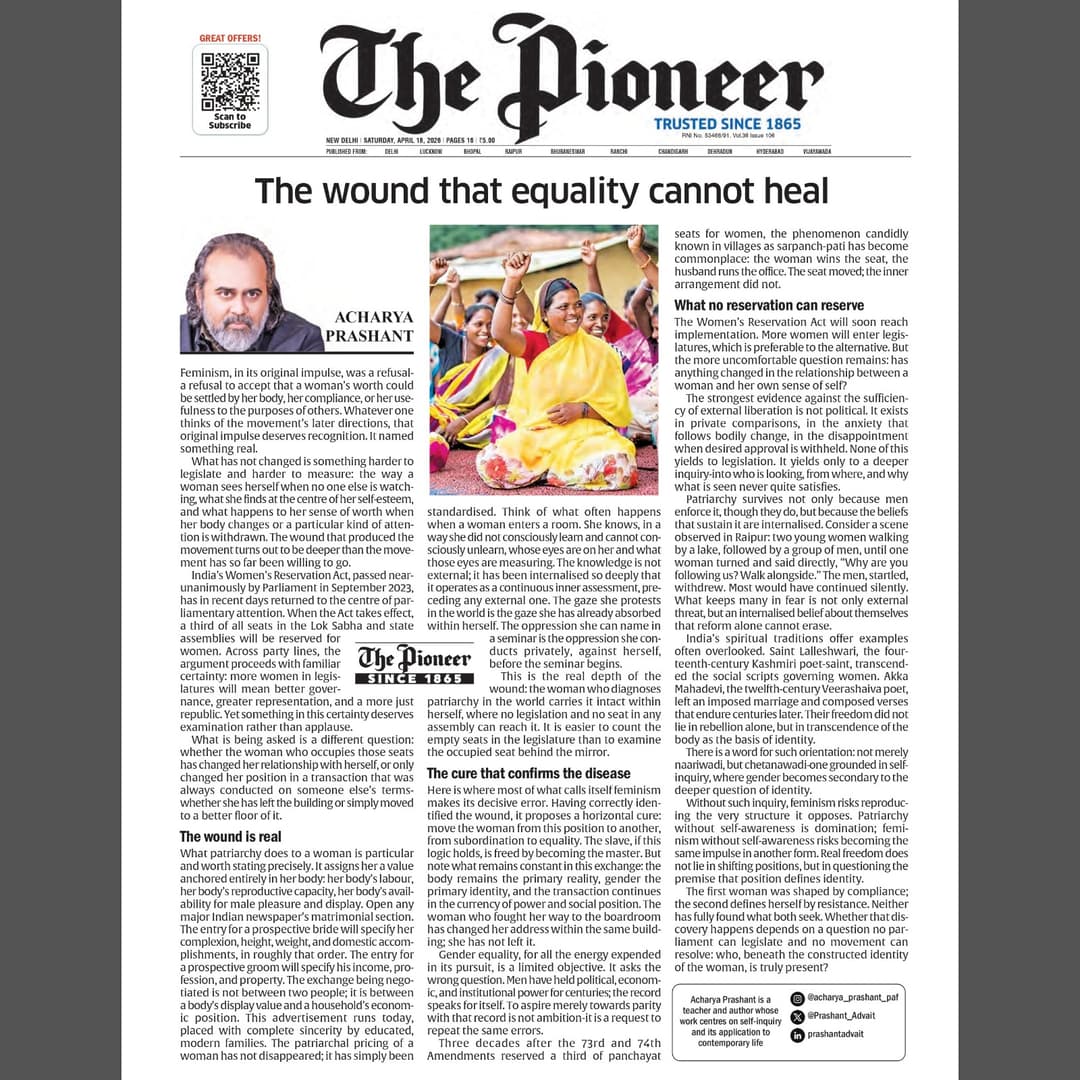
Feminism challenged external oppression, yet the deeper wound remains untouched. Rights, representation, and power have increased, but a woman often still sees herself through the same objectifying lens. The issue is not just social but internal. Without self-inquiry, change only shifts roles, not bondage; the cage remains, merely better furnished.
This summary is AI-generated. Please read the full article for complete understanding.
Originally published in The Pioneer on 18 apr '26
Feminism, in its original impulse, was a refusal. A refusal to accept that a woman's worth could be settled by her body, her compliance, her usefulness to the purposes of others. That refusal was not merely political; it was, in its best moments, a refusal to accept that a human being could be exhausted by her roles, that the woman standing inside all those assigned functions was not also something more. Whatever one thinks of the movement's later directions, that original impulse deserves recognition. It named something real.
And yet something has not followed from that naming. In the century since the refusal was first articulated, laws have changed, doors have opened, and the vocabulary of equality has entered every political conversation. What has not changed at the same pace is something harder to legislate and harder to measure: the way a woman sees herself when no one else is watching, what she finds at the centre of her self-esteem, what happens to her sense of worth when her body changes or a particular kind of attention is withdrawn. The wound that produced the movement turns out to be deeper than the movement has so far been willing to go.