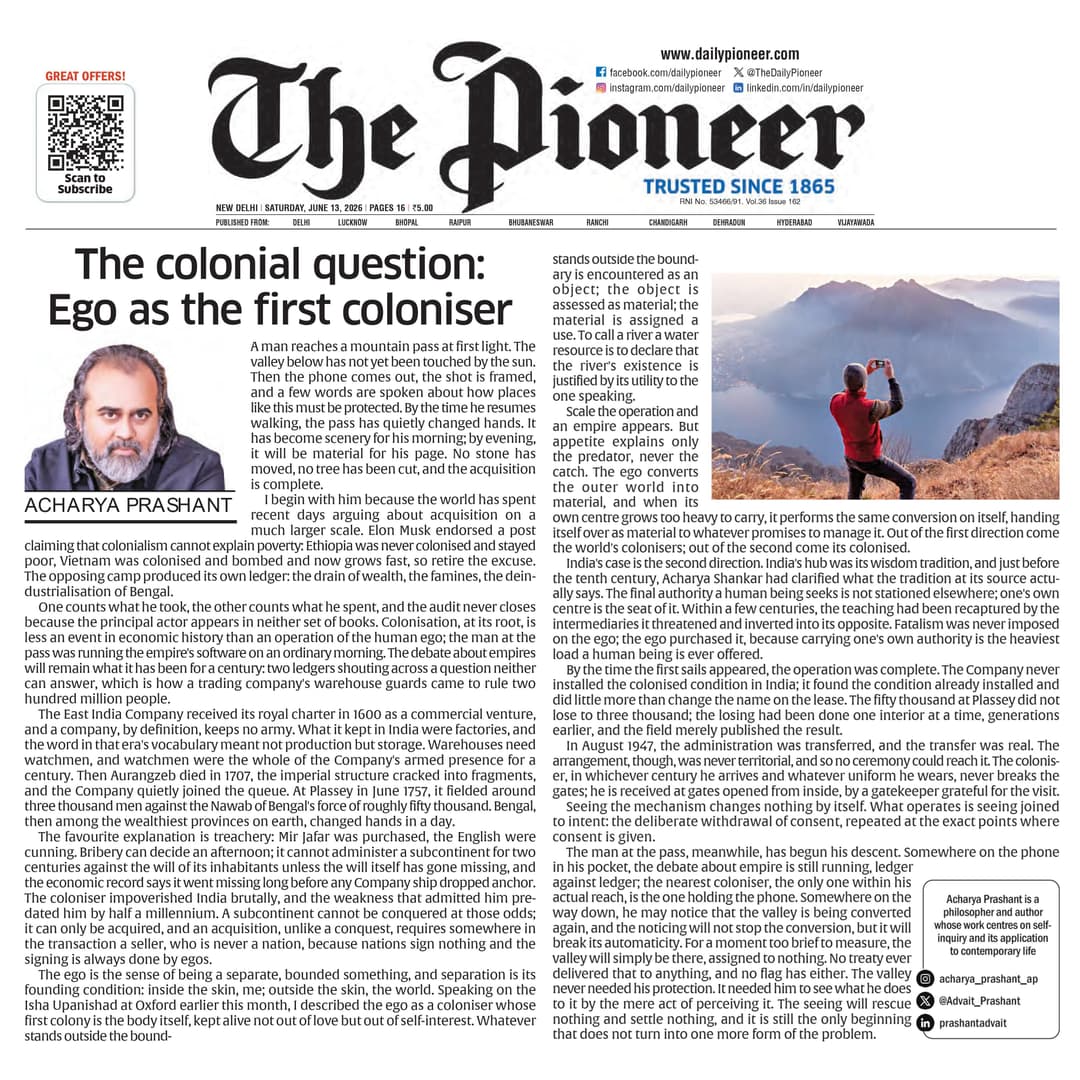
Colonialism is not only a historical event but a recurring psychological pattern. Empires succeed when individuals surrender inner authority and allow external forces to think, choose, and decide for them. Political independence alone cannot end colonisation if the mind remains dependent on ideology, superstition, social conditioning, or authority. Real freedom begins with self-awareness, personal responsibility, and the continual refusal to hand over one’s judgment to any external ruler.
This summary is AI-generated. Please read the full article for complete understanding.
Originally published in The Pioneer on 13 jun '26
A man reaches a mountain pass at first light, three hours of walking in the dark behind him. The valley below has not yet been entered by the sun; the river on its floor is a grey thread, older than the language he thinks in. He stands still for perhaps a minute. Then the phone comes out, the shot is framed, his own face is recorded against the ridge, and a few words are spoken about how places like this must be protected before they are lost. By the time he resumes walking, the pass has quietly changed hands. It has become scenery for his morning and proof of his sensitivity; by evening, it will be material for his page. No stone has moved, no tree has been cut, and the acquisition is complete.
I begin with him because the world has spent recent days arguing about acquisition on a much larger scale. Elon Musk endorsed, with a single word of agreement, a post claiming that colonialism cannot explain poverty: Ethiopia was never colonised and stayed poor, Vietnam was colonised and bombed and now grows fast, so retire the excuse. The arguments that gathered around the repost went further. Colonies, it was claimed, were mostly unprofitable, with more spent on railways and roads than was ever carried away; and Singapore and Hong Kong wore the colonial yoke for over a century and now outshine their neighbours. The opposing camp produced its own ledger: the drain of wealth, the famines, the de-industrialisation of Bengal, the museums of Europe furnished with other people's history.