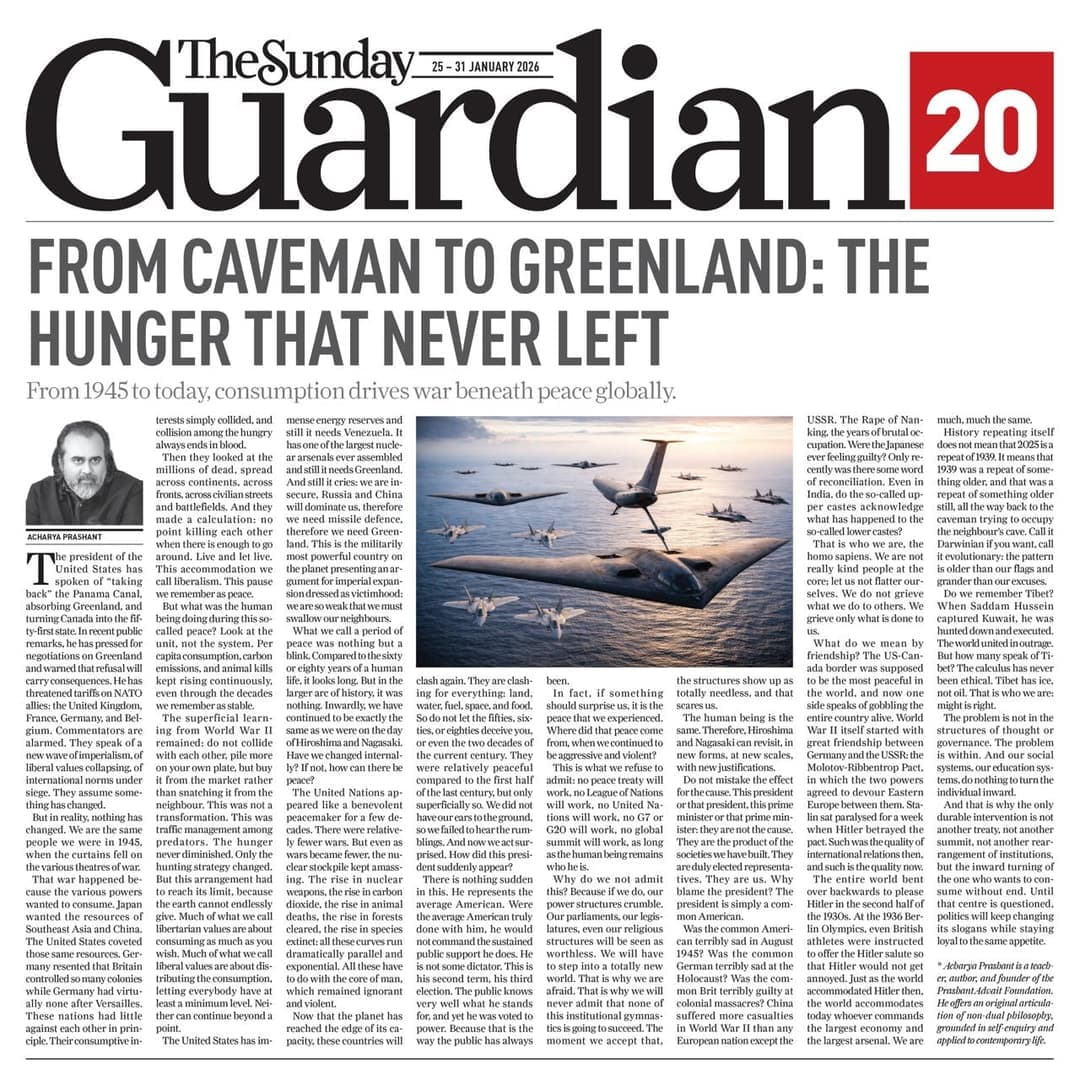
From 1945 to today, consumption drives war beneath peace globally. We have continued to be exactly the same as we were on the day of Hiroshima and Nagasaki. That war happened because the various powers wanted to consume. Have we changed internally? If not, how can there be peace? The problem is not in the structures of thought or governance. The problem is within.
This summary is AI-generated. Please read the full article for complete understanding.
Originally published in The Sunday Guardian on 25 jan '26
The president of the United States has spoken of “taking back” the Panama Canal, absorbing Greenland, and turning Canada into the fifty-first state. In recent public remarks, he has pressed for negotiations on Greenland and warned that refusal will carry consequences. He has threatened tariffs on NATO allies: the United Kingdom, France and Germany. Commentators are alarmed. They speak of a new wave of imperialism, of liberal values collapsing, of international norms under siege. They assume something has changed.
But in reality, nothing has changed. We are the same people we were in 1945, when the curtains fell on the various theatres of war. That war happened because the various powers wanted to consume. Japan wanted the resources of Southeast Asia and China. The United States coveted those same resources. Germany resented that Britain controlled so many colonies while Germany had virtually none after Versailles. These nations had little against each other in principle. Their consumptive interests simply collided, and collision among the hungry always ends in blood.