On Children’s Day I sat with a hall full of children. They had balloons in their hands and a lot of questions. One of them asked me, “Why did the bad people cut down the forest?”
This summary is AI-generated. Please read the full article for complete understanding.
Originally published in Times Now on 22 November '26
On Children’s Day I sat with a hall full of children. They had balloons in their hands and a lot of questions. One of them asked me, “Why did the bad people cut down the forest?”
I said, because they cut everything. It is not only forests that they cut. Suppose there are no forests left tomorrow. Do you think the cutting will stop? Then I told them about the dodo. It was a big bird, very simple, very trusting. If you called it, it would often come to you, and if you chased it, it could not run very fast. So we killed it, and kept killing it, till there was not one dodo left anywhere in the world. And once the dodo was finished, did we stop killing? No. We simply moved on to the next one.
We talked about the chicken also. You think you have killed one chicken and the matter ends there. It does not. You have given the one inside who kills a little more power. Why will he stop at the chicken? He will kill the bird and the tree, he will not spare the people in his own house, he will kill the river too, and the mountain. So I asked the children never to stop at the question, “Why are those people cruel to trees?” The question to ask is, “Why are we violent at all?”
One thing stayed with me afterwards. The child had said “the bad people”. By the time I finished answering, I was saying “we”. A child can be forgiven for placing the cutters somewhere outside. We adults do the same thing, only with much more skill.
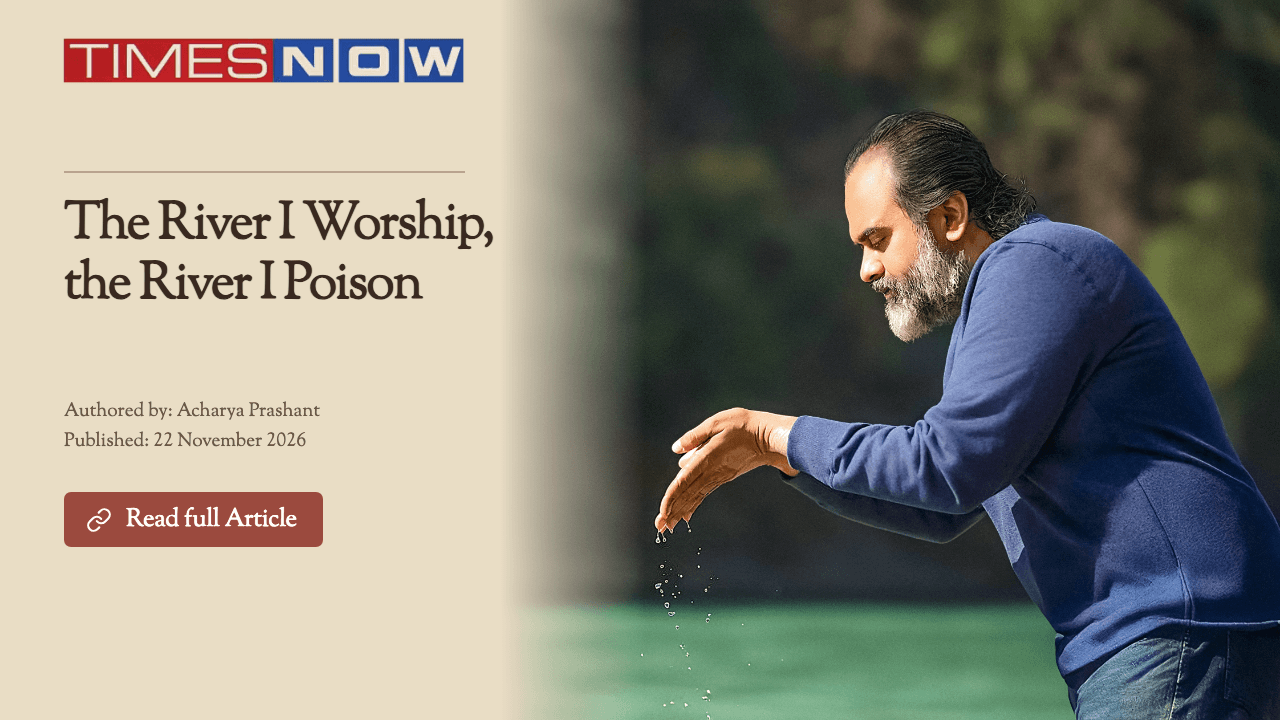
The next evening, people stood in the Yamuna at Kalindi Kunj, next to the Okhla barrage, to offer their prayers to the setting sun. All around them was thick white foam. Boats of the Delhi Jal Board went up and down spraying a chemical to break the foam, as they have done in recent winters. Earlier in the month the Supreme Court had observed that pollution in the Yamuna has increased in spite of the huge amounts spent on cleaning it.
We call the Yamuna our mother. I have no reason to doubt that the person standing on that bank means it. But the bowing takes a few minutes, and what I do in the remaining hours of the day also reaches her, through a pipe. When I stand in the river, she is my mother. When I stand in my bathroom a few kilometres away, where do I think the water is going? Can I call somebody my mother and keep poisoning her? What kind of love is that?
Suppose the drain outside my house gets blocked and the dirty water enters my bedroom. What will I do? I will call the municipality within the hour. Then a man comes and clears the drain, the water moves, and I am relieved. Now, where did that water go? It went where it always goes, to the Yamuna. The official writes “complaint resolved”. Has he misunderstood my complaint? No, he has understood it exactly. I never wanted the dirty water treated. I only wanted it out of my house, and he took it out of my house.
I am about to drink a glass of water. Will I let somebody spit into it? Obviously not. But see what I send down the drain every day, far worse than spit, into water from which somebody downstream will fill his glass. So at what point does water become worthy of my concern? Only when it is about to touch my lips. Only when it becomes mine.
This is what Vedanta calls the ego. Please understand, by ego I do not mean pride. I mean this “I” with a line drawn around it, and the name of that line is “mine”. The body has a boundary and it needs one. But who decided that my concern must end where my skin ends? Inside the line I can be very, very clean. Whatever lies outside the line is somebody else’s problem. And the fish, for whom that water was home long before I came along with my glass? The fish must first prove that its death will do something to my health. Only then does it get a hearing. So is this love for nature, or just one more form of love for myself?
At Palla, where the Yamuna enters Delhi, the city’s own samples this September found the water within the prescribed limit on the main measure of organic pollution. At the ISBT bridge the same measure was ten times the limit, and the bacteria that come from human waste were fourteen times what is permitted for bathing. Between those two places, what joined the river? Our drains. The stretch from Wazirabad to Okhla is just 22 kilometres. That is less than two per cent of the river’s length, and it accounts for around three-quarters of the river’s pollution. In the dry months very little fresh water flows past Wazirabad at all. Which means that what we call the Yamuna in Delhi is largely the water that Delhi has finished using.
The plan placed before the Supreme Court counts 520 drains that empty into the Yamuna and its tributaries, carrying nearly 970 crore litres of wastewater every single day. And what is the biggest source? It is domestic sewage. Domestic means home. So the enquiry that began with “the bad people” has now reached my bathroom and my kitchen.
The dairy industry is culpable as well. By the municipal corporation’s own estimate, Delhi’s dairies produce about 1,500 tonnes of dung every day, and only around 200 tonnes of it is processed. Much of the rest goes into the drains and then into the river. I take the milk. The river gets the dung. And see, we call the cow mother too. We want her milk, and we are not very interested in how she is kept, or in what happens to her once she stops giving it. Then what exactly are we worshipping?
A drain can take you back to a dye house, and the owner has a duty to treat what leaves his factory. Let us also follow the cloth out of the other gate. Where is it going? It is coming to me. There is a wedding in the family and I want a new kurta. What is wrong with the one I have? Nothing. It still fits. But I wore it at the last wedding and it is there in all the photographs. So I stand in front of a full cupboard and say, I have nothing to wear.
Please tell me, what can the cloth merchant do about that? He can give me cloth to cover the body. The body was already covered. What the body requires has a limit. What I want from the new kurta is that my cousin should think a little better of me, and that want has no limit. The factory supplies the kurta. Who supplies the demand? I do. Now how much cloth does it take to cover a man who feels small? And when a want has no limit, what limit can there be to what it takes from the river?
The same relatives whose opinion decides what I wear will also have an opinion on when I should have a child. I have to ask what kind of world I am preparing for that child, and what my own choices are doing to it. It is not an invitation to count the children in a poorer man’s house.
The foam at Okhla is pollution, obviously. But it is also feedback. The river is giving an accurate report on the people who live along it.
Think of a pan sitting on a lit burner. I put a piece of ice on it and the temperature falls. In a little while the pan is hot again, so I bring more ice. Soon I have a budget for ice and a report every year on how much ice was brought. The trouble begins when the ice becomes the reason nobody reaches for the knob.
Detergents in our sewage and in industrial waste help the foam to last as the water tumbles over the barrage. In one drive of about nine weeks last winter, the Jal Board spent nearly ₹80 lakh on 48,000 kilograms of defoaming chemical. People who watch the river say the foam starts coming back within an hour of the spraying stopping. Ask what we want. A clean river, or a river that looks clean for a few hours?
A family whose lane has no sewer line is owed one, and what the sewer collects must reach a plant that actually works. But what matters about a plant is the water that comes out of it, not its capacity on the day of inauguration. The plan before the Court said that 28 of Delhi’s 37 plants meet the prescribed standards. The central pollution board looked at all 37 and found that not one of them meets all the standards. For the wider basin, the plan now proposes 125 new plants. Build them. But the Court itself has said that pollution has to be stopped at its source, and the source is where the pipe begins, not where it ends. The river also needs water of its own.
In 1957, stretches of the Thames in London were declared biologically dead. Decades of money and work brought the fish back, and today more than a hundred species are recorded there, though sewage overflows still trouble the river. Then what has the Yamuna gained from being called mother?
The factory owner may have to accept a smaller profit. I may have to wear the same kurta to the wedding. One can understand everything and still refuse to act. The question is whether I love what is right enough to pay for it.
It is the government’s job to build the sewers, to police industrial discharge and to enforce the standards, and when it fails it must be held to account. I cannot lay a sewer by looking into my motives. But the municipality also cannot decide for me what I am willing to overlook when my own people are in office. The party out of power points at the foam. Once it is in power, it points at the previous government. The parties exchange places and the foam stays where it is. The politician speaks about whatever wins him votes, and who taught him that? We did.
The air tells the same story. On the 17th of this month Delhi had its cleanest air of the month. The AQI was 204. The cleanest, and still in the “poor” category. No volcano erupted in Delhi. Something is burning inside us, and the smoke is coming out of that.
Those of us who can afford it buy a purifier and shut the door. I have moved the problem outside my line, and the pollution is where it was. The man who has no purifier must breathe whatever comes in through the window. And the father who learns that the water in his only tap is contaminated must still carry that water home. Please do not mistake his silence for ignorance. What do you propose he give his children to drink tonight?
One well-known estimate says that if Delhi’s air met the World Health Organization’s guideline for fine particles and stayed there, the average person in Delhi would live 8.2 years longer. Why does it not feel long? Because nobody comes to my door on any particular morning and asks me to hand over eight years.
Let us try a bargain. Suppose somebody is offered one crore rupees. The condition is that he must live at an AQI of 500, and he is told plainly that he may then have only five years. What will he choose? Many will still say, give me the crore, at least I will live well for five years. Now see what we have learnt to call living well. As a boy he heard the admiration in an elder’s voice when some relative bought a big house, and that was his education. He was made literate in everything except himself. The choice is still his.
Vedanta calls the one who acts the karta, and the one who experiences the result the bhokta. As the voter, the customer, the fellow going to the wedding, I am very happy to be the one who chooses. When I stand at the river and the water stinks, suddenly I know myself only as the one to whom something terrible has been done. And the result does not even stay with the doer. The fish has to live in that water without having bought a kurta or voted for anybody.
My worship does not escape this enquiry either. We want more of the very things for which we are already using up the river, and then we go to the river and ask for her blessings in getting them. One man goes to the Ganga because he has been told that a dip will wash away his sins. Another man goes into the same water to pull out the rubbish, and comes back with mud all over his clothes. Tell me, which of the two has understood worship? But if even in worship I want the river to do something for me, when exactly do I intend to do something for her?
I am asking only that our relationship with things stop being blind. The filth outside is real, and so is the disorder inside the one who produces it. If you clean the river and never look at that disorder, the work is incomplete, because the same fellow will be back at the drain tomorrow. And if you look at yourself and never clean the river, that is simply an escape.
In the tenth chapter of the Durga Saptashati, when the demon Shumbha falls, the sky clears, the rivers return to their courses, the winds blow pure and the sun shines bright again. I want the river back in its course and a sun I can actually see. It is only when I come to the question of who Shumbha is that I start looking around at my neighbours.
Next winter there may again be boats at Okhla. If that child from Children’s Day were standing next to me on the bank, I could explain what the men in the boats are spraying and why the foam has gone. But suppose the child wants to follow the drain back the other way, to see where it begins. Will I be just as keen to continue the lesson when we reach my house?
Originally published in Times Now on 22 November '26