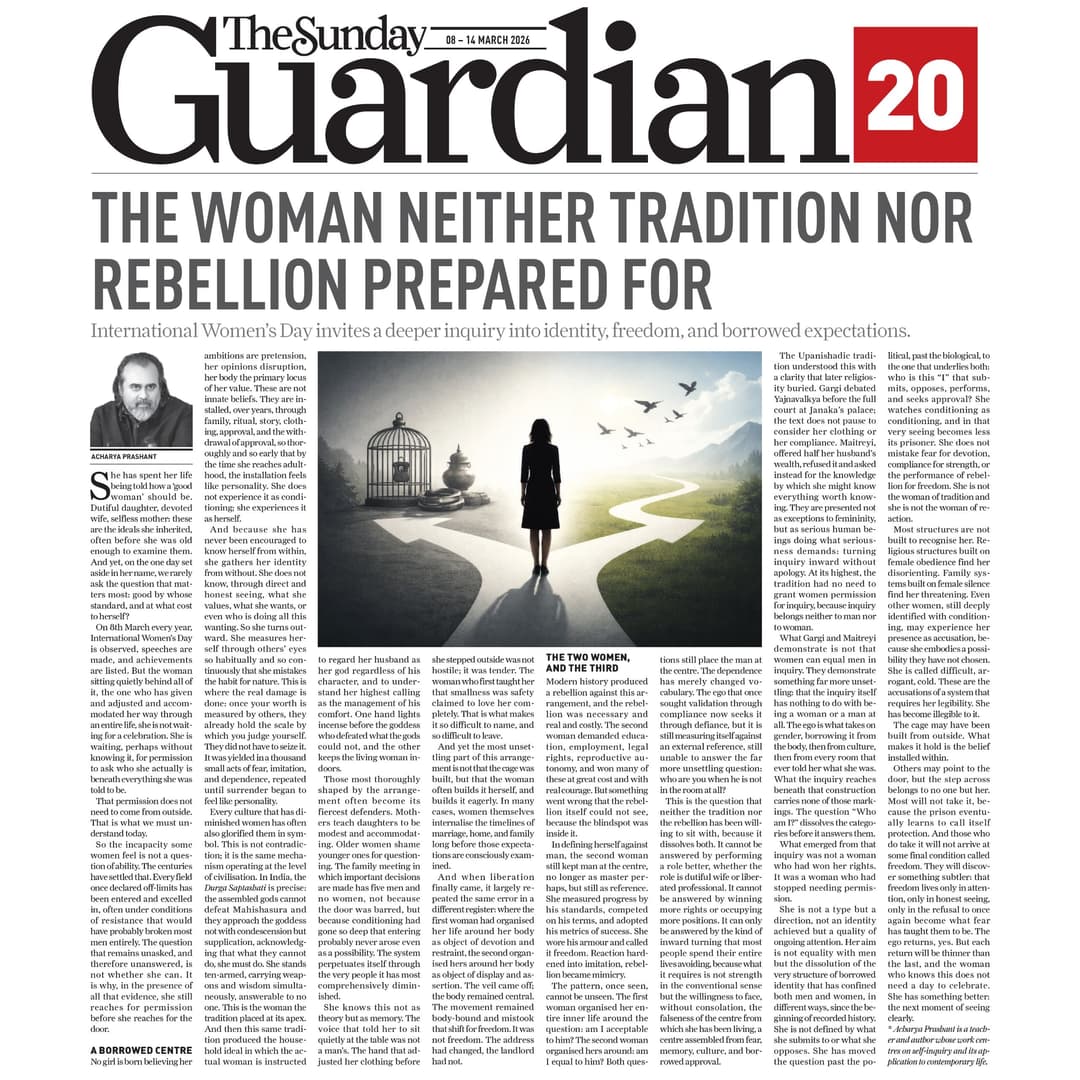
The incapacity some women feel is not a question of ability. Those most thoroughly shaped by the arrangement often become its fiercest defenders. Where the first woman had organised her life around her body as object of devotion and restraint, the second organised hers around her body as object of display and assertion. The movement remained body-bound and mistook that shift for freedom. The Upanishadic tradition understood this with a clarity that later religiosity buried.
This summary is AI-generated. Please read the full article for complete understanding.
Originally published in The Sunday Guardian on 8 mar '26
She has spent her life being told how a ‘good woman’ should be. Dutiful daughter, devoted wife, selfless mother: these are the ideals she inherited, often before she was old enough to examine them. And yet, on the one day set aside in her name, we rarely ask the question that matters most: good by whose standard, and at what cost to herself?
On 8th March every year, International Women’s Day is observed, speeches are made, and achievements are listed. But the woman sitting quietly behind all of it, the one who has given and adjusted and accommodated her way through an entire life, she is not waiting for a celebration. She is waiting, perhaps without knowing it, for permission to ask who she actually is beneath everything she was told to be.