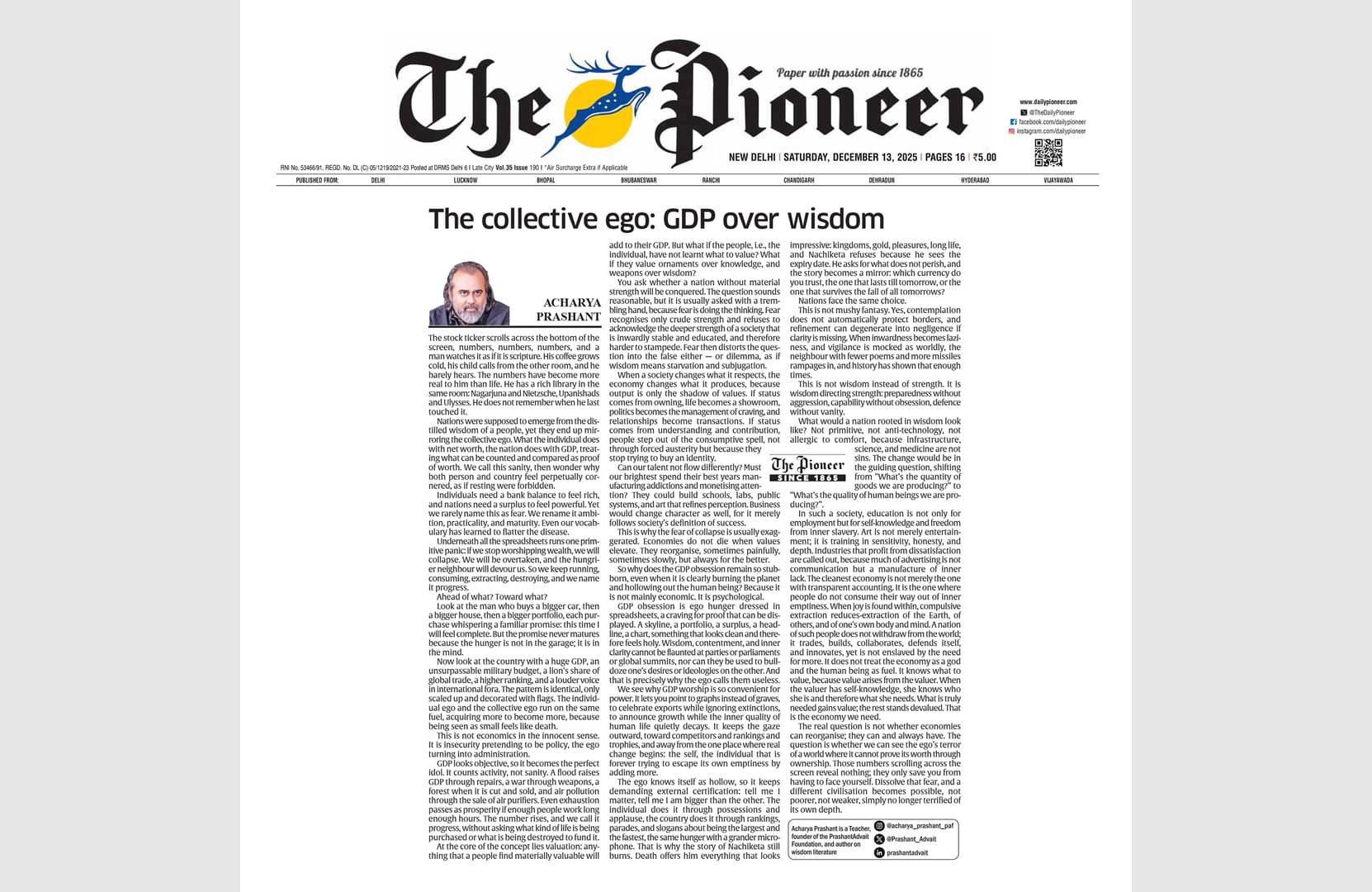
When a society changes what it respects, the economy changes what it produces, because output is only the shadow of values. If status comes from owning, life becomes a showroom, politics becomes the management of craving, and relationships become transactions. If status comes from understanding and contribution, people step out of the consumptive spell, not through forced austerity but because they stop trying to buy an identity.
This summary is AI-generated. Please read the full article for complete understanding.
Originally published in The Pioneer on 13 dec '25.
The stock ticker scrolls across the bottom of the screen, numbers, numbers, numbers, and a man watches it as if it is scripture. His coffee grows cold, his child calls from the other room, and he barely hears. The numbers have become more real to him than life. He has a rich library in the same room: Nagarjuna and Nietzsche, Upanishads and Ulysses. He does not remember when he last touched it.
Nations were supposed to emerge from the distilled wisdom of a people, yet they end up mirroring the collective ego. What the individual does with net worth, the nation does with GDP, treating what can be counted and compared as proof of worth. We call this sanity, then wonder why both person and country feel perpetually cornered, as if resting were forbidden.
Individuals need a bank balance to feel rich, and nations need a surplus to feel powerful. Yet we rarely name this as fear. We rename it ambition, practicality, and maturity. Even our vocabulary has learned to flatter the disease.