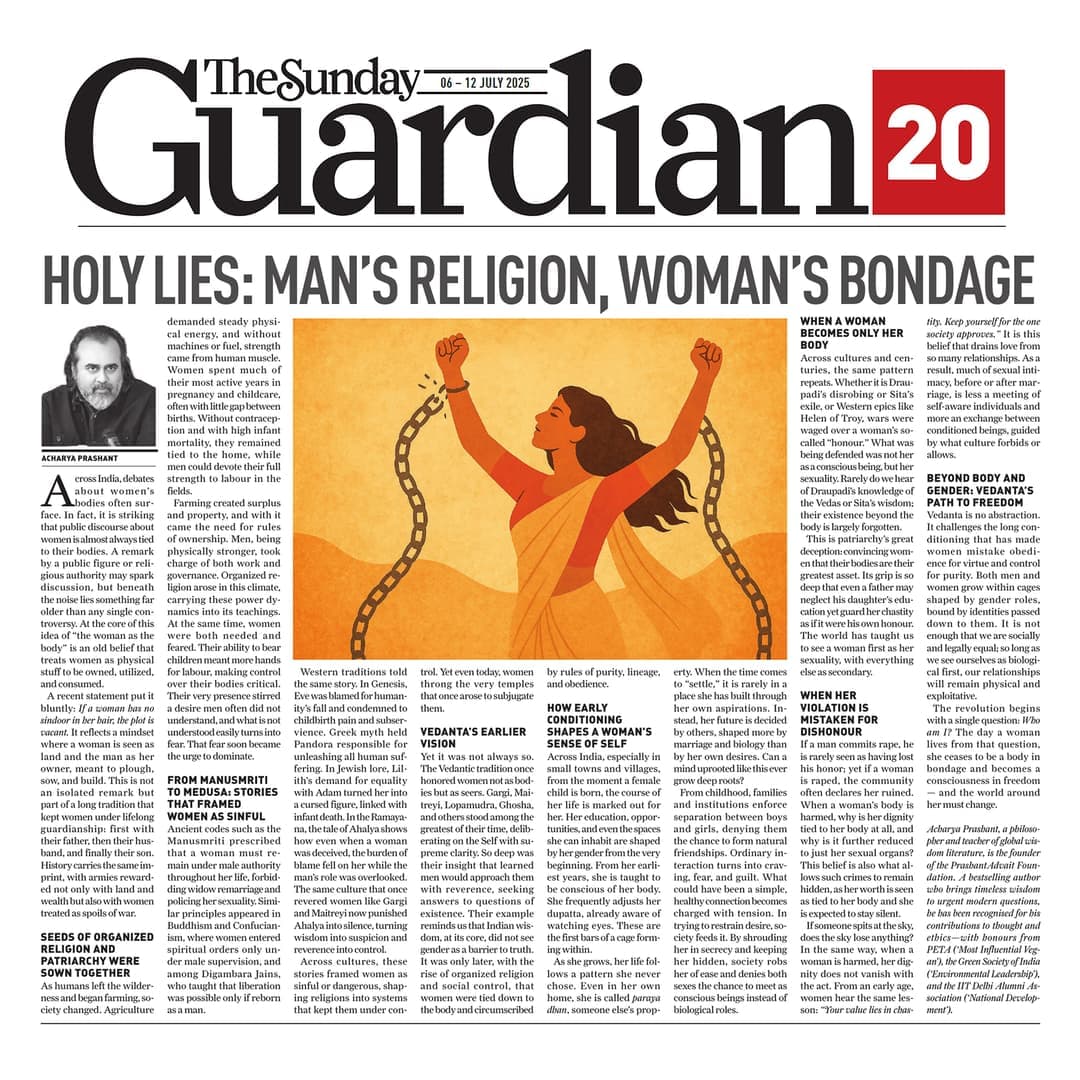
The Vedantic tradition once honored women not as bodies, but as seers. It was only later, with the rise of organized religion and social control, that women were tied down to the body and circumscribed by rules of purity, lineage, and obedience. The world has taught us to see a woman first as her sexuality, with everything else as secondary. The revolution begins with a single question: 'Who am I?' The day a woman lives from that question, she ceases to be a body in bondage and becomes a consciousness in freedom — and the world around her must change.
This summary is AI-generated. Please read the full article for complete understanding.
Originally published in The Sunday Guardian on 3 aug '25.
Across India, debates about women’s bodies often surface. In fact, it is striking that public discourse about women is almost always tied to their bodies. A remark by a public figure or religious authority may spark discussion, but beneath the noise lies something far older than any single controversy. At the core of this idea of “the woman as the body” is an old belief that treats women as physical stuff to be owned, utilized, and consumed.
A recent statement put it bluntly: If a woman has no sindoor in her hair, the plot is vacant. It reflects a mindset where a woman is seen as land and the man as her owner, meant to plough, sow, and build. This is not an isolated remark but part of a long tradition that kept women under lifelong guardianship: first with their father, then their husband, and finally their son. History carries the same imprint, with armies rewarded not only with land and wealth but also with women treated as spoils of war.