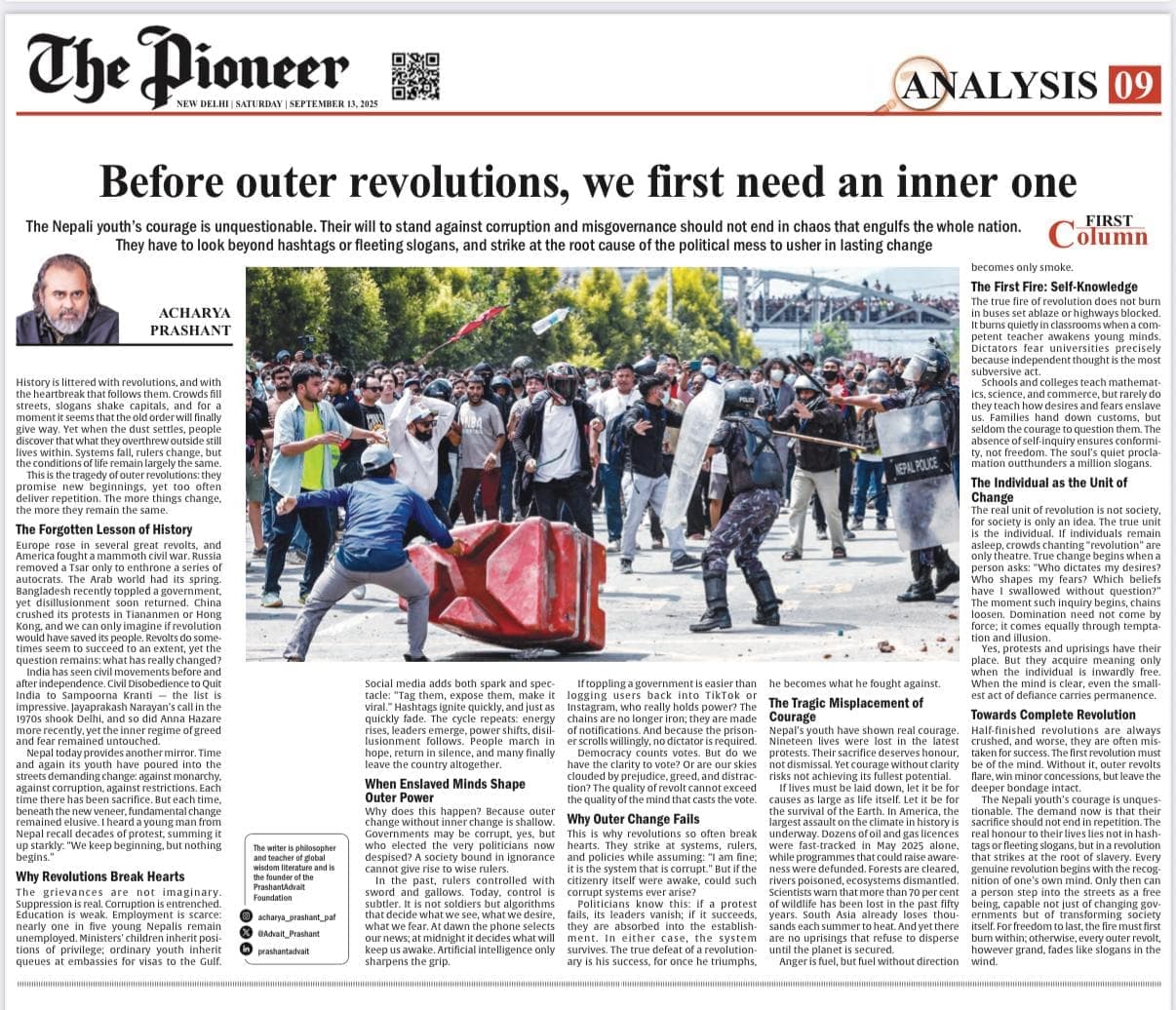
Before Outer Revolutions, We First Need an Inner One

Acharya Prashant

7 min
896 reads
Before Outer Revolutions, We First Need an Inner One
The true fire of revolution does not burn in buses set ablaze or highways blocked. Outer change, without inner change, is shallow. Every genuine revolution begins with the recognition of one’s own mind. Only then can a person step into the streets as a free being, capable not just of changing governments, but of transforming society itself. For freedom to last, the fire must first burn within; otherwise, every outer revolt, however grand, fades like slogans in the wind. This summary is AI-generated. Please read the full article for complete understanding.

Originally published in The Pioneer

History is littered with revolutions, and with the heartbreak that follows them. Crowds fill streets, slogans shake capitals, and for a moment it seems that the old order will finally give way. Yet when the dust settles, people discover that what they overthrew outside still lives within. Systems fall, rulers change, but the conditions of life remain largely the same.

This is the tragedy of outer revolutions: they promise new beginnings, yet too often deliver repetition. The more things change, the more they remain the same.

The Forgotten Lesson of History

Europe rose in several great revolts, and America fought a mammoth civil war. Russia removed a Tsar only to enthrone a series of autocrats. The Arab world had its spring. Bangladesh recently toppled a government, yet disillusionment soon returned. China crushed its protests in Tiananmen or Hong Kong, and we can only imagine if revolution would have saved its people. Revolts do sometimes seem to succeed to an extent, yet the question remains: what has really changed?
India has seen civil movements before and after independence. Civil Disobedience to Quit India to Sampoorna Kranti — the list is impressive. Jayaprakash Narayan’s call in the 1970s shook Delhi, and so did Anna Hazare more recently, yet the inner regime of greed and fear remained untouched.

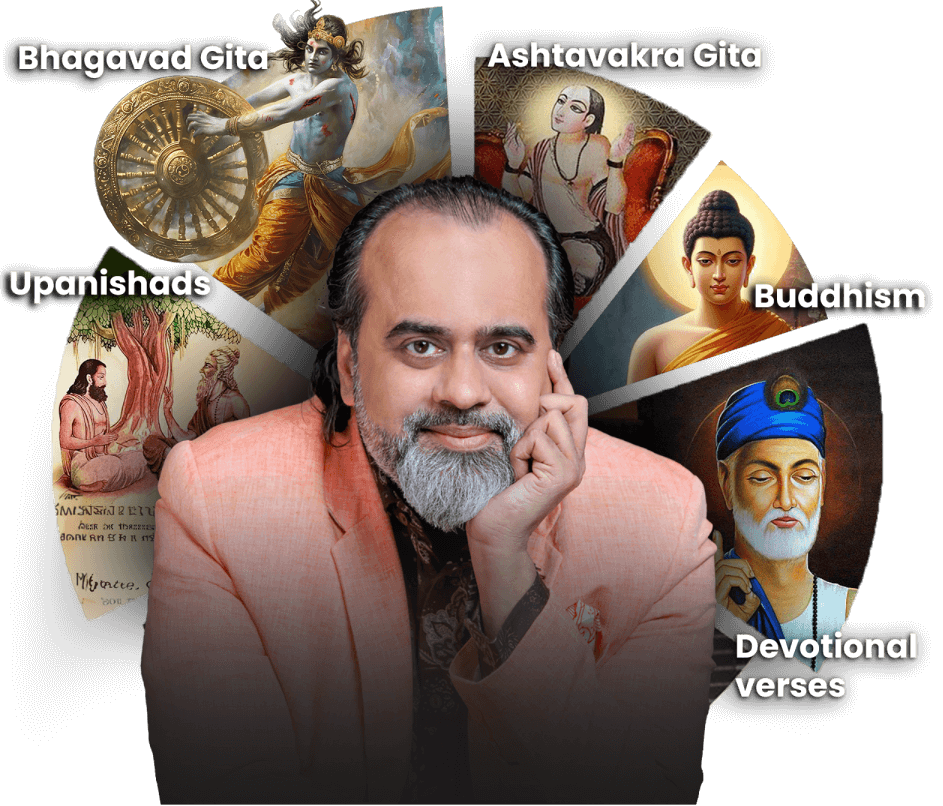
Nepal today provides another mirror. Time and again its youth have poured into the streets demanding change: against monarchy, against corruption, against restrictions. Each time there has been sacrifice. But each time, beneath the new veneer, fundamental change remained elusive. I heard a young man from Nepal recall decades of protest, summing it up starkly: “We keep beginning, but nothing begins.”

Why Revolutions Break Hearts

The grievances are not imaginary. Suppression is real. Corruption is entrenched. Education is weak. Employment is scarce: nearly one in five young Nepalis remain unemployed. Ministers’ children inherit positions of privilege; ordinary youth inherit queues at embassies for visas to the Gulf. Social media adds both spark and spectacle: “Tag them, expose them, make it viral.” Hashtags ignite quickly, and just as quickly fade. The cycle repeats: energy rises, leaders emerge, power shifts, disillusionment follows. People march in hope, return in silence, and many finally leave the country altogether.

When Enslaved Minds Shape Outer Power

Why does this happen? Because outer change without inner change is shallow. Governments may be corrupt, yes, but who elected the very politicians now despised? A society bound in ignorance cannot give rise to wise rulers.

In the past, rulers controlled with sword and gallows. Today, control is subtler. It is not soldiers but algorithms that decide what we see, what we desire, what we fear. At dawn the phone selects our news; at midnight it decides what will keep us awake. Artificial intelligence only sharpens the grip.

If toppling a government is easier than logging users back into TikTok or Instagram, who really holds power? The chains are no longer iron; they are made of notifications. And because the prisoner scrolls willingly, no dictator is required.

Democracy counts votes. But do we have the clarity to vote? Or are our skies clouded by prejudice, greed, and distraction?

The quality of revolt cannot exceed the quality of the mind that casts the vote.

Why Outer Change Fails

This is why revolutions so often break hearts. They strike at systems, rulers, and policies while assuming: “I am fine; it is the system that is corrupt.” But if the citizenry itself were awake, could such corrupt systems ever arise?

Politicians know this: if a protest fails, its leaders vanish; if it succeeds, they are absorbed into the establishment. In either case, the system survives. The true defeat of a revolutionary is his success, for once he triumphs, he becomes what he fought against.

The Tragic Misplacement of Courage

Nepal’s youth have shown real courage. Nineteen lives were lost in the latest protests. Their sacrifice deserves honour, not dismissal. Yet courage without clarity risks not achieving its fullest potential.

If lives must be laid down, let it be for causes as large as life itself. Let it be for the survival of the Earth. In America, the largest assault on the climate in history is underway. Dozens of oil and gas licences were fast-tracked in May 2025 alone, while programmes that could raise awareness were defunded. Forests are cleared, rivers poisoned, ecosystems dismantled. Scientists warn that more than 70 per cent of wildlife has been lost in the past fifty years. South Asia already loses thousands each summer to heat. And yet there are no uprisings that refuse to disperse until the planet is secured. Anger is fuel, but fuel without direction becomes only smoke.

The First Fire: Self-Knowledge

The true fire of revolution does not burn in buses set ablaze or highways blocked. It burns quietly in classrooms when a competent teacher awakens young minds. Dictators fear universities precisely because independent thought is the most subversive act.

Schools and colleges teach mathematics, science, and commerce, but rarely do they teach how desires and fears enslave us. Families hand down customs, but seldom the courage to question them. The absence of self-inquiry ensures conformity, not freedom. The soul’s quiet proclamation outthunders a million slogans.

The Individual as the Unit of Change

The real unit of revolution is not society, for society is only an idea. The true unit is the individual. If individuals remain asleep, crowds chanting “revolution” are only theatre. True change begins when a person asks: “Who dictates my desires? Who shapes my fears? Which beliefs have I swallowed without question?” The moment such inquiry begins, chains loosen. Domination need not come by force; it comes equally through temptation and illusion.

Yes, protests and uprisings have their place. But they acquire meaning only when the individual is inwardly free. When the mind is clear, even the smallest act of defiance carries permanence.

Towards Complete Revolution

Half-finished revolutions are always crushed, and worse, they are often mistaken for success. The first revolution must be of the mind. Without it, outer revolts flare, win minor concessions, but leave the deeper bondage intact.

The Nepali youth’s courage is unquestionable. The demand now is that their sacrifice should not end in repetition. The real honour to their lives lies not in hashtags or fleeting slogans, but in a revolution that strikes at the root of slavery. Every genuine revolution begins with the recognition of one’s own mind. Only then can a person step into the streets as a free being, capable not just of changing governments but of transforming society itself.

For freedom to last, the fire must first burn within; otherwise, every outer revolt, however grand, fades like slogans in the wind.

Originally published in The Pioneer

This article has been created by volunteers of the PrashantAdvait Foundation from transcriptions of sessions by Acharya Prashant
Comments
LIVE Sessions
Experience Transformation Everyday from the Convenience of your Home
Live Bhagavad Gita Sessions with Acharya Prashant
Categories