Friendships naturally change as people follow different paths in life. When you remain focused on your true purpose, you stop clinging to those who only accompany you briefly. Instead of dwelling on memories or fearing others' intentions, examine your own expectations and self-deception first. Honest self-awareness brings clarity, wiser relationships, and the freedom to move forward without resentment or attachment.
This summary is AI-generated. Please read the full article for complete understanding.
Questioner: Namaste, Acharya Ji. I'm Ashi Jain. Sir, how do I accept when friendships change or people stop valuing you?
Acharya Prashant: How do I accept when friendships change?
Questioner: Yes, sir. Because, as we are young, we have a lot of friends, but as we grow older, they become distant. We miss them. We don't even check up on them. So, there are many people who face these issues. Even I have. So, sir, how do I accept it, and how do I overcome it?
Acharya Prashant: Tell me one place that you really desperately love to go to.
Questioner: Besides home?
Acharya Prashant: Let's say home. And you're traveling to your home from a place 100 km away. Right? You're traveling to your home, and you really love home. Home. And this is the road that's taking you to your home. How many cuts and crossings do you meet?
Questioner: A lot.
Acharya Prashant: A lot. How many vehicles do you find coming to you, staying along for a while in your sight, and then taking some cut, some other road, some deviation, some other direction? How many of them?
Questioner: A lot, sir.
Acharya Prashant: Do you miss them?
Questioner: No, sir, because I'm not attached to them.
Acharya Prashant: That's the answer. One must be firmly on the road to home.
Questioner: Yes, sir.
Acharya Prashant: And then one doesn't miss all these people and vehicles who coincidentally come along for a while and then depart.
Questioner: Sir, sometimes we don't miss the people, but we miss the memories, sir.
Acharya Prashant: If you will be so much in memory of the car that was in front of you, that memory will cause a collision. Think of it.
There was a car in front of you. There was a car by your side. There was one trailing you. And now they are no more, and you're still thinking of them. But the condition has changed. The road has changed. Right?
Questioner: Yes, sir.
Acharya prashant: There are new cars. And in your heart sits your…?
Questioner: Goal.
Acharya Prashant: Home.
Questioner: Yes, sir.
Acharya Parshant: The home is what you are in love with. Right? And if there is someone really worth being with, he will travel all the way with you, right till your home. How can you miss him? And if there are people who desert you, who leave you while you are traveling home, are they really worth being with?
Questioner: I guess not, sir. Thank you, sir.
Questioner: So, my question is: How are we supposed to know and gauge people's intentions towards us? Because people fake their emotions for a long period of time as well.
Acharya Prashant: How do we know and gauge people's real intentions and emotions towards us? Because people fake. People fake their emotions, their faces, their personality, their intentions. That's the question, right?
Who is the first person that you know? Who is the one person closest to you? Who is the one person most intimate to you?
Questioner: Ourselves.
Acharya Prashant: Right? You are the one closest to you. If you do not know this person, can you know any other person? This person is your workshop, your laboratory, your most intimate testing ground, your home ground. Right?
When we say we cannot judge others' intentions, the question is: Do we know our own intentions? We do not know whether the other is fooling us. Do we know when we are fooling ourselves?
The greatest deception is not the one others inflict on us. The greatest deception is self-deception.
Don't we fool ourselves, cheat ourselves all the time? When you say, "How to know the other's real face because he's wearing a mask?" Has it happened? People wear masks. When you say, "I want to know that fellow's real face," do we know our own real face? Are you sure you know your own real face? Do you?
When you say, "I cannot see where he's coming from. This fellow is there, and I cannot see his center, the point he's coming from," do we really know where we are coming from?
If, for example, you feel angry, do you really always know where your anger is coming from? Have you gone to the depth of it? Don't you experience moods and fluctuations? And somebody asks you, "Why do you look upset today? Why are you so down?" And you say, "I don't know. Just moods."
Do you really know where your moods are coming from? If you do not know where your thoughts, feelings, emotions, personality, faces are coming from, how will you know where the other is coming from? Because you are the one closest to yourself. You are the laboratory in your own backyard. You are your own testing ground. You have to begin with yourself.
But we are extremely sensitive to being fooled by others. "No, no, no. I don't want to be shown up as an idiot. I want to be smart, clever." We just don't like it when somebody manages to get past us. When somebody proves smarter, we don't like it. Right? But we're surprisingly okay with being beaten daily by ourselves. Does that not happen? You know what is right, yet you end up doing something else. Does that happen? Does it happen? So, who has defeated you? An external opponent? Your own self? But you're okay with it. This is not something that you grieve.
Somebody else, an outsider, comes and defeats you, puts you down and pins you there, and you'll take it to your heart. Right? You might even shed a few tears. You say, "Damn it. That fellow prevailed over me."
But when you keep sleeping, when you know you should be on your feet and running and doing something and achieving something or whatever, and you still find yourself snoring in bed, do you feel an equal amount of pain or guilt? No. Rarely. Even if some guilt is experienced, we forgive ourselves. We rationalize it. We invent excuses, don't we?
So, when we defeat ourselves, when we cheat ourselves, we justify. We come up with innovative excuses. But we just don't like it when the same treatment is meted out to us by others.
What we don't realize is that our worst enemy is not outside of us. And also our best friend. Neither of them is located outside of us.
Outside, what you see are very secondary kinds of friends and foes. The one who is her own enemy will find she's surrounded by millions of enemies outside. And the one who is her own friend will find that even so-called adverse situations outside are being utilized constructively by her.
So, if somebody has managed to play a fraud on you, defeat you or cheat you, the finger must point inward. Don't lay the blame there (outside). Watch what is here (inside of us). There is somebody here so content with getting fooled that deception has become a way of life.
Even in intimate matters of life, if somebody asks you, for example, "Why are you here in this institution of higher learning?" Do we really know the exact reason? Rarely. And even if we do know it to some extent, are we able to confess? Do we do that?
You go to someone and say, "I love you." Is that really the matter? Is that really the matter? Do we know where that thing called love is coming from? Do we know our own center? We don't know our own center. But then, how is it surprising that somebody comes, professes love to us, and then in a few days or weeks or months turns his back? How is it any surprising? Just as we do not know where our own center is, we also fail to see where the center of that person is.
The one who fools us is first of all in the mirror. The person who declares, "I'm not going to fool myself anymore. I'll be very ruthless with the facts of my being," such a person will be very, very difficult to cheat, or conquer, or condition. You see this?
Now onwards, when it happens that you find that your expectations have been belied, your trust has been broken, life has given you some kind of a shock, use these things. Use these as opportunities to turn inward.
If somebody has broken your expectations, tell yourself the fault lies not with that person or that event or whatever. The fault lies with the expectation itself.
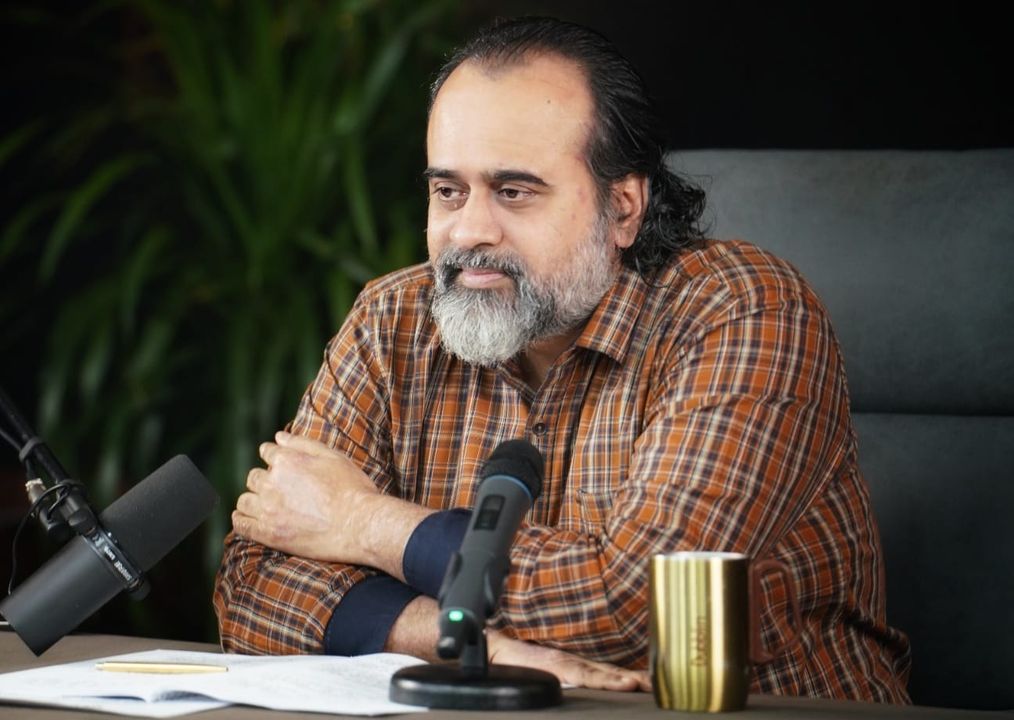
This is black tea. And how do I know it's black tea? Because it's contained in a black mug. That kind of logic I carry. Right? And I sip. "What kind of Kaliyuga is this? Coffee?" It came displaying its color and intent to me via its container. I trusted it to be tea, but it turned out to be coffee.
Now, should I blame this, take this and throw this away and play all kinds of tantrums and break the mug and shout aloud? We all love doing that. Or should I ask myself, "Was I being discreet there in expecting this to be coffee?" Or is it so that I was so much in craving for coffee that I wanted this to be coffee? Did it say that it is coffee, or was it me who superimposed his desires on this thing because I wanted this to be coffee?
And when it turns out to be tea, I say, "You know, look at this world, full of thugs and liars. They say one thing and do another." Didn't this fellow show this mug to me? You were seeing the outside. You never tested the inside. Because when it comes to our own life, we have practiced it so much to stay on the outside and never venture inside.
So, just as we stay on the outside of our own being and don't venture inside, similarly, when it comes to the other person, all we look at is their face, their words, what they profess, what they promise. That's what we limit ourselves to. We don't inquire deeper. We don't test. We don't taste. What do we do? We posit. We imagine. We assume. We superimpose our desires on that person.
Has it happened with you? When you want something, you start seeing it everywhere. And when that thing that you are assuming to be the thing that you want does not turn out to be the thing that you want, you put blame on that thing. Is that thing to be blamed, really?
So, know where your desire is coming from. And make it a practice to be honest. You are here. Labs do not exist just in the academic building or in the departmental blocks. The first lab must be inside.
Inquiry is not merely a credit requirement at an IIT. Inquiry is a way of life. I want to know. I want to understand. I'm not an automaton, and I'm also not an animal. To be human, I must be conscious. And to be conscious is to know with discretion. It's to ask repeatedly. It's to test and experiment, not to fool oneself with amusing belief.
Questioner: Thank you, sir.