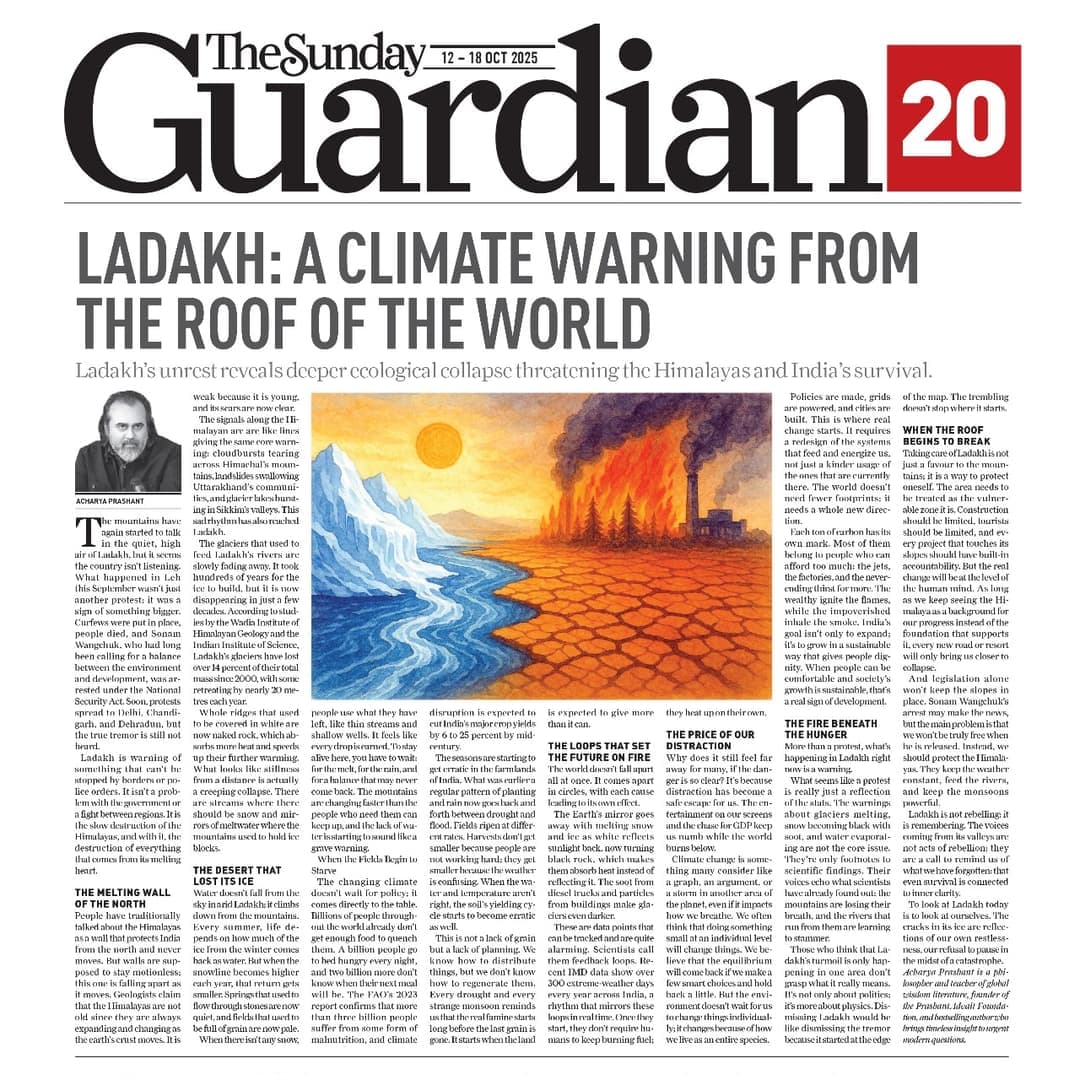
Taking care of Ladakh is not just a favour to the mountains; it is a way to protect oneself. Ladakh is not rebelling; it is remembering. The voices coming from its valleys are not acts of rebellion; they are a call to remind us of what we have forgotten: that even survival is connected to inner clarity. To look at Ladakh today is to look at ourselves. The cracks in its ice are reflections of our own restlessness, our refusal to pause in the midst of a catastrophe.
This summary is AI-generated. Please read the full article for complete understanding.
Originally published in The Sunday Guardian on 12 oct '25.
The mountains have again started to talk in the quiet, high air of Ladakh, but it seems the country isn’t listening. What happened in Leh this September wasn’t just another protest; it was a sign of something bigger. Curfews were put in place, people died, and Sonam Wangchuk, who had long been calling for a balance between the environment and development, was arrested under the National Security Act. Soon, protests spread to Delhi, Chandigarh, and Dehradun, but the true tremor is still not heard.
Ladakh is warning of something that can’t be stopped by borders or police orders. It isn’t a problem with the government or a fight between regions. It is the slow destruction of the Himalayas, and with it, the destruction of everything that comes from its melting heart.