Migration is a natural part of human life, but not every movement comes from the same place. Moving for survival, safety, education, or livelihood is different from moving in pursuit of fulfillment through consumption. The same distinction applies to those receiving migrants: neither blanket acceptance nor blanket rejection is wise. What is needed is viveka, the ability to distinguish genuine need from desire, while balancing human compassion with responsibility.
This summary is AI-generated. Please read the full article for complete understanding.
Originally published in The Pioneer on 8 August '26
The human being did not evolve to stay fixed to one patch of soil. Movement is prakriti; it is natural, older than any border ever drawn on a map. You will watch a migratory bird cross a continent and feel something lift in you, but let the same instinct arrive on two legs, with a bag over its shoulder, and the feeling curdles into suspicion, even derision. Why the difference? Why not ban the birds too, and scold them for arriving uninvited at this lake or that field? They come because that is how prakriti moves, and you are not meant to remain confined to the village you were born in.
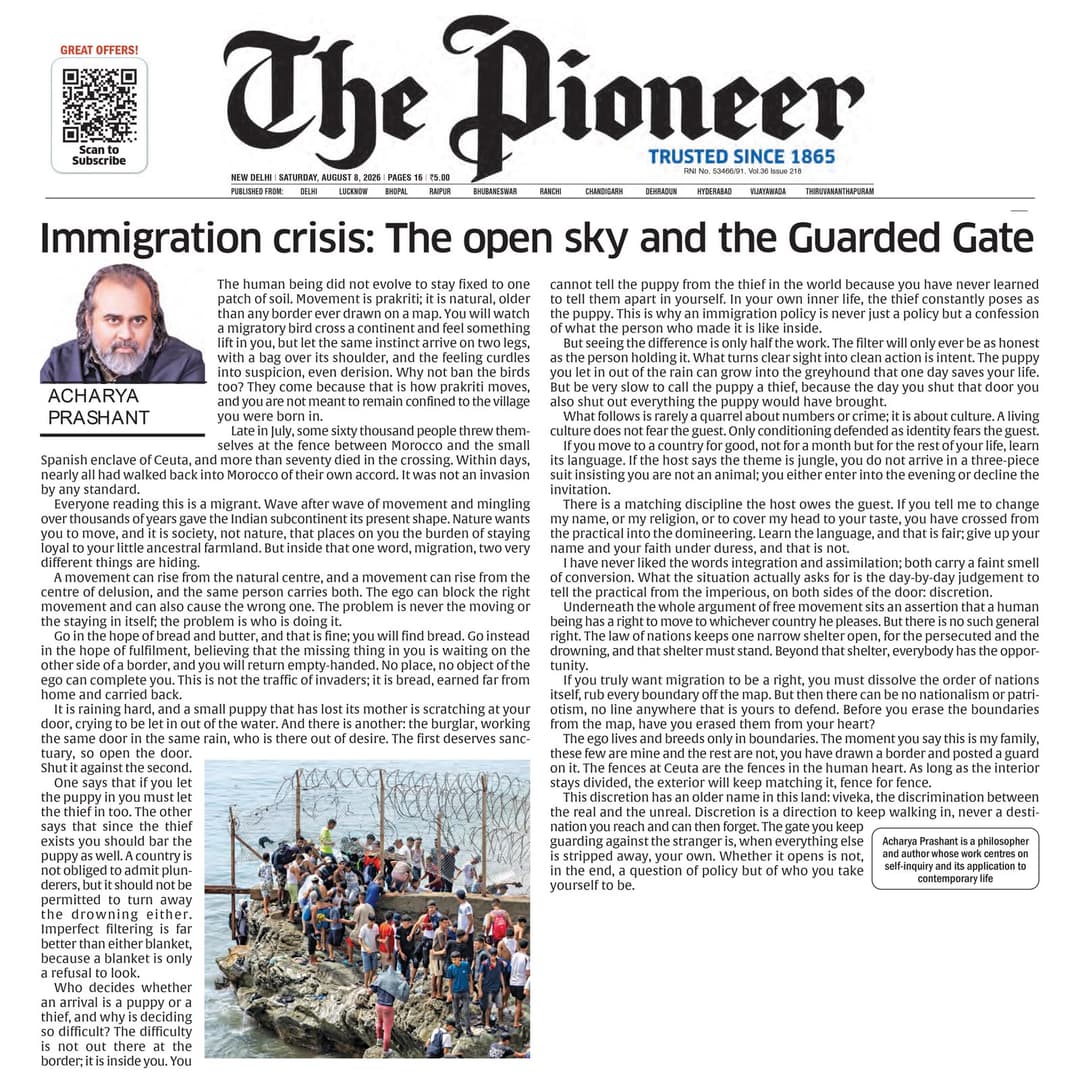
Late in July, some sixty thousand people threw themselves at the fence between Morocco and the small Spanish enclave of Ceuta, and more than seventy died in the crossing. The scenes were read everywhere as a siege. A siege is the easy word for it, but the wrong one. Within days, nearly all of the sixty thousand had turned around and walked back into Morocco of their own accord; fewer than two thousand remained. An invasion does not go home. What crossed that fence was not an army and not even a settlement; it was a surge of hope answering a rumour. Spain had announced a scheme to regularise migrants already living in the country, more than a million people applied to it, and trafficking networks promptly went to work, twisting a court ruling into a story that a door had swung open. Sixty thousand human beings moved on a promise that somebody had manufactured in order to sell it to them. So what is actually pressing at that fence? An instinct older than any nation, harnessed by salesmen, running up against one of the newest things human beings have made, the border. For almost the whole of human history there was no such thing to meet. Passports were not generally required to cross a frontier until the First World War, and the familiar booklet was standardised only in 1920, at a conference of the League of Nations. Those who built the pyramids and those who filled Ellis Island moved without one. The fence is barely a century old. Walking is as old as the species.