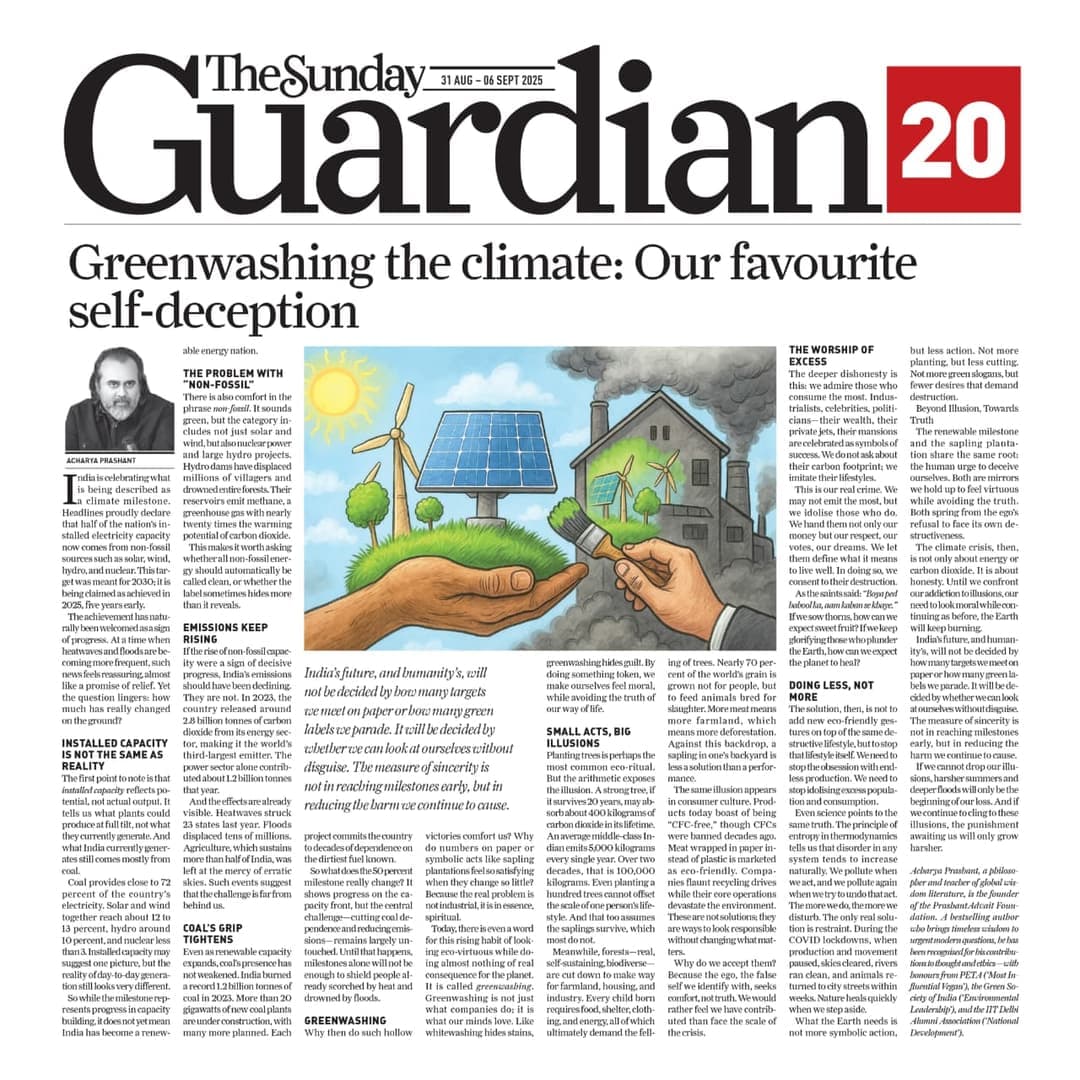
"India’s future, and humanity’s, will not be decided by how many targets we meet on paper or how many green labels we parade. It will be decided by whether we can look at ourselves without disguise. The measure of sincerity is not in reaching milestones early, but in reducing the harm we continue to cause."
This summary is AI-generated. Please read the full article for complete understanding.
Originally published in The Sunday Guardian on 31 aug '25.
India is celebrating what is being described as a climate milestone. Headlines proudly declare that half of the nation’s installed electricity capacity now comes from non-fossil sources such as solar, wind, hydro, and nuclear. This target was meant for 2030; it is being claimed as achieved in 2025, five years early.
The achievement has naturally been welcomed as a sign of progress. At a time when heatwaves and floods are becoming more frequent, such news feels reassuring, almost like a promise of relief. Yet the question lingers: how much has really changed on the ground?
Installed Capacity Is Not the Same as Reality
The first point to note is that installed capacity reflects potential, not actual output. It tells us what plants could produce at full tilt, not what they currently generate. And what India currently generates still comes mostly from coal.