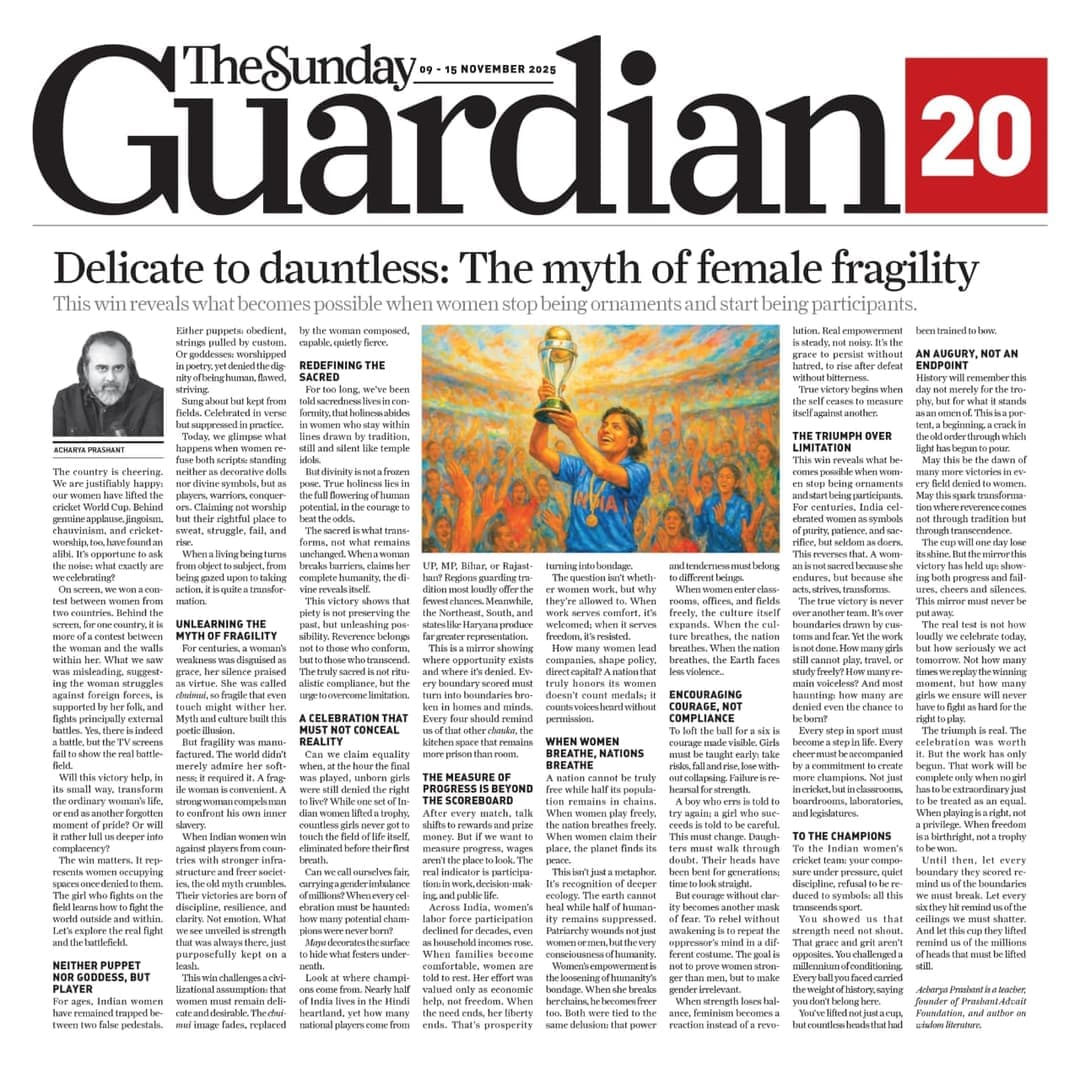
Our women have lifted the cricket world cup. This win challenges a civilizational assumption: that women must remain delicate and desirable. For centuries, India celebrated women as symbols of purity, patience, and sacrifice, but seldom as doers. This reverses that. A woman is not sacred because she endures but because she acts, strives, transforms. The chuimui image fades, replaced by the woman composed, capable, quietly fierce.
This summary is AI-generated. Please read the full article for complete understanding.
Originally published in The Sunday Guardian on 9 nov '25.
The country is cheering. We are justifiably happy: our women have lifted the cricket World Cup. Behind genuine applause, jingoism, chauvinism, and cricket worship, too, have found an alibi. It’s opportune to ask the noise: what exactly are we celebrating?
On screen, we won a contest between women from two countries. Behind the screen, for one country, it is more of a contest between the woman and the walls within her. What we saw was misleading, suggesting the woman struggles against foreign forces, is supported by her folk, and fights principally external battles. Yes, there is indeed a battle, but the TV screens fail to show the real battlefield.
Will this victory help, in its small way, transform the ordinary woman’s life, or end as another forgotten moment of pride? Or will it rather lull us deeper into complacency?