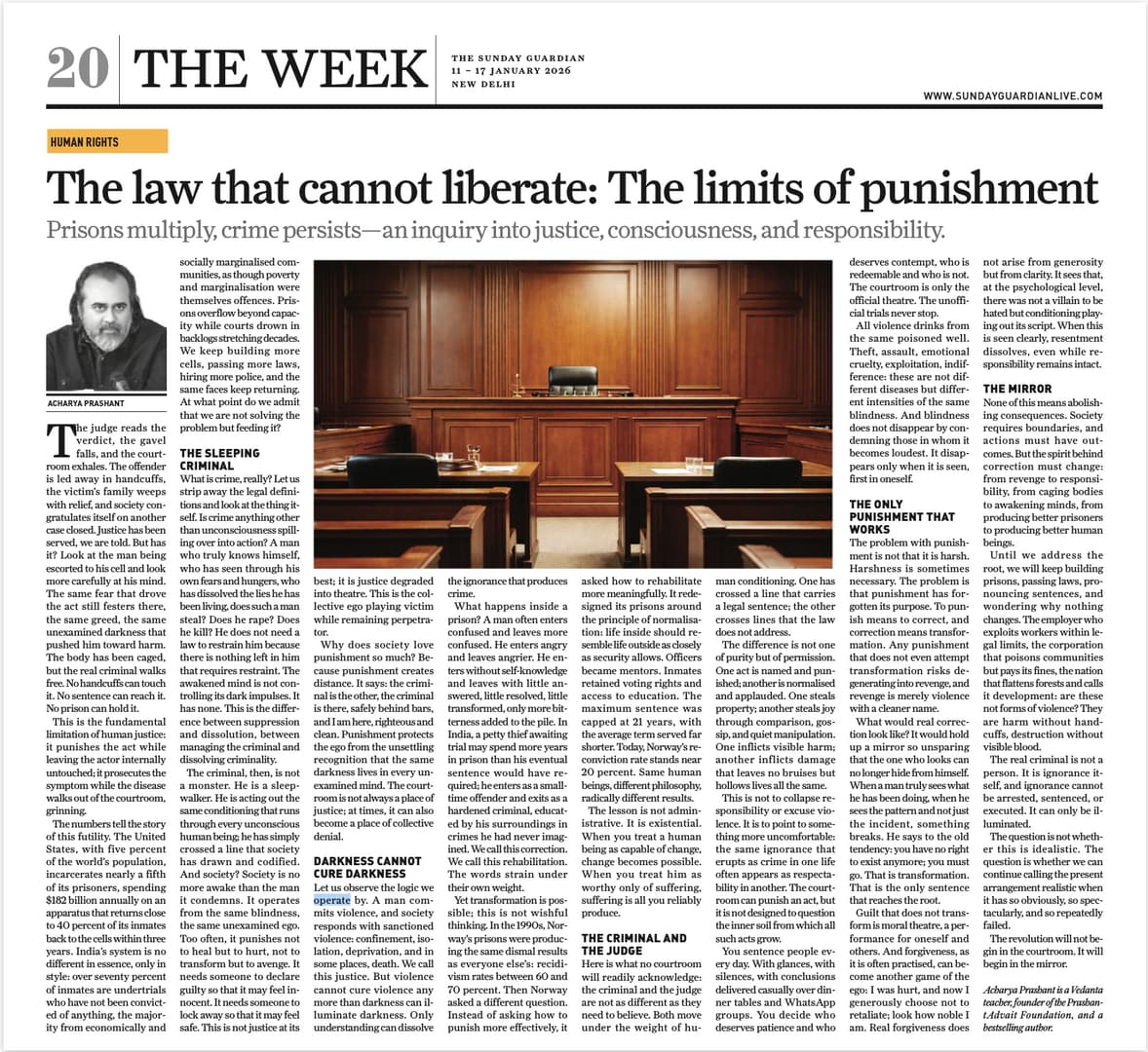
Human justice often punishes the act while leaving the inner criminal untouched. Crime arises from unconsciousness, fear, greed, and unexamined conditioning, which prisons rarely transform. Real correction must move beyond revenge and punishment toward self-knowledge, responsibility, and inner change. The root problem is ignorance, and it can only be dissolved through honest seeing.
This summary is AI-generated. Please read the full article for complete understanding.
Originally published in The Sunday Guardian on 11 jan '26
The judge reads the verdict, the gavel falls, and the courtroom exhales. The offender is led away in handcuffs, the victim’s family weeps with relief, and society congratulates itself on another case closed.
Justice has been served, we are told. But has it? Look at the man being escorted to his cell and look more carefully at his mind. The same fear that drove the act still festers there, the same greed, the same unexamined darkness that pushed him toward harm. The body has been caged, but the real criminal walks free. No handcuffs can touch it. No sentence can reach it.
No prison can hold it. This is the fundamental limitation of human justice: it punishes the act while leaving the actor internally untouched; it prosecutes the symptom while the disease walks out of the courtroom, grinning.