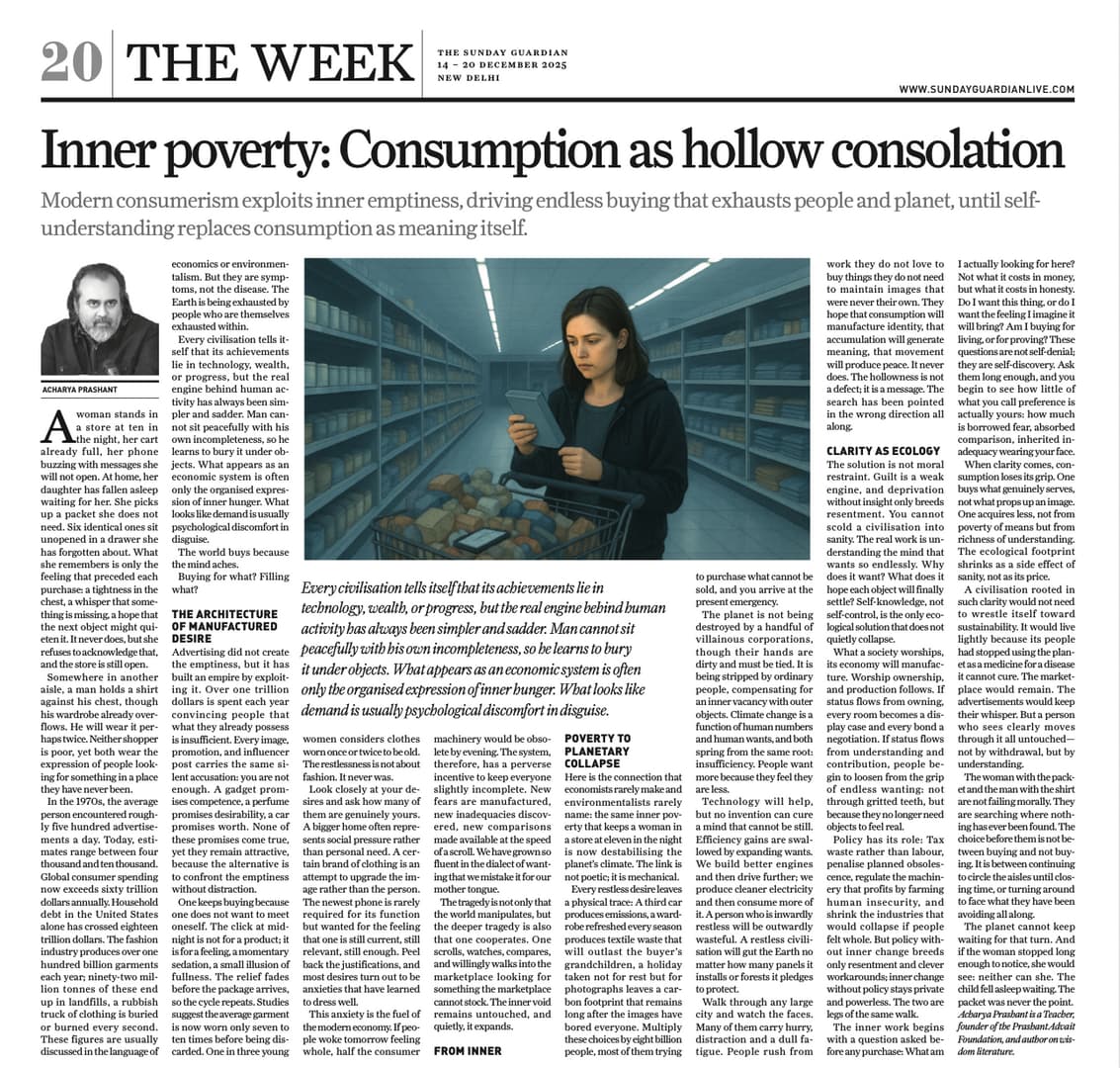
Consumerism feeds on inner emptiness by turning anxiety, comparison, and incompleteness into endless buying. Objects promise relief, identity, and meaning, but only deepen restlessness while exhausting the planet. Real ecological change begins with self-understanding: seeing what one is truly seeking before consuming, and buying only what genuinely serves life, not the image of oneself.
This summary is AI-generated. Please read the full article for complete understanding.
Originally published in The Sunday Guardian on 14 dec '25
Modern consumerism exploits inner emptiness, driving endless buying that exhausts people and planet, until selfunderstanding replaces consumption as meaning itself.
A woman stands in a store at ten in the night, her cart already full, her phone buzzing with messages she will not open. At home, her daughter has fallen asleep waiting for her. She picks up a packet she does not need. Six identical ones sit unopened in a drawer she has forgotten about. What she remembers is only the feeling that preceded each purchase: a tightness in the chest, a whisper that something is missing, a hope that the next object might quieten it. It never does, but she refuses to acknowledge that, and the store is still open.
Somewhere in another aisle, a man holds a shirt against his chest, though his wardrobe already overflows. He will wear it perhaps twice. Neither shopper is poor, yet both wear the expression of people looking for something in a place they have never been.